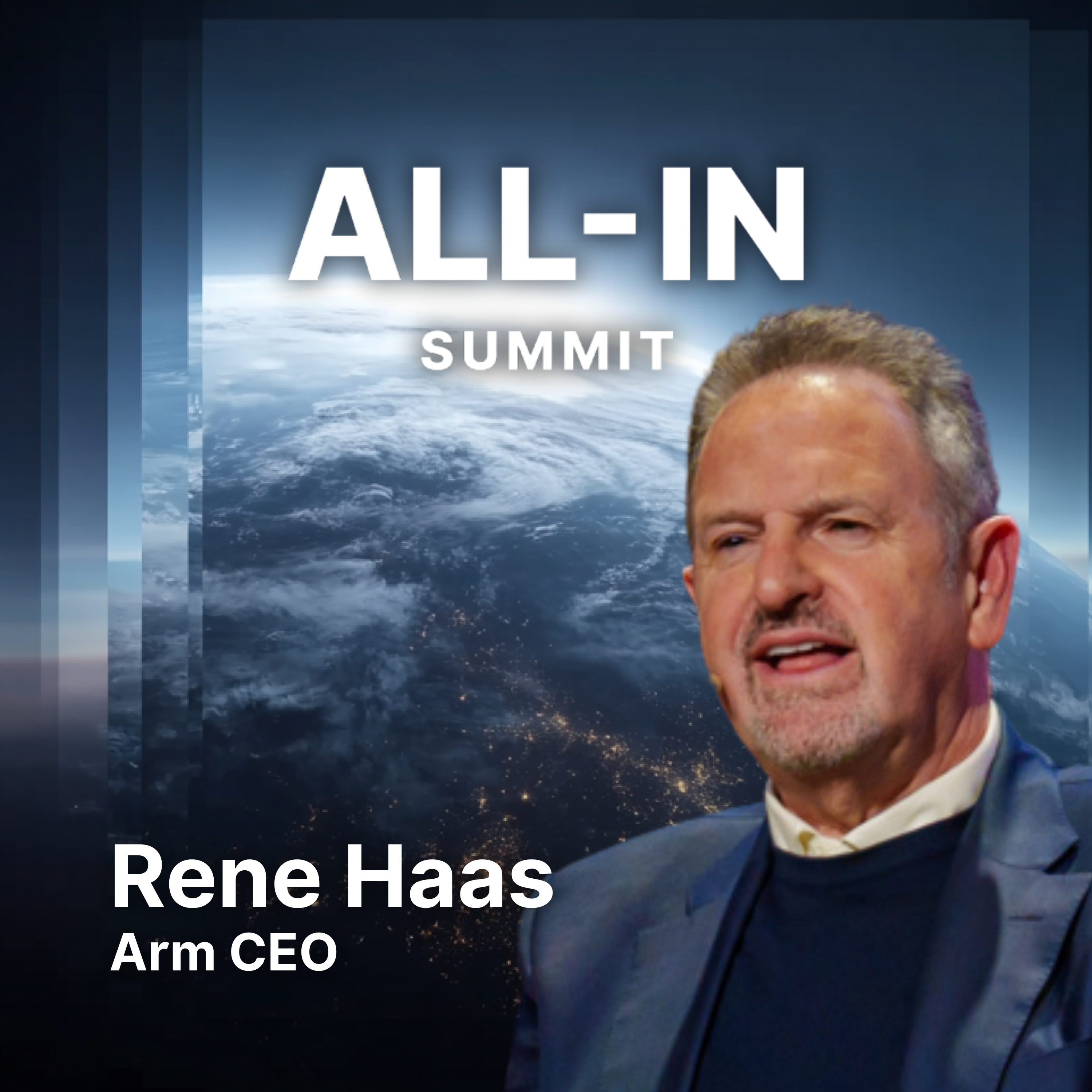
本集简介
双语字幕
仅展示文本字幕,不包含中文音频;想边听边看,请使用 Bayt 播客 App。
有一家公司,几乎每家芯片制造商都依赖它,但它实际上并不生产任何有形产品。
There's a company nearly every chipmaker relies on that doesn't actually make anything tangible.
然而,它在九月的首次公开募股估值超过了540亿美元。
Yet its blockbuster IPO in September valued it above 54,000,000,000.
这是两年多来最大的一次公开募股。
It's the largest public offering in over two years.
这家公司的估值已经翻了三倍。
The valuation of the company has tripled.
如果你口袋里或面前有一部智能手机,那么它的内部就 somewhere 有一个手臂电路。
If you have a smartphone in your pocket or in front of you, you have an arm circuit somewhere inside of it.
我们是CPU,是所有事物的核心。
We are the CPU, the heart of everything.
他们在CPU这一侧是赢家。
They're the winner of the CPU side.
基础模型和软件的发展速度远远快于硬件。
The foundation models, the software, it's moving far faster than the hardware.
所以我们看到,人们正在越来越快地投资于新硬件,这对我们来说是好事。
So what we're seeing is people investing faster and faster into new hardware, which ends up being a good thing for us.
女士们、先生们,请欢迎Arm首席执行官雷恩·哈斯。
Ladies and gentlemen, please welcome Arm CEO Rene Haas.
你好,大卫。
Hello, David.
太多了。
So much.
你怎么样
How are
你好吗,大卫?
you, David?
欢迎。
Welcome.
欢迎。
Welcome.
大卫,你好。
David, hey.
很高兴见到你。
Good to see you.
嘿,老兄。
Hey, man.
你好。
Hello.
雷内,最近你在忙什么?
Rene, what are you banging these days?
是三毫克的ALP封装,还是已经升级到九毫克了?
Three milligrams of ALP pouches or you're up to nine?
我知道你在和英伟达竞争,所以你 probably 想选九毫克的。
I know you're competing with Nvidia, so you probably wanna go with the nine.
对吧?
Right?
我会选择九。
I will go with the nine.
和詹森合作,你必须做大手笔。
With Jen with Jensen, you have to go big.
和詹森合作就得做大手笔?
You have to go big with Jensen?
和英伟达竞争是什么感觉?
What's that like to compete against Nvidia?
我会说,英伟达是我们客户。
Well, I will say Nvidia is a customer of ours.
所以今天我不会说詹森是我的竞争对手。
So I'm not gonna say Jensen is my competitor today.
但你知道,我为英伟达工作了很多年,你也知道,他非常出色。
But you know, I worked for Nvidia for for many many years as as you know And he's fantastic.
对吧?
Right?
在那里工作、为他工作、和他共事,我学到了很多。
And learned so much working there, working for him, working with him.
然后,Nvidia 在2020年几乎收购了Arm。
And then Nvidia, you know, almost acquired Arm in 2020.
所以我差点就有机会再次和他共事了。
So I almost, you know, had a chance to work with him again.
你从Jensen那里学到了什么?
What did you learn from So Jensen?
你知道,Jensen身上有一样特别了不起的地方,我认为这同样适用于像迈克尔·戴尔、孙正义这样的人。
You know, one of the things about Jensen that is amazing, I think it's also true for people like Michael Dell, Masa.
你有这些企业家,他们三十年前、四十年前就创立了自己的公司,到现在依然在亲自经营。
You have these entrepreneurs who started their companies thirty years ago, forty years ago, and and they're still running it.
所以他们具备一系列非凡的特质:远见、速度、无畏、敢于冒险,以及能够非常迅速地调整方向。
So you have this amazing set of characteristics of vision, speed, fearlessness, taking risk, and ability an ability to pivot very very fast.
我在Nvidia工作时就看到了很多这样的例子,那时候我们的年销售额只有大约40亿美元,我们正在探索各种不同的业务增长模式。
And and I saw that a lot at Nvidia, you know, when I was there, we were only about $4,000,000,000 in sales and and at that time, we were looking at lots of different ways to grow business models and such.
我记得有一次,我们参加了一个战略务虚会,原本是想回顾一下各个业务负责人各自规划的路线图。
And I just remember being, you know, one story we were at a a strategic off-site and it was supposed to be a review of road maps where we were looking at each one of the general managers going through what they projected in their business.
但原本只是路线图审查的会议,结果变成了我们要调整战略、取消某个产品线,并把2000名工程师从项目X转移到项目Y。
And what was intended to be a roadmap review turned into we're changing the strategy, we're abolishing this product line, we're gonna move 2,000 engineers off of project X onto project Y.
顺便说一下,那时候我们公司大约只有6000人。
And by the way, we were only about 6,000 people at the time.
项目X是什么?
What was Project X?
项目Y是什么?
What was Project Y?
当时我们正参与开发一种移动芯片组,用于连接英特尔处理器。
So we were involved, at that time in trying to do, mobile chipsets connecting to an Intel processor.
对吧?
Right?
在那个年代,熟悉PC架构的人都知道,做这种芯片组并与英特尔竞争是非常艰难的生意。
And back in the day, for those who remember PC architecture, doing these chipsets, competing with Intel was really hard business.
英特尔在集成方面做得非常好,让我们很难与之竞争。
And Intel was making it very, very hard to compete relative to the integration that they did.
事实上,这正是英伟达开始大力转向Arm架构的起点。
And in fact, that was the genesis of starting to pivot to Arm in a very big way inside Nvidia.
因为当时,黄仁勋看到了SoC和Arm架构的发展趋势,并让所有人转向了这一项目。
Because at that time, Jensen looked at what was going on with SoCs and Arm based architecture and moved everybody onto the program.
让我们稍微退一步,为观众理清一下背景。
Let's maybe take a step back and level set for the audience.
简单介绍一下背景,孙正义和软银将Arm私有化了。
So just to give some background, Masayoshi Son and SoftBank took Arm private.
将其私有化了。
Took it private.
是的。
Yeah.
以320亿美元的价格。
For $32,000,000,000.
320亿美元。
$32,000,000,000.
然后试图将其出售,众所周知。
And then tried to sell it famously.
是的。
Yes.
找不到买家。
Couldn't find a bidder.
找不到买家。
Could not find a bidder.
保留了下来。
Hung on to it.
使其上市。
Took it public.
现在是一家市值1500亿美元的公司。
It's now a $150,000,000,000 market cap company.
没错。
That's right.
你刚才在后台跟我们说,他 famously 拒绝出售任何股份。
And you were telling us backstage, he famously, you know, refuses to sell a share.
没错。
That's right.
所以这就像一个缓慢的过程,逐步建立股东基础,但你们作为一家公司表现得极为出色。
So it's like a slow kind of process of just building the the shareholder base, but you've done phenomenally well as a business.
这为人们理解英伟达——全球最有价值的公司——提供了一个窗口,而它也是理解人工智能的窗口。
Just set the landscape for people that wanna understand Nvidia, the most valuable company in the world, but it's a it's a window to understanding AI.
嗯。
Mhmm.
他们到底制造了什么如此强大的产品?为什么至今还没有其他竞争者能达到同等规模?
Why does what do they make that's so powerful and why aren't there other competitive solutions at at that level of scale yet?
你认为未来五到十年,这种情况会如何变化?
And how do you think that changes over the next five, ten years?
天哪。
Oh boy.
要描述的内容实在太多了。
A lot lot a lot there to to describe.
所以,看待英伟达的方式是,尽管我是ARM的CEO,但我不一定非要把它和ARM联系起来。
So the the way to think about Nvidia and to some extent, I don't even though I'm the CEO of Arm, I don't wanna tie it necessarily back to Arm.
但在我们的世界里,真正驱动需求的是计算负载。
But in our world, what really drives demand is compute workloads.
归根结底,还是计算负载。
You know, at the end of the day is compute workloads.
当一种新的负载被发现或创造出来时,关键就在于哪种架构的处理器最适合应对这种负载。
And when a new workload is essentially either identified and or invented, then it comes down to what is the best architecture processor wise to address that workload.
让我们来看看人工智能。
So let's look at AI.
你知道,AlexNet的出现以及Dennis和他的团队所做工作的那个瞬间,就像一道闪电。
You know, the lightning bolt moment of of Alex Net and the work actually that the Dennis and team were working on.
人工智能,尤其是训练,是一个非常复杂的并行问题,非常适合用GPU来处理。
AI, particularly training, is a very very complex parallel problem that is well suited for a GPU.
事实上,工程师们在AlexNet上的最早工作并不是使用Blackwell芯片。
And in fact, the very first work done by the engineers on AlexNet was not with Blackwell.
而是使用了一款游戏显卡,也就是一款游戏GPU。
It was not with a an AI processor but it was with a gaming GPU, a gaming card.
因此,相对于DeepMind时刻、AlexNet、Transformer以及训练和加速这些复杂AI模型,NVIDIA正处于一个非常有利的位置,正如Demis刚才提到的,这是一项巨大的工作。
So Nvidia was in a a very very good place to seize that moment relative to deep mind moment slash AlexNet slash the transformer slash training and fast forward training these complex AI models as Demis was just talking about, this is a huge huge amount of work.
那么,Arm在这里扮演了什么角色呢?
Now, what role does Arm play there?
每一种工作负载都需要一个CPU,不仅用于运行计算机,还要协助加速器运行。
Every one of these workloads requires a CPU to not only main run the computer, but help the accelerator run.
而这就是NVIDIA今天作为Arm客户的原因。
And that's where Nvidia is a customer today.
他们最先进的芯片Grace Blackwell包含了72个Arm CPU,采用Blackwell架构。
Their most advanced chip called Grace Blackwell is 72 Arm CPUs with a Blackwell architecture.
这就是英伟达如今所扮演的角色。
And that's that's where Nvidia plays today.
所以回到英伟达的位置问题。
So back to where does Nvidia fit.
存在竞争。
There is competition.
德米斯之前提到过谷歌,他们自研了一款叫TPU的芯片。
Know, Demis talked about prior with Google, they do their own chip called TPUs.
显然,英伟达在通用芯片领域是领导者。
Obviously, Nvidia is the leader with general purpose.
但如今,我们正处在一个有趣的时代,人们在思考:是用通用芯片?
But right now, we're in this interesting world where people are looking at, is it a general purpose chip?
还是用定制芯片?
Is it a custom chip?
诸如此类。
Etcetera etcetera.
毫无疑问,现在是进入这个行业最令人着迷的时期。
It's a fascinating time to be in this industry for sure.
你觉得像特斯拉这样的公司怎么样?特斯拉最近合并了两个团队,现在正在研发AI5和AI6,还有一些新兴公司,比如Cerebras,以及Grok等一大批公司,已经筹集了巨额资金。
Where do you think companies like Tesla, you know, Tesla recently merged two pads and now they're working on AI five and AI six and some of the more emergent companies like Cerebras and there's a whole slew of companies now, Grok and others that have raised enormous amounts of money.
你认为Arm的角色应该是——用个不太贴切的说法——成为所有需要这种能力公司的‘军火商’吗?
Do you believe that the the role of Arm should be to be the lack of a better phrase, the arms dealer to all of those folks that need that capability?
或者在某个时刻,你会觉得你已经看到了足够多的东西,然后想:‘天啊,我自己其实能做得更好’?
Or at some point, do you think that, you know, you see enough of it or you're like, gosh, I could just do this better?
可能两者都有。
Maybe a little bit of both.
我的意思是,如今我们的角色是,越来越成为连接这些加速器的微处理器,无论是Cerebras、Nvidia还是谷歌开发的,它们都与之相连。
I mean, today, the role we play is we are now increasingly that microprocessor that connects to these accelerators, whether it's something that's done by Cerebras or it's something that's done by Nvidia, something done by by Google, they're connected.
我们自己能否开发一些定制化的产品?
Could we do something ourselves custom?
这是有可能的。
It's possible.
我们能否也为那些正在开发定制芯片的公司提供知识产权?
Could we also supply the intellectual property to somebody building a custom chip?
我们今天已经在这样做了。
We're doing that today.
所以在某种程度上,我们处于一个非常独特的位置:不仅能够提供标准或定制的解决方案,而且随着人工智能从吉瓦级数据中心向头戴设备、可穿戴设备或需要节能的设备迁移,你仍然需要运行计算负载,但现在你还需要运行AI工作负载。
So to some extent, we're in a very unique place that not only can we provide the solution, whether it's standard or custom, but as AI moves from gigawatt data centers to running in these headsets or running in a wearable or running in something that needs to be energy efficient, you still need to run the compute workload, but now you need to run the a run the AI workload.
我认为,只有Arm才具备独特的优势来应对这一挑战。
And that is a place that I think only Arm is uniquely positioned to address.
所以你们要制造芯片并与Nvidia竞争吗?
So you're gonna make chips and compete with Nvidia?
我今天不会这么说,但我们能这么做吗?
I'm not gonna say that today, but could we do that?
我在上一次电话会议中暗示过,我们正在考虑比现在走得更远一些。
I hinted in the last conference call that we're looking at going a little bit further than we do today.
在未来几年内,我们是否能看到训练和推理市场出现分化?
Could we see in the, you know, next few years, could we see a divergence in the market between training and inference?
因为我注意到,你有XAI和OpenAI,还有谷歌已经在用TPU了。
Because what I've noticed is that you've got XAI and OpenAI and, you know, Google's already doing it with TPUs.
他们正在为推理构建自己的芯片,这可能是99%的工作负载。
They're they're building their own chips for inference, which might be, I don't know, 99% of the workloads.
他们似乎承认Nvidia在训练方面是最优秀的,至少目前还没有宣布要挑战Nvidia在训练领域的地位。
They seem to acknowledge that Nvidia is the best at training and they don't seem They haven't at least announced an effort to challenge Nvidia for training.
所以,市场会不会分化为训练芯片和推理芯片,而推理领域变得更具竞争性?
So is there a possibility that the market could sort of bifurcate into training chips and inference chips and inference gets much more competitive?
是的。
Yes.
我还觉得,你还有一个第三类,那就是训练过程会简化为更简单的训练芯片,你不再需要运行万亿参数的模型。
And I also think you have a third bucket where training distills down to simpler training chips, that you don't need to run a trillion parameter model.
你可以有一个庞大的模型,用来指导和教授更小的模型,比如混合专家模型,拥有两千亿参数,这种模型可以同时兼顾推理和训练,进行强化学习,而芯片现在也在帮助学习训练区域。
You can have a giant model that now treats and teaches smaller models, mixture experts, 20,000,000,000 parameters that can be a mix of inference and training, doing reinforcement learning where the chip is now helping learn trained areas.
这就像教授在教导学生,而这个学生也可以成为助教,两者都能做一点。
It's almost like the professor teaching a student who can also be a student teacher, right, who can do a little bit of both.
而推理部分随着时间推移将变得非常专用,特别是当你面对那些无法使用功耗达千瓦级GPU的终端设备时。
And then there's inference that over time will be very dedicated and particularly as you get to endpoints that you can't have a GPU that runs at kilowatt of power.
这根本不可能。
It's impossible.
没错。
Right.
所以如果你在野外部署机器人,我们有五亿台机器人,那么机器人领域的芯片市场会是什么样子?
So if you have robots in the field, we have 500,000,000 robots, what is the chip market gonna look like for robotics?
与今天嵌入式端和数据中心端的AI芯片相比,有什么不同?
How What makes it different than what we have today on the embedded side versus the data center side for AI
物理AI将成为一个巨大的市场。
Physical AI is going to be a gigantic market.
我的意思是,坦率地说,它们
I mean, quite candidly, they're
比数据中心还大?
Bigger than data centers?
是的。
Yeah.
我觉得是的。
I think so.
而且我认为,如今它们主要使用重新利用的汽车芯片。
And because I think they're gonna Today, they largely use repurposed automotive chips.
对。
Right.
对吧?
Right?
这些芯片具有功能安全性和ADAS相关的合规性,但并不专门针对执行器或关节的较小部件。
Things that have functional safety, compliance around ADAS, but they're not specific for actuators or specific for smaller parts of the joints.
因此,物理AI,特别是能够学习的AI,我认为将是一个巨大的市场,因为机器人本身将配备数十个甚至数百个芯片。
So physical AI, particularly AI that can learn, is I think gonna be a giant market because the robots themselves will have have tens of chips, hundreds of chips.
所以,从单位数量来看,这个市场可能非常庞大。
So yeah, from a unit standpoint, it could be huge.
这些数字将远远超过我们目前所看到的水平。
The numbers are gonna be well beyond what we what we see
开始做这个业务时,Arm推出了参考设计,然后与合作伙伴合作。
started the business or Arm started really making reference designs and then working with partners.
这是否让你对出口管制和出口限制,以及中国在这个生态系统中的角色,有了不同于其他厂商的视角?那些厂商自己直接流片并试图销售产品。
Does that give you a different perspective on things like export controls and export restrictions and the role that China plays in this ecosystem than say a different kind of vendor who would actually be, you know, originating trying to tape out themselves and trying to sell through?
在某种程度上是的。
To some extent.
尽管我们并不制造任何产品。
Although we don't build anything.
对吧?
Right?
我们的商业模式是进行设计。
Our business model is we do the design.
其他人负责制造芯片,主要在台积电,有些在三星,甚至英特尔。
Someone else has the chip built, mostly at TSMC, some at Samsung, even Intel.
但因为我们处于价值链的早期阶段,相对于软件生态系统而言,换句话说,我们可能比任何人都更早看到人们在做什么,因为最终我们是硬件和软件之间的桥梁。
But because we are early in the value chain relative to the software ecosystem, in other words, we probably see what people are doing earlier than anybody else because ultimately we're the link between the hardware and the software.
所以关于出口管制,是的,在某种程度上,我们对此有非常清晰的视角。
So on export control, yes, to some extent we have a very big lens into it.
如今,中国的生态系统实际上紧跟全球生态系统,这一点很好,因为中国所有的智能手机虽然不运行谷歌安卓,但都运行着安卓的一个版本。
Now today, the China ecosystem actually follows the global ecosystem, which which is good from the standpoint that every mobile phone in China, it doesn't run Google Android but runs a version of Android.
并且它们利用了安卓带来的应用生态系统。
And it leverages the app ecosystem that comes off of Android.
自动驾驶汽车也是如此。
Same thing with autonomous vehicles.
它们利用了由Arm、高通和英伟达开发的ADAS平台。
They leverage the ADAS stack that was created by by Arm and then Qualcomm and Nvidia.
因此,目前中国的软件生态系统看起来与西方非常相似,这对我们来说显然是非常好的。
So right now, the China ecosystem on software looks a lot like like the West, which for us is obviously great.
而且我们对于希望事情朝哪个方向发展,有着非常明确的市场观点。
And we have a very, you know, market opinion in terms of where we want things to go.
如果全球生态系统保持开放,那就太好了。
It's great if the global ecosystem remains open.
你对特朗普总统收购英特尔10%股份怎么看?这家公司为何如此严重地错失了这场革命?
What's your take on president Trump taking 10% of Intel and and how did that company miss this entire revolution so badly?
所以,你知道,半导体——我整个职业生涯都在这行,我1984年加入德州仪器,一辈子都在做半导体。
So, you know, semiconductors which I've spent my entire career at I I started TI in 1984 and I've just been semiconductors my my whole career.
产品周期很长。
There are long product cycles.
开发芯片需要很长时间。
It takes a long time to develop chips.
要投资晶圆厂。
Invest in fabs.
定义架构和生态系统也需要很长时间。
It takes a long time to define architectures and ecosystems.
如果错失几次机会,时间会狠狠惩罚你。
If you miss a few, time is very very You will be punished for that.
我认为英特尔在几个领域都受到了惩罚。
And I think Intel has been punished on a few areas.
他们在移动领域显然受到了惩罚。
They were punished on on mobile, obviously.
他们完全错过了这个领域。
They missed that completely.
他们在制造方面也受到了惩罚,特别是没有采用EUV技术;EUV是一种用于制造全球最小芯片的先进工艺。
They were also punished in terms of manufacturing of of going to EUV on EUV is an advanced methodology for building the smallest chips on the planet.
他们可能在十年前决定不投资EUV技术,而台积电当时却大力投入,结果他们落后了。
They decided not to invest in that probably a decade ago at the rate that TSMC did and they fell behind.
一旦在芯片领域落后,就很难赶上来,因为技术周期会不断压垮你。
Once you fall behind in chips, it's very, very difficult to catch up because the cycle gets on top of you.
如今,台积电拥有世界上最好的晶圆厂。
TSMC now has the best fabs in the world.
领先的公司,如苹果、英伟达、AMD,都委托台积电生产芯片。
The leading edge companies, Apple, Nvidia, AMD, they all build a TSMC.
台积电在他们所制造的产品上不断进步。
TSMC gets better at what they're building.
英特尔和三星则失去了这样的机会。
An Intel, a Samsung, they don't get the opportunities.
这只会不断累积。
It just compounds.
这个飞轮一旦开始累积、持续累积、不断累积,就很难再赶上了。
And and and that flywheel, once it compounds and it compounds, it compounds, it's very hard to catch up.
所以这是一系列的环节。
So it's a series of positions.
如果你认为英特尔已经失去了优势,你提到了EUV以及像ASML这样的领先企业,甚至再往前一步的卡尔·蔡司,它们制造这些镜头。
So if you think about maybe then Intel having lost its footing, you did mention EUV and the leaders there like companies like ASML and then even one step back companies like Carl Zeiss that make these lenses.
这些都是西方国家所需的关键基础设施。
Those are critical infrastructure that the West needs.
政府是否应该投入更多资金来培育这类技术,以便我们在供应链上拥有更多的多样性?
Is there a role for the government to be spending more capital to incubate those kinds of things so that we have a little bit more diversity in the supply chain?
所以,如果你对比一下,虽然有英特尔的投资,但还有其他一些事情或许我们也应该去做?
So that, you know, if you contrast and compare, there's the Intel investment but then there's these other things that are still maybe we should also be doing?
绝对是的。
Oh, 100%.
我的意思是,你看在制造芯片时,最关键的组件之一就是这些稀土化合物。
I mean, you look at what are the one of the most critical components in building chips are these rare earth compounds.
人们普遍认为,中国垄断了市场,因为他们掌握了所有稀土矿物的资源。
And there's a belief that, oh, China has cornered the market because they have all the access to these rare earth minerals.
但矿物的获取渠道是全球性的。
The access for the minerals are global.
在获取原材料方面没有任何问题。
There's no issue in getting access to materials.
是的。
Yeah.
问题在于提炼过程,以及能够对材料进行提炼的工厂的建设。
The issue is in the refinement and actually building the the factories that can refine the materials.
这又是一个以十年为单位的投资规模。
Again, that's a decade's level of of investment.
我告诉你一件事,我在中国生活了多年。
And I'll tell you one thing that I I lived in China for a number of years.
当我住在那里时,让我印象深刻、至今仍印象深刻的是,中国政府内部有一项工业政策,能够跨越选举周期持续稳定地推进。
And one of the things that I was very impressed with when I lived there and still am is the industrial policy that sits inside the central government that will last respectfully an election cycle.
这项政策会要求大量从事高科技领域的人成为工程师,去思考如何建设相关产业。
And it will essentially be something that they require a lot of the folks who are in the mystery of technology to be engineers, to be thinking about a policy on building.
所以,回到你的问题:美国应该这样做吗?
So to your question, should The US do it?
当然应该。
Absolutely.
好的。
Okay.
Rene,我来考考你。
So Rene, let me put you on the spot.
看,嗯。
Look Mhmm.
从韩美贸易协定、日美贸易协定到欧美贸易协定,这些国家将向美国投入近2万亿美元的投资资本。
Between the Korea trade deal, the Japanese trade deal, the European trade deal, you know, we have close to now 2,000,000,000,000 of investment capital that these countries will make into The United States.
我们该如何打造一家像ASML那样的公司,或者具备类似能力,比如这些光刻镜头?
How do we go about creating an ASML type company or capability or you know, these lenses?
我们到底该怎么做?
Like how do we do that?
我们应该联系哪些大学或实验室?
What universities do we go to or what labs do we go to?
我们该做些什么?
What do we do?
我认为美国的公司之间可能需要更多合作,我之所以这么说,是因为ARM并不是一家美国公司,但如果是我的话,我也会这么做。
I think there probably needs to be more of some of The US companies working together and I'll say this because Arm is not a US company but we I would do the same if I would.
通过合作,集中资本推动一些项目,从而奠定一定的基础。
Working together, pooling capital for some of initiatives to essentially get some type of grounding.
你需要大学,但同时也需要企业支持,以及私人股权等各种资金,因为这是一项巨大的资本投入,既需要企业的投资,也需要私人股权的支持,而且这种投入必须持续多年。
You need universities but you need corporations to get behind this as well as well as financing, private equity, all kinds of different capital because this is a this is a huge capital investment that also requires investment from companies and and and private equity but at the same time, needs to last for years.
我们来谈谈晶圆厂。
Just talking about the fabs.
台积电在亚利桑那州建了这个工厂。
TSMC's built this facility in Arizona.
有报道称,他们难以招聘到劳动力,难以培训员工,找不到合适的说法来形容这种状况。
There was reports about the inability to get labor, to train labor, to get a workforce that I don't know what the right term to use is.
从文化上讲,员工的工作方式应该和在台湾时一样,但他们面临很大挑战,不得不派人从台湾调到亚利桑那州来运营工厂。
Culturally, the workforce would operate the same way as they do back in Taiwan and they were really challenged and they had to bring folks over to Arizona to work the facility.
这些都是新闻报道,所以我们并不是亲历者。
These were news reports so I I we don't know this firsthand.
你认为我们在美国本土有能力建设晶圆厂吗?
Do you think we have the capacity to do fabs in in The United States on onshore here?
如果你在政府任职,你觉得需要什么条件?
And what's it gonna take if you were in the administration?
假设你是AI事务主管,比如。
Let's say you were the AIC's are for example.
你会建议总统采取什么措施来确保这件事成功完成?
What would you advise the president to do to ensure that that happens successfully?
是的。
Yeah.
我不想贬低大卫的贡献。
I don't wanna I don't wanna take anything away from David.
他作为AI事务主管做得非常出色。
He's doing an amazing job as the AI czar.
不过你确实点出了一个关键要点,即在美国实现世界级制造所需要的条件。
You hit a very key tenant though relative to world class manufacturing inside The United States and what is required to to make that happen.
几十年前我们曾经拥有过这种能力。
We had it decades ago.
信不信由你,曾经有一段时间,全球领先的合同制造商都是美国公司,我们确实懂得如何做到这一点。
Believe it or not, there was there was a time where the leading contract manufacturers in the world were US based companies and and we knew how to do that.
如果你回溯三十年前,当时苹果和康柏还自己生产电脑,并拥有自己的工厂,你可能难以置信,但后来这一切都转移到了伟创力、SCI等公司。
And if you go back thirty years ago when Apple and Compaq used to build their own p c's and they had their own factories, believe it or not, Then all of that went to companies like Flextronics and SCI, etcetera etcetera.
所以我们曾经拥有过这些。
So we had that.
最终,由于成本原因,这些生产全部迁移到了远东地区,比如中国的富士康等公司。
Ultimately, for cost reasons, that began to move all the way to to the Far East, into Foxconn in China, etcetera etcetera.
有一本很棒的书叫《苹果在中国》,详细记录了这些内容。
There's a great book, Apple in China, that documents a lot of this.
关于你提到的,我们是否能重新获得这些能力?
To your point in terms of, you know, could we get that back?
在某些方面,我们完全没有理由做不到,但这是一种心态问题。
In some ways, there's no reason why we why we couldn't, but it is a mindset.
台积电是24/7全天候运营的,一旦生产线出问题或客户遇到难题,不仅技术人员必须随时待命,工程师也必须立即响应。
TSMC is a twenty four seven operation where if a line goes down or a customer's got a problem, not only are the technicians need to be ready to go, the engineers need to be ready to go.
坦白说,我认为美国已经丧失了如何做到这一点的肌肉记忆。
And that is something that I think we've lost the muscle memory inside The United States, quite frankly, on how to go do that.
我的意思是,我们可能在一代人以前还拥有这些能力。
I mean, we may have had it a generation or so ago.
我不知道我们现在是否还拥有。
I don't know that we have it now.
我们当然也没有培养出一代人,让他们把制造业工作视为高收入且受人尊敬的职业。
And we certainly haven't trained a generation of folks to look manufacturing jobs as being something that is as lucrative and prestigious.
他们总觉得,哦,这不过是蓝领工作。
They're sort of thinking, oh, it's a blue collar job.
我不想走那条路。
I don't want to go into that way.
但在台湾,情况并非如此。
It's not viewed that way in Taiwan.
对吧?
Right?
在台湾,如果你说你在台积电工作,或者正在学习相关领域,这是一件非常有声望的事情。
And in Taiwan, if you say you're working for TSMC or studying to go off and do that, it's a highly prestigious kind of thing.
所以这不仅仅是AIC的问题。
So it's it's not just the AIC's problem.
我认为这在更深层次上是美国的问题。
I think it's it's deeper than that in terms of The US
既然你已经诊断出了问题,你有解决方案或建议吗?
So getting you've diagnosed the problem, do you have a solution or recommendation?
你能简要概括一下吗?
Is there a short form that you could highlight?
我觉得大学已经做了大量的工作。
I I I, you know, I think we've seen a huge amount of work already done by universities.
几周前我刚去过卡内基梅隆大学。
I was at Carnegie Mellon a couple weeks ago.
他们现在开设了芯片设计的微电子课程。
They now have microelectronics classes for chip design.
这种课程几年前就消失了。
That was gone a number of years ago.
当时甚至没有人设计芯片。
There weren't even people designing chips.
所以我认为,需要将制造运营卓越性引入大学,让大学将其作为一个学科领域来支持,以在美国建立这一能力,我认为这是必需的。
So I think getting manufacturing operations excellence into the universities, making that a field of discipline that the universities get behind to build up that capacity in The US, I think that's required.
让我继续说。
Let me go
回到出口管制问题,查马斯提到了这一点。
back to export controls, which Chamath mentioned.
我不确定在座的人是否清楚这些机制的具体运作方式,但基本来说,如果一种产品(如先进半导体)被列入出口管制清单,那么销售方或购买方必须向商务部申请许可证,才能完成采购订单。
I'm not sure people here know exactly how these things work, but basically, if a product like an advanced semiconductor is put on the export control list, it means that the company that's selling it or the buyer, they have to apply for a license from the commerce department to get their purchase order fulfilled.
商务部随后会处理这一许可证申请,并提交给一个跨机构委员会,五个不同的部门必须共同批准。
And the commerce department will then process that license request and it goes through some interagency committee and five different departments will basically have to sign off on it.
最理想的情况下,这个过程也需要数月之久,但有些许可证申请实际上已经积压了两年,等到审批下来时,芯片早已过时。
And best case scenario, it takes months, but there are license applications that literally have been in the hopper for two years by which time the chip is obsolete.
但你可能想不到,目前华盛顿有很多团体正呼吁将全球所有先进半导体的销售都纳入许可制度,因为他们认为GPU就像钚一样,本质上就很危险。
And believe it or not, there are a lot of people on groups in Washington right now who are calling for literally every sale of an advanced semiconductor worldwide to be a licensed sale because they think that GPUs are like plutonium or something and they're inherently scary.
我的意思是,现在正在进行的这种讨论真是太严重了。
I mean, is seriously the discourse that's going on right now.
事实上,在拜登政府任期的最后五天,曾提出了一项重大规则,称为‘拜登扩散规则’,基本上要求全球所有GPU的销售都必须获得许可,尽管有一些例外情况。
And in fact, there was a major rule that was put forward called the Biden diffusion rule in the last five days of the Biden administration that basically did require every sale of a GPU worldwide to be licensed subject to some carve outs.
我们撤销了这项规则,但华盛顿方面却不断施加压力,要求重新推行这类规定。
We rescinded that, but there is a never ending clamor and pressure in Washington to bring back these sorts of rules.
讽刺的是,那些倡导这些措施的人自称为‘中国鹰派’,但在我看来,半导体产业之所以发展如此迅速、每年都能推出新芯片,正是因为政府在很大程度上放任其自由发展。
And the irony is that the people who are advocating for these things call themselves China hawks, but it seems to me that the whole basis of the semiconductor industry, the reason why it moves so fast, why you get new chips every year, is it's really been left alone by the government for the most part.
它从来不是一个高度监管的行业。
It hasn't hasn't been a highly regulated industry.
我想知道,如果政府现在像我描述的那样对这个行业进行严格监管,会对产业和创新速度产生什么影响?
And I'm curious, what do you think will happen to the industry and the pace of innovation if the government now makes it heavily regulated the way that I'm describing?
你提到了
You you've brought
一个很好的观点。
up a great point.
而且我认为,我们可能还有几个已经积压了几年尚未获批的申请。
And I think I think we may even have a couple of those in the queue that hasn't been approved for a for a couple of years.
你说得对。
You're right.
半导体行业传统上并没有受到严格监管。
Semiconductors have not been regulated traditionally.
正因如此,如果你看看推动半导体增长的核心——计算能力,无论是英特尔、ARM还是英伟达,这些都属于西方。
And because of that, if you look at the real heart of what drives semiconductor growth, compute, whether it's Intel, whether it's Arm, whether it's Nvidia, that's the West.
为什么这些是西方的呢?
And why is that the West?
因为这需要芯片层面的创新以及全球性的软件生态系统。
Because that requires both innovation at the chip level and a global software ecosystem.
当世界是开放的,买卖对象和生态系统构建没有限制时,全球运作得非常好。
And the world works really well when it's flat and there isn't constraints relative to who you sell to or how ecosystems get built.
如果你切断了某种计算架构向世界其他地区的供应,会发生什么?
If you shut off supply of a computing architecture into other parts of the world, what what will happen?
世界上某些具备人才、技术或创新能力的地区,总会找到办法。
Certain parts of the world that have the capabilities either in terms of people, technology, innovation, they will find a way.
他们会找到绕过这个问题的方法。
And they will find a way around around the problem.
一旦发生这种情况,你就创造了两个平行的宇宙。
And once that happens, you've now created two parallel universes.
那么,美国和西方就面临另一个生态系统成为首选生态系统的风险。
And then The US and the West would be at risk of that other ecosystem being an ecosystem of choice.
所以,如果你能推动这些许可证的快速审批,当半导体行业保持开放时,世界会运行得非常好。
So if you can navigate for those licenses being expedited, the the world works really well in semis when it's flat.
一个全球性的生态系统,让最好的公司胜出。
And a global ecosystem, may the best company win.
雷内,这家公司起源于剑桥。
Rene, the company started in Cambridge.
最初,员工都在那里,但现在大约有一半的员工在英国。
And originally, the employees were there, but now it's sort of, you know, I think 50% of the employees are in The UK.
跟我们讲讲在那里创业的经历,以及你是如何基于技术发展趋势,从多元文化的角度来规划公司未来的。
Tell us about building a company there and just multiculturally and where you're going based on sort of, you know, where technology is going.
这家公司最初在英国剑桥的一个谷仓里成立,是苹果牛顿项目的一个合资企业,负责开发一款处理器,由苹果和VLSI技术公司共同合作。
Company was started in in The UK in Cambridge in a barn, part of a joint venture for the Apple Newton building a processor, a combination of a joint venture of Apple and VLSI technology.
他们需要一款低成本、能靠电池供电的芯片。
They needed a low cost chip that could run off a battery.
他们外包给一家公司来制造这款芯片。
They contracted a company to build the chip.
芯片表现并不理想,但一些人说:‘等等,我觉得……’
The chip wasn't so good but a bunch of guys said, you know what?
芯片的设计其实很不错,我们为什么不试着围绕它创办一家公司呢?
The design's pretty good and why don't we try to build a business from it?
就这样,Arm公司诞生了。
And that that's how Arm Arm was born.
我是第四任CEO。
I'm the fourth CEO.
我是第一个非英国籍的CEO。在我接任的三年半里,我一直努力保留剑桥那批杰出的科学家和技术创新能力,同时注入一些硅谷式的进取精神,推动我们更快地前进。
I'm the first one that is not from The UK And I'm What I've been trying to do in the in the three and a half years that I took over is to keep the great scientists and technology innovation that we have in Cambridge, but inject a bit of a Silicon Valley aggressiveness and and twist to to moving faster and going quicker.
正如你所说,一半的员工在英国,但我们全球都有人才,比如班加罗尔有2000人,美国各地可能超过1000人,还有欧洲不同地区。
Now, as you said, half the employees are in The UK, but we've got folks globally, 2,000 people in Bangalore, probably over over a thousand in The United States, different parts of Europe.
所以这是一家高度全球化的公司。
So it's a highly global company.
我们去哪里寻找人才,就去哪里设立团队,专注于招募优秀的工程师。
And we go where the talent is, and we look for great engineers.
你们现在还能在当地找到优秀的STEM人才吗?还是说你们现在更需要加大对核心半导体和芯片设计的投入?
Are you able to find great STEM talent still here or do you need now more investment in core double e and chip design?
我们需要更多的投资。
We need far more investment.
我们的业务目前还没有到因为AI而减少招聘的地步。
Our business is not one yet where I can say I'm hiring less people because of AI.
我确实减少了对财务和法务人员的招聘。
I'm certainly hiring less finance people and legal people.
抱歉,杰森和斯宾塞,如果你们在观众席的话。
Sorry, Jason and Spencer, if you're in the audience.
但对于工程师来说,AI用于开发、AI用于创造、AI用于科学,这仍然是一个难以解决的问题,因此我们需要更多工程师来开发芯片,这非常好。
But for engineers, AI for development, AI for creation, AI for science, that's still a hard problem to solve, which is why we need more engineers to develop chips, which is great.
我想起一个问题:对算力的需求是否增加了?
I think back to, is there more demand for compute?
我们正在经历的这场AI浪潮会持续下去吗?
Is this AI wave that we're seeing going to continue?
在生成式AI用于科学和创造的领域,我认为还有很长的路要走。
In the world of generating AI for science and creation, I think there's a ways to go.
暂且跳过一步,来看看我们与中国的关系,稍微涉及一点地缘政治,你如何看待中国与美国?
Leveling up for a second and looking at our relationship with China and to get a little geopolitical here, how do you view China versus America?
AI领域会是赢家通吃吗?还是这两个大国能够和平共处?
Is this gonna be a winner take all with AI or can these two, you know, powers get along?
我们是竞争对手吗?
Are we competitors?
我们是合作者吗?
Are we collaborators?
我们注定要在台湾发生冲突甚至战争吗?就像去年在这个舞台上我们讨论过的那样?
Are we destined to fight and go to war in Taiwan like we talked about last year on this stage?
你怎么看?
What's your take on it?
我们和中国之间是否存在实现良好合作的路径?
And is there a path to us having a great collaboration with China?
在这里,杰森,我愿意做个乐观主义者,我认为答案是肯定的。
I'm going to be an optimist here, Jason, and say I think yes.
我认为中国在看待AI相关问题时,比如是否需要设置护栏、政策或机制来确保安全措施到位,他们的想法是正确的。
I think that China views some of the things around AI in terms of whether there are These are things like guardrails or policies or things to keep things in such a way that we've got the right level of safety checks, I think their their minds are in the right space.
我这么说,只是基于我与那边人士的交流。
And I say this just based upon conversations I've had with folks over there.
我不会直接将其与核军备竞赛相提并论,但在某种程度上,两者确实有相似之处——拥有能力的国家必须愿意坐下来对话。
I wouldn't necessarily compare it to the nuclear arms race but in some ways it's not dissimilar in the sense that you need the the the countries that have the capabilities to be willing to sit at the table to have the conversations.
据我的经验,中国迄今为止已经展现了这一点。
And China, in my experience, has shown that so far.
女士们、先生们,雷内·哈斯。
Ladies and gentlemen, Rene Haas.
谢谢。
Thank you.
谢了,老兄。
Thanks, man.
谢谢。
Thanks.
很好。
Great.
谢谢,雷内。
Thanks, Rene.
非常感谢。
Thank you so much.
关于 Bayt 播客
Bayt 提供中文+原文双语音频和字幕,帮助你打破语言障碍,轻松听懂全球优质播客。