本集简介
双语字幕
仅展示文本字幕,不包含中文音频;想边听边看,请使用 Bayt 播客 App。
在健身房的那一个小时,到底值什么?
That one hour in the gym is worth what?
值得跑一个小时的步吗?
Is it worth one hour of running?
轻松吗?
Easy?
是一次高强度训练吗?
Is it one high intensity session?
最重要的一点是,训练量是表现的最大预测因素。
The number one thing is that training volume is the biggest predictor for perform.
当然,你可以增加一个小时的训练,但这是你时间的最佳利用方式吗?
Sure you can add one hour of training, but is that the best use of your time?
你真正需要做的是,看看所有可能投入额外时间的地方,然后找出哪里的回报最高。
What you actually need to do is to look at all the potential places where you could invest that additional time that you have and see what will give you the best bang for your buck.
大家好,欢迎来到《Born on the Trail》的新一期节目,我们继续深入探讨。
Hello everyone, welcome to a new episode of Born on the Trail going longer.
看视频版的朋友们可以看到,今天我没有嘉宾,就我一个人。
As those of you who are watching on the video version of this podcast can see, I have no guest today, its just me.
别担心,有嘉宾的节目很快就会来,其实我已经录好了三期了,但今天我想做点不一样的。
Don't worry, more episodes with guests will be coming soon, in fact I already have three episodes recorded, but today I wanted to do something a bit different.
可能有些朋友不知道,也许你只在YouTube或Spotify上看我的内容,其实我的主要平台是在Substack上写文章。
For those of you who don't know, maybe you only consume my content through YouTube or Spotify, my main platform is actually articles written on Substack.
今天我想做的,就是把我的一篇Substack文章改编成一个小型的单人播客。
What I want to do today is try and convert one of my Substack articles into a small kind of solo cast.
今天我们要聊的话题是力量训练,内容主要会围绕我今年一月写的那篇文章,同时我会在这个音频视频形式里补充一些更细致的观点和细节。
The topic we'll be talking about today is strength training and it will largely follow the contents of the article I wrote back in January with some added nuance and details which I can give in this audiovisual format.
虽然我会尽量让听音频版的朋友也能轻松理解,但看视频的朋友可以随时暂停,看看屏幕上的额外细节。
Although I will try to make it easy to understand by those who are listening to the audio version of the podcast, those watching on video can stop the video and look at additional details on the screen.
屏幕上会展示一些细节,我也会在音频版里讲出来,但我会尽量少用数字,把核心观点讲清楚。
The screen will contain some details which I will also narrate in my audio version, but I will try to keep it light on the numbers and try to deliver the core premise of the story.
不过,如果你想深入了解细节,当然可以去Substack看原文,链接就在下面的描述里。
However, if you want to dive deeper into the details you can of course read the original article on Substack, which is linked in the description below.
好了,所有细节和链接都在这里了,包括我引用的每一项研究和资料来源。
And there you have all the details and all the links to each and every one of the studies and sources that I am quoting.
那我们就开始吧。
So, let's get started.
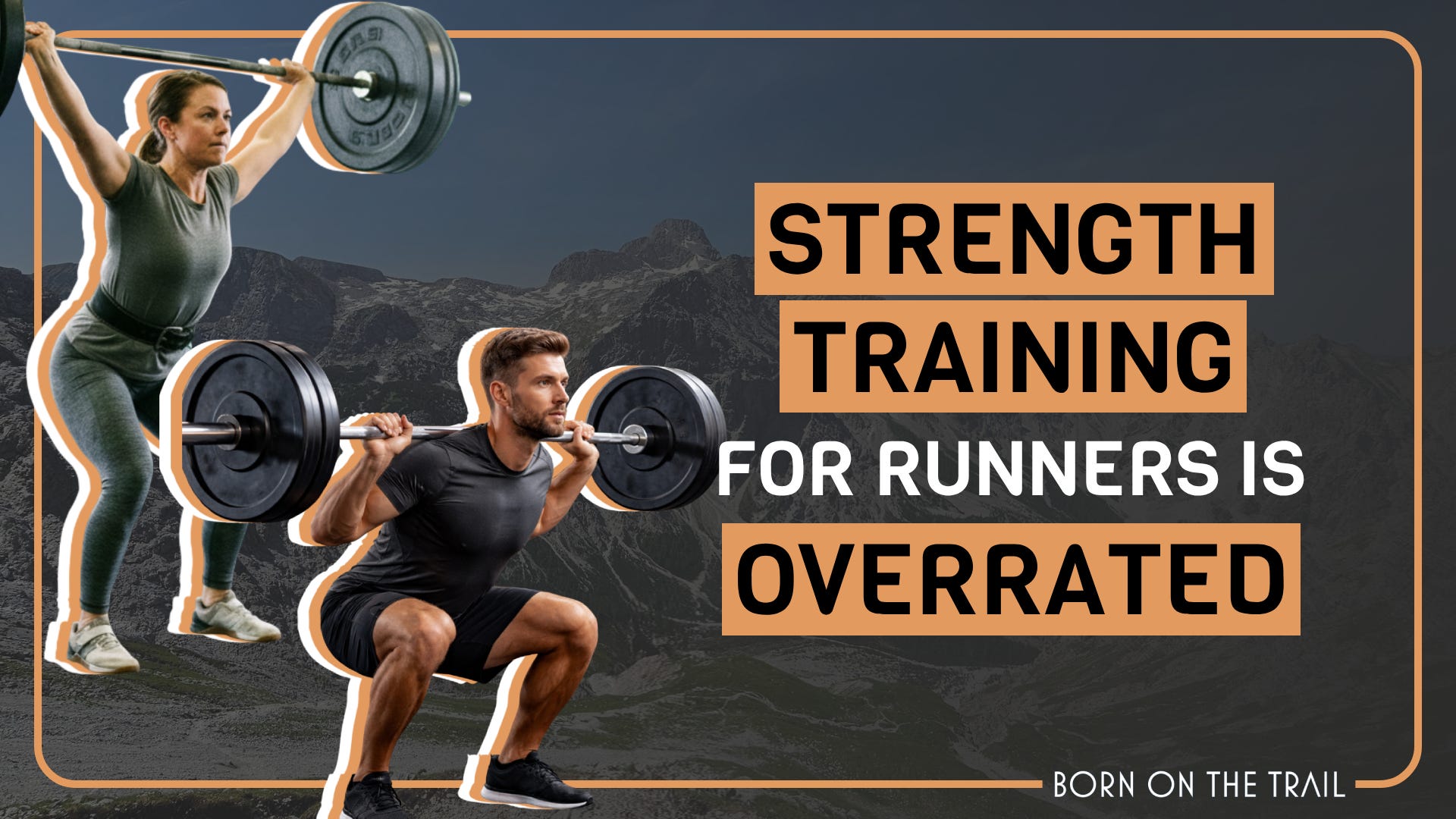
今天的标题有点争议,可能也有点夸张,叫做《力量训练对跑者来说被高估了》。
The title here is a bit controversial and maybe a bit strong and it says Strength Training for Runners is Overrated.
为什么?
Why?
嗯,从我的角度来看,我其实是从这里开始的。
Well, from my point of view, I actually start over here.
这些是我看到的一些关于力量训练的文章标题。
These are the titles from some articles which I see being presented on the topic of strength training.
跑者的力量训练:通过举重提升跑步表现。
Strength training for runners: Improves your running performance by lifting weights.
让你成为更好跑者的力量训练,加入这些动作来预防伤病,给你的跑步加点肌肉,想让每次跑步都更轻松吗?
The strength workout to make you a better runner To help prevent injury, add these moves to your routine Give your run some muscle Want to make every outing feel easier?
在你的日常训练中为力量训练留出时间。
Make room for strength training in your routine.
预防受伤的10个关键力量动作。
10 essential strength moves for preventing injury.
跑步者的力量训练:你应该做的四种动作:力量训练对帮助跑步者跑得更好、避免受伤以及减轻关节额外压力至关重要。
Strength training for runners: four types of moves you should be doing: Strength training is crucial to help runners run better, avoid injury, and extra stress on the joints.
10个提升跑步表现的力量练习。
10 strength exercises to improve your running.
解锁职业跑者汤姆·埃文斯的全身训练,提升你的表现并降低受伤风险。
Unlock pro runner Tom Evans full body workout to boost your performance and cut injury risk.
现在就开始提升你的跑步水平吧。
Elevate your running now.
所以,关于力量训练的说法通常分为两类。
So, the claims around strength training tend to fall into one of two buckets.
要么承诺提升你的表现,让你变得更强壮,要么承诺降低受伤风险,从而通过这种方式让你成为更有韧性、更强壮的跑者。
They either promise to improve your performance and make you stronger, or they promise to reduce your injury risk and therefore make you more resilient and stronger runners through that.
有些情况下,这些标题承诺两者兼得。
And in some cases they promise to do both, as some of these headlines show.
我一直觉得这些说法有点好得让人难以置信,因为实际上,如果真有一种训练方法既能提升表现又能降低受伤风险,那大家肯定都会去练。所以这些关于力量训练的说法一直让我不太信服,因此我想去调查一下。
I always found these statements a bit too good to be true, Because in reality, if there was an intervention which improved your performance while also making you less injury prone, then of course everybody would be trying to do this, And therefore these claims around strength training never really sat well with me and therefore I wanted to investigate.
在我看来,我一直坚持的原则是:非凡的主张需要非凡的证据。
From my point of view, the line that I kept coming to is that extraordinary claims require extraordinary evidence.
我这么说是什么意思呢?
What do I mean by this?
也就是说,你不能一边声称某种训练能提升表现、降低受伤风险,一边却没有确凿的证据来支持。
Again, you can't claim that an intervention will improve performance while also reducing injury risk and not have extraordinary evidence to back this up.
所以,我当然做了我最擅长的事——开始调查。
So, of course, I did what I do best and I started investigating.
我首先从预防受伤的说法入手。
I first started with the injury prevention claims.
为了验证这些说法,也就是力量训练的两大好处,我把它分成了两类。
So, in order to do this, to therefore prove these two statements or these two advantages of strength training, kind of bucketed it in two.
我首先想看看它在预防受伤方面的效果,然后我查阅了一些相关研究。
I first tried to look at the injury prevention aspect of it, and I looked into a few studies over there.
我最初找的,或者说我翻阅的研究,是针对新手跑者的。
The first studies I looked for, or I looked through rather, dealt with novice runners.
这些跑者跑步时间不到两年,他们被分成了三组。
So athletes had been running for less than two years, and these athletes were assigned into one of three groups.
其中一组做功能性力量训练,比如弓步和深蹲。
So, one group was doing functional strength training, so stuff like lunges and squats.
另一组用弹力带做一些训练。
Another was doing some work with elastic band.
第三组则结合静态和动态拉伸进行力量训练,其实主要就是一些动作模式。
And the third group was doing strength based training using a combination of static and dynamic stretches, so really just movement patterns.
研究发现,各组之间的受伤率差不多,大约每千小时跑步会有26.7到32.9次受伤。
And the study found that the injury rates were similar across all the groups, so they were looking at around twenty six point seven to thirty two point nine injuries per thousand hours of running.
这个数字本身已经相当高了,但更有趣的发现是:第一,力量训练的类型对受伤率没有太大影响;第二,在干预开始的头几周,受伤率比之后四个月的维持期要高。这说明,每加入一种新的干预措施——在这里不管是三组中的哪一组——都可能导致受伤率上升,然后在维持期逐渐下降。
In itself, that is already quite a high number, but the interesting take home here was one, that the type of strength training did not really make a difference on injury rates, and that injury incidence was higher during the first weeks of the intervention, compared with the subsequent four month maintenance period, which shows that there is the potential here that every new intervention you add, and in this case irrelevant if it was one of the three groups, it tended to cause an increase in injury rates, which is then reduced over the maintenance period.
所以这一点要记住。
So this is something to keep in mind.
如果你想引入新的刺激,不应该在比赛前太近的时候做,因为那样受伤的风险可能会更高。
If you want to introduce a new stimulus, you shouldn't do it very close to your race because of course the injury risk derived from that intervention can be higher.
我研究的第二项研究涉及720名马拉松跑者。
The second study I looked at is in seven twenty marathon runners.
这些人主要是中后段的跑者,因为他们的平均完赛时间是5小时。他们把这些跑者大致分成两组,人数差不多。
These were mainly mid pack, back of the pack runners because their average finishing time was five hours And they split them in roughly two equally sized groups.
其中一组保持正常训练。
And in one group, they left their training as normal.
那就是对照组。
So that's the control group.
他们只做耐力训练。
So they did just endurance training.
另一组则被分配了一些力量训练,包括核心、髋外展肌和股四头肌的强化练习。
And the other groups were assigned some strength training routines for core, hip abductor, and quads strengthening exercises.
他们都跑完了自己训练准备的那场马拉松。
And they all ran this marathon that they were training for.
结果显示,力量训练并没有显著减少导致无法完赛的过度使用损伤,也没有让完赛时间更快。
And the results showed that there was no significant reduction in the overuse injuries leading to the marathon non completion, nor did it produce faster finishing times.
所以在这项研究中,做力量练习的跑者,他们的受伤情况和完赛时间都没有统计学上的显著变化。
So on this study, there was no statistically significant change in the injury patterns or the finishing time of the runners who performed the strength exercises.
在受伤事件、比赛期间的平均疼痛以及医疗帐篷使用率等方面,确实有轻微的减少。
There was a small reduction in stuff like injury incidents, average pain during the tent and medical tent usage.
也就是说,做力量训练的人受伤稍微少一点,平均疼痛也稍微轻一点,但这些差异都没有达到统计学显著。
So the people who did the strength training routines had slightly less injuries and slightly less average pain, but none were statistically significant.
对于不太熟悉科研文献的朋友,统计显著性是为了判断一个结果到底是随机产生的,还是真的由干预措施导致的。
For those of you who are not as literate in scientific literature, statistical significance aims to discern whether a finding is the result of randomness, or whether the finding is the result of actually the intervention.
所以,当一个结果具有统计显著性时,我们可以比较有把握地说,这个结果是因为干预措施,而不是因为人群中本来就存在的随机性。
So when a finding is statistically significant, we can say with a relatively high degree of confidence that the finding is due to the intervention, not due to a specific randomness which is present in the population.
在这个案例中,虽然有一些小的发现,但并没有达到统计显著的水平。
In this case, although there was a small finding, it was not statistically significant.
所以从科学角度来说,我们不能说力量训练导致了那些受伤次数的减少。
So scientifically, we can't say that it was a strength training which led to those small reductions in injury incidents.
接下来我要讲的第三项研究,虽然不是最后一项,是一项在线调查。
So the third but not final study that I'm going to talk through is an online survey.
在这项调查中,人们自行提交了关于力量训练和跑步的信息,研究人员试图找出抗阻训练习惯和受伤发生率之间的关系。
So here people self submitted responses on their strength training and the running, and the researchers try to find the relationship between resistance training habit and injury prevalence.
在这616份结果中,44.6%的受访者报告在过去一年中遭受了与跑步相关的伤害。
Over here within the six sixteen results, forty four point six percent of respondents reported sustaining a running related injury in the previous year.
这个数字看起来不高,但这是44.6%的人啊。
That seems be low number, but forty four point six percent of the people.
从这个数据集中,无论是总体来看,还是按性别、年龄或跑步距离分层,都没有发现抗阻训练与受伤发生率之间的关联。
And from this dataset, there were no associations found between resistance training and injury prevalence, either overall or when stratified by sex, age or running distance.
所以这里告诉我们的是,在填写调查的616人中,没有发现关联,也就是说力量训练似乎对受伤率没有太大影响。
So what we're being told here is that from the six sixteen people who filled in the survey, there was no association, so there didn't seem to be much of a difference in injury rate from the strength training.
我要讲的第四项也是最后一项研究是一篇综述,一篇叙述性综述。
The fourth and last study I'm going to cover in this is a review, a narrative review.
所以我总是尽量至少涉及或深入一篇综述,因为它能让我们对文献有更广泛的理解,因为那正是综述的目的。
So I always try to at least cover or dive into one review because it kind of gives us broader understanding of the literature because kind of that is what a review is meant to do.
它本身不是单一的研究或干预研究,而是汇集了许多研究,试图找出它们之间的共同模式。
It in itself is not a singular study, an intervention study, but it gathers a lot of studies together and tries to find kind of common patterns between them.
这第四项研究呼应了我们到目前为止所说的内容。
This fourth study of echoes what we've been saying up till now.
有些研究提出力量训练可能对预防受伤有保护作用,但其他研究显示其实没有好处。
So some studies suggested a potential protective effect of strength training for injury prevention, but others showed really no benefit.
所以作者的结论是,关于力量训练预防受伤的研究仍然没有定论。
So the conclusion kind of from the author is that strength training for injury prevention, the studies remain kind of inconclusive.
他们还指出了方法上的局限性、样本量小,以及过度依赖军人群体,这让我们很难确切地说力量训练能降低你的受伤率。
They also pointed towards some methodological limitations and small sample sizes and over reliance on military populations, which kind of makes it hard for us to say definitively that strength training decreases your injury incidence rate.
所以如果我们总结一下我最近几分钟讲的内容,力量训练能减少受伤这个说法,从分析的研究来看似乎站不住脚。
So if we summarize the last few minutes of what I've been talking about, this claim that strength training reduces injuries doesn't seem to hold up from the research analyzed.
确实有一些微小的迹象,但证据仍然在很大程度上没有定论。
There does seem to be some small indication, but evidence remains largely inconclusive.
所以对我来说,这个话题暂时就告一段落了,以后可能会再捡起来,但就目前而言,力量训练能减少受伤这个说法还没有定论。
So for me, this is kind of a closed chapter for now, which I will reopen maybe in the future, but for now the claim that strength training reduces injury is still in balance.
第二件我们需要研究的事情,当然是力量训练是否能提升运动表现。
The second thing that we needed to look into is of course whether strength training drives performance improvement.
也就是说,通过力量训练,你能不能跑得更快。
So whether you can get faster through performing strength training.
我们首先看的是训练有素的跑者。
So the first that we're looking into here is in well trained runners.
他们平均年龄29岁,五公里成绩是九十分钟。
So they are average age of 29 years old with a five ks time of ninety minutes.
所以水平相当不错。
So quite good.
这些跑者被分成了干预组和对照组。
And these runners were divided into an intervention group and a control group.
干预组在耐力训练的基础上增加了半蹲训练,他们每周做三次,每次四组,每组四次,持续了八周。
The intervention group supplemented endurance training with half squat training and they did four sets of four repetitions three times a week for eight weeks.
所以在这八周里,一组人在训练计划中加入了力量训练,另一组则继续像以前一样进行同样的耐力训练。
So for eight weeks, one group added strength training to their training regimen, and another group kind of continued doing the same endurance training as they were doing before.
而干预组确实表现出了明显的进步。
And the intervention group demonstrated quite an improvement.
比如,在最大摄氧量的70%强度下,跑步经济性提高了5%;在乳酸阈值时心率降低了2%;在最大摄氧量的70%强度下心率降低了1.9%。
So for example, five percent in running economy at 70% of VO2 max, a 2% reduction in heart rate at lactate threshold, and a 1.9% reduction in heart rate at 70% of VO2.
所以确实有改善。
So there was an improvement.
而对照组没有表现出这样的进步。
And the control group showed no such improvement.
因此,作者从这篇文章得出的结论是,加入力量训练可以或将会提升表现,正如在这组训练有素的跑者身上所展示的那样。
So the conclusion that the authors made from this article is that the addition of strength training could or will enhance performance as shown in this group of well trained runners.
我们看的第二项研究非常相似。
The second study we are looking into is very similar.
这次我们找了20名中距离跑者,这里的中距离指的是1500米到10000米的跑者,他们也训练得相当不错。
This time we had 20 middle distance runners, so middle distance in this case is from 1,500 ms to 10,000 ms runners, and these were also quite well trained.
他们的平均最大摄氧量是61。
They had an average VO2 of 61.
这次研究的时间跨度长得多,因为干预组在跑步训练之外,还增加了一个为期四十周的结构化力量训练计划,而对照组则继续他们原有的训练时间。
This was over a much longer time period because the intervention group added a structured forty week strength training program on top of their running training, while the control group continued their existing training hours.
结果和之前看到的那项研究类似,干预组的跑步经济性提高了3.5%,最大摄氧量速度提高了4%。
The results were similar to the one we saw previously, that the intervention group saw an improvement of 3.5% in running economy and 4% improvement in velocity at vo2 max.
对照组也有进步,但幅度较小。
The control group did improve also, but by less.
而且同样,这在统计上并不显著。
And once again, it is not statistically significant.
所以从科学角度来说,我们无法确定对照组的进步是来自耐力训练,还是纯粹是随机因素造成的。
So again, in terms of science, we do not know that the improvement of the control group was due to the endurance training, or whether it was down to random chance.
那些小幅进步很可能归功于耐力训练,但科学上还不能下定论。
Probably the small improvements were due to the endurance training, but the science can't say that for certain.
而干预组的结果在统计上是显著的。
While the intervention group, the results of the intervention group were statistically significant.
所以我们看到的是,做力量训练的那组在四十周内,也就是差不多一个赛季的时间里,比没有做力量和抗阻训练的那组进步更大。
So what we're seeing here is that the strength training group improved more over forty weeks, so basically almost a season, compared to the group which did not do strength and resistance training.
最后我想提一点,之前那个研究也有这个情况,就是两个研究在身体成分方面都没有看到什么明显差异。
The last thing I want to note, which is also present in the previous study, is that both studies didn't see really any difference within body composition.
这意味着运动员有可能在不增加肌肉体积的情况下增强力量。
So what this means is that it is possible for athletes to build strength without building hypertrophy.
换句话说,就是可以在不增肌、不增加体重的情况下变得更强壮。
So said that other words, it is possible to kind of get stronger without building bulk or building muscle or increasing weight.
这一点在第三个研究里也能看到。
And this is also something we see in the third study.
我还是很喜欢看到这样的结果。
Again, I like to see these.
我也喜欢在我的综述里加入其他综述,这样能更全面地了解相关文献。
I also like to add reviews in my own review in order to get a wider sense of the literature.
而这第三个研究,我们就要进入系统综述的部分了。
And in this third study, we're getting into the systematic review.
他们在这项研究中查看了24篇已发表的研究。
And here what they did is they looked into 24 published studies.
基本上,他们总体发现,中长跑中的跑步经济性往往会提高2%到8%。
And basically, what they found overall is that running economy tends to be improved in by two to 8% in middle to long distance running.
虽然这并非在所有研究中都一致。
Although this was not consistent through all studies.
当然,由于测试的群体、人群、不同的干预措施、不同的测试方案以及方案持续时间的不同,研究之间总会存在一些差异。
So, of course, you will always see some variability between studies due to the group, the population being tested, different interventions, different test protocols, different durations of the protocol.
但总的来说,加入力量训练往往能将表现提高2%到8%。
But in general, the addition of strength training tends to improve performance by two-eight percent.
在1.5到10公里的距离上,计时赛成绩有所提高,同时无氧相关素质也得到了改善。
Time trail performance over distances ranging from 1.5 to 10 kilometers was improved, along with anaerobic related qualities.
诸如最大摄氧量、最大摄氧量速度、血乳酸测量和身体成分等变量通常不受影响。
Variables such as VO2 max, velocity as VO2 max, blood lactate measurements and body compositions were typically unaffected.
所以这可能意味着,很多结果主要体现在跑步经济性、第二乳酸阈值的速度以及最大摄氧量70%时的速度上。
So probably what this means is that a lot of the results shown were around running economy and around velocity at your second lactate threshold and velocity at 70% of VO2, for example.
它似乎不会提升的是你的绝对最大能力。
What it doesn't seem to improve is your absolute max capacity.
所以,我们看了那三项研究,你可能会发现它们之间的规律是,力量训练能提升表现。
So, we looked at those three studies and kind of you might see that the pattern between those three studies was that strength training improves performance.
不过,对我来说,这还不算一次令人满意的深入探讨,如果我可以这么说的话。
However, for me, this was not a satisfactory deep dive, if I can put it like that.
就像我在屏幕上写的,事情并不总是表面看起来那样。
And as I wrote on the screen, not everything is as it seems.
为什么?
Why?
因为如果你仔细听我说,我说的是对照组保持了他们的耐力训练,而干预组,也就是做力量训练的那组,是在此基础上额外增加了力量训练。
Because if you listen to me very closely, I was saying that the control group maintained their endurance training, while the intervention group, the group doing strength training, added that strength training on top.
对我个人来说,这不算是一个公平的比较,因为我会认为训练更多的组应该获得更多的适应,而不是和训练较少的组一样。
And for me personally, that wasn't an equal comparison, because I would expect that the group who trains more to derive more adaptations not be equal to the group which trains less.
如果训练更多和训练更少的组之间的提升是一样的,那么训练更多的组基本上就是在浪费时间。
If the improvement between the group that trained more and less was equal, then kind of the group training more is wasting time.
他们增加了更多的训练时间,但进步却更少,或者用更少的训练时间获得了同样的进步。
They are adding more training time for less improvement or equal improvement with less training time.
所以对我来说,这个结果并不令人满意,因为我想知道,如果我把一部分跑步换成力量训练,会不会有效果?
So for me, this wasn't a satisfactory kind of result because I wanted to know if I replace some of the running with strength training, does that give me results?
力量训练是不是比单纯多跑步更可行的替代方案?
Is strength training a viable addition alternative to running more?
这就是我想要研究的问题。
So this is what I try to look into.
我试着找了一些研究,这些研究要么减少了部分耐力训练并用力量训练替代,要么增加了力量训练,但同时也增加了一定量的跑步作为补偿。
I try to look at studies where some part of endurance training was removed was removed and replaced by strength training, or where strength training was added, but some level of running was added in compensation too.
这才是我真正感兴趣的比较。
That is really the comparison that I was interested in.
所以我看了更多这方面的研究。
So I looked at a few more studies here.
第一个研究是针对16名男性耐力跑者的,他们的训练水平相当高,平均最大摄氧量是60,而且同样分为力量组和对照组。
The first study which we looked at is in 16 male endurance runners with again quite well trained, an average VO2 max of 60, and once again they had the strength group and the control group.
这项干预持续了八周。
This intervention lasted for eight weeks.
力量组把跑步里程减少了58%,但加入了两次力量训练,而对照组至少从计划上看,耐力训练保持不变。
The strength group reduced the running mileage by 58% but they incorporated two strength training sessions, while the control group left their endurance training the same, at least on paper.
我们很快会详细讨论。
We'll get into the details soon.
我们发现,400米成绩提高了4.8%,还有一种叫做“悠悠间歇测试”的成绩提高了18.5%,这个测试基本上就是两次20秒冲刺,速度逐渐加快。
And what we found is a 4.8% in 400 ms performance and an 18.5% test called the yoyo interval test, so it is basically two times twenty seconds sprints at increasing speeds.
我们在这里看到的是,加入力量训练并减少跑步里程的那组,400米成绩提高了,冲刺表现也提升了。
What we see here is that it appears that the group which added the strength training and reduced running mileage improved their 400 ms performance, while also improving their sprints.
但同样,我对这个结果并不满意,所以我更深入地研究了他们训练的具体构成。
But again, I wasn't happy with this so I went into more details around the composition of their training.
虽然干预组的总里程确实减少了,但他们的间歇跑里程增加了312%。
While it is true that total mileage for the intervention group decreased, their interval running mileage increased by 312%.
所以他们进行的间歇跑或高强度训练次数是之前的三倍。
So they were doing three times more running interval or high intensity sessions compared to what they were doing previously.
相比之下,对照组在纸面上保持了相同的耐力训练,但在干预前后,他们的总里程减少了16%,而间歇训练时间增加了25%。
In comparison, the control group on paper left their endurance training the same, but pre and post intervention, their total mileage reduced by 16% and their interval training time increased by 25%.
所以,我觉得从方法论上讲,对照组基本保持不变,但间歇训练组的变化我觉得不太公平,尤其是他们的间歇跑里程增加了300%。
So again, I felt that methodologically the control group largely stayed the same, but the change in the interval group I felt wasn't particularly fair, especially because they increased their interval running mileage by 300%.
测试方案是400米跑和两次20秒的间歇跑。
And then the testing protocol was 400 meter long and two times twenty seconds intervals.
所以他们增加了间歇训练,高强度训练的表现也随之提高。
So they increased their interval training and their performance in high intensity sessions improves.
这到底是力量训练的效果,还是高强度跑量增加的效果呢?
Is it down to the strength or is it down to the increase in high intensity running mileage?
谁知道呢?
Who knows?
我们还从研究中得知,两组的10公里成绩几乎都没有变化。
What we also know from the study is that 10 kilometer performance remained virtually unchanged in both groups.
所以力量训练对10公里没有帮助,增加高强度训练也没有帮助,但对照组呢,他们的10公里成绩也保持不变。
So the strength training did nothing for 10 ks, the increase in high intensity did nothing, but also the control group, their 10 ks performance remained the same.
所以我看的第二项研究是关于年轻的长跑运动员的。
So the second study I looked at looked at young distance runners.
这次我们说的是十六到十八岁的年轻人。
So in this case, so we're talking sixteen to eighteen years.
在这个研究中,干预组把19%的耐力训练换成了冲刺跑和跳跃练习,而剩下的耐力训练中,95%是在无氧阈值以下进行的。
In this case, we had an intervention group where 19% of endurance training was replaced with running sprints and jumping drills, while 95% of the remaining endurance training was being performed below at the anaerobic threshold.
所以这里我们又看到耐力训练被替换了,但这次不是用传统的力量训练或抗阻训练,而是用冲刺跑和跳跃练习。
So again, we are seeing a replacement of Endurance Training, but this time not with really a strength protocol, a traditional strength or resistance protocol, but with running sprints and jumping drills.
而且这一点后面会很重要。
And again, this will become important.
我们看到的结果是,三十米冲刺速度提高了1.1%,而最大耐力表现和最大摄氧量基本没变。
So what we see is a 1.1 improvement in 30 ms sprint speed, while maximal endurance performance and VO2 max remain largely the same.
对我来说,这个测试和干预措施的变化是最匹配的。
Again, for me, the test kind of fits closest to the change in intervention.
他们减少了一些耐力训练,然后加入了冲刺跑和跳跃练习,而测试的项目是三十米冲刺速度。
So they removed some endurance training and they added running sprints and jumping drills for a test, which was a thirty minute sprint speed.
我个人还是觉得,这个改变,也就是增加的内容,是针对干预措施本身来的。
Personally, once again, I feel that the change the addition was specific to the intervention.
所以不管他们之前练的是什么,我本来就会预期看到这样的结果,因为增加的刺激跟测试项目是匹配的,所以确实能看到进步。
So irrelevant of how the kind of what they were doing previously, I would have expected that actually the result is what we see that we do see an improvement given that a stimulus which was specific to the test protocol was added.
所以再说一遍,这完全不是我的个人看法,而是苹果对苹果的比较。
So again, not entirely my opinion, to apples comparison.
第三个也是最后一个研究,其实揭示了一个问题,就是当我们试图用力量训练来替代耐力训练时,会遇到一些复杂情况。
The third and last study kind of highlights a bit of a complication with how are trying to replace endurance performance with strength.
那我来详细说说。
So let me get into it.
在第三项研究中,达芬奇组用爆发力训练替代了32%的训练内容。
The da Vinci group in this third study replaced 32% of their training with explosive strength training.
而对照组只替代了3%,也就是说,他们只把3%的耐力训练时间换成了爆发力训练。
In the Control group, this was only 3%, so they only replaced 3% of their Endurance training time with an Explosive Strength training session.
两组保持了相同的强度分布。
Both groups maintained identical intensity distribution.
所以再说一次,这一点非常重要。
So again, this is very important.
在跑步量中,他们有4%的训练是在乳酸阈值以下进行的,其余部分则在阈值以上。
Within the running volume, they had 4% of their training performed at below their lactate threshold, And the remainder of it was above.
而且,这可能是最严谨的方案了。
And again, this is probably the most robust protocol.
为什么?
Why?
因为他们试图在中间那段训练中,让跑步训练的能力或类型保持均衡。
Because they are trying to equal the capacity or the type of running training that they did in the middle there.
测试方案是爆发力训练,时长15到90分钟,包括5到10次20到100米的短跑冲刺,以及各种跳跃练习,要么不加重物,要么用轻杠铃。
And the test protocol was explosive sessions fifteen to ninety minutes consisting of short sprints of five to 10 sprints of 20 to 100 meters and various jumping exercises performed either without external load or with a light barbell.
所以,这些人用的重量其实非常小,甚至可能没有,因为是从0到40%的最大重复次数。
So again, these people here were doing quite a very small weight, if at all, because it was from zero to 40% of one rep max.
所以他们更注重爆发力,而不是纯粹的力量。
So they were focusing more on power rather than pure strength.
我们在这里看到的是,力量组的跑步经济性提高了8.1%,五公里成绩提高了3.1%,而对照组没有改善。
And what we see here is that the strength group improved the running economy by 8.1% and their five ks performance by 3.1%, while the control group showed no improvement.
这个干预,在我看来,主要依赖于增强式训练,而不是大重量低次数的抗阻训练,所以他们选择的干预方式与他们的测试方案最接近。
The intervention, again, in my opinion here relied heavily on plyometric drills rather than heavy low repetition resistant training, so they chose an intervention which is closest to their testing protocol.
不过,我之前开始研究这项研究时就说过,它揭示了我们在比较训练方式时存在的一个问题。
Nonetheless, I told you when I started looking into the study that this study uncovers kind of an issue with the way we compare training.
我来解释一下为什么。
And I will explain why.
因为当你说,好的,我每周做六小时耐力训练,我打算把其中一小时换成抗阻训练。
Because when you say okay, I am doing six hours of endurance training, and I'm going to replace one hour of it with resistance training instead.
那剩下的五小时你怎么办?
What do you do with your remaining five hours?
你还是按照以前的比例来训练吗?
Do you still train in the same percentage that you used to do before?
还是说,你只是把一小时轻松跑换成了一小时健身房训练?
Or are you replacing an hour of easy running with an hour in the gym?
你怎么能把五小时的跑步和一小时的健身房训练,等同于六小时的跑步呢?
How can you equate five hours of running and one hour in the gym to six hours of running?
那一小时的健身房训练到底值多少?
That one hour in the gym is worth what?
它值一小时的跑步吗?
Is it worth one hour of running?
轻松的那种?
Easy?
是一次高强度训练吗?
Is it one high intensity session?
当然,你没法用心率、TRIM或者任何主观疲劳程度来平衡这两者,因为力量训练和耐力训练的对应关系并不好找。
You can't of course equalize this through heart rate or of trim or any sort of effort because resistance and strength training do not map very well to TRIM.
也许你可以从恢复角度去平衡,但话说回来,如果你跑步的时间更长,而力量训练对你来说是全新的刺激,那身体恢复肯定需要更久。
Maybe you equalize it for recovery, but again, that you probably have been running for much longer but strength will be a new stimulus to you, then of course recovery for the new stimulus will take longer.
虽然我确实努力去找那些试图平衡力量训练和跑步训练的研究,但我们其实很清楚,相比把同样时间花在跑步上,力量训练带来的提升究竟源于什么。
Although I really try to look into studies where they try to equalize the resistance and running training between them, we actually know what the improvements derive from strength training compared to spending that same time running.
我确实明白这很难做到。
I do really recognize that it is very hard to do.
所以,我从这些研究中得出的结论是,表现的提升很大程度上取决于你增加的训练刺激与测试项目之间的相关性和针对性。
So the conclusion which I came up with from these studies was that performance improvements were largely driven by the specificity and relevance of the added training stimulus relative to the performance test.
我这么说是什么意思呢?
What do I mean by that?
如果你的测试项目是三十秒的间歇测试,而你增加的训练干预主要是力量型的,比如跳跃、低次数、爆发力强的动作。
If your testing protocol is a thirty second interval test and you add your training an intervention which is heavily power based, so you're jumping and you're using low reps and very explosive movements.
那么我预计,这种训练的增加会与测试项目非常匹配,因为两者都是力量型的,而且你增加的干预正好针对你的测试项目。
I would expect that that addition to your training will map very closely to the testing protocol because both of them are power based and kind of you've added an intervention which is specific to your testing protocol.
比如说,如果你在准备马拉松、平地五十公里或者甚至山地超马,那么跳跃训练相比在健身房跑步,真的能提升你的表现吗?
If for example, you are trying to run a marathon, a flat 50 ks or even maybe a mountain ultra, will a jumping drill improve your performance compared to spending that time running in the gym?
我不知道。
I don't know.
所以,回到这个问题:力量训练真的能提升你的表现吗?
So again, if I come to this question of does strength training improve your performance?
我不知道,这对我来说真的很难说。当然,如果你增加力量训练,其他什么都不变,可能会有好处,就像我们之前看到的。
I don't know, it's really hard for me to say, of course, if you add strength training and you leave everything the same, there could be benefits to that as we saw previously.
但实际上,生活从来没那么简单。
But in reality, life is never that simple.
当然,你可以增加一个小时的训练,这本身就是力量训练,但这是你时间的最佳利用方式吗?
Sure, you can add one hour of training, which is in itself strength training, but is that the best use of your time?
也许你可以把那额外的一小时用来跑步?
Could you maybe spend that extra hour running?
所以这时我决定,好吧,我觉得我是在从相反的角度看这个问题。
So at this point, I decided, okay, I think I am looking at the problem from the opposite side.
所以我想换个角度,考虑到我的听众主要做耐力训练和超跑,我会试着从另一个角度来审视。
So I want to go from the other side and given my audience mainly does endurance training and ultra running, I'll try to look at it from the other side.
这个角度就是什么决定了超跑的表现。
So this other side is what determines ultra performance.
所以如果我研究超跑,试图理解哪些特质、哪些特征驱动超跑表现,那么从那里我或许能得出力量训练是否能引发这些适应,从而提升我的超跑表现。
So if I look at ultras, and I try to understand what attributes, what characteristics drive performance in ultras, then from there I can maybe get to whether strength training elicits those adaptations and therefore will provide me improvements in my ultra performance.
所以我们这里又有几项研究。
So once again we have a few studies here.
第一项研究观察了93名参加100公里超级马拉松的男性跑者。对于这些人来说,作为个体变量,每周跑量(以公里计)是表现的最强预测指标。
So the first study looked at 93 male runners competing in a 100 kilometer ultramarathon And for these people, as an individual variable, weekly trading volume measured in kilometers was the strongest predictor of performance.
在双变量分析中,也就是两个单一变量之间的简单关系或关联,个人最佳马拉松成绩是超级马拉松比赛结果的最强单一预测指标。
In a bivariate analysis, which is a simple relationship or association between two singular variables, personal best marathon time was the single strongest predictor of ultramarathon race outcome.
所以,我们又开始看到,你的马拉松成绩和每周训练量是很好的预测指标。
So again, here we are starting to see your performance at the marathon is a good predictor and your weekly training volume.
第二项研究非常相似,但这次是169名男性跑者,参加100公里超级马拉松。
In the second study, here it was very similar, but this time 169 male runners and 100 kilometer ultramarathon.
在这种情况下,使用双变量分析,我们发现,当然,之前的最佳100公里成绩是比赛表现的最强单一预测指标。
And in this case using a Bifurite analysis we found that of course the previous personal best 100 kilometers time emerged as the single strongest predictor of race performance.
当然,这是我们可以使用的最具体的指标,即之前的成绩。
Of course that is the most specific metric that we can use, previous performance.
它总是最好的预测指标。
It is always the best predictor.
但接下来我们发现,个人最好成绩和平均训练速度也是很好的预测指标。
But following that we saw merit and personal bests being a good predictor and average training speed.
所以训练时跑得越快,比赛时表现就越好。
So the faster you train the better you would perform in the race.
这听起来又有点理所当然。
Again, it feels kind of obvious here.
再次,用不同的分析方法,比如多元回归模型,最能预测表现的变量是训练速度、每周跑步量和年龄。
Once again, using a different methodological analysis, so multiple regression models, the values or the variables which seem to predict performance the most were training speed, weekly running volume and age.
所以,我们还是在看速度、训练量和过往成绩,这些是影响或预测超马未来表现的主要变量。
So again, we're looking at speed, volume and previous history as the variables which most influence or predict future success at ultramarathon.
第三项研究,只有25名参与者,样本量小得多,但这是一场为期七天的山地超马,全程350公里,累计爬升和下降11000米。
The third study, this one was 25 participants, a much smaller sample size, but it was a seven day mountain ultramarathon over three fifty kilometers with 11,000 meters of cumulative gain and loss.
在这个案例中,个人最好马拉松成绩和平均训练速度再次成为与表现关联最强的两个变量。
In this case, once again, personal best marathon time and average training speed were the two variables which most strongly associated performance.
所以,我们又看到了一个显而易见的点:在短距离上跑得快的人,在更长距离的比赛中通常也会表现更好,这也许并不太令人意外。
So again, we're seeing kind of obvious moment where faster people at slow distances will in general perform better in longer races also, which is maybe not too surprising.
但在第四项研究中,再次发现最佳马拉松成绩和超马成绩是预测表现的两个主要变量,此外还有完成过的超马次数。
But in the fourth study, once again, best marathon time and ultramarathon time were the two variables which best predicted performance, along with the number of completed ultramarathons.
这三个因素可以说是预测表现的主要指标。
Those were kind of the three main predictors of performance.
在训练特征方面,这是第二组能预测表现的类别。
In terms of training characteristics, these were the second set of this was the second category which predicted performance.
之所以说是第二组,是因为这项研究还考察了身体特征,比如体脂率、肌肉密度之类的数据。
And I say it's the second is because this one also the study also looked at body characteristics, so stuff like skin folds and muscle density and stuff like that.
但第二个特征,或者说第二组因素中,最能预测比赛成绩的是你的训练情况。
But the second characteristic or the second group, which best predicted performance was your training.
具体来看,是那些每周跑量更高的人,无论是按公里算还是按小时算,而且平均配速也更快。
And in this case, it was athletes with higher weekly mileage volumes, both in kilometers and hours, and higher average training speed.
其他因素,比如耐痛能力、配速以及配速策略,对成绩的预测作用就没那么大了。
Other factors such as pain tolerance, pace and pacing strategy were less predictive.
所以当然,经验仍然是最重要的预测指标。
So of course, experience is the number one predictor.
如果你跑过五场超级马拉松,而且每次都在十六小时内完赛,那你的预测成绩至少比那些第一次跑一百公里超级马拉松的人要准。
If you did five ultramarathons and you all went under sixteen hours, you at least have a better prediction rate than someone who is entering their first 100 kilometers ultramarathon.
但排在第二位的,我们一直看到的是,训练量更大的运动员,无论是时间还是距离,往往跑得更快,当然,不用说,跑得快的人在比赛中自然表现更好。
But second to that, what we've seen consistently is that athletes who train more both in terms of hours and distance tend to perform faster, and of course, it goes without saying, faster people perform faster during races.
所以我的理解是,这其实也是显而易见的,就是强大的超级马拉松表现是建立在马拉松级别的体能基础上,再加上逐步增加的训练量,来应对更长距离比赛的需求。
So what I take from this, which again is a bit of a no brainer, is that strong ultramarathon performances are built on a foundation of marathon level fitness combined with progressively higher training volumes to support the demands of longer races.
所以如果你马拉松跑得快,那你在超长耐力跑中取得好成绩就有了一个很好的起点。
So if you're faster than marathon, you'll have a very good start to doing well in ultra endurance running.
然后你需要增加一些额外的训练,以及一些更针对性的训练,来应对更长距离的需求,但这两类因素似乎是预测超级马拉松表现的关键。
You then need to add some additional training and some more specific type of training in order to handle the demands of longer distances, but those seem to be the two categories which predict ultramarathon performance.
我还想深入探讨一下,这里说:强大的超级马拉松表现是建立在马拉松级别的体能基础上的。
What I also try to look into is dive a bit deeper is, okay, over here the statement says: Strong Ultramarathon performances are built on a foundation of marathon level fitness.
那么,不言而喻,这里什么决定了马拉松表现呢?
So it goes without saying, what determines marathon performance here?
同样,我不会讲得太细,但在第一项研究中,总跑步距离是表现的最强预测指标。
And again, I won't go into too much detail here, but total running distance in the first study emerged as the strongest predictor of performance.
而且作者在这里非常明确地指出,运动员必须积累大量的训练量,通常每周要超过一百公里。
And the authors here very clearly stated that there is a fundamental need for athletes to accumulate large training volumes, typically over 100 kilometers a week.
所以我们开始看到,要想在马拉松比赛中表现出色,训练中也需要跑很长的距离,每周超过一百公里。
So we are starting to see that for baritone performance you also need to run long distances in training, more than 100 kilometers per week.
在第二项研究中,他们分析了从五公里到马拉松的休闲跑者,共两千三百零三人。
In a second study, here they analyzed recreational runners ranging from five kilometers to a marathon for 2,303 recreational runners.
同样,每周跑量是表现的重要预测指标,参加节奏跑和间歇训练也有助于提高比赛成绩,但最重要的预测指标还是每周跑量。
Again, weekly mileage was a significant predictor of performance, and participation in tempo runs and interval trainings further contributed to a faster race time, but the number one predictor was weekly mileage.
所以我们再次看到,马拉松和超马一样,表现好坏取决于你训练的量。
So we are once again looking at marathon same as ultramarathon being predicted by the amount of volume or training that you do.
所以在这两组研究中,无论是预测超马表现还是马拉松表现,反复出现的最重要因素就是训练量,无论是马拉松距离、较短距离还是更长距离,训练量都是最大的预测指标。
So Throughout these two sets of studies, both the what predicts ultramarathon performance and what predicts marathon performance, the number one thing which keeps coming up is that training volume is the biggest predictor for performance, be it at marathon distance, shorter distances and even higher distances.
所以当有运动员来找我当教练,跟我说:嘿,Nikki,我想做力量训练,我的回答不会是行或不行,而是:你为什么想做力量训练?
So when an athlete comes to me as a coach and tells me Hey Nikki, I want to strengthen, my answer will not be yes or no, my answer will be but why do you want to strength train?
因为我说力量训练被高估的原因在于,它被宣传成一种能提高表现、减少受伤的干预措施。
Because the reason I started with strength training is overrated is because it is sold as this intervention, which improves performance and reduces injury incidents.
所以,这能一起降低你受伤的风险。
So reduces your chances of injury together.
但实际上,科学告诉我们,提高成绩的最大预测因素是增加训练量。
But actually, science shows us that the biggest predictor for improving performance is actually an increased volume.
所以,如果有人来告诉我,而且这很重要,我想提高成绩,因此我想开始力量训练,那我就会有点质疑。
So if someone comes to me and tells me and this is important, I want to improve my performance, and therefore I want to start strength training, then I would question it a bit.
所以,对于“你为什么想练力量?”这个问题。
So if for the question, why do you want to strengthen?
他们问我,嘿,你知道,我喜欢跑步,但我不热爱它。
They asked me, hey, you know, I like running, but I don't love it.
我想要一些变化。
I want some variety.
或者现在是冬天,又冷又下雪,我不想出门,我想做一些室内训练。
Or it's the winter, it's cold, it's snowy, I don't want to go out, I want to do some indoor training.
如果他们说,你知道吗,我20岁了,对我来说,看起来好看和跑得好一样重要,那么我想做力量训练。
If they say you know what, I'm 20, it's equally important for me to look good rather than just run well, then I want to do strength training.
如果他们告诉我,嘿,我伴侣去健身房上力量课,我们想一起去,那我们就做力量训练。
If they tell me, hey, my partner goes to the gym goes to some strength classes, and we want to go together, then we'll do strength training.
如果他们有过受伤史,反复尝试超过某个跑步阈值,但过去因此受过伤,而他们想通过力量训练来改善,那这可能是个做力量训练的好理由。
If they have an injury history, if they've repeatedly tried to go over a certain running threshold, And they have said that and they've got an injured in the past, but and they want to do strength training because of that, that might be a good reason to do strength training.
如果他们就是喜欢。
If they just enjoy it.
也许你是那种喜欢去健身房、喜欢举铁的人,所以你想多做点。
Maybe you're one of those people who enjoys going to the gym enjoys lifting, and therefore you want to do more of it.
或者如果你其实对提升表现不太感兴趣,而是更关心长寿,或者随着年龄增长变得更强壮,那么力量训练是个不错的补充。
Or if actually you're not really interested in improving your performance, you're actually interested in, I don't know, longevity and maybe being stronger as you age, then strength training is a good addition.
所以再说一遍,原则上我不反对力量训练。
So again, in principle, I am not against strength training.
我认为力量训练有很多好处。
I think strength training has a lot of benefits.
但如果你最大的动力是提升表现,而你的解决方案是增加力量训练,那我会请你重新考虑,我不认为提升表现的最大杠杆就是增加力量训练。
But if your one big driver is to improve performance, and your solution to improving performance is adding strength training, then I would ask you to reconsider, I don't necessarily think that the biggest lever to increase performance is the addition of strength training.
这可不是我随便说说的。
And this is not just something I say.
你现在看到的是一个金字塔。
So what you are seeing here is a pyramid.
其实是两个金字塔。
It's two pyramids.
左边那个是史蒂文·泰勒的,是他关于耐力训练需求的层级图。
Actually, the one on the left is from Steven Tyler, it's his hierarchy of endurance training needs.
你可以清楚地看到,在最底层。
And you have to see and you can see clearly that at the bottom.
金字塔的底座,也就是耐力训练需求的基础,是总的训练频率和训练量。
The base of your pyramid, the base of your endurance training needs is total frequency and volume of training.
其他所有东西,不管是高强度训练、周期化安排,还是特定刺激,都没有总的训练频率或训练量重要。
Everything else, whether it's high intensity training, periodization or specific stimulus, is less important than total frequency or volume of training.
右边那个是杰森·库普的,他在关于超马训练需求的层级文章里特别提到,他的这个层级是改编自史蒂文·泰勒的,所以他加了一些对超马很重要的补充,但同样,这个层级的基础是总训练负荷,其次重要的是充足的休息。
The one on the right is from Jason Koop, so Jason Koop in his article of his hierarchy of ultramarathon training needs, he specifically says that his hierarchy is adapted from Steven Tyler's, so he added a few additions which are important for ultra, but again the base of that hierarchy is total volume of workload and importantly second is adequate rest.
所以,他们俩都把总训练量放在最底层,不是其他任何干预措施,总训练量就是最基础的那一层。
So at the basis he puts total volume, both of them, not any of the other interventions, total volume is the one at the base.
所以这两位教练想表达的是,在考虑其他训练方法之前,你首先应该努力最大化的是你的总训练量。
So what these two coaches are showing is that the number one thing you should be trying to maximize first before you go on to other interventions is actually your total volume.
我还看了一本书叫《为苹果运动员而训练》,作者是史蒂文·豪斯和斯科特·约翰斯顿。
And I also was looking at the book called Training for the Apple Athlete, It's by Steven House and Scott Johnston.
你们有些人可能知道,他们非常强调力量训练的部分。
And as some of you might know, they put a lot of emphasis on the strength component.
他们以肌肉耐力方面的观点而闻名。
They're kind of famous or popular for their muscular endurance.
但即使在那本书里,我这里也有三句引用。
But even there, what I have here are three quotes from the book.
如果不先最大化你的基础有氧能力,你永远无法最大化你的耐力。
You will never maximize your endurance without first maximizing your basic aerobic capacity.
对于本书的大多数读者以及书中涵盖的所有运动项目来说,训练的首要重点必须是增加那个至关重要的有氧基础。
For most readers and for all sports covered in this book, the number one area of training focus must be on increasing that all important aerobic base.
没有这个基础,其他一切都是空谈。
Without this base, all the rest is mere window dressing.
这本书里提到的每个项目,最大的表现限制都来自你的有氧代谢,所以我们会把大部分注意力放在那里。
For every event covered in this book, the biggest limitation to performance will come from your aerobic metabolism, hence we will focus most of our attention there.
其他所有训练都只是辅助和支持性的,用来增强那个有氧系统。
All other training will be acting in a supplemental and supportive role to enhance that aerobic system.
所以即使是特别强调力量训练的教练,也会说你需要优先最大化、优先提升的,是你金字塔的底座,也就是你的有氧能力。
So even coaches who put a very specific emphasis on strength, say that the first thing you need to maximize that you need to improve that it's the base of your pyramid is your aerobic capacity.
就是那种在低强度下长时间坚持的能力。
It is this ability to tolerate long durations at that low intensity.
你可能会说,好吧,我已经做了很多了,或者我已经做得够多了。
Now you might say, okay, I already do a lot of that or I already do enough of that.
《训练苹果运动员》这本书在后面还把运动员分成了两类。
So the training for the Apple Athlete book also kind of classified or categorizes athletes later in the book into two categories.
第一类是初学者和经验较少的运动员,第二类是更有经验的运动员。
So category one are the beginners and less experienced athletes and category two are more seasoned athletes.
那么,如果一个运动员要归入第一类,他们至少得满足以下标准中的一条。
Now, for an athlete to be in category one, they have to meet at least one of the following criteria.
然后在我们这里,对我来说第一条标准最重要,因为如果运动员每年平均训练时间没超过四百小时,那他们就被视为初学者或经验较少的运动员。
And then our case, the first criteria for me is the most important because it is the app if an athlete has not averaged more than four hundred hours per year, then they are considered to be beginner or less experienced athletes.
所以每年四百小时,大概就是全年每周训练七个半小时。
So four hundred hours per year is roughly seven and a half hours per week of training year round.
所以如果你全年平均每周训练时间是四小时、五小时、六小时。
So if your average training per week over the duration of the year is four hours, five hours, six hours.
那么根据这本书《苹果运动员的训练》和这个训练方案,你就属于第一类。
Then according to this book training for the Apple Athlete and this prescription you fall into category one.
再说一遍,第一类运动员能获得的最大好处,就是通过增加那个更重要的有氧基础,那个至关重要的有氧基础。
And again the category one at least the biggest benefit they can get is by increasing that more important aerobic base that ever important aerobic base.
所以再说一次,如果你是那种全年平均每周跑五小时的运动员。
So again, if you are one of those athletes who runs at five hours a week as an average during the year.
根据这本书,你应该更专注于有氧基础。
According to this book, you should focus more on the aerobic base.
我还有两段引文,也指向这个方向。
And I have two more quotes here, which further point into this direction.
把太多时间和精力花在一般力量训练上,不仅会挤占更有效的专项训练时间,还可能因为过度力量训练带来的肌肉块头而变得过于强壮。
Spending too much time and effort on general strength can not only detract from more beneficial specific training time, but it is possible to become too strong with the bulky muscle that comes with that excess strength.
所以,即使是那些特别强调力量训练的教练也会说,嘿,别在这上面花太多时间。
So again, even coaches which put deliberate emphasis on strength training, say, hey, don't spend too much time on this.
确保你的有氧训练打好了基础,然后再在之上加一些力量训练。
Make sure that your base is covered through your aerobic training, and then add some strength training on top of that.
我们再来看最后一段引文,我准备提一下。
Again, let's read the last quote I'm going to see I'm going to mention.
但它又一次谈到了加入一种干预措施。
But again it once again talks about the addition of an intervention.
我来读一下。
I'll go through it.
任何运动,不管方式或强度如何,对不健康的人都有好处。
Any exercise regardless of modality or intensity will benefit an unfit person.
但是,一旦你达到竞技休闲水平,交叉训练的好处就会很快减少。
But the benefits of cross training diminish pretty fast once you are at a competitive recreational level.
如果你每周只能跑不到25英里或40公里,或者不到6小时,那么增加其他运动方式,比如徒步、骑行、划船、椭圆机,甚至游泳,都会对你有好处。
If you can only handle running less than 25 miles or 40 kilometers or six hours per week, then you will see benefit from adding other modes like hiking, cycling, rowing, steer machine, even swimming.
然而,如果你能承受更高的训练量,并且想最大化成绩提升,那么你额外的训练精力就需要投入到跑步上。
If, however, you are comfortable with a much higher training volume and want to maximize performance gains, then your additional training energy needs to be devoted to running.
所以,这真的充分说明了我想要表达的观点。
So, this really hammers home the point that I'm trying to make.
如果你还没有最大化或至少接近你所能承受的跑步量,那么最大的提升点就在于增加有氧配速,增加跑步量,以较低强度跑更多,以及提高在特定速度下以较低强度跑步的效率。
If you are someone who hasn't maximized or gotten at least close to how much running volume they can do, then the biggest needle mover will be in increasing that aerobic pace, in increasing your running volume, in running more at a lower intensity, in being more efficient at running at a certain speed at a lower intensity.
我觉得这段话让这个观点变得非常贴切。
And I think this code really makes that point very pertinent.
我想提供的最后一个观点来自一位马拉松教练。
The last perspective that I want to provide here is from a marathon coach.
那就是史蒂夫·马格纳斯,我直接从他的一个YouTube视频里摘录的,当然,所有资源都会链接在你收听这一集的节目描述里。
So from Steve magnus, and I'm taking these right out of one of his YouTube videos, which of course all the resources will be linked in the descriptions for wherever you are listening to this episode.
在这个视频里,他特别提到,对于1500米及以上的项目,跑量是基础。
And in this video, he specifically says mileage is foundational for anything 1,500 and up, so 1,500 meters.
对于精英级别的5000米跑者,大多数人每周仍然保持70到100英里的跑量,而且随着比赛距离的增加,跑量还会更多。
For Elite five ks runners, most still maintain seventy-one 100 miles per week with more as race distance increases.
对于非精英跑者来说,工作、家庭和压力等因素常常限制了训练量,如果伤病史让你无法增加跑量,你可以通过骑车、椭圆机或游泳来补充,获得类似的有氧适应。
For non elite factors like work, family and stress often limit training volume and if injury history prevents higher running mileage, you can supplement with biking, elliptical or swimming to gain similar aerobic adaptations.
所以,我们在这里说的是什么?你的首要指标,你最大的推动力,就是跑量,就是里程。
So again what are we saying here, your number one metric, your number one needle mover is volume is mileage.
职业选手不会花五个小时做力量训练来提高成绩和降低受伤风险。
The pros don't spend five hours doing strength training to improve their performance, and reduce their injury rate.
他们做的是尽可能多跑,然后因为有时间,有精力,再去做一些力量训练。
What they do is that they run as much as they can and then because they have the time, because they have the capacity, they do some strength training.
也许他们在赛季的某些阶段会减少一些跑量,但最大的推动力仍然是跑量。
Maybe they reduce some of their volume in certain phases of the season, but the number one needle mover still remains volume.
不过,Steve在这里提出了一个非常有趣且重要的细节。
However, Steve here provides a very interesting or important nuance.
展开剩余字幕(还有 78 条)
对于非精英跑者来说,工作、家庭和压力这些因素常常会限制训练量。
It's for non elite factors like work, family and stress often limit training volume.
所以我一直把力量训练看作是一场游戏,或者说是一场围绕机会成本展开的对话。
So I always saw strength as a game or as a conversation which is centered around opportunity cost.
在我看来,没有足够的证据表明力量训练能提升成绩、降低受伤风险,更别说有证据显示增加力量训练比单纯多跑更有效了。
From my perspective, there is not enough evidence to show that strength training will improve performance and reduce injury rates, and even less evidence to show that the addition of strength training is more beneficial than just running more.
所以,是的,如果你加入力量训练,你确实会跑得更快。
So yes, if you add strength training, you will become faster.
但也没有任何证据表明,把原本用于力量训练的时间拿来跑步,不会带来同样甚至更大的提升。
But there is nothing to say that spending the time you would have spent strength training actually running will not improve running by the same amount or more.
我觉得机会成本的关键就在这里。
And I think this is where the opportunity cost comes in.
如果有运动员来找我说,嘿,Nikki,我每周多出一到两个小时的训练时间,我想提升成绩。
If an athlete comes to me and says hey Nikki, I have an additional hour or two hours per week of training and I want to improve my performance.
我们能做些什么呢?
What can we do?
那么我的工作就是考虑所有可能利用这些额外训练时间的地方。
It is my job then to consider all the potential places we could spend that extra training time.
所以,我们能不能把这些额外的时间用来多跑一些,做更多的高强度训练,或者做一些交叉训练,不管是力量训练还是骑行?
So could we spend that extra training time running more, doing more high intensity, doing some sort of cross training, whether it be strength, whether it be cycling?
或者我们也许应该用这些时间多休息,比如有人睡眠不好,假设他们平均每周睡六个小时,也许我们应该说,你知道吗,我希望你把这额外的一两个小时用来睡觉、恢复,坐在沙发上什么都不做。
Should we maybe use that time actually to recover more, maybe someone has bad sleep, let's say they sleep at average of six hours a week, maybe we should say actually, you know what, I want you to dedicate that extra hour or two in a week to sleep to recover, to sit on the couch and do nothing.
所以如果你想提高成绩,而且你训练量不大,突然有了额外的训练时间,我说力量训练被高估的原因是,人们认为这些额外的时间应该立刻用来做力量训练,好像增加力量训练就能提高成绩同时降低受伤风险。
So if you want to improve your performance, and you're low and you have suddenly some extra training time, The reason I say strength training is overrated is because people think that that extra time should immediately be spent doing strength training, that the addition of strength training will somehow improve their performance while reducing their injury risk.
但我不确定是不是这样。
But I don't know if that is the case.
你真正需要做的是,看看所有可能的变量,或者所有你可以投入更多时间或额外时间的地方,看看哪个能带来最大的回报。
What you actually need to do is to look at all the potential variables or all the potential places where you could invest more time or that additional time that you have and see what will give you your best bang for your buck.
是的,对于精英运动员来说,他们每周已经跑二十多个小时,甚至三十个小时,当他们有更多时间时,当然会加入不同的刺激,因为可能多跑一个小时带来的收益不如其他刺激。
Yes, for elites already running twenty plus hours a week, maybe thirty hours a week, when they have more time, of course, they're going to add a different stimulus, because probably adding an extra hour of running will give them less benefit than a different stimulus.
但对你这样的业余运动员,日常运动员,需要在其他事务中挤出时间运动的人来说,如果把这额外的时间花在力量训练上,可能不是最好的利用方式,你需要看全局。
But you for the amateur athlete, the everyday athlete who's trying to fit in their sport alongside all their other commitments, that extra hour might not necessarily be used in the best way if it is spent on strength training, you need to look at the entire picture.
所以再说一次,我的结论是它被高估了,因为它被宣传成一种神奇的东西,既能提升表现,又能降低受伤风险。
So again, the conclusion for me is it is overrated, because it is sold as this magical thing which will improve performance while reducing injury risk.
而且我真的不认为在大多数情况下,至少对业余跑者来说,这是他们时间的最佳利用方式,前提是他们把表现放在首位。
And I don't really think in most cases for amateur at least it is the best use of their time assuming they are prioritizing performance.
就像我之前说的,如果你有其他目标,比如追求体型美观,或者想和伴侣一起锻炼增进感情,或者你受过伤,不能跑太多,那可能做力量训练就有道理。
As I said previously, if you have other goals like aesthetic benefits, maybe partner bonding time, you have an injury history such that you can't go over a certain running volume, then maybe it makes sense.
但总的来说,要看全局,找到最适合投入额外训练时间的地方。
But in general, look at the entire picture and try to find where you it is best to spend as additional training time.
现在,如果你经过这番讨论,得出的结论是,我想把额外的训练时间花在力量训练上。
Now, if you go through this discussion, and the result, the conclusion of it is, I want to spend my additional training time on strength training.
那我该怎么练呢?
How should I train?
我刚刚在Substack上写了一篇关于这个的文章,是基于ACSM的立场声明。
I just wrote a Substack article about this based on the ACSM position stance.
ACSM指的是美国运动医学会。
The ACSM stands for American College of Sports Medicine.
他们算是力量训练领域的顶尖机构之一,甚至可以说是最顶尖的。他们刚发布了立场声明,这算是他们在这个话题上最权威的指导文件了。
They are kind of one of the leading, if not the leading institute on strength training, and they just released their position stand, which is kind of their most authoritative guideline on this topic.
我关于这个话题的文章链接也放在描述里了。
You can find the link for my article on this topic also in the description.
我从中总结出的几个关键点,关于增肌方面,他们发现练总比不练强。
But kind of some of the key takeaways I found here that when it comes to strength building, they found that doing something is better than doing nothing.
所以你不一定非得去健身房做那种很重的杠铃深蹲之类的。
So you don't need to go into a gym and do very heavy barbell squats and stuff like that.
他们发现,即使是居家训练或者用弹力带训练,也能比完全不练更好地提升力量。
They found that even home based exercises and elastic band exercises improved your strength compared to doing nothing.
可能有人觉得这是理所当然的,但这就是他们的研究结果。
Again, one might think it's a given, but this is kind of what they found.
他们还发现,练到力竭其实并不是我们想要的。
They also found that kind of going to failure is actually not what we want.
而且,长时间的训练似乎并不会带来特别明显的适应性变化。
And longer sessions don't seem to produce that much of an adaptation.
所以结论是,我总结出的一个要点就是,持续进行短时间高强度的训练,也就是用大约八到十的自觉用力程度,并且做全幅度的动作,似乎比那种做到力竭的长时间疲惫训练效果更好。
So the conclusion, one of the conclusions or the takeaways that I took is that consistent short sessions at a high intensity, so an RPE of around eight and ten using the full range of motion seem to outperform long exhausting sessions down to failure.
说到跑步和跑步表现,他们发现,对于跑者来说,基于爆发力的训练方法似乎效果更好。
When it comes to running and running performance, what they found is that a power based approach seems to perform better for runners.
所以这意味着,区别在于力量和爆发力。力量是指你能举起多重的东西。
So what that means is that so the difference is strength and power strength is whether you can lift a specific weight.
而爆发力还考虑了时间因素。
And power also takes time into the consideration.
所以他们发现,基于速度的动作,也就是在特定时间内完成全幅度动作,并通过速度下降或动作变慢来监测疲劳,这种力量训练方法最能转化为跑步表现。
So what they found is that velocity based movement, so moving through the range of motion within a specific time and monitoring fatigue by the decay or by how slower you can go through the motion during your strength exercise is the approach for strength training which best translates to running performance.
所以,并不是用接近你最大重量的三次慢速重复动作最能提升跑步表现,而是用较轻的重量,我记得是最大重量的百分之三十到七十,快速完成动作,这样似乎最能提升跑步表现。
So it is not doing three repetitions close to your one rep max very slowly, which seems to translate the best for running performance, but it is lower weight, anywhere between, I think it was 30% to 70% of one rep max, done quickly, which seems to translate best to running performance.
再说一遍,这更偏向于爆发力训练,而不是纯粹的力量训练。
Again, it's more power based training rather than strength based training.
就像我之前说的,我们其实不需要做最大重量的一次举重,也不需要训练到完全力竭或完全疲劳。
As I said previously, we don't really want to do one rep maxes and we also don't really want to train until total failure or total fatigue.
所以,练到力竭几乎总是有害的,实际上我们总是希望确保自己留有两到三次的余力。
So it's almost always detrimental to train to fatigue and actually we always want to make sure that we leave around two to three repetitions in the tank.
这样似乎就足够产生适应了,而且继续练下去似乎也没什么额外的好处。
That seems to be enough adaptation and there doesn't seem to be any benefit to going longer.
关于跑步者的力量训练或抗阻训练,我想提一点,就是当你去健身房时,你可以关注两个不同的方面。
One thing that I want to mention when it comes to strength training or resistance training for runners is that when you go into the gym you can look to two separate things.
你可以去健身房获得一种与你在越野跑中得到的不同的适应,或者你可以寻求一种刺激,这种刺激与你的跑步表现相似或更接近。
So you can go to the gym to get an adaptation which is different to what you get on the trails, or you can look to get a stimulus which is similar or which translates closer to your running performance.
所以,你去健身房是为了增强力量,想举重物,因为你在跑步训练中无法获得这种刺激,还是你去健身房是为了辅助你的跑步训练,以获得与你的跑步量或跑步中的适应相似的适应?
So, are you going into the gym to build your strength, so you want to lift heavy because you are not able to get that during your running volume, Or are you going to the gym to augment your run training to get adaptations which are similar to your running volume, or the adaptations in your running?
这两种方法都是有效的。
Both approaches are valid.
你决定如何对待健身房的方式将决定你需要什么样的练习或哪种类型的练习。
And the way you decide to approach the gym will determine how or what type of exercises you want.
所以在跑步中,我们往往有很多,尤其是越野跑,在上坡时,那似乎是一种基于力量的移动。
So in running we tend to have a lot of kind of, especially trail running, when going uphill that seems to be kind of a power based movement.
为什么?
Why?
因为你通常负重很轻,大概只有体重的百分之三到七,但你要做很多次重复动作,要爬坡、爬山,可能持续一个小时左右,身上还带着体重的百分之三到七的重量。
Because you tend to have a very low weight, maybe anywhere between three-seven percent of your body weight, but you are doing multiple repetitions, you are going up a hill, are going up a mountain, maybe for an hour or so with three-seven percent of your body weight.
这就算是一种力量型训练。
That is considered to be a power based exercise.
另一种选择是去健身房练力量。
The alternative is going into the gym for strength.
这种情况下,你会做较少的次数,但重量更大,大概是你单次最大重量的百分之八十左右,目标是增强力量。
So in that case, you are doing lower repetitions, and higher weight, anywhere between or kind of somewhere around 80% of your one rep max, the goal there will be to build strength.
所以你可以选择去健身房,要么获得一种与跑步表现相似的刺激,可能是因为你没法跑更多,但想要更具体的刺激,要么是试图建立一种与越野跑不同的适应。
So you can either approach the gym, to get a stimulus, is similar to your running performance, maybe because you can't run more, but you want more of the specific stimulus, or you're trying to build a kind of an adaptation which is different to what you get on the trail.
如果是后者,你就采用力量训练的方式。
And in that case, you do a strength based approach.
如果你问我更倾向于哪种,我觉得你应该试着把它分期进行。
If you had to ask me what I would prefer is I think you should try to periodize it.
我觉得我会在休赛期或者冬季的时候,专注于最大力量,做那些低次数、高强度的训练。
I think what I would try to do is in the off season or in the winter months, I would work on maximum strength and focus on those lower reps, higher intensity sessions.
到了赛季,我会选择一种跟力量训练类似但可能更不容易让人疲劳的刺激方式。
And in season, I would try to do a stimulus which is similar and potentially less fatigue inducing than that strength approach.
我会采用爆发力训练的方法。
I would go for a power based approach.
所以再总结一下,我会在休赛期和冬季进行力量训练。
So again, to conclude, I would go for a strength based approach in the offseason in the winter months.
随着比赛临近,我会增加重复次数,降低强度。
As competition comes closer, I would increase those repetitions, I would reduce the intensity.
然后我会更倾向于速度训练。
And I would try to go more for a velocity based approach.
如果你想了解更多关于力量训练、抗阻训练,或者从机会成本的角度,或者从训练计划的角度来看,我提到的两篇文章的链接,或者我过去写的相关文章,都会放在视频描述里,不管你在哪个平台看。
If you want to learn more about strength training, resistance training more on this opportunity cost perspective, or maybe more on the prescription side, all the links or the links for the two articles that I referenced, or that I wrote in the past will be linked in the description below, irrelevant of the platform that you are on.
当然,那里有更详细的内容,我可以更深入地讨论,也会涉及更多数据方面的分析。
And of course, there I have significantly more detail and I can go into kind of a more nuanced discussion, also a more numbers based discussion there.
好了,就这样,这期我的单人播客就到这里结束了。
With that out of the way, this concludes this kind of solo cast episode from me.
我很想知道你们喜不喜欢这期节目,是不是觉得无聊了,因为说实话,我也不确定以后还会不会做更多这样的节目。
I would really like to know if you enjoyed it, if I bored you, because to be honest, I don't really know if I will do more of these in the future.
我之所以想做这期,是因为这个话题在我脑子里已经很久了。
I wanted to do this one because it was on my mind for long.
但接下来要做什么,我自己也没想好。
But I don't know what I'm going to do going forward.
再说一次,就像我之前说的,接下来会有更多带嘉宾的播客节目。
Again, as I said, previously, more podcast episodes with guests are coming.
所以我很期待看到你们的反馈。
And so I'll be interested to see your feedback on that.
不过在那之前,如果你们还有其他问题,当然可以在下面留言。
But in the meantime, if you have any other questions, you can of course put them in the comments below.
我会关注所有平台上的评论区。
Monitor the comment section for all my platforms.
不过,我的主要平台还是Substack。
But of course, my main platform is Substack.
所以,如果你想阅读我未来的所有文章,也想把所有播客节目直接发到你的邮箱里,那你当然可以去Substack关注我。
So if you want to read all my future articles, and if you also want to get all episodes in of the podcast right into your email inbox, then of course you can go on to Substack and follow me there.
今天就说这么多吧。
For today, that's enough for me.
希望你喜欢这期节目。
And I hope you enjoyed it.
我们下期播客或文章再见。
And I'll see you in the next podcast or article.
谢谢。
Thank you.
关于 Bayt 播客
Bayt 提供中文+原文双语音频和字幕,帮助你打破语言障碍,轻松听懂全球优质播客。