本集简介
双语字幕
仅展示文本字幕,不包含中文音频;想边听边看,请使用 Bayt 播客 App。
稳定币是当前最大的金融创新,所以我邀请了两位专家来喝一杯。
Stablecoins are the biggest financial innovation happening right now, so I invited two experts for a pint.
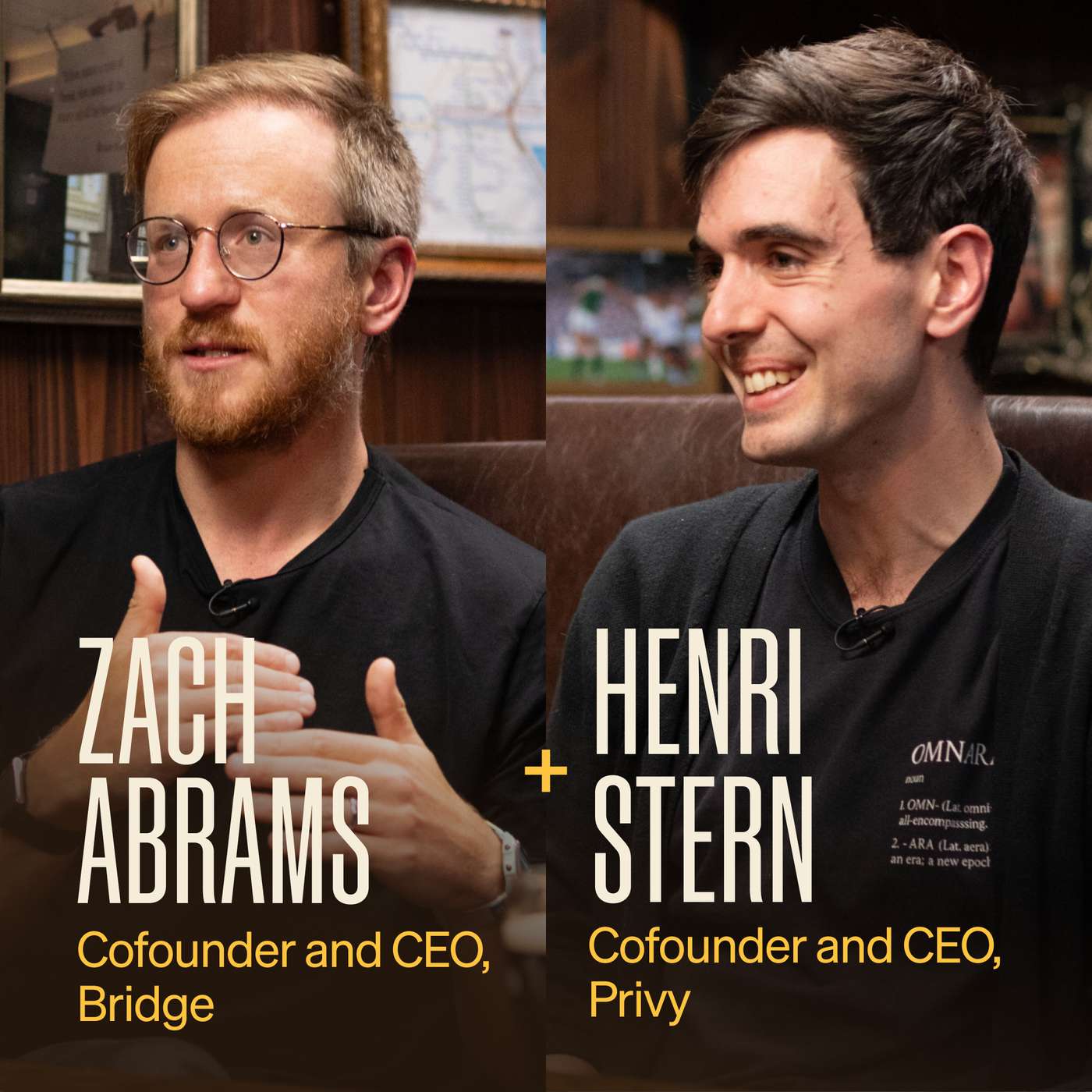
Zach Abrams 是领先的稳定币编排平台 Bridge 的创始人,Henry Stern 是领先的加密钱包基础设施 Privy 的创始人。
Zach Abrams, founder of Bridge, the leading stablecoin orchestration platform, and Henry Stern, who founded Privy, the leading crypto wallet infrastructure.
这两家公司最近都被 Stripe 收购,并正深度参与帮助加密公司和传统企业构建基于稳定币的应用。
Both these companies recently joined Stripe via acquisitions, and they're in the thick of helping both crypto companies and regular companies build with stablecoins.
干杯。
Cheers.
嗯。
Yeah.
在这儿。
Here it is.
好的。
Okay.
关于 Bridge 和 Privy,有很多话题可聊。
Lots to talk about with, both Bridge and Privy.
我意识到,当你刚开始做Bridge的时候,是2023年。
I realized with Bridge, when you started this, it was 2023.
那时候是不是加密货币最低迷的时刻?
Was that like at the very nadir of the doom loop
对于加密货币而言?
for crypto?
我们其实是在那之前就开始了。
We started right before then.
所以我们是在事情变得有趣的时候开始的,这可能让情况更糟。
So we started right when it was interesting, which maybe made it worse.
这没关系。
Which is fine.
是的。
Yeah.
你根本不知道接下来会这么糟糕。
You did not know it was going be horrible.
不是2023年我们才推出API的。
Was It wasn't 2023 is when we launched our APIs.
2022年我和肖恩创立了公司并筹集了资金。
2022 is when we start Sean and I started the company and raised money.
我们刚融完资,Terra Luna就崩盘了。
Then immediately after we raised money, Terra Luna happened.
随后整个领域被彻底摧毁,接着FTX又崩了,再次被扫荡。
And then the whole space was nuked, and then FTX happened, it was nuked again.
好吧,让我回忆一下当时的情况。
Okay, so remind me of the vibes here.
2022年那时候,还没到FTX爆雷吧?
Like, twenty twenty two was still Like, that was pre FTX blow up?
在FTX爆雷之前,一切进展得非常顺利。
Pre FTX, the things were going really well.
那是在乌克兰战争爆发之前,整个经济格局开始发生变化的时候。
It was before, like, when the Ukraine war happened, the whole sort of economy started to shift.
在那之前,风险投资资金非常充裕。
And it was before that, VC funding was really high.
但到了六月,资金就消失了。
And then by June, it was gone.
整个领域几乎都蒸发了,尤其是在加密领域。
Everywhere was Everything had Most of the space had evaporated, but especially in the crypto space.
当时,以加密货币的年份来衡量,我们公司创立时的第一个想法是用你的银行账户购买NFT。
And at the time to mark this in crypto years, when we started the company, the first idea we had was using your bank account to acquire NFTs.
所以,这是公司碳定年法中的NFT阶段。
So, it was the NFT phase of the carbon dating of the company.
而当时几乎所有交易量都来自NFT发行。
And that's where almost all the volume was, was NFT drops.
另一件事是
The other thing
我想说的是,关于Bridges的开端,我们曾在Privy举办过一次全员会议,形式是午餐学习会,我们的同事Max之前曾与Zach共事过。
I was gonna say just about Bridges Beginnings is we had an early all hands at Privy where it was a lunch and learn, and one of our teammates, Max, worked with Zach prior.
所以扎克来向Privy推销Bridge。
And so Zach came to pitch Bridge to Privy.
他说,我们要做
He like, we're gonna work
Sable Quins。
on Sable Quins.
我们当时想,这家伙在说什么?
We were like, what is this guy talking about?
在我们这边,当NFT市场爆发时,我们的初始产品就消失了。
Well, on our side, when the NFT market blew up, our initial product went away.
我们当时正在四处摸索,试图弄清楚我们想做什么。
And we were sort of pivoting around to try to figure out what we wanted to do.
我们最早的想法之一是做钱包即服务,这显然是你们的业务。
One of our first ideas was to build wallets as a service, which is obviously your business.
当时,我不认为你们可能存在,至少完全不在我们的关注范围内。
At the time, I don't think that you Maybe you existed, but at least it wasn't weren't on our radar at all.
我记得观察这个领域时心想:不,这是个泥潭。
And I remember looking at the space and being like, Nope, that's a tar pit.
那里没什么是我们能做的。
There's nothing for us to build there.
竞争太激烈了。
It's so deeply competitive.
然后我们很快转向了稳定币的方向。
And then we quickly moved on and went our way to stablecoin.
所以,回过头来看,我经历了完全相同的过程,看到了同样的想法、同样的机会,心想:对,就是这个了。
So, for me, looking back, went through the exact same thing, saw that same idea, saw that same opportunity and was like, Yes, this the thing.
当然,你们在那里打造了非常出色的产品。
Obviously, built something really good there.
那么,今天你会如何向别人描述 PLOS BridgeDough 呢?
And so, how do you describe PLOS BridgeDough today to people?
让开发者能够使用稳定币进行开发,他们想构建什么都可以。
Enable developers to build with stablecoins and it could be anything they want to build.
我们帮助像 SpaceX 这样的公司使用稳定币进行资金转移
So, we help folks like SpaceX use Stablecoins to move money
跨境。
cross border.
我们帮助
We help
帮助像 Dollar App 这样的公司基于稳定币构建新型银行。
folks like Dollar App build neo banks on top of Stablecoins.
我们帮助像 Felix Pago 这样的公司利用稳定币构建跨境支付体验。
We help folks like Felix Pago build cross border payments experiences with Stablecoins.
我们帮助财务人员用稳定币重新调配内部资金。
We help treasurers rebalance their internal funds with stablecoins.
稳定币是一种广泛的支付平台,基于它可以构建多种新的支付体验,我们构建了API来让人们使用它。
Stablecoins are sort of this broad payment platform on top of which a bunch of new payment experiences can be built, and we build APIs to let people use it.
我想回头再聊聊这些用例,但也许先跟上进度。
I want to come back to all those use cases, but maybe first to catch up.
那Privy呢?
So how about Privy?
在加密货币的热潮、崩盘再到重新热潮的周期中,你们是什么时候创立Privy的?
Where in the crypto hype and then bust and then re hype cycle did you guys start Privy?
热潮顶峰时期。
Peak hype.
我之前就从事过加密货币领域的工作,我认为从那段经历中,我意识到这个领域非常了不起。
I'd worked in crypto prior, and I think I came out of that experience thinking this space is incredible.
我们拥有了前所未有的方式,可以在网络上编码所有权,但没人关心构建人们真正想用的产品。
We have these rails that can be used to codify ownership on the web in a way that hasn't been possible before, but also no one cares about building products that people actually want to use.
你需要真实的客户使用场景。
You need the actual and customer use cases.
于是我离开了,而峰值加密热潮又把我拉了回来,因为我当时想投身于数据代币化,这最初是我们的想法。
So I left, and think Peak Crypto brought me back, which is I was like, I want to work on data tokenization, which was the initial idea.
所以我们最初的版本是:我们能否构建一种数据代币化方案,帮助加密公司对用户进行私密的KYC验证?
So our first version of it was, can we build data tokenization that would enable crypto companies to privately KYC people?
这是2021年很典型的想法——你需要通过KYC才能访问那些私密的流动性池。
Which is a very 2021 idea of these private pools of liquidity that you need to be KYCed for.
天啊,这让我们转向了Wallace项目,因为发现人们根本没有能力实际签署操作,而且大多数用户根本不想拥有钱包。
My gosh, That I led us to Wallace, which was, this is really hard because people don't have the means of actually signing for things, and most users don't want to get a wallet.
所以我们觉得,应该先解决这个问题,然后再回头做数据代币化。
And so we're like, should solve that problem first, and then we can come back to it.
这就是我们如何走向Privy的。
And that's how we got to Privy.
那么,你们如何向别人描述Privy如今的运作方式呢?
And so how do you describe to people how Privy does today?
我们主要构建数字资产账户。
We build basically digital asset accounts.
钱包是控制加密货币、稳定币和任何数字资产的手段。
Wallets are the means of controlling crypto, stablecoins, any digital asset.
因此,我们开发了API,让开发者可以直接在他们的应用中构建数字资产账户。
And so we build APIs so developers can build basically digital asset accounts directly into their app.
而不是要求用户离开应用去获取账户,你可以将其作为你的NeoBank支付平台或消费者应用的一部分,这正是我们服务的用户群体。
Rather than requiring a user to go outside the app to get an account, you can get it as part of your NeoBank payments platform consumer app, and those are the people that we serve.
但本质上,我们为你提供了在应用内控制资产的手段。
But basically, we give you the means of controlling assets in app.
是的。
Yes.
有趣的是,根本没人打算被稳定币颠覆,对吧?
So, is it basically no one plans to be disrupted by stablecoins, funnily enough?
所以,如果你是一个汇款应用,或者是一家新兴银行,或者你是其中任何一种公司,你都希望原生地将数字资产功能集成到你的应用中,而你们为这些公司提供了实现这一目标的WAZ基础设施。
And so, if you're a remittance app, if you're a neobank, if you're any of these guys, you want to natively build digital asset functionality into your app, and you guys provide the WAZ infrastructure for them to do that.
没错。
Exactly.
我认为目标是说明:你不需要拥有博士学位,也不需要对自我主权有深入了解,才能参与这个领域。
And I think the goal is to say, like, you shouldn't need a PhD or deep interest in, you know, self sovereignty in order to want to engage in this space.
你应该能够像在网页上做其他任何事情一样轻松地完成它。
You should be able to do it as easily as you do anything else on the web.
是的。
Yes.
我们让这一切成为可能。
And we make that possible.
当我与那些不从事稳定币业务的商业人士交谈时,尤其是那些在金融科技领域但不涉及稳定币的人,他们说:我确实听到了很多关于稳定币的消息,但似乎它们还没有真正落地。
When I talk to business people who are not in Stablecoins, and especially maybe, say, people who are in fintech but not in Stablecoins, they say, I'm sure hearing a lot of about Stablecoins, but it doesn't seem like they're actually happening yet in a real way.
显然,Stripe Bridge和Privy的观点,基于我们从客户使用数据中看到的一切,是:不,它们正在发生。
And obviously, the Stripe Bridge Privy Houseview informed by all the data we're seeing in our customer usage is like, no, they're happening.
比如,对你来说可能还没大规模发生,但在行业层面已经在发生了。
Like, they're maybe not happening for you yet in a big way, but they're happening at an industry level.
但我觉得人们很难想象,因为他们会说:‘我并没有用稳定币在酒吧付款啊。’
But I think people have a hard time visualizing because they say, well, I don't, you know, pay at the bar using Stablecoins.
我只是自己没在用,他们说,所以我根本看不到它的存在。
It's just I I I am myself not paying, they say, therefore, I just don't see it.
也许你们能给大家澄清一下,到底什么才是真正正在运行的,因为美国的消费者零售支付并不是稳定币创新的热点。
Maybe you guys can level set for people what's actually working because, like, consumer retail payments in The US are not, you know, the hotbed of stablecoin innovation.
那么,稳定币现在到底在哪里发挥作用呢?
Just where is the stablecoin stuff happening today?
第一个应用场景主要是跨境支付。
The first use case was predominantly cross border payments.
而且
And
当时是把钱汇入,我们的第一个开发者是一个叫Zulu的团队,他们是一家位于哥伦比亚的公司。
it was taking money in You know, our first developer was this team called Zulu, and they were a company based in Colombia.
他们把哥伦比亚比索兑换成稳定币,通过桥接API发送这些稳定币,再转换成美元。
And they were taking Colombian pesos, converting them into stablecoins, sending those stablecoins through the bridge APIs, converting them into dollars.
所以,你通过稳定币从哥伦比亚比索兑换成美元。
So, you go from Colombian pesos to US Dollars via stablecoins.
由于多种原因,这种方式更便宜、更快。
And for a bunch of reasons, it was cheaper and faster.
他们向我们展示了跨境支付的机遇,因为在他们之前,我根本不知道稳定币在跨境支付中会有用。
And they showed us the cross border payment opportunity because before them, I actually had no idea that stablecoins would be useful for cross border payments.
从那以后,我们看到像Dollar App这样的新兴银行基于我们的平台取得了巨大成功。
And then since then, we've seen like neo banks, like Dollar App, and so on become very, very successful building on top of us.
有一些基于稳定币的全球美元应用,可以在整个拉美地区使用。
There are global US dollar app built on stablecoins that can be used all across LATAM.
好的。
Okay.
所以是跨境支付。
So cross border payments.
是的。
Yeah.
新兴市场人们的美元余额和美元资产。
Dollar balances, dollar holdings for people in emerging markets.
还有别的吗?
Anything else?
之后,我们看到了SpaceX来找我们。
After that, we've seen So, SpaceX came to us.
他们在全球范围内销售Starlink。
They're selling Starlink all over the world.
因此,人们在数十个不同国家用他们的卡片支付Starlink费用,他们因此收到了当地货币。
And so, as a result, they're collecting local So, people are paying for Starlink in, know, many dozens of different countries with their cards.
所以,他们在这些国家收到了当地货币,需要将这些资金汇回美国,因为他们的业务资金来自美国。
So, they're getting local currencies in all these countries and they need to repatriate all those funds to The US because they fund their business out of The US.
于是,他们开始使用我们的服务将货币汇回美国。
And so, they started using us to bring currencies back to The US.
因此,他们会从非洲和拉美多个不同国家提取资金,并通过稳定币将资金汇往美国。
And so, they would take money out of a bunch of different countries in Africa and LatAm and send it to The US via stablecoins.
他们是如何将卢旺达本地货币、玻利瓦尔或其他货币最初兑换成美元的呢?
How do they do the initial conversion from, you know, Rwandan local currency or, you know, Bolivars or what have you to So, US
我们为他们提供这项服务,但我们的做法是:如今在几乎所有这些市场中,稳定币(如USDC或USDT)与本地货币之间都已形成了非常成熟的外汇市场。
we do that for them, but the way that we do that is that in almost all these markets now, there are very robust FX markets effectively that exist between, you know, a stable coin like USDC or USDT and the local currency.
这就像在每一个加密周期的最后阶段,越来越多的基础设施被建立起来,推动了这一进程。在上一个加密周期中,发生的大事是,所有这些本地交易所开始兴起。
And this was like the last, you know, with each one of these crypto cycles, like more of the infrastructure gets built that enables the And next in the last crypto cycle, the big thing that happened was that all these local exchanges started.
于是,拉美、非洲、中东、菲律宾等地的本地交易所纷纷开始规模化发展。
So, you had local exchanges in Latam, in Africa, The Middle East, The Philippines all begin to get scale.
这些交易所的交易量主要由稳定币主导,实际上已经演变为替代性的外汇市场。
And those exchanges are dominated by stablecoin volume and they've effectively just become alternative FX markets.
目前还存在哪些缺口?
What's the remaining gap like?
在营销宣传与现实可行性之间,最大的差距是什么?
Is there the biggest gap between marketing and reality of this is doable today?
我认为我们在市场上看到的最重要的一点是,这些外汇市场——比如墨西哥比索与USDC或墨西哥比索与美元之间的兑换——某些法币市场深度惊人且效率极高。
I would say that the biggest thing that we see in the market is that these FX markets, so, you know, converting between Mexican peso and USDC or Mexican peso and dollar, some of these fiat markets are phenomenally deep and phenomenally efficient.
因此,有人可以向墨西哥汇入一亿美元并将其兑换成比索,而不会影响市场价格。
So, someone could send $100,000,000 to Mexico and convert it into pesos without moving the market.
但稳定币市场的深度还不够。
But the stablecoin market is not as deep.
所以,它极其高效。
So, it's hyper efficient.
其中有趣的动态是,在法币外汇市场中,当你交易规模变大时,你的报价会下降。
The interesting dynamic at play is that in the fiat FX markets, as you get bigger, your pricing comes down.
而在加密货币市场中,当你交易规模变大时,你的报价反而会上涨,因为买卖价差会扩大。
In the crypto markets, as you get bigger, your pricing goes up because the spreads widen.
因此,对初创公司而言,这个市场要高效得多。
So, the market is way more efficient for startups.
随着时间的推移,市场变得越来越深,这些初创公司也在不断扩张。
Over time, the markets get deeper and deeper, and so those startups are scaling and scaling and scaling.
我们看到像费利克斯·塔戈等人就是这样。
We see that with, like, Felix Tago and others.
我认为你所强调的外汇动态在加密领域被低估了,加密作为一个平台,实际上是一个让所有人汇聚在一起创造更好事物的焦点。
I think what you're highlighting with the FX dynamic is underappreciated in crypto being a platform on which, you know, it's like a shelling point for everyone to come together to create better things.
因此,我们现在有了比以往更高效的方式将玻利瓦尔兑换成美元。
And so we now have just more efficient ways to convert Bolivar's to US dollars than we had before.
这种特定的滞后本身并不是加密原生的,但加密在将所有人聚集在一起方面起到了关键支撑作用。
It's not particularly crypto native, that particular lag, but crypto is load bearing in bringing everyone together.
这正是我们在我们的市场中看到的情况,我的类比是稳定币。
That's kind of what we see, I think, in our market, which is to say, like, you know, what my analogy is is stablecoins.
这是一个非常自我服务的软件对硬件的类比,但稳定币就像是货币领域的星链,你需要地面站将管道从同轴或光纤发射到视线范围内的零重力太空。
It's a very self serving software to hardware analogy, but, like, stablecoins are like Starlink for, you know, money where you need the ground stations to actually beam the pipes up from coax or fiber onto line of sight, like zero gravity like space.
但地面上的地面站必须被建立起来。
But the ground stations on the ground have to be built.
至少在我们所服务的市场中,你们已经完成了法币兑换加密货币这一最困难的工作之后,我们才介入。
And at least where we take care of the market is mostly after you guys have done the really hard work of converting fiat to crypto.
那么,问题来了:你实际上能用加密货币做什么?
Then the question is what can you actually do with the crypto?
而正是在这里,显然,钱包等工具成为人们来找我们的原因。
And that's where, obviously, wallets and those are the powers that people will come to us for.
这个比喻可能比你想象的要深刻得多,因为你知道吗,在Starlink网络中,他们最初部署了更多的地面站,但随着时间推移,他们正在增强卫星之间的互联,以减少对地面站的依赖?
That analogy may be deeper than you think because do you know in the Starlink network where they started with more ground stations and then over time they're enabling more satellite to satellite connectivity to reduce the need for ground stations?
所以,这可能是一个非常深刻的比喻。
And so it could be a pretty deep analogy.
好,亨利,我问你同样的问题:人们到底用稳定币做什么?
Okay, same question to you, Henry, where just what are people actually using stablecoins for?
对我们来说,很多情况是,一旦钱包作为账户系统成为控制平面,当你拥有稳定币后,你能用它做什么?我认为,人们使用我们的主要用途之一,就是持有。
For us, it's so a lot of it is basically once wallets as the account system are kind of like the control plane, once you have the stablecoin, what can you do with And so I think the majority of what people use us for is one, specifically the holding.
我想持有这些资产,并让这些资产发挥作用。
Want to hold these assets and I want to put these assets to work.
这为以前无法获得信贷市场和收益的人打开了机会。
So it's opening up credit markets and yield generally for people who otherwise didn't have access before.
USDT 的一个令人震惊之处在于,它就像一个零到一百的对冲基金。
And one of the things that's shocking about USDT is USDT is like a zero one hundred hedge fund.
它们为你保留了全部收益,这说明了全球人们对稳定货币的强烈需求。
They keep all of the carry for you, which speaks to how much people want stable currency across the world.
许多早期公司现在拥有了完整的基础设施,可以构建出全球数字银行(如Revolut、Chime)花费数十年才建成的系统,而它们只需一年就能完成,因为这里的一切都已经准备就绪。
A lot of early stage companies that now have the actual stack to build everything that has taken the neobanks of the world, the Revoluts, the Clarinas, decades to build and they can do in a year because everything's ready for them here.
因此,这两类使用场景是:我想构建完全全球化的银行账户,让任何能够获得加密货币的消费者都能使用。
So, those are the sort of two types of use cases, which is I want to build like bank accounts that are fully global, that work for any consumer once they can get their hands on crypto.
然后我想确保这些资产通过传统市场或投资其他资产得到有效利用。
And then I want to make sure that these assets are put to work either through traditional markets or by actually investing in other assets.
是的。
Yeah.
我的意思是,我最乐观的一点是,以前如果你想要进入多个不同国家,你必须单独构建你的美国基础设施、欧洲基础设施和墨西哥基础设施。
That's what, I mean, one of the things I'm most optimistic about is you have like the financial world before, if you wanted to expand into a bunch of different countries, you had to uniquely build your US infrastructure, uniquely build your European infrastructure, uniquely build your Mexican infrastructure.
下一个公司出现时,也得重复同样的过程,你知道吗?
And the next company that came around had to do the same thing, you know?
再下一个公司出现时,也得做同样的事情。
And then the next company around had to come and do the same thing.
而现在可能的是,你有一个钱包,只需要一个人构建一个美元稳定币,然后把它放入钱包,你就拥有了美元余额。
And, you know, now what's possible is you have a wallet and one person just needs to build a US dollar stablecoin, and then you throw it into the wallet and now you have a US balance.
然后世界上其他地方的人需要构建一个奈拉稳定币,现在你就拥有了奈拉。
And then someone else in the world needs to build a naira stablecoin, and now you have naira.
世界上其他地方的人,构建日元稳定币。
Someone else in the world, JP JPY stablecoin.
以前是 n 的平方,现在只需要 n。
Now you have Previously, was n squared and now it's just n.
嗯。
Yeah.
是的,没错。
Yeah, exactly.
你相当于把你的金融基础设施开源了。
You kind of open source your financial stack.
而且,你知道,这还处于非常早期的阶段。
And, you know, it's like very early days in this.
而要实现这一点,我们需要本地稳定币。
And to get here, we need local stablecoins.
目前,稳定币主要由美元主导。
And right now, stablecoins are dominated by US dollars.
但如果你把金融基础设施开源,那些基于此构建的公司虽然现在落后了,但本质上是在赌:全球所有开发者的累积力量将在未来几年内创造出更好的应用。
But you open source your financial stack, and the companies who are building on top of this are behind today, but basically making a bet that the cumulative power of all the builders in the world is going create a better application over n years.
为什么本地稳定币的发展这么慢?
Why have the local stablecoins been so slow?
因为你知道,美元在全球货币余额中的占比其实并不大,但美元却占了稳定币余额的95%以上。
Because like, you know, US dollars are not that big a share of global currency balances, but the, you know, US dollars are 95 plus percent of stablecoin balances.
那欧元、加元和瑞士法郎的情况又如何呢?
What's going on with the euros and the Canadian dollars and the Swiss francs and
我的观点是,这反映了人们的实际偏好。
My theory is that this is like revealed preference.
美元在实物货币中的占比其实并不高。
US dollars are not that big a share for Exactly.
而真正的偏好是,如果你去一些国家——我能想到很多这样的地方——手里有一张崭新的100美元钞票,它的价值远超任何其他货币。
Physical Whereas the true preference, if you go to a country that, you know, I can think of many, you and have a crisp $100 bill that's worth a lot more than like any other currency.
我曾去过一些地方,手里既有欧元也有美元,但人们会说:‘不,先给我美元。’
I've traveled to places where I have euros and dollars, and people are like, No, give me the dollars first.
我相信在新兴市场背景下,如果你在土耳其,可以在土耳其里拉和美元之间选择,这根本就不是个问题。
I believe you in the emerging market context where clearly if you're in Turkey and you can hold Turkish lira or US dollars, that's not even really a contest.
作为一个欧洲人,我并不太介意持有欧元。
I don't as a European, I'm not that unhappy holding euros.
我对这个问题并不太担心。
I'm not that concerned about it.
因此,欧元稳定币、瑞士法郎稳定币以及其他主要市场的稳定币应该大得多。
And so euro stablecoins, Swiss franc stablecoins, just other major market stablecoins should be a lot bigger.
这就是我说的,我不知道。
And this is where I mean, I don't know.
对我来说,有两个二元对立:一个是美国 vs 全球,另一个是B2B vs B2C。
The the two dichotomies to me is like US versus global, and then it's like B to B versus B to C.
我认为如今稳定币市场的大部分是B2B。
I think the majority of the stable core market today is B to B.
这种情况会改变,但现实是,在B2C领域,它主要发生在新兴市场,因此更偏好美元。
And that'll change, but like the reality is basically, it where it is B to C, it's emerging markets, hence the US dollar preference.
在B2B领域,它是美国公司,因此也偏好美元。
Where it's B to B, it's American companies, hence the US dollar preference.
嗯。
Mhmm.
据说,随着时间推移,这种情况会趋于平衡,但至少目前来看,美元确实存在明显的偏好。
Supposedly, So it'll even out over time, but at least for now, it seems to be a real preference that like dollars are
我认为这可能是真的。
I think that's probably true.
我认为,多年来稳定币的两大主要用途,或者说最主要用途,是交易。
I think that the majority of the two main use cases for stablecoins for or the main use case for stablecoins for many years was trading.
在这个市场中,所有资产都以美元计价,并且形成了强大的网络效应。
And in that market, everything is just quoted in dollars, and there's a real network effect.
因此,随着越来越多的流动性集中在少数几种美元稳定币上,这也就顺理成章了。
So, you know, as more and more liquidity was built around a few dollars, that makes sense.
我认为,随着时间推移,你会看到更多这类稳定币出现。
I think over time, you will see more of these stablecoins.
但最终,这些相同的网络效应将会持续发挥作用。
But ultimately, those same network effects are going to, you know, I think perpetuate.
我认为,尽管法币美元在全球市场中只占X%,但稳定币形式的美元将永远占据远高于此的份额。
I think you're going to see while like, you know, fiat US Dollars are X percent of the global market, stablecoin US dollars are going to be, you know, way more forever.
但我确实希望本地稳定币能占到市场15%到20%,因为这些市场在交易中需要它们,你希望拥有替代的外汇市场,并让人们能够以本地货币存储价值。
But I do think we I hope we get to local stablecoins being 15%, 20% of the market because you need them transactionally in all these markets and you want to have alternative FX markets and you want people to be able to store in local currencies.
我认为这将带来更好的体验。
I think that's going to create much better experiences.
但我们还远未达到这一点。
But we're not there yet.
关于这一点,从历史来看,Tether最初是作为交易的存款资产出现的。
And then to your point, just about the history of this, Tether got started as a deposit asset for trading.
人们不想频繁地兑换回美元。
Didn't want to basically have to trade out back to dollars.
你不想隔夜持有头寸。
You didn't want to hold your position overnight.
而且他们无法获得美元。
And they couldn't get dollars.
没错。
Exactly.
但我认为这就像一种24/7的货币。
But I think like it's a 20 fourseven currency.
你不需要等才能转移。
You don't have to like wait to move.
我认为,如果你今天在从事一个广泛涉及资金处理的业务,但我的资金运作良好,你为什么要在意呢?
I think why should you care if you're working on a business today that broadly handles money but it's like, my money works fine.
是的。
Yes.
是的。
Yes.
我认为,对于消费者来说,拥有一个全天候的资金通道,用户体验会好得多。
I think the UX is going be much better for consumers to actually have an always on money rail.
除此之外,还有一个现实是,你可以与用户建立更持久的关系。
Beyond that, there's a reality which is you get to have a relationship with your user that's much longer lasting.
表面上,优步已经这样做了,优步司机可以通过这种方式获得汽车融资;但现在任何公司都可以这样做,不再只是支付后关系就结束,因为银行现在拥有了用户,而是可以通过它们提供的账户持续与用户保持关系。
Ostensibly, Uber has done this where Uber drivers get financing for their cars via But now any company can really do this, where instead of paying out and then the relationship ends because the bank now owns the user, They can maintain a relationship with the user via these accounts that they enable.
每个公司表面上都可以构建一个新兴银行功能,将其融入其中,从而为其用户群体创造更紧密的收益闭环。
Every company ostensibly has a neo banking arm that they can build into this to create a much tighter loop of benefits to their constituency.
但这里的长期均衡点在哪里呢?
But what's the long term equilibrium here?
因为 presumably 消费者并不希望自己的资金分散在他们所使用的15个不同服务中,或者他们真的希望如此吗?
Because presumably consumers don't want their money spread out across 15 different services they interact with, or do they?
我的意思是,根据我在Reddit子论坛上看到的,购物卡用户可能会说,他们确实希望如此。
Mean, card shopping, as I see it on Reddit sub threads, would say that maybe they do.
但我认为这正是关键所在,也是Privy在嵌入式钱包方面经常被批评的地方:过去,钱包是属于用户的,你会带着它在各个应用之间流转,所有资金都集中在一个单一的入口点。
But I think this is the entire point and where at least Privy gets dinged a lot with embedded wallets is it used to be the wallet was the users and you would carry it with yourself from like app to app to app, and you had a single point where you held everything.
这对于集中控制这些功能来说非常好。
And that's great for centralization of these controls.
但这对用户体验来说非常糟糕,因为这意味着你在每个访问的网站上都要运行第三方软件。
It's really bad for UX because it means you're running third party software on every site you go to.
我们实现了这一模式的反转,应用程序可以将自托管钱包作为应用体验的一部分提供,但这造成了碎片化。
We've enabled an inversion of that whereby the app can serve their own self custodial wallets as part of the app experience, but it creates this fragmentation.
至少对我来说,这正是构建这些资金网络的真正机遇:如果你能帮助用户理解这种碎片化,即使你的资产分散在15个不同的应用中,你手机上的每个应用都像一家银行。
And at least to me, this is the real opportunity for building these money networks where if you can help users make sense of that fragmentation, where even though you have your assets in 15 different apps, each app on your phone is a bank.
你可以有一个控制面板来管理这些资产。
You have some control plane where you can manage those assets
如果这些功能是可编程的,那么这种碎片化就没那么严重了。
between It's all of not that fragmented if it's programmable.
这就是希望所在。
That's the hope.
没错。
Yeah.
我认为这个问题将主要由监管要求决定。
I think that this question is overwhelmingly going to be dictated by regulatory requirements.
我认为在自由市场中,我们最终会趋向于90%都是美元。
I think in a free market, then we would resolve to 90% US dollars or something.
Mica是好是坏,还是无所谓?
Is mica good, bad, fine?
我觉得它似乎还不错,但也可能有坏处。
I would say it seems to be fine, but it could be bad.
我认为所有这些监管要求的问题在于,它们都还没有经过检验。
And I think the thing with all of these like regulatory requirements are that they're sort of like untested.
所以,目前的情况是,只有少数人在欧洲合规,并且他们正在放宽监管要求,以满足自己的特定需求。
And so, what's basically happening is there's like a few folks who are compliant in Europe, and they're stretching it to, you know, the regulatory requirements to meet their like specific needs.
随着时间推移,他们会收紧监管。
And then, over time, they're going to clamp down.
五年后,欧洲合规的标准可能会与今天大不相同。
And what it looks like to be compliant in Europe will probably be different, very different in five years versus today.
哦,有意思。
Oh, interesting.
所以,你的意思是,我们还没看到MICA的执法行动,而它将影响人们对MICA的看法?
So, you're saying we haven't seen MICA enforcement yet and that will inform people's views of MICA?
是的,正是如此。
Yes, exactly.
例如,USDC遵守要求的方式与本地欧洲发行方遵守要求的方式大不相同。
Like the way that USDC is complying with the requirements are very different than the way local European issuers are complying with the requirements.
对我们而言,有趣的差异在于,我们看到欧洲客户在MICA下尝试了更多事情,因为他们至少大致知道边界在哪里,
The interesting delta for us at least was we saw European customers trying a lot more things under Micah because at least they knew ostensibly where the
界限在哪里,
lines were,
而这一点在Genius之前并不成立。
which wasn't true before Genius.
现在我们在Genius上也看到了这种情况,人们愿意参与其中。
And now we're seeing that with Genius where people are willing to engage.
因此,我认为,与之前相比——那时既没有清晰度,也没有参与意愿——有总比没有好,
So I would argue that compared to what existed before, which was no clarity and no willingness to engage, something is better than It's
对
been very good for the
欧洲,完全如此。
European Totally.
是的。
Yeah.
你把泰达描述成一个零到一百的对冲基金。
You described Tether as a zero one hundred hedge fund.
我以前没听过这种说法。
Hadn't heard that before.
但它
But it
在我看来,支付0%的收益在稳定币领域并不是长期的均衡状态。
feels to me that paying out 0% of the yield is not the long term equilibrium when it comes to stablecoins.
那么泰达会怎样呢?
And so what happens to Tether?
所以一年前我去肯尼亚度假了。
So I went to Kenya on holiday a year ago.
哦,在新兴市场非常普遍。
Oh, It's very widespread in emerging markets
而且那里有一张海报,上面有一个加密货币应用,上面有两个标志。
And there there was a there was a a poster that had a crypto app on it and there were two logos on it.
一个是比特币,一个是泰达币。
It was Bitcoin, it was Tether.
所以我认为品牌在某种程度上是有意义的。
And so I do think brand matters in a sense.
我认为,如果你问某人,你是想要泰达币还是其他稳定币,他们会选泰达币。
I think like if you ask someone do you want, you know, Tether or alternate stable, They will pick Tether.
所以我认为,大部分情况下——虽然你对开放发行有更多看法——但将会实现广泛的互操作性,每个应用都可以有自己的稳定币,从而自行选择如何编程其稳定币。
And so I think for the most part, and you have more views on this open issuance, but, like, there will be broad interoperability and every app can have their own so that they can choose how to program their stablecoin.
但我怀疑,网络效应是否已经如此根深蒂固、如此强大,以至于它们可能不得不以某种方式改变收益管理机制,但它的地位已经太稳固,不可能被彻底颠覆。
But I wonder if, like, the network effects are already so entrenched and so powerful that maybe they're forced to change somehow the yield management works, but it's too far established for it to be a complete inversion.
是的。
Yeah.
我的意思是,我认为泰达币将会取得巨大成功。
I mean, I think Tether is going to be wildly successful.
我的意思是,它已经成功了。
I mean, it already has been.
它可以说是过去三十年里最成功的金融科技之一。
It's like arguably one of successful fintechs in the last like three decades or something.
但我认为未来还会继续有更多这样的产品。
But I think there will be and continue to be.
我认为他们的业务背后有着巨大的网络效应。
I think there is this like enormous network effect behind their business.
话虽如此,我认为很快,就在明年,任何想要获得无风险利率的消费者都将能够获得。
That being said, I think that pretty soon, like in the next year, any consumer who wants access to the risk free rate is going to have access to it.
我认为这将导致一些USDT被抽走,但我也认为这将推动市场大幅扩张。
And I think that is going to create a sucking sound from some USDT, but I also think that it's going to take the market and expand it materially.
是的。
Yes.
我希望发生的情况是,USDT增长,但它的市场份额不是占60%到70%,而是降到10%左右。
What I hope happens is that USDT grows, but instead of it's at like 6070% of the market, it becomes like 10% of the market.
另一个观点是,我们也要想想替代方案。
The alternative point is simply like, also let's figure out the alternative.
现实是,你可以持有泰达币,或者每年损失25%的净资产,但是
The reality is you can hold Tether or you can lose 25% of your net worth every year but
你确实,我同意它一直是个
you're I agree it's been a
真正的遗憾。
real shame.
我只是想知道,长期的竞争均衡状态会是什么样?
Just wondering what's the long term competitive equilibrium?
比如五年后,你觉得泰达币会支付收益吗?
Like, in five years, do you think Tether pays yield?
不会。
No.
真的吗?
Really?
不。
No.
我会站在同一边。
I would take the same side of that.
是的。
Yeah.
是的。
Yeah.
不。
No.
只是因为这是他们的观点,是的。
Just because that is their view Yeah.
他们的世界观。
Their worldview.
嗯。
Yeah.
嗯。
Yeah.
嗯。
Yeah.
我认为他们为了保持主导地位并不需要这样做。
I don't think they'd have to in order to stay dominant.
嗯。
Yeah.
Tether最成功的领域是交易,在那里不需要支付收益,而且网络效应非常显著。
The areas where Tether is most successful, is in trading, there's no need to pay yields back and the network effects there are really material.
话虽如此,我认为两年前交易用例占了100%的市场,今天占了80%,而若干年后可能会降到5%。
That being said, I think that the trading use case was like a 100% of the market two years ago, was 80% of the market today, and, you know, will be 5% of the market in some number of years.
我们正在讨论稳定币的国际采用。
We're talking about the international adoption of stablecoins.
我向人们解释的是,通常情况下,那些具有强大网络效应的产品首先在国际上被采用,然后才进入美国。
What I've been explaining to people is I feel like it's pretty common that you have very network effect y products that are adopted first internationally and then come into The US.
所以WhatsApp最初只在国际上使用,后来才被一些具有国际视野的美国人使用,比如他们有国际朋友,或者经常出国旅行等等。
And so WhatsApp used only be used internationally, And then it was used by Americans who were kind of cosmopolitan and had international friends, you know, or like, I travel abroad, you know, or whatever.
如果你在用微信,那是因为你认识中国的人。
It's like, you know, if you have WeChat, it's because you know people in China.
是的。
Yeah.
有一段时间,情况就是这样。
And so for a while, it was that.
现在它在美国变得更加主流了,我的意思是,虽然还没有被广泛使用,但已经相当普遍了。
And now it's more mainstream in The United States, and it's, you know I mean, it's not totally broadly used, but it's pretty commonly used.
在我看来,稳定币在美国的采用过程也是如此,你会开始看到一些网络效应在发挥作用。
That feels to me the story of how stablecoins get adopted in The United States, where you start to see some of these network effects being used.
是这样吗?还是会看到其他不同的采用方式?
Is that the case, or will we just see other ways they're adopted?
我认为我们正目睹一个完整的S型曲线,即采用情况的发生阶段。
I think we're really seeing a complete sigmoid in terms of, like, where the adoption's happening.
因此,你有一些绝对的巨头,比如应用和公司,它们大约有2万名用户,但这些用户通过交易和投资转移了数百万美元的资产,并在美国及其他地区大量使用稳定币。
So you have these absolute whales, like apps and companies that have, call it, 20,000 users, but the users are moving millions of dollars in assets through trading and investing, and using stablecoins heavily in The US and elsewhere.
而在另一端,你有批发端。
Then on the other side, you've got a wholesale.
企业交易者。
Businesses traders.
或者这个
Or the
好的。
Okay.
所以
So
你
you
有大量美国交易者在进行这一切
have very large US traders doing all this
没错,正是如此。
kind Exactly.
而在另一端,你则有更小的海外消费者,分布在更广泛的网络中。
And then on the other side, you've got much smaller consumers abroad in a much wider network that you're talking about.
但我认为你会看到,这将是一种双管齐下的策略,从两个方向同时渗透。
But I suspect you kind of see this, like, you know, it's going be a two pronged strategy where it comes in through both ends.
我认为这是对的。
I think that's true.
但我的意思是,我们现在确实看到了你所提到的这种动态正在发生。
But I mean, I think right now we see, you know, the dynamic that you're mentioning certainly playing out.
一个很好的例子就是像Poly Markets这样的全球市场,它们建立在稳定币之上。
Like a great example of this is like the poly markets of the world, like global markets built on top of stable coins.
现在它们正进入美国。
They're now coming into The US.
这些相同的市场将以稳定币为导向。
Those same markets are gonna be stable coin oriented.
因此,用户将能够从他们的银行账户存入资金,但所有资金最终都会转化为稳定币,因为你希望打造一个全球统一的市场。
And so, are gonna be able to deposit from their bank accounts, but it's all gonna land in stable coins because you want one global market.
我们在金融科技领域也看到了同样的情况,比如一些公司正在拓展国际市场。
And we're seeing the same thing with fintechs where, you know, you have folks who are expanding internationally.
最终,你只希望拥有一个美元余额。
Eventually, you just want one dollar balance.
不会想要多个不同的美元余额,我认为这绝对是实际情况。
Not going to want different, many different dollar balances, and think that's like definitely the case.
我认为,当我们展望今天新成立的初创公司时,即使你只是服务美国市场,选择基于稳定币构建也是合理的,因为这样成本更低,上市速度也快得多。
I think that as we look, you know, startups that are starting today, even if you were just serving The US market, it makes sense for you to build on stablecoins for, you know, it's cheaper, that's like much faster go to market.
但你也知道,最终你很可能希望拓展到国际市场,而稳定币正是实现这一目标的基础。
But you also know that eventually, probably will want to go international, and this is the foundation that enables you to do that.
每个人都希望具备前瞻性,没错。
Everyone wants to be future proof, and Yes.
Silvercoin 是实现这一点的唯一方式。
Silvercoin is the only way to do that.
是的。
Yes.
这很酷。
Well, it's cool.
作为欧洲人,至少作为一名法国人,我一直觉得法国初创公司很难发展,因为市场太小,欧洲各国差异太大。
As European, at least, you know, as a French person, like, always felt tough to see French startups because the market is too small and there's too many European differences.
在法国销售并不意味着你也能在西班牙或德国销售。
Selling it to France doesn't mean you can sell it to Spain or Germany.
而美国从未面临过这个问题,因为市场太大了。
And The US has never had that problem because the market is so big.
看到金融科技领域也正在全球范围内打破地域限制,这很令人振奋——如果你能从第一天起就打造一家全球性企业,机会要大得多。
And it's cool to see that at a FinTech level, is always landlocked playing out globally, where there's just a much bigger opportunity if you can build a global business from day one.
另一个令人惊叹的趋势是,全球金融科技生态系统一直非常集中。
The other amazing dynamic is that FinTech ecosystem just overall has been very concentrated globally.
展开剩余字幕(还有 480 条)
在美国,我们并没有意识到有这么多银行,更没有意识到其中有多少银行愿意支持各种疯狂的金融科技创意,又有多少银行提供了API、贷款产品、卡片产品等等。
Like in The US, we don't appreciate how many banks there are, and how many of them are willing to support, you know, all these different crazy fintech ideas, and how many of them have APIs, and, you know, lending products, or card products, or what have you.
但在一些国家,你进入一个国家,发现只有一家银行,而这家银行根本无意支持你开展业务,因此该市场的消费者在金融体验上看不到任何进步。
But in some countries, you go into a country, there's one bank, and that bank has like no interest in enabling And you to build a as a result, the consumers in that market see no advancement in their financial experiences.
因此,稳定币为世界上很大一部分地区提供了前所未有的机会。
And so, stablecoins represent like the first opportunity for like large slots of the world.
美国人并不了解其他国家银行体系有多么不同,因为美国的银行体系实在太优越了。
People in The US do not have a good mental model for how different the banking ecosystem in every other country is because The US is so sweet generous.
美国目前有大约5000家银行,或者 whatever 的数字。
It's like 5,000 banks or whatever the number is currently in The US.
而其他所有国家的银行市场通常只有三到八家银行。
Whereas every other banking market has between three and eight banks.
而且这些市场高度集中,总体上也非常稳定。
And it's very concentrated and generally pretty steady.
是的。
Yeah.
当我们与这些不同市场的众多创始人交谈时,有些人告诉我们,他们正在申请某个国家的银行牌照。
When we were like talking to a bunch of founders in all these different markets, some of them would tell us like, Oh, we're getting our bank license in, you know, whatever country.
在我心里,我只是觉得,这就像获得一个MTL之类的许可而已。
And like in my mind, I'm just like, Oh, that's like the equivalent of getting like an MTL or something like whatever.
你知道的?
You know?
但在他们看来,这可是件了不起的大事。
And in their mind, like, no, this is like a huge deal.
现在我对这一点有了更深的理解。
And now I have like a much deeper appreciation.
是的,是的,
Yeah, yeah,
谁会在美国打造出成功的数字银行?
Who will build the successful neobank in The US?
会是一个超级应用吗?
And was it gonna be a single super app?
它真的会变得碎片化吗?比如,因为这样会有更多玩家出现。
Is it actually gonna get fragmented as, like, you know, there'll be more of them because it's
好的。
Okay.
听起来你有一个明确的观点。
It sounds like you have a thesis here.
嗯,我认为实际上更可能像你所说的那样,这是在开源金融科技栈。
Well, think it's actually much more likely to your point about, like, this is open sourcing the, like, fintech stack.
现实是,你可以自由选择想要参与的层级。
Like the reality is you actually get to pick and choose the layers at which you want to play.
你可以向消费者提供信贷,或者提供余额服务。
You can offer credit to your consumers or you can offer like, you know, balances to your consumer.
你可以向消费者提供支付服务。
You can offer payments to your consumer.
但如果你不想,就不必把所有功能都捆绑在一起。
But you don't have to bundle all of them if you don't want to.
所以我认为我们会看到两件事。
So I think we'll see like two things.
我认为,如今最接近的案例可以说是Robinhood和Cash App,它们是我所看到的在美国运作的类似欧洲风格的数字银行。
We'll see, I would argue that today the closest things are I guess call it Robinhood and Cash App, are the closest things I see to a European style neobank working in The US.
我认为重心已经转移到了加密货币和稳定币所推动的领域。
I think gravity has shifted, to the sort of stuff that crypto is enabled and stablecoins have enabled.
我基本上在想,这会是单一平台,还是会成为更多平台架构中的一部分。
And I basically wonder if it's going to be singular platforms or if it's just going become a part of the fabric of many more platforms.
我认为这会发生,但如果你具体思考一下,以工资发放到哪个账户来衡量新银行的主导地位的话。
I think that will happen, but if you think concretely, if you measure new banking primacy as where does your paycheck get deposited?
比如在我的情况下,我为了上大学搬到美国,大一的时候开了一个美国银行账户,直到今天,我的Stripe工资仍然存入那个美国银行账户。
Like at least in my case, I moved to The US for college, and when I was there, freshman year in college, I set up a Bank of America account, and my Stripe paycheck to this day is deposited in that Bank of America account.
十年后,人们会把工资存入哪家银行?
Like, in ten years' time, who are people getting their paychecks deposited into?
我认为市场将会如此,我认为这些银行仍然会非常庞大。
I think that the market is going to I think that these banks are still going to be really big.
我也遇到过同样的情况。
They were Same thing happened to me.
我在校园里,有人送我一件免费的杜克大学T恤,条件是开通银行账户。
I was on campus and someone gave me a free Duke T shirt to sign up for a bank account.
我到现在还保留着那个银行账户,你知道的。
And I've still had that bank account, you know.
有点奇怪。
Something weird is there.
客户获取成本与生命周期价值的动态?
CAC to LTV dynamics?
那些T恤简直就是现金。
They're like those T shirts are cash money.
对他们来说,这就像风险投资式的回报。
It's like a venture type outcome for them.
就像
Like,
如果市场上竞争更加激烈,银行业还会像以前那样具有粘性吗?
is banking going to be as sticky as it was if you have a lot more competition in the market?
而这一点,合理地说,将会引发这种局面。
Which, sensibly, this will engender.
我认为将会发生的是,大多数金融体验都将基于区块链重建。
Well, what I think is going to happen, I think that most financial experiences are going to be rebuilt on blockchains.
我认为借贷将基于区块链重建。
I think lending is going to be rebuilt on blockchains.
我认为交易显然会如此,储蓄、消费也都会被重建。
I think obviously like trading is going to be, I think saving is going to be, spending is going to be.
我认为许多这些金融体验都将基于区块链重建,并且它们会相互叠加,使那些建立在加密钱包之上的新一代数字银行在多个维度上显著提升。
I think a lot of these financial experiences are going get rebuilt on blockchains, and they will all compound each other to make the next generation of neo banks that are building on top of crypto wallets materially better across a bunch of different dimensions.
因此,我认为市场将与今天相比出现相当明显的碎片化。
And as a result, I think there will be a pretty material fragmentation of the market versus where it is today.
而如今市场已经相对碎片化了。
And it's already relatively fragmented.
对我们Privy来说,SVB倒闭那天真是艰难的一天。
A very hard day for us at Privy was SVB.
压力很大。
Stressful.
那是我们刚上线的第一周。
Was the first week we launched.
天哪。
Oh my God.
那几天特别漫长,我们的投资方要求我们比之前更多地分散风险。
Yeah, it was a long few days and we were asked by our backers to diversify risk a little bit more than we had up till then.
那是我们唯一的银行账户。
It was our only bank account.
于是我们后来在三家不同的机构都开设了账户。
And so we've then built basically like, you know, accounts at like three different institutions.
至于加密货币自托管的宣传,过去常说:账户是你的,你选择通过哪个渠道使用它,也就是说,用户体验、附加服务等,都取决于你把账户装进的‘套筒’。
And at least the pitch for self custody in crypto used to say the account is yours, the skin that you choose to take it through, meaning the UX of the actual sort of rails, the add on services that you get, all of that will come through the sleeve that I guess you put the account in.
但账户是属于你的,可以反复迁移。
But the account is yours and can be ported over and over and over again.
我认为在未来十年,我感兴趣的一个重大问题是托管账户与自托管账户的比例是多少?
I think that's one of the big questions I'm interested in over the next decade, is what is the split of custodial versus self custodial accounts?
这是一个非常古老的类比,但很多人不知道摩根大通自己开发软件。
So this is like a very old time analogy, but many people don't realize that Chase builds their own software.
大型银行确实如此。
The big banks do.
但如果你在信用合作社或中型银行开户,它们绝对不自己开发用于记账和财务管理的银行软件。
But if you bank with a credit union or a mid sized bank, they absolutely do not build their own banking software for the ledgering and managing the accounting or anything like that.
像Fiserv、Jack Henry、First Data这样的公司存在。
And there's Fiserv, there's Jack Henry, there's First Data.
有几家这样的公司,它们构建了所谓的银行核心系统。
There's a few companies like this who build the bank cores, as they're known.
因此,银行实际上只是资产负债表、信贷策略和品牌等,而前端的所有软件都是由其他人提供的。
And so the banks are actually a balance sheet and a credit strategy and a brand and various things, but in front of all this software that is provided by someone else.
所以你的意思是,你的愿景是这种模式会更加普遍,你可以插入加密货币版的银行核心系统,这就像传统的金融基础设施一样。
And so are you saying that your vision is that there's much more of that where you can plug in the crypto equivalent of a bank core again, this is like a total trad fine algae.
但你可以将加密货币版的银行核心系统接入到数字银行中,或者像优步、Lyft这样的公司可能想为他们的司机构建这样的系统,诸如此类。
But you can plug in the crypto equivalent of a bank core into a neobank or, you know, maybe Uber and Lyft want to build this for their drivers, you know, or something like that.
这基本上就是你对未来发展的设想吗?
Is that basically your vision of where things go?
我认为,这在很多方面正是我们希望事物发展的方向,或者说是应该走向的方向。
That's, I think, the hope in many ways for where things should go or could go.
我认为,这仍然是一个开放性的问题。
I think, you know, it's very much an open question.
这正是我们认为自己有责任去努力确保的一个重要领域——让双方都能拥有公平的竞争环境和良好的机会。
It's a big part of where we feel as privy that we have a responsibility to try and make sure that it's kind of an even playing field and there are good opportunities on both sides of the aisle.
但没错,我认为这正是关键所在。
But, yeah, I think that's exactly the point.
我认为重点在于,账本已经是公开的,因为它在链上。
I think the point would be the ledger is already public because it's on chain.
账户本质上就是密码学。
The account is really like cryptography.
它就像私钥,人们应该能够随身携带。
It's like private keys that people should be able to take with them.
因此,作为消费者,你可以自行迁移银行核心系统。
And accordingly, you can move the banking core yourself as a consumer.
我认为,优步和 Lyft 的这个类比,如今已经是一个陈旧的加密货币类比了。
And I think the Uber and Lyft analogy is, at this point, a very tired crypto analogy.
我敢肯定你已经听过很多次了。
I'm sure you've heard it.
但旧的加密货币梦想是:如果优步让你根据所处的不同群体拥有不同的评分系统,会怎么样?
But the old crypto dream was, what if Uber basically enabled you to have a different rating system based on where you were in a different pool?
核心网络是共享的,但你实际使用的应用程序和交付机制,则可以更容易地在其上构建。
The core network is shared, but then the actual app and delivery mechanism through which you have is something that you can build on top of much, much more easily.
是的。
Yeah.
我用这个类比是不是太脱离现实了,显示出我有多不懂?
Was that a woefully out of touch analogy for me showing just how No.
我一直试图弄清楚,我们该如何解释自托管,因为唯一自托管的资产就是现金。
I've been trying to figure out how do we explain self custody in because the only self custodial asset is cash.
所以,实际上拥有更多心理模型是非常有帮助的
And so it's very helpful actually to have more mental models for
它。
it.
我认为人们在思考加密货币时犯的一个错误是,把加密货币当成一种颠覆性发明。
So one of the things mistakes I think people make thinking about crypto is they think of it as a discrease invention.
就像,你知道,有一天我们有了计算机,当然,有一天我们有了像UNIVAC这样的计算机。
Like, you know, one day we had computers, but, of course, one day we had, like, Univac.
然后我们有了Apple I,接着有了Macintosh,实际上计算机随着时间推移变得越来越好,甚至几乎变成了完全不同的东西。
And, you know, then we had the Apple One, and then we had the Macintosh, you know, and actually the computers got much better over time to the point of almost being different things.
我认为人们同样认为区块链是在某个时间点突然出现的,但其实我们早就在2013、2014年左右尝试过支付场景,那时只有原始的比特币,还没有闪电网络之类的东西。
And I think similarly people think of blockchains happening at one point in time, but like we tried for the payments use case, we tried raw Bitcoin, no Lightning or anything back in the day in like 2013, 2014.
我得说,那根本不是一个好的支付区块链。
That was not a good payments blockchain, I'll tell you that.
尽管比特币白皮书确实将支付作为核心用例,而不是比特币真正成功的许多其他方面。
Despite the fact that the Bitcoin white paper really talks about payments as the core use case rather than many things that have really worked for Bitcoin.
所以我很想知道,回顾过去五到十年的区块链进展,
And so I'm curious, as you look at the last five to ten years of blockchain advancements,
你们会如何描述它们呢?
just how would you guys describe them?
我们刚开始构建,
We started building,
你知道,
you know,
大约两三年前就开始在区块链上构建支付用例了。
payments use cases on top of blockchains like two, three years ago.
我们立刻就清楚地意识到,这些系统没有一个是为了这个用例而优化的。
And it became very clear to us immediately that none of these things were optimized for this use case.
这是一系列微小的决策,这些决策对于各自优化的不同用例可能有道理,但却让我们很难成功。
And it was like a bunch of micro decisions that probably made sense for different use cases that were being optimized for, but made it really hard for us to be successful.
举个例子,在某些区块链上,为了让一个地址能够接收USDC,你必须先向它充值并激活,这个过程可能需要花费30美分。
So, one example is that on some blockchains, in order to make the address, make it possible for that address to accept USDC, you have to fund it and prime it so that it is available to accept that USDC, and that might cost 30¢.
你不能把USDC发送到一个没有USDC的地址吗?
You can't send USDC to an address that doesn't have it?
是的。
Yeah.
那个地址有Gas费,但并没有被设置为可以接收USDC。
That have does gas and has not been basically programmed to accept USDC.
因为它
Because it
会卡在那里,
would be stuck there,
事实上。
in fact.
是的。
Yeah.
交易会被直接拒绝,钱也取不出来。
It would just The transaction would just get denied and you couldn't get it out.
所以,想象一下,你想用这个区块链同时创建数百万个钱包。
And so, imagine that you want to use this blockchain to create millions of wallets at the same time.
这会变得极其昂贵。
That becomes phenomenally expensive.
另一点是,大多数这些区块链在发送稳定币交易时,都需要另一种随机的代币,现在人们已经普遍习惯了这种做法。
The other thing is that the majority of these, you know, blockchains in order to send a stablecoin transaction, you need this other random token that, know, now it's kind of just like common that folks are comfortable with that.
或者,区块链的吞吐量要求或失败率对于支付场景来说相对较高。
Or just the throughput requirements on blockchains or the failure rates on blockchains are relatively high for payments use cases.
事实上,我们第一次进行援助支付发放时,是与美国政府合作,向拉丁美洲发放援助款项。
I mean, in fact, the first time we did an aid payment disbursement, we were working with the US government to disperse aid payments into LATAM.
我们当时发送了数万笔支付,这对我们来说已经很多了。
We were sending tens of thousands of payments, which was like a lot for us.
这对Stripe来说不算什么。
It's not that much for Stripe.
我们花了大约十八个小时才发送完所有这些交易。
Took us like eighteen hours to send all of those transactions.
瓶颈是什么?
And what was the bottleneck?
基本上,所有的交易都需要依次通过区块链并得到确认。
It was basically, all of the transactions need to be serially sent through the And confirmed through the blockchain.
结果就是,这些交易的失败率相对较高。
And what would end up happening is that there's a relatively high failure rate for these.
所以,有不少交易会失败。
So, a decent number would fail.
我们不得不把它们记录下来,然后重新发送。
We'd have to capture them, chronicle them, and then resend them.
这仅仅是因为它们没有被选中
And it's just because they're not picked
当你到达那个阶段时,手动设置交易的nonce,这比在区块链上工作还要糟糕。
up, No you worse fate working on a blockchain than having to manually set the nonce for the transaction when you get to that place.
知道吗,那真是段黑暗的时光。
Know, it's a dark, dark time.
是的。
Yeah.
因此,我们一次又一次地意识到,虽然已经有许多区块链是为交易用例构建的,也有为存储用例构建的,但专门为支付用例设计的区块链却很少,而这些支付链在成百上千个细微决策上的优化,才能真正带来显著提升的支付基础设施体验。
And so, just realized time and time again that there's been blockchains that have been built for trading use cases, and blockchains being built for storage use cases, but not many blockchains that were built for payments use cases, have their own, you know, hundreds of very small decisions that add up to a materially improved experience if you want to build payment infrastructure.
难道Solana的人不会说Solana解决了这个问题吗?
Wouldn't Solana people say Solana solves this?
它不是为可扩展性而设计的区块链吗?
Like, it's the blockchain built for scalability?
Solana在很多用例上都是很棒的区块链,但它在支付方面依然不够出色。
Solana is a great blockchain for a lot of use cases, it's still not great for payments.
是的。
Yeah.
也许这是一个非常极客的视角。
Maybe a geeky, very geeky take on this.
如果你回顾历史,早期的比特币就像是20世纪90年代末到21世纪初点对点计算的复兴,只不过这一次,我们为点对点网络加入了激励机制,而不再是像Tor或其他网络那样的志愿者网络。
If you go through the history, it's like very early Bitcoin is, I the reemergence of peer to peer computing from the late 90s, early aughts, where instead of these being volunteer networks like Torres or others, we've built incentivization into P2P.
因此,你有了通过这些网络在全球范围内激励资源协调的手段。
So you have a means of incentivizing resource coordination globally through these networks.
这是第一步。
So that's step one.
我认为以太坊的第二步是,我们从单一用途的链(比特币)转变为真正可编程的链。
I think step two with Ethereum is we've gone from a single purpose chain, Bitcoin, to now actually a programmable chain.
这类似于冯·诺依曼架构。
So this is akin to Von Neumann architecture.
你从固定程序转向了可以将程序与计算分离,并让计算机做任何事情。
You move from fixed programs to you can now store the programs separately from the compute and you can have the computer do anything.
因此,这些是图灵完备的,实际上是图灵完备的区块链。
And so these are like Turing complete they are actually Turing complete blockchains.
以这方面而言,以太坊就是全球计算机。
Ethereum is the world computer in that regard.
我认为我们现在所处的阶段是可扩展性。
I think the phase we're in now is scalability.
所以这就是二层网络、Solana,以及专业化。
So this is the L2, Solana, and also specialization.
我认为加密货币经常犯的一个错误是过于部落化的观点。
And I think a lot of what crypto gets wrong is a super tribal take.
流行的说法是我们想吸引接下来的十亿用户。
The meme is we want to bring on the next billion people.
但我认为很多人其实并不真心这么想,因为如果你真的吸引了接下来的十亿用户,你就不再是为这项技术而战的反叛者了。
But I think a lot of people don't mean it, because if you bring on the next billion people, then you are no longer the rebel fighting for this technology.
这项技术被接受了,这感觉非常艰难。
The technology gets accepted, which feels very hard.
但相反,真正该担心的是:我们其实知道如何构建可扩展的系统——直接用数据库就行了。
But I think conversely, the appropriate concern is we know how to build scalable systems, just use a database.
他们很棒。
They were great.
所以,如果我们把导致这些系统混乱不堪、并让我们能够扩展这项技术的关键要素都免费给予,同时去中心化,那么这一切到底是为了什么?
And so if we give away a lot of what has made these systems janky, what has been needed for us to scale this technology, and we decentralize, then what was all this for anyways?
我认为,这样说是有道理的:加密货币如果仅仅沦为监管套利的工具,那是因为我们已经剥离了让这些技术真正独特的东西。
And this is, I think, a sensible way to say, crypto becomes solely regulatory arbitrage, it'll have been because we'll have taken away a lot of things that make these real special.
所以,我认为围绕新链的防御心态源于三个方面。
So I think some of the defensiveness around new chains comes from three things.
这就像周围有太多诈骗链,人们就会想:哦,这又是一个新链, probably 是个骗局。
It's like too many scam chains around and people being like, well, this is a new chain, it's probably a scam.
与其添加第十五个标准或 XKCD 漫画,不如直接使用已经存在的那些。
And instead of adding the XKCD comic, instead of adding your fifteenth standard, just use one of the ones that's already here.
第二,我认为是出于一种恐惧:我为这个付出了那么多,现在这些新人却要把它从我手中夺走。
The second, I think, is a fear of, I've bled for this, and now these newcomers are going take it away from me.
我认为第三个非常理性的担忧是,人们意识到存在一些简单的技术路径可以解决区块链带来的低效问题,但这些路径是有代价的。
And I think the third really rational one is a concern that there are easy technical paths to solving some of the inefficiencies that blockchains introduce, but those come at a cost.
用户体验可以更好,但自我主权、去中心化等问题却被放弃了。
The UX can be better, but the questions of self sovereignty, decentralization and so on are given up.
但以我的看法,Tempo 只是另一种计算设备。
But at least the way I would see it is Tempo is another computing device.
有时手机是完成许多任务的绝佳形态。
Sometimes the mobile phone is a great form factor for doing a number of things.
有时电脑是。
Sometimes the computer is.
有时平板电脑偶尔是。
Sometimes rarely the iPad is.
但你需要不同的计算形态来完成这些事情。
But you need different computing forms to do these things.
我认为 Tempo 是为单一用途专门设计的链,并不意味着它适合所有事情。
And I think Tempo is a chain purpose built for like one use case and doesn't mean it'll be good for everything.
但反过来,也不意味着其他东西在支付这类事情上特别出色。
But conversely, it doesn't mean the other things are like particularly good for that either, payments being.
是的。
Yeah.
我觉得有趣的是,你看到这些现象——这并不是区块链特有的,但你会看到某些时刻,很多人不约而同地去构建同样的东西来解决同一个问题,因为这个问题变得如此紧迫,以至于世界都在想:‘这明显是需要有人来构建解决方案的。’
I think it's like interesting where you see these like, this isn't like a blockchain specific thing, but you see these pockets where there are moments in time where a bunch of people build the same thing to solve the same problem because the problem becomes so acute that like the world is like, Oh, this is obviously a thing that someone needs to build a solution around to do it.
如果你聚焦到区块链领域,我们已经看到这种情况发生了两次:几年前,每个人都忙着构建可扩展的区块链,比如Sui、Aptos和Solana,它们几乎在同一时期涌现,旨在解决以太坊和比特币的可扩展性问题。
And if you zoom into the blockchain where we've seen this now twice where a couple years ago, everyone was building scalable blockchains, you know, Sui and Aptos, and Solana, and all of these kind of came out right around like the same time period to solve the scalability problems of Ethereum and Bitcoin.
而现在,我们正经历同样的时刻:大家逐渐意识到,那些曾经表现优异的区块链,其实并不特别适合支付场景。
And then now, we're going through the same moment where everyone's realizing that those blockchains that were previously great were really good, but not great for payments use cases.
于是,Tempo和其他项目应运而生,专门解决支付场景的问题,而且它们似乎都在同一时间推出市场——这对区块链生态来说是好事,因为这些项目中,无论是一个还是多个,最终都会解决这些问题。
And we have Tempo and others coming out to solve the payments use case, and all of them seemingly coming out and going to market at the same time, which is a good thing for the blockchain ecosystem because, you know, one or many of these will solve these problems.
这正是我们在Privy与Stripe讨论并购时谈到的一部分内容:我们觉得在什么条件下,我们才能在这里取得成功?
And this was a part of the conversations that we had at Privy when talking to Stripe about M and A, which was like, what are conditions under which we think we can be successful here?
我认为其中一个条件是,必须能够与竞争对手合作。
And I think one of them was the need to be able to work with competitive endeavors.
Endeavor本身就是Stripe的竞争对手,当然,桥接方案也不例外。
Endeavor is competitive to Stripe itself, and no offense to the bridge as well.
我认为重点是,在市场发展的早期阶段,试图垂直整合整个栈为时过早。
And I think the point was to say it's way too early in market development to try and verticalize the stack.
该栈的核心价值主张之一在于它实际上是分层的,你可以根据自己的使用场景灵活组合。
Part of the core value prop of the stack is that actually it's layered and you can assemble it in the way that best fits your use case.
是的。
Yes.
我认为,至少我看到的担忧是,人们认为这是一场试图掌控全部的博弈,而不是专注于可组合的模块。我希望,为了我们能为Stripe创造价值,Stripe会进行组合,让Stripe用户能通过Bridge和Privy获得极佳的体验;同时,Privy和Bridge的客户也能自由选择最适合他们使用场景的工具。这至少是我感到兴奋的一点,但我也花了时间与团队讨论,比如我们该如何与Tempo合作,又该如何保持距离。
And I think, at least the fear that I'm seeing is people thinking, well, this is a play at owning the entire thing as opposed to owning modules that you can intercompose that I hope, for the sake of us being useful to Stripe, that Stripe will compose so that Stripe users get a really great experience leveraging Bridge, leveraging Privy, but where Privy and Bridge customers can use whatever they want to get the best possible experience for their use case and their So that's at least part of what I've been excited about, but I think has taken, you know, talking to my team and so on about, you know, this is how we'll work with Templa and this is how we won't.
我认为,如果你认真对待栈的每一层,就不能把它们全部绑定在一起,就像你不可能做到——如果微软真的认真对待Office套件的话。
I think it's like if you're serious about all these layers of the stack, you can't bind them all together because just like there's no way you're going to get that you know, if Microsoft is serious about the Office Suite Yeah.
他们会确保Office在Mac和Windows上都能运行,否则你根本不可能获得有意义的市场份额。
They're going to have it run on Mac and Windows because you're just not going to get a meaningful market share of an Office Suite otherwise.
此外,微软现在虽然有自己的笔记本电脑,但并没有自己研发芯片。
And beyond that, Microsoft, you know, at this point has its own laptops, but, like, they're not building their own chips.
也许他们在做,但重点是,你不能垂直整合。
Maybe they are, but, like, the point is you can't verticalize
整个对的。
the entire Right.
主要是不自己生产运行
Mostly not building their own laptops that
运行着
are running,
Windows软件的笔记本电脑。
you know, with Windows software.
是的。
Yeah.
最终,我们希望这些区块链能解决支付用例。
Ultimately, we want these blockchains to solve payments use cases.
人们只会围绕他们认为开放且中立的基础设施来构建支付用例。
Folks are only going to build payments use cases around infrastructure that they feel like is open and neutral.
是的。
Yeah.
不可能存在这样一个世界,其中有摩根大通链、Stripe链、美国银行链,以及上千个各自独立的公司区块链。
There's not a world where there's like a JPMorgan chain and a Stripe chain and a Bank of America chain and there's like a thousand unique company blockchains.
这种情况不会发生。
That's not going to happen.
我想指出的一点是,Tempo所解决的许多问题,理论上在其他任何链上都是可能实现的。
The one thing I think I'll note is a lot of the things that are being solved by Tempo are theoretically possible on any other chain.
但我认为,我们在这个领域经常犯的一个错误,就是理论上的可能性与实际可行性之间的差距。
But I think this is one thing that we often get wrong in this space, which is the gap between the theoretically possible and the actually true.
因此,我所知道的我们的客户对Tempo所有功能都感到兴奋,比如用任何资产支付Gas费、在链上内置批量交易、实现真正可靠的吞吐量(交易不会被丢弃)、以及为支付设置优先通道(即使链上发生状况,也不用支付更多费用)。
And so, all the tempo features that I know our customers are excited about, the ability to sponsor gas with any asset, the ability to have batch transactions built into the chain, really reliable throughput where transactions aren't getting dropped, or priority lanes for payments where you're not paying more because something happened on the chain.
所有这些功能在其他地方理论上也是可能的。
All this stuff is theoretically possible elsewhere.
但我认为,将这些功能作为链的核心目标,并使其成为开箱即用的特性,会彻底改变开发者使用它时的体验。
But I think making it a primary purpose of the chain and making it something that comes out of the box with it ends up leading to a very different developer experience if you're building with it.
所以,你没有提到其中最具争议的一点,那就是去中心化。
And so I You didn't touch on the most controversial of all of those, which is decentralization.
不,但确实如此。
No, but yeah.
我认为这两方面是这样的:我认为Tempo的启动合作伙伴阵容非常令人兴奋,因为如果你为这些客户构建产品,这与以往的构建方式高度一致——我们会为客户而构建。
And I think that's the two sides are like, if you work I think the set of launch partners that Tempo has is exceedingly exciting because if you build for these customers, it's been super true of how previous sought to build, which is we will build for customers.
他们会以非常实际的方式主导我们的产品路线图,这让我们能够避开炫目但无用的功能陷阱,避免开发没人真正想用的东西。
They will dictate our product roadmap in a very real way, and that is how we stay away from shiny object syndrome or building stuff that no one actually cares to use.
我认为,如果Tempo能够做到这一点,并兑现其合作伙伴的承诺,它将打造出一条极其有用的支付链。
And I think if Tengo can do that and deliver for the partnerships that they have, they'll build an exceedingly useful payment chain.
但我认为这存在过度中心化的风险。
I think it comes at the risk of actually over centralizing.
我认为真正的问题是,在两到三年的进程中,他们能否真正实现验证者集的去中心化,以及让运行Tempo交易验证的各方真正实现去中心化?
And I think the real question is over two year, three year journey, can they make good on actually decentralizing the validator set and the people who are running transaction validation on Tempo altogether?
这不正触及到一个相关的问题吗?那就是,没人真正知道代币应该如何估值。
Doesn't this get to the related question, which is like, nobody really knows how a token should be valued.
特别是,至少对我来说,一直不清楚的是:即使以太坊的交易量增加十倍,甚至一百倍,也无法明确地从数学上说明这应该对应以太坊代币价格的何种变化。
And in particular, it's not clear it's at least never been clear to me that you could have 10 times the transaction volume on Ethereum or 100 times the transaction volume on Ethereum, And no one can really tell you mathematically what that should correspond to in terms of the Ethereum token price.
而且我认为,如果你从底层出发来推理,比如这种价值会如何累积到底层代币持有者身上。
And I think if you try to reason about it bottoms up on, like, this is how much value will accrue to the underlying token holder.
这正是这种动态最有趣的地方。
This is what's so interesting about the dynamics.
我认为以太坊作为网络,其表现远远低于其实际效用。
Like, Ethereum, I think, vastly underperformed its utility as a network.
是的。
Yeah.
这关乎价值捕获和价值创造。
It's like a value capture, value creation.
是的。
Yeah.
以太坊创造了巨大的价值,在所有区块链中价值创造最高,但价值捕获却最少。
And like Ethereum, wild value creation, of all the blockchains, minimal value capture.
而其他一些区块链,比如Solana,可能完美地实现了价值创造与价值捕获的平衡。
Whereas there are a bunch of others where, you know, like Solana is probably perfect, you know, value creation, value capture.
还有一些项目,价值创造非常少,但价值捕获却很多。
And then there are some others where there's like very little value creation, lots of value capture.
你应该把它们说出来。
You should name them.
不过,我认为比特币至少非常简单。
No, but that's why I think Bitcoin at least is very simple.
是的。
Yeah.
就像我们
Like, we
我们知道我们在估值什么,而且市场也这样估值
know what we're valuing and it's valued by
市场以这种方式对其进行估值。
the market in that way.
是的。
Yeah.
我
I
猜。
guess.
嗯。
Yeah.
还有Solana。
And and Solana.
嗯。
Yeah.
这一切都取决于你的参照点是什么。
It all it all depends on what your reference point is.
你的参照点是其他加密资产,还是公司?
Is your reference point other crypto assets or is your reference point companies?
对。
Right.
为什么加密货币如此派系化?
Why is crypto so tribal?
是因为人们就像每个人都是自己支持的足球队的股东一样,而且人们还在不断创建新的足球队吗?
Is it just because people it's as if people were it's as if everyone was a shareholder in their soccer team and, like, people are constantly starting new soccer teams?
这基本上就是正在发生的事情吗?
Is that basically what's going on?
我认为有两个原因。
I think there's two reasons.
我认为,第一,人们对金钱的关系非常复杂。
I think, one, people's relationship to money is very complicated.
而且,作为一个在美國的法国人,我能明显看到人们对待金钱的方式有何不同。
And I think, you know, as a French like, being a French person in The US, like, it's stark to see the difference between how people interact with money as a thing.
嗯。
Mhmm.
所以我认为就是这个原因。
And so I think it is that.
这就像足球队一样,人们将自己与某种近乎宗教的东西认同,尤其是因为在过去的十年里,从事加密行业一直不断被其他人拒绝。
It is like soccer teams and a self of identification with something that's quasi religious, especially because working in crypto for the last decade has been just being rejected time and again by anyone else.
你可以通过人们如何描述自己的工作来判断加密市场的走向。
You can tell how the crypto market is going by how people describe what they do.
我从事科技或金融科技工作。
I work in tech or in fintech.
但我想,长期被当作麻风病人对待,会让人与其他人都建立起非常牢固的亲情纽带。
But I think being part of a leper colony for long enough creates really strong bonds of kinship with others.
而除此之外,还有金钱。
And then on top of that, you've got money.
这我认为造成了极其强烈的部落主义,让你觉得如果别人成功了,就意味着对你不利。
And that creates, I think, an insane amount of tribalism where you feel like if anybody else succeed, it comes at your detriment.
每个人都想共同分享苦难。
Everyone wants to share a suffering together.
是的。
Yeah.
而且我认为,加密货币如此零和博弈真是极大的遗憾,因为本有机会让这件事变得困难得多。
And I mean, I think crypto being so zero sum is such a great shame because there's such an opportunity to make this difficult.
有一种心态
There's a mindset
是一种心态。
to be a mindset.
没错。
Exactly.
并不是这样。
It's not.
也不应该是这样。
And it shouldn't be.
这其实是非常正和的。
It's very positive sum.
但我觉得我们都以为,别人成功就意味着我们自己表现得更差。
But I think we all act as though someone else succeeding means we are doing less well.
是的。
Yes.
在《天才法案》之后,你们的世界发生了什么变化?
What has changed in your guys' worlds post Genius Act?
在我们这边,这为我们业务带来了巨大的顺风。
On our side, it has been this incredible tailwind to our business.
稳定币的好处并没有改变。
The benefits of stablecoins have not changed.
你知道,你可以
You know, you can
但它们之前就是合法的,这很有趣。
And they were legal before, so it's funny.
这并不是你业务上的技术性变化。
It's not a technical change to your business.
是的,像构建全球产品、使用稳定币的经济效益、稳定币的跨境机会,这些好处一直存在,但人们参与或发行稳定币的感知风险确实很高。
Yeah, like the building of global products and the economic benefits of using Stablecoins, cross border opportunities of Stablecoins, all of these benefits were there, but the perceived risk of engaging with stablecoins or issuing stablecoins was really high.
所以这让每个人对使用稳定币都感到安心了?
So it made everyone comfortable with doing stuff with stablecoins?
是的。
Yes.
是的。
Yes.
从人们的投资回报率角度来看,它确实降低了前期风险,并提高了……
It it it purely, like, in people's ROI brain, you know, it it lowered the the risk upfront and and increased the
这就像美国政府发布了一项官方声明,称稳定币……
It was like an official statement from the US government that stablecoins
现在你们可以尝试一些新事物了。
You can try things now.
所以,第一件事就是发生了这个变化。
And so, that's the first thing that happened.
第二件事是,我们推出了这个开放发行平台,因为现在所有人都有兴趣发行稳定币,人们也意识到他们有资格参与这个市场,而这个市场很可能将成为美国金融体系中一个庞大且永久性的组成部分。
And the second thing that happened is, you know, we launched this open issuance platform because now, all these folks are interested in launching stablecoins and now people realize there's license for them to participate in the market and this market is likely going to be very big and a permanent part of The US financial ecosystem.
描述一下开放发行策略、早期客户以及那里正在发生什么?
Describe the open issuance strategy and early customers and just like what's going on there?
是的。
Yeah.
Bridge 的理念基于两个信念:一是稳定币会变得重要,二是会出现多种稳定币。
Bridge was sort of predicated on belief that, one, stablecoins would be important and then two, that there would be many of them.
我们相信会出现多种稳定币,纯粹是因为企业会出于自身利益行事。
And our belief that there would be many of them was just purely based on companies acting in a self interested manner.
是的。
Yes.
他们会希望掌控自己所构建的基础设施,并希望掌握稳定币的底层经济机制。
And that they're going to want to control the infrastructure on top of which they're built, and they're going to want the underlying economics of the stablecoin.
而且重要的是,到目前为止情况并非如此,大部分币量主要集中在美元、DC 和泰达币上。
And importantly, this has not been the case up to now where it's mostly been US, DC and Tether is like where most of the coin balance
都集中在这里。
have been.
嗯。
Yeah.
很长一段时间里,都是USDC和Tether。
And it was all US DC, all Tether for a long time.
这是因为发行稳定币、创建稳定币的风险被认为非常高。
And that was because the perceived risk of issuing a stable coin, creating a stable coin, doing that was really high.
在过去大约一年里,我们一直在构建这个开放发行平台,让任何平台都能轻松地来找我们发行自己的稳定币,从而获得底层的经济收益,并掌控其上构建任何金融体验所依赖的资金。
And we then, over the last, you know, basically year, have been building this open issuance platform that makes it really easy for any platform to come to us to issue their own stablecoins so that they can access the underlying economic benefits, and they can control the money on top of which whatever financial experience they want is built.
那么,谁在发行自己的稳定币?谁应该发行自己的稳定币?
So, who is issuing their own stablecoin, and who should issue their own stablecoin?
听你这么说,我是不是也该发行一个稳定币?
Like, listening to this should be like, I should issue a stablecoin?
我的意思是,所有掌握资金的平台都应该发行自己的稳定币。
I mean, everybody who's sitting on top of money, they should issue a
币。
coin.
那就是市场,所有资金都处于静止状态。
That's the market, is all money at rest.
今天,我们正在与Fantom发行稳定币,与MetaMask发行稳定币,也为Hyperliquid发行稳定币。
And today, we're issuing stable coins with Fantom, we're issuing stable coins with Metamask, we're issuing stable coin for Hyperliquid.
前两种情况显然是领先的加密钱包,第三种则是交易平台。
These are obviously leading crypto wallets in the first two cases and a trading platform in the
第三种情况。
third case.
我们观察到的这种有趣的双头垄断现象中,有一件我们认为非常重要的事,就是既要服务那些对加密货币本身不感兴趣、只看重加密货币带来的好处的传统企业,也要服务加密原生企业。
This has been an interesting duopoly that we've seen, which is a lot One of the things that we find really important is to serve both traditional businesses who are otherwise uninterested in crypto other than the benefits that crypto gets them, and then crypto businesses.
我认为这两类企业都会成为大生意。
And I think both have are gonna be big businesses.
我的意思是,其中一类已经如此了,而加密企业将继续增长。
Mean, one of them already are and crypto businesses will continue to grow.
但我认为服务两者非常重要,因为加密领域的早期采用者会率先尝试这些事情,从而为其他人树立标准。
But I think it's really important to serve both because you have early adopters in the crypto businesses who are the first to do these things Then set the rails for this is how it's done for everyone else.
我认为 Genius 至少已经打开了局面,让更多的传统企业作为早期采用者参与进来,并愿意成为 ATT 的早期采用者。
And I think Genius has at least opened it up so that you have a lot more traditional businesses engaging as early adopters and willing to be early adopters of ATT itself.
是的。
Yeah.
我们在采用曲线中看到的是,许多加密企业,比如 Phantom 和 MetaMask,率先发行了稳定币。
Like, what we see on the adoption curve is you had a lot of the crypto businesses, you know, the Phantoms, the MetaMask coming and issuing stablecoins, issuing stablecoins first.
我们很快看到金融科技公司紧随其后。
We very quickly see the fintechs coming after them.
任何正在构建全球数字银行的人,其底层都依赖于稳定币。
And this is like any of those folks who are building a global neobank, they're sitting on top of stablecoins.
他们持有数百万、数千万、数亿甚至数十亿美元的稳定币,并且可以 literally 随时兑换,从而轻松获得这些余额高达 4% 的收益。
They're sitting on top of millions, tens of millions, hundreds of millions, billions of dollars of Stablecoins, and they can literally just swap them out and all of a sudden earn, you know, 4% on all of those balances.
对他们来说,这样做在经济上极其合理。
It is extremely economically rational for them to do that.
对于一家持有余额的企业来说,收益是唯一让你这么做的原因吗?
Is the yield the only reason why you would want to do it as a business sitting on a balance?
不。
No.
另一个非常重要的原因是,你可以掌控自己的资金。
The other really big reason is that then you control your money.
而这体现在两个方面。
And so, and that manifests in two ways.
一方面,假设你想在某个特定的区块链上构建应用。
So, one is, let's say you want to build on a specific blockchain.
比如说,你想在Tempo上构建,或者在Arc上构建,或者在SWE上构建,或者在Aptos上构建,等等。
Let's say you want to build on Tempo, or you want to build on Arc, or you want to build on SWE, or you want to build on Aptos, or what have you.
如果你拥有自己的稳定币,你就能确保它始终可用。
If it's your stablecoin, you can guarantee that it will be available to
你。
you.
或者,也许你想构建自己的区块链。
Or maybe you want to build your own blockchain.
你可以确保你的资产在任何地方都可用,而第二点是你掌控了它的所有基本经济机制。
You can guarantee that your asset will be available wherever And you then the second thing is that you control all of the fundamental economics of it.
目前,许多稳定币,比如泰达币,会收取销毁费用。
So, right now, a lot of stablecoins like Tether, for instance, charges burn fees.
当你退出该稳定币时,假设你在一个稳定币之上构建了一个大型平台,但随着时间推移,这个稳定币改变了经济规则。
When you move out of that stablecoin So, let's say you build a giant platform on top of a stablecoin, and then over time, that stablecoin changes the economic game.
突然间,为了存入或取出资金,如果想要免费操作,就会出现延迟。
And now, all of a sudden, in order to move in and out of it, there are additional Now, all of sudden, to move in and out of it, there are delays if you want it free.
但如果你想快速操作,就必须支付更多费用。
But if you want it fast, you have to pay more for it.
所有基于该平台构建的经济活动都是如此。
All the economics of building on the platform.
这就像你作为Zynga在Facebook上构建业务,然后突然间Facebook说:‘你们赚的钱比我们还多。’
Like, it's not that different than being Zynga and building on Facebook, and then all of a sudden Facebook is like, Oh, you're making more money than we are.
我们为什么不拿走这笔钱呢?
Why don't we take that money?
因此,它只是减少了对通用平台的依赖,这种依赖可能是经济上的,也可能是路线图上的等等。
So it just reduces general platform dependence, which can be economic, but can be roadmap and all
但这感觉像是从‘我想使用稳定币,我该自己构建一个吗?’这一想法的巨大飞跃。
these But it feels like the leap from, I want to use Stablecoins, should I build my own?
如果你已经确信想使用稳定币,那么自己构建的优势就在这里。
This is if you're already convinced that you want to use stablecoins, these are advantages of building your own.
对于那些在摩根大通账户里有余额、通常觉得‘我的储蓄账户收益还不错’的人,你的说服理由是什么?
Like, do you have the pitch for the people who have balances in a Chase account and are generally saying, well, I am earning yields, like my savings account kind of works.
对于那些根本没在使用稳定币的企业,你的核心卖点是什么?
Like, what's the pitch for the business that, you know, is otherwise not using stablecoins at all?
我认为,最终所有企业资金都会转向稳定币。
So, I think that ultimately all like corporate treasuries will move into stablecoins.
比如说,你是一家大型跨国公司,拥有业务,我其实刚和这样一家公司谈过。
So, like, let's say you're a large global company and you have a business and I was actually talking to one such company.
你在美国有业务,同时在巴西也有业务。
You have a business in The US and then you have a business in Brazil.
为了将资金从美国转移到巴西,由于你们实体的设置方式,实际上需要先从美国转到爱尔兰,再从爱尔兰转到新加坡,最后从新加坡转到巴西。
And in order to move money from The US to Brazil, you actually, because of the way your entities are set up, need to move it from The US to Ireland, Ireland to Singapore, Singapore to Brazil.
如今,这需要反复通过SWIFT系统进行结算,SWIFT结算,SWIFT结算,SWIFT结算。
You know, today, that's SWIFT, settle, SWIFT, settle, SWIFT, settle.
未来,你们只需将资产负债表代币化,设置好钱包和所有余额,点击一个按钮,资金就能依次经过四步直达目的地。
In the future, you should just tokenize your treasury, set up wallets and all balances, click a button, and it goes one, two, three, four down into thing.
而这应该是你们自己的稳定币,因为你们不希望自己的资金与其他人的资金混在一起,同时希望获得收益。
And that should be your own stablecoin because you don't want your balances commingled with everyone else and you want access to yield.
这是一个非常好的类比,对于企业财务主管来说,他们确实需要建立自己的资产负债管理机制。
That's a very good analogy where, yeah, say for a corporate treasurer, they then have their own system for kind of managing their treasury.
但重要的是,人们会想:如果出现成千上万种稳定币,这不会太疯狂吗?
But importantly, people think, won't this be crazy if there are thousands, tens of thousands of stablecoins?
其中一部分愿景是,它们都是相互兼容的,对吧?
Part of the vision is that they're all interoperable, right?
是的。
Yes.
最终,这些稳定币将退居幕后,纯粹作为基础设施存在。
There will be Ultimately, these stablecoins will recede into the background purely as infrastructure.
而且
And
我相信再过几年,如今你看到一个产品时,会认为这是稳定币余额,那是美元余额。
I believe that in a couple of years, you know, today, you look at a product and you're like, Oh, that's a stablecoin balance and that's a dollar balance.
这就像另一种外汇交易一样。
And like, it's like another FX out there.
实际上,存在许多种,因为你可能拥有一个钱包。
And actually, there are many because you could have a wallet.
在这个钱包里,你可能拥有美元、Solana上的USDC、以太坊上的USDC、特隆上的USDT等等。
In that wallet, you could have US dollars and you could have USDC on Solana and USDC on ETH and USDT on Tron and so on.
所以,对于人们来说,正确的类比是什么?因为当人们听说每个人都会拥有自己的稳定币时,目前的稳定币差异非常大。
So, like, is the right analogy for people because I think when people hear everyone's going to have their own stablecoin, currently, stablecoins are very different.
这是一件大事。
It's a big thing.
你知道,它们之间有着非常明确的界限。
You know, there are very hard boundaries between them.
也许人们的心理模型应该是:你的钱存在不同银行的不同账户里。
Maybe people's mental model should be like, you have money in different bank accounts like, with different banks.
在不同银行之间转账并不是即时且微不足道的,但也很简单。
And moving money between banks isn't, like, instant and trivial, but it's pretty trivial.
这或许就是我们应该有的心理模型。
And that's maybe the mental model.
是的。
Yeah.
我认为,像在MetaMask和Phantom之间转移稳定币那样,资金转移将变得完全无缝。
And I think it will be like completely trivial to move money like, you know, already from moving money to MetaMask to Phantom with stablecoins we issue, it's a seamless transition.
当你从一个钱包转移到另一个时,它会以现金或MUSD的形式结算。
And when you move from one to the other, it settles as cash or MUSD.
当钱在全球范围内流转时,无论是通过Stripe、Walmart还是Amazon,它都会不断改变其归属形式,对应到每一个不同的平台。
And that's going to be the case as money pings all around the world when it comes to Stripe, and then when it goes to Walmart, and then when it goes to Amazon, and so on, it will just change How shape be attributed to each of the different
关于你,这个天才般的问题,它如何改变了你的生活?
about you, the genius question, how's it changed your life?
我们是一家软件公司。
So we're a software business.
在这方面,我感到非常感激,相比你们两位。
In this regard, I feel very grateful compared to both of you.
我们的生活比你们简单得多,也不涉及资金流动。
We have a much simpler life than you do, and we're not involved in the flow funds.
所以我们开发软件,构建关键的密钥管理以及所有相关功能,这为我们打开了大量新业务,让那些原本不愿参与、对数字资产不感兴趣的公司现在也兴奋起来了。
And so we build software, we build really key management and everything that comes with it, which enables So these digital asset what it's really done for us is it's opened up a lot of new business for us of companies who are not willing Companies to being excited.
那些公司。
Who are.
我们的客户基础更广泛,金融科技领域更广,现在还有许多大型企业也加入了进来。
So much broader US customer base, much broader FinTech base, and then much larger companies who are now engaging in this.
是什么让你对加入Stripe感到兴奋?
How got you excited about joining Stripe?
很多事情。
Many things.
想想看,扎克,我们和扎克有着紧密交织的旅程。我记得第一次见到扎克时,他正在谈论Bridge这个项目,当时我们都觉得这想法太疯狂了。
Think So Zach, we have a strong interweaving journey with Zach where I think So the first time I met Zach was when he was talking about what Bridge was, and we all thought this is a crazy idea.
稳定清洁剂根本不存在。
Stable cleanser is not a thing.
我第二次见到扎克时,我想我当时是给你做红杉资本背景调查的联系人。
The second time I met Zach, I think I was your reference call for Sequoia.
是的,是的,是的。
Yeah, yeah, yeah.
我们是红杉资本的共同投资人。
We're our joint investor at Sequoia.
是的。
Yes.
我当时在想,你想和扎克聊聊吗?
I was like, do you wanna talk to Zach?
我觉得让他了解我们合作起来是什么样子会很有帮助。
Like, I feel like it'd be helpful for him to understand what we're like to work with.
是的。
Yeah.
第三次是你作为我在Ribbit的推荐人。
And then the third time was you were my reference for Ribbit.
第四次,我们在一起做了很多工作,我记得你有一句话,大概是说:在未来两年里,我们要么一起合作,要么会激烈竞争。
And then the fourth time, we were doing a lot of work together, and I think you had a choice sentence, which was something along the lines of, in the next two years, we will either work together or we will compete very heavily.
那句话并不是威胁,而是一个纯粹的事实陈述,我认为这确实是事实。
And it wasn't said as a threat, it was said as a pure statement of fact, which I think was factual in fact.
是的。
Yeah.
因为你们在做的事情太相似了。
Because what you guys were building was so close to each other.
我们在很多方面都在开发非常不同的产品。
We're building very different products in so many ways.
我会说,你们正在构建这些程序。
I would argue that you guys are building the programs.
稳定币就是程序。
Stablecoins are programs.
不,但地理位置上很接近。
No, but geographically close.
但地理位置接近,而且有一种感觉,那就是当你扩展时,你会想要进入彼此的领域。
But geographically close, and there's a sense that as you expand, you want to move into each other's spaces.
所以我认为这是答案的一部分。
So I think this is part of the answer.
这是最不浪漫的部分。
It's the least romantic part.
但答案中最不浪漫的部分是,我们确实有一种强烈的感受:如果我们想快速前进并在这个领域产生真正的影响,那么整合具有巨大的价值。
But the least romantic part of the answer was there was a real sense of if we want to move fast and we want to have real impact in the space, there's deep value to bundles.
以及能够将我们的软件与稳定币协调、稳定币发行、传统法币流动和支付渠道,以及Stripe在市场和商家等领域构建的网络结合起来。
And to being able to layer our software with stablecoin orchestration, stablecoin issuance, with traditional fiat money movement and rails, with the networks that Stripe has built across, like, you know, marketplaces and merchants.
因此,我们有一种感觉:可以把我们原本十年的路线图——其中充满各种死亡风险——转变为两年的路线图,如果我们能融入一个更能提供完整服务的整体,我们在世界上所创造的预期价值将变得巨大得多。
And so there was a sense of we can take what are ten year road maps for us with many possibilities of death and turn these into two year road maps, where the expected value that we have in the world becomes much, much greater if we're able to become a part of a whole that can serve something much more complete.
所以,这是第一点。
So that was the first one.
我认为第二点听起来可能会很奉承,抱歉,
I think the second one, which is going to sound very brown nosy, so sorry,
就像很多
is like a lot
我们在塑造Privy时,参考了Stripe这家公司的做法,观察它是如何将极其复杂的事物变得简单,并努力实现API的优雅,从而解锁那些原本不可能实现的功能。
of how we've shaped Privy was looking at Stripe as a business and what it meant to take very complex things and make them more simple, and hopefully work towards elegance of APIs in order to unlock things that otherwise would not be possible.
因此,至少在我们可能被收购的世界里,谁会是收购方呢?
And so, at least from in a world in which we were going to be acquired, who would the acquirer be?
我认为,从浪漫的角度来看,这对我们来说非常合理,这就是答案。
I think it romantically made a lot of sense for us that this would be it.
然后,坦白说,回到扎克身上,看到他走过的历程,并与他交谈,了解他的感受,这让我感到非常安心。
And then frankly, going back to Zach, I think having seen him go through the journey and talking to him about what was like, it felt very reassuring.
感觉他好像已经走过了
It felt like he had sort of walked
所以我们能跑起来。
so we could run.
我不知道你怎么能做到这一点,
I don't know how you would do this,
但基本上,他已经完成了并购和整合中所有艰难的工作,我们只需要跟着走
but basically, he had done all of the hard things of figuring out M and A and integration, and we got to sort of following
你的流程。
your process.
为
Pave for the
你铺平道路。
you to go down.
是的。
Yeah.
那你呢,Zay?
What about you, Zay?
所以,一开始我们谈话时,我认为我们的公司并不具备被收购的条件。
So, first, when we started talking, I didn't think our company was acquirable.
我只是觉得我们对稳定币的潜力太过乐观了。
Like, I just didn't I thought we were so optimistic about what was possible with stablecoins.
难道没有人比我们更乐观吗?
No one else could be more optimistic?
根本不可能有人更乐观了。当时,那些既如此乐观、又有资本支持、并且愿意推动这个领域前进的公司,它们的交集几乎不存在,我觉得根本找不到这样的公司。
No one could be more There was like the Venn diagram of companies that were as optimistic and had like the capital behind it, you know, and the tolerance to push this space forward was like, there was like, I didn't think there was anybody in that intersection.
所以在整个过程中,我和肖恩一直觉得这根本不可能是真的。
So, I think as we went through the process, you know, Sean and I were kind of like, the whole time, This is like not real.
但随着时间推移,我们逐渐意识到这确实是真实的。
And then over time, it became pretty apparent that it was real.
而且我们对前方的巨大机遇有着强烈而一致的信念。
And there was like a very, like a strong shared belief in how big the opportunity ahead was.
我觉得在过去两年里,我们在稳定币领域取得了实质性的进展。
And I feel like we have pushed the stablecoin space forward in this like pretty material way over the last two years.
我们希望继续推动这个领域的发展,尽可能地把它推向更远。
And we wanted to continue pushing the space forward and pushing it as far as it could possibly go.
很明显,与其独自行动,不如联手合作,更能实现这一目标。
And it was pretty clear that that was like much more possible to do that together than to do it alone.
我的意思是,比如我们刚刚推出的稳定币发行平台,就有很多这样的事情。
I mean, there's just a lot of things like our stablecoin issuance platform that we just launched.
这是一个绝佳的机会。
An amazing opportunity.
我们可以把这个平台作为独立业务推出,但由此吸引的客户群体和市场机会会非常不同。
We could launch that as an independent business, but it is a very different opportunity, a very different set of customers that are interested in working with us as a result.
我有个问题,奥斯汀和我作为联合创始人一直在问:在过去一年左右的时间里,经过几次迭代,你对并购的看法发生了怎样的变化?
One question I have that, know, Austin, my co founder and I have been asking is like, how has your view of M and A changed over the last, call it, year through a few iterations?
我的意思是,你之前当然也做过并购。
I mean, obviously, you've done M and A before.
是的。
Yes.
希望你们在事后还能进行并购。
Hopefully, you will do M and A post fact.
我们并没有让你对并购前景感到反感,但关于如何收购和整合Stripe内部的公司,你的世界观发生了什么变化?
We've not disgusted you from the prospect, but like, what's changed about your worldview on this is how we should acquire and integrate companies within Stripe?
是的。
Yeah.
在某种程度上,Bridge和Privy让我对并购更加乐观,因为我们当初就有个想法,而Stripe非常认真地对待加密货币和稳定币。
At some level, Bridge and Privy make me much more bullish on M and A because we had an idea going in, and Stripe was very much taking crypto and stablecoin seriously.
如果我们没有收购Bridge和Privy,我们不可能达到现在的成就,Stripe也不可能达到我们如今的水平。
And there's no way we would collectively be where we are now, or there's no way Stripe would be where we collectively are now.
我认为,并非所有事情都像加密货币那样,像Stripe这样在加密货币出现之前就成长起来的公司,与更原生的加密公司之间,存在文化差异——严格来说,Stripe本质上是在加密货币兴起之前就已发展起来的。
Had we not bought Bridge and Privy now I think not everything is like crypto where I think the cultural difference between companies like Stripe that essentially grew up before crypto I mean, technically, they come back before perceived Stripe, you know, for all intents and purposes grew up before crypto, and more crypto native companies.
我认为这种文化差异很有价值,而我们带入的正是这种文化。
I basically think that cultural difference is useful, and part of what we are bringing in is that culture.
但在其他纯粹的领域,这可能并不成立,我们知道如何开发软件,也知道如何打造许多东西。
And that's probably not true in other pure, you know, we know how to build software and, you know, we know how to build a bunch of things.
因此,正因为整体来看效果非常好,这让我对并购更加乐观。
And so it makes me more bullish because of how well it has worked, broadly speaking.
我认为另一个真正的细微差别是,甲骨文在成熟行业中,当一家公司以15%到20%的速度增长时,会以15倍的市盈率收购它,然后削减10%的成本,诸如此类。
I think the other real nuance is, like, Oracle buys companies for 15 times PE when they're growing at 15 to 20% in a mature industry, and then they pull out 10 of the cost, blah, blah, blah.
但这完全是那些非常成熟的公司一再重复的做法,而它们确实非常擅长这一点。
But it's like this total rinse and repeat of very established you know, companies, and they know how to do that really well.
顺便说一句,它们非常出色。
And they're exceptional, by the way.
它们几乎像一家准私募股权公司,但又不完全一样。
They're almost like a quasi private equity firm, but it's a different thing.
而真正的艺术在于,如何通过收购来内部培育新业务,并且做好这件事。
Whereas I think the real art is how do you grow new initiatives internally through acquisitions and do that well.
这其中存在优先级,我们总是努力从中学习。
And there are there is priority here, and, you know, we always try to learn from that.
你知道,谷歌是个很好的例子,YouTube现在是一个年收入500亿美元的业务,而我相信它当初根本没有收入。
And, you know, Google is a good example of YouTube is now $50,000,000,000 revenue business, and I believe they literally had no revenue.
我的意思是,他们当时一直在亏钱,嗯。
I mean, they were hemorrhaging money Mhmm.
谷歌收购他们的时候,但重要的是,他们当时没有任何收入。
When Google acquired them, but importantly, they had no revenue.
而现在,它已经成为谷歌最核心的资产之一。
And now it's like one of the the crown jewels in Google.
实际上,当你纵观谷歌的整个发展历程时,所有这些业务都是在极其早期的阶段被收购的。
And actually, as you look across a huge amount of Google, it was all acquired in at this incredibly early stage.
你知道,有些收购后来变成了谷歌地图,还有单独的谷歌地球,以及谷歌文档等等这类产品。
You know, there were acquisitions that became Google Maps and separately Google Earth and, you know, Google Docs and all this kind of stuff.
最近确实有一些关于这些收购案例的精彩回顾。
And there's actually some good acquired episodes on this recently.
我认为,收购那些年增长率达10%的公司,是一种不同的能力。
And I think that is a different skill to acquire things that are growing, you know, 10
当然。
x Sure.
并且要建立这些业务。
And and build those businesses.
这种艺术的一个重要部分,你们也看到了,就是公司本质上是标准化机器,因为它们做事都有固定方式。
And a big part of the art of this, and you guys have seen, is companies are sort of standardization machines because, like, there's a way they do things.
对吧?
Right?
嗯。
Mhmm.
当一家大公司进行收购时,自然的倾向是,好吧。
And when a large company makes an acquisition, the natural tendency is like, okay.
太好了。
Great.
从现在开始,我们要按Stripe的方式做事了。
You know, we're going to do things the Stripe way now.
在某些方面,按照Stripe的方式做事是有价值的。
And there are some places where it's valuable to do things the Stripe way.
比如,Stripe在某些方面很擅长,但真正了不起的艺术在于,确定哪些方面我们要标准化。
Like, there are certain things Stripe is good at, but it's an incredible art to, okay, these are things that we're going to standardize.
哪些方面你们将继续保持初创公司的做法,这种做法比Stripe的方式更自由灵活,这很好。
These are things where, yeah, you guys are going to stay doing it the startup way and that's more freewheeling than the Stripe way and that's great.
当我们完成交易后,我联系了一些把公司卖出去的人,询问他们对这个过程的感受如何。
When we closed the deal, I reached out to a bunch of folks who had sold their companies to get feedback on how did you like it?
这好吗?
Was this good?
这不好吗?
Was it not good?
确实,有不少令人恐惧的故事、遗憾和泪水。
There was like, for sure, there was like a fair share of horror stories and regret and tears.
但最有影响力的是这位在谷歌负责整合的人。
But the person who was the most impactful was this guy who leads integrations at Google.
他见过YouTube、Nest、Waze和DeepMind等众多成功和不那么成功的收购案例。
And he had seen YouTube and Nest and Waze and DeepMind and all these really successful and some unsuccessful.
当我加入时,他告诉我一件事,因为任何创始人进入公司时都会想:你觉得自己很擅长经营公司。
And one of the things that he told me because I was coming in, you know, like I think any founder who comes into the company is like, You like running your company.
你觉得自己相当擅长经营公司。
You think you're like pretty good at running your company.
要知道,你的公司被收购是有原因的,所以你自然希望继续经营自己的公司,做自己想做的事。
Know, there's a reason why your company was bought, so you kind of want to like keep running your company and like doing your thing.
他告诉我,他已经见证了几乎所有这些收购案例。
And he was telling me that like, now he's seen basically all these acquisitions.
你收购一家公司,是因为你相信某种方式下,一加一能大于二。
And, you know, you buy a company because you believe that there is some way in which, you know, one plus one equals more than two.
所以,如果你完全保持独立,不进行任何整合,那么一加一可能只等于二,但更可能小于二。
And so, if you totally stay independent and you don't do any form of integration, there is like one plus one equals maybe two, but probably less than two.
几乎可以肯定的是,从定义上讲,你正在让自己陷入小于二的结果。
Almost certainly, like definitionally, you are setting yourself up for less than two.
所以在整个过程中,某个时刻总会到来,可能是一年内,也可能是五年后,总之会变得很明显:双方必须融合,才能创造出这种价值。
And so, at some point in time during the journey, there is like this moment that comes, and it could be in year one, or it could be in year five, or whatever, where it becomes clear that the two need to come together to, like, create that value.
你必须学会利用大公司拥有的资源,否则你们合作的意义何在?
You have to learn how to use the stuff that the large company has because otherwise, why are you gonna work together?
是的。
Yeah.
这不会立刻发生,但某个时刻会变得清晰,那时你就需要主动推进。
And it doesn't happen right away but at some point it becomes clear and then you need to lean into it.
没错。
Yes.
一个很好的例子就是谷歌旗下的DeepMind。
And a great example of this is like DeepMind at Google.
DeepMind在十年里一直是完全独立的业务,各方面都彼此分离。
DeepMind was a totally separate business, separate everything for ten years.
但现在,人工智能已经成为它的核心,如今两者已经合二为一。
But now, AI is like its thing and now it's one.
而关键在于让其保持独立,推动前沿发展。
And the art was like enabling it to stay its own thing and like push forward the frontiers.
但一旦我们进入这个时刻,就需要将它们融合在一起。
But as soon as we entered this moment, bringing them together.
是的。
Yeah.
这有点像一种集体信念。
It's like a bit of collective faith.
我们可以暂时相信,连接点会以有机的方式自然产生,没错。
We can suspend this belief that the connection points arise in ways that are organic and Yeah.
是的。
Yeah.
我坚信,加密货币支持的交易将在不久的将来成为Stripe业务的重要组成部分。
A big part of my conviction is we think crypto enabled transactions are going to be a very large part of the economy and just Stripe's business in the relatively near future.
但同时,也不会存在一个加密货币经济和一个普通经济,两者永远互不相干。
But then it's also the case that there isn't going to be a crypto economy and a regular economy, and never the two shall meet.
我们已经看到了这一点。
And we're already seeing this.
比如,我最看好、最看好的稳定币应用之一就是Felix Pago网站。
Like, one of my favorite one of the most bullish Stablecoin things in my mind is the Felix Pago website.
Felix Pago是一个汇款应用。
Felix Pago is a remittance app.
它由稳定币驱动。
It's powered by Stablecoins.
它的网站上完全不提及稳定币或加密货币。
It doesn't mention Stablecoins or crypto anywhere on the website.
它只谈客户价值,比如与Spots应用的良好集成等等。
It just talks about customer value, the fact that it's nice integration with Spots app and things
类似这样的东西。
like that.
所以Felix Pago只是在汇款领域独立竞争。
And so FelixPago is just off competing in the remittance space.
关于 Bayt 播客
Bayt 提供中文+原文双语音频和字幕,帮助你打破语言障碍,轻松听懂全球优质播客。