本集简介
双语字幕
仅展示文本字幕,不包含中文音频;想边听边看,请使用 Bayt 播客 App。
今天,我与Ada Palmer聊天,她是一位文艺复兴历史学家、小说家,同时也是芝加哥大学的作曲家。
Today, I'm chatting with Ada Palmer, who is a Renaissance historian, a novelist, a composer based at the University of Chicago.
今天,我们要讨论你的著作《发明文艺复兴》。
And today, we're discussing your book, Inventing the Renaissance.
Ada,感谢你来到这个播客。
Ada, thanks for coming on the podcast.
一直很期待这次对话。
Been looking forward.
第一个问题。
First question.
在15世纪末到16世纪初的意大利,你提到了许多不同的共和国,比如威尼斯、佛罗伦萨和热那亚。
You've got in this period in the late fifteenth century, early sixteenth century in Italy, all these different republics, Venice, Florence, Genoa.
这在当时当地看来似乎很不寻常。
And that seems unusual both for the time period and for the place.
是的。
Yeah.
怎么回事?
What gives?
意大利城市共和国集中在意大利的一个重要原因在于,当西罗马帝国解体后,各个城市不得不自行治理。
One of the big reasons that the Italian city republics are clustered in Italy is that when the Roman Empire dissolved in the West, individual cities then needed to self govern.
这在整个欧洲都是如此。
And this is true all across Europe.
对吧?
Right?
这些城市再也无法依赖中央罗马政府来管理供应链、保障道路免受盗匪侵扰。
And those individual cities could no longer get the centralized Roman government to oversee supply routes, keep the roads free of bandits.
你再也无法大规模地进口和出口商品。
You could no longer import and export goods at scale.
你再也无法依赖中央基础设施。
You could no longer rely on central infrastructure.
你必须自己来维持这些事务。
You had to support things yourself.
更大、更富裕的城镇能够完成这一过渡,因为它们可以依靠本地资源和附属的农田自给自足。
Larger, wealthier towns were able to make this transition because they could support themselves from the local resources and the farms attached to them.
因此,那些被优质农业用地环绕的较大、较富裕的城镇,更成功地转向了:好吧,让我们设立一个像古罗马元老院那样的参议院。
So the larger, wealthier towns surrounded by good agricultural land were more successful at converting over to, Okay, let's have a Senate like the old Roman Senate.
让我们由最显赫的家庭组成一个议会。
Let's have our top families form a council.
他们将统治。
They will rule.
一个自身难以维持的较弱小城镇,更容易出现一个富裕家族纠集打手接管权力,并自封为该地区的君主。
We'll set up We'll A weaker town that can't support itself as well is much more prone to one wealthy family realizes that they can get goons and take over and declare themselves the monarch of the area.
或者更糟的是,这个城镇无法自我维持。
Or worse, this town cannot self sustain.
它缺乏足够的资源。
It doesn't have enough.
那里的人们无法获得食物。
People there can't get food.
他们很害怕。
They are scared.
他们担心会被那些走投无路的人抢劫。
They're afraid of being robbed by people who are desperate.
但在镇外,有一座属于贵族家庭的豪华庄园,他们有保镖。
But outside of town, there is a wealthy villa that belongs to a noble family, and they have bodyguards.
嘿,贵族家庭。
Hey, noble family.
如果我搬到你们庄园附近,为你们工作,你们会用保镖保护我吗?
If I move next to your villa and work for you, will you protect me with your bodyguards?
于是镇子空了。
So town's emptied out.
因此,庄园及其周边地区逐渐发展成了村庄。
And villages, as in villa and its environs, developed as a result.
从这个意义上说,村庄是一种君主制结构,是人们从城镇迁移到地方领主保护范围的结果。
And a village was a monarchal structure in this sense that was the migration of people out of a town into the protection zone of a local lordling.
对吧?
Right?
然后这些村庄发展成不同的规模,有些成了城市,有些没有。
And then those villages grew to different scales, some of them cities, some not.
所以意大利拥有出色的农业和肥沃的农田。
So Italy had great agriculture and great agricultural land.
因此,意大利的更多城市能够自给自足,发展为城邦共和国。
So more of Italy's cities were able to sustain themselves as towns and be republics.
我觉得你书中的核心观点是,他们试图复兴罗马的美德。
I feel like the big take of your book is they were trying to resuscitate Roman virtues.
罗马皇帝具备哪些美德,才使得安全和良好治理得以实现?
What were the things that what were the virtues that the Roman emperors had which allowed this, you know, the safety and good government, etcetera, to work.
我不明白阅读西塞罗、思考伟大皇帝的美德,与科学和技术之间有什么联系。
And, I don't understand the connection between reading Cicero and contemplating the virtues of a great emperor to dot dot dot science and technology.
也许根本就没有联系。
Maybe there isn't one.
但你认为有这种联系吗?
But do you think there is one?
那这种联系到底是什么?
And what exactly is that connection?
就像许多过程一样,答案是涉及多个步骤,而且很复杂。
As with many processes, the answer is there are multiple steps, and it's complicated.
其中一些步骤是意识到早期的步骤并没有奏效。
And some of the steps are realizing that the earlier steps didn't work.
彼特拉克经历了黑死病,生活在一个意大利内战频发、外国雇佣军肆意掠夺、土匪横行的时代。
So Petrarch, lives through the Black Death and lives in a moment when Italy is wracked by civil war and foreign mercenary troops are raiding and pillaging, Italy is wracked by bandits.
彼特拉克在失去众多朋友后幸存于黑死病,并收到一封信。
When Petrarch survives the Black Death after losing so many friends, he gets a letter.
他的两个朋友还活着。
Two of his friends are alive.
他原本以为自己认识的任何人都不可能活下来。
He had given up that anyone he knew would survive.
但他有两个年轻的学者朋友还活着。
But two of his younger scholar friends are alive.
他们打算来看望他。
They're going to come visit him.
在路上,他们遭到了土匪的袭击。
On the way, they were attacked by bandits.
其中一人被杀,另一人迷失在山中并受了伤。
And one of them was killed, and the other was lost in the mountains and wounded.
他不知道自己的朋友还活着,直到一年半以后。
And he didn't know that his friend was alive for another year and a half.
对吧?
Right?
因此,在这个时期,土匪是真实存在的。
So the bandits are very real in this period.
彼特拉克环顾四周,说:这是一个灰烬与阴影的时代。
And Petrarch looks around him and says, this is an age of ash and shadow.
我们需要效仿古人的艺术。
What we need is to imitate the arts of the ancients.
让我们试着弄清楚罗马人是怎么做的。
Let's try to figure out how the Romans did it.
具体来说,问题出在我们的领导者身上。
And specifically, the problem is our leaders.
我们的领导者很自私。
Our leaders are selfish.
我们的领导者更关心自己的财富、家族荣誉和权力,而不是人民。
Our leaders care more about their wealth and their family honor and their power than they do about the people.
《罗密欧与朱丽叶》对我们理解这一点非常有帮助,对吧?
This is where Romeo and Juliet is really helpful for us to understand, right?
蒙太古勋爵和卡普莱特勋爵在他们的打手们在街上互相刺杀时,只关心击败对方。
Lord Montagu and Lord Capulet, as their goons are knifing each other in the street, they care about defeating each other.
他们关心意大利的福祉吗?
Do they care about the good of Italy?
他们关心维罗纳城的福祉吗?
Do they care about the good of the city of Verona?
不关心。
No.
他们的世仇正在损害维罗纳城,但他们毫不在意。
Their feud is harming the city of Verona, they don't care.
他们要求宽恕罗密欧的谋杀罪,只因他是他们的儿子。
They demand that Romeo get away with murder because he is their son.
对吧?
Right?
这并不是对国家的奉献。
That is not service to the state.
彼特拉克读到古罗马的布鲁图斯,不是那个刺杀凯撒的,而是那个被后者试图效仿的祖先。
And Petrarch reads about the ancient Roman Brutus, not the one who killed Caesar, but the ancestor to whom that one was trying to live up.
布鲁图斯是罗马的执政官之一,他在任职期间得知自己的儿子们密谋推翻国家、拥立他为国王。
Brutus, one of the consuls of Rome, and he learned while in office that his sons were plotting to take over the state and make him king.
所以他亲自处决了自己叛国的儿子。
So he executed his own sons for treason against the state.
你能想象蒙特鸠勋爵会因为罗密欧叛国而处决他吗?
Can you imagine Lord Montecue wanting to execute Romeo for treason against Verona?
他绝不会这么做。
He would never do that.
所以当你生活在《罗密欧与朱丽叶》的故事中,读到李维等崇高传记中描述的古罗马人物时,你会感叹:要是我们的领袖也能这样行事就好了。
So when you're living in the plot of Romeo and Juliet and you read about these ancient Roman figures as described in the lofty biographies of someone like Livy, you read them and you say, wow, if only our leaders would act like that.
那么,他们是如何被养育长大的?
Well, how were they raised?
我们能以同样的方式培养我们的领袖吗?
Can we raise our leaders the same way?
我们能否建立图书馆,收藏年轻西塞罗和年轻布鲁图斯读过的书?
Can we make libraries filled with what young Cicero read and what young Brutus read?
他们读了些什么?
What did they read?
他们读的是柏拉图和荷马。
Well, they read Plato, and they read Homer.
所以我们需要这些东西。
So we need these things.
我们能否重现培养出他们那样的教育环境?
Can we recreate the educational environment that produced them?
彼特拉克提出了这一点。
And Petrarch suggests this.
他的学生和后继者们接受了这一理念,投入资金穿越阿尔卑斯山寻找手稿,前往君士坦丁堡从富庶的东方购买书籍,并将它们带回以建立这些图书馆,随后培养像马尔西利奥·费奇诺这样的导师,让他们精通希腊语和拉丁语,让欧洲的年轻王子公主们沉浸在这些价值观中,希望他们能像布鲁图斯那样行事,而不是像西塞罗。
His students and successors embrace this idea and pour money into traveling across the Alps to look for manuscripts, traveling to Constantinople to purchase manuscripts from the wealthier East where books are common, and bringing them back to assemble these libraries, and then raise tutors like Marcilio Ficino, who can know Greek and Latin and surround the young princes and princesses of Europe with these values in the hopes that they will act like Brutus and not like Cicero.
这基于一个假设:教育非常类似于渗透,只要你接触过某种东西,就会模仿它。
This is based on an assumption that education is very much like osmosis, that if you're exposed to something, you'll imitate it.
这一理念的接受度很高,因为意大利当时也充斥着新崛起的统治者,他们刚刚通过政变夺取权力,毫无合法性,也无权统治他们所掌控的领土,因而遭到人民的憎恨。
And the uptake of this is strong because Italy is also full of upstart rulers who just seized power five minutes ago by having a coup in their state and have no legitimacy and no right to be ruling what they're ruling and are resented by their people.
但他们可以装扮成罗马皇帝,举办带有美德象征人物的游行,投资建造宏伟的宫殿,正面带有山墙,看起来像古罗马建筑,并用古典时代的装饰将自己包裹起来。
But they can dress up like a Roman emperor, and they can have a parade with allegorical figures of the virtues next to them, and they can invest in an impressive palace that has a pediment on the front and looks like a Roman building to the eyes of the period and cover themselves with the trappings of antiquity.
然后人们可能会看着他们说,这个人跟我们以前见过的不一样。
And then people might look at them and say, Oh, this guy is different from what we've had.
这个人就像凯撒一样。
This guy is like the Caesars.
凯撒的时代很不错。
The days of the Caesars were pretty good.
也许我们想要这样的人。
Maybe we want this guy.
也许他不会是个暴君。
Maybe he's not going to be a tyrant.
也许他会是个好君主,带来一个黄金时代。
Maybe he's going to be a good prince and he's going to make a golden age.
所以第一个梦想是理想主义的。
And so the first dream is idealistic.
让我们培养更好的统治者。
Let's make better rulers.
这种接纳是自私且具有宣传性质的。
The adoption is self serving and propagandistic.
嘿,我是个暴君,但我可以看起来比单纯的暴君更好。
Hey, I'm a tyrant, but I can seem like something better than just a tyrant.
如果我把自己塑造成尤利乌斯·凯撒的样子,人们就会喜欢并尊重我。
If I make myself look like Julius Caesar, then people will like and respect me.
或者在佛罗伦萨美第奇家族的情况下,我们只是商人渣滓,和周围所有人相比简直是尘土。
Or in the case of Florence with the Medici, we are merchant scum, and we are dirt compared to everybody around us.
我们甚至不是佛罗伦萨的重要家族。
We're not even one of the important families of Florence.
就连在商人渣滓的等级里,我们也要低上三等。
We're like three ranks down even on the standards of merchant scum.
我们是更渣的商人渣滓。
We're extra scummy merchant scum.
但如果我们能掌握拉丁语和希腊语,引用西塞罗的话,看起来像古人,人们就会认真对待我们、尊重我们,即使我们其实并不具备这些底蕴。
But if we can have Latin and Greek and quote Cicero and seem like the ancients, people will take us seriously and respect us and talk to us even if we don't have it.
让我举个例子。
So let me give an example.
想象一下,你是来自法国的外交官,正前往罗马,因为一位新教皇刚刚当选。
So imagine that you are an ambassador from France, and you're on your way to Rome because a new pope has just been elected.
每当新教皇当选时,欧洲每个国家都必须派遣一位特别大使,他的任务是发表一篇冗长的演说,内容是:我是来自一个富裕国家和强大君主的富有的大使。
And whenever a new pope is elected, every country in Europe has to send a special ambassador whose job it is to deliver a long winded oration that says, I am the wealthy I'm the ambassador from a very wealthy country and a very powerful prince.
他非常高兴您成为教皇。
And he's so glad you're the pope.
恭喜您。
Congratulations.
但你得连续讲上一个小时。
Only you have to do that for like an hour.
你还需要向教皇赠送一份礼物,而且必须非常隆重。
And you have to give a gift to the pope, and it has to be very impressive.
你还必须是一位非常重要的人物。
And you have to be a really important person.
你是那种可以离开本国而不引发政治危机的最重要人物。
You're like the most important person who can leave your country without causing a political crisis.
比如,你可能是王位继承人。
You might be the heir to the throne, for example.
所以你正在前往的路上,或者你可能是一位地位较低的使节,但至少也得是伯爵的儿子。
And so you're on your way, or you might be a more minor ambassador, but you're at least minimum the son of a count.
你正前往罗马。
And you're on your way to Rome.
你沿着意大利全境前行。
You're heading along the length of Italy.
你会经过佛罗伦萨。
You're going to go through Florence.
它就在路上。
It's on the way.
那里没什么值得交谈的人,因为那简直就是一窝渣滓和恶棍。
There's nobody there worth talking to because it's just a pit of scum and villainy.
而且事实上,那里还充满污秽与堕落,因为佛罗伦萨无疑是欧洲的鸡奸之都。
And in fact, also filth and depravity because, of course, Florence is the sodomy capital of Europe.
在多种欧洲语言中,'佛罗伦萨人'这个词汇甚至成了肛交的动词。
And to Florentine is the verb for anal sex in several different European languages.
在法国的法律中,你甚至可能仅仅因为一生中曾到访过佛罗伦萨就被指控犯有鸡奸罪。
And in the laws of France, you can be indicted for sodomy on the grounds that you have ever once in your life even visited Florence.
这已经被视为充分的证据。
That's considered evidence enough.
于是你正前往这个无与伦比的污秽之地,充满渣滓与邪恶。
So you're on your way to this matchlessly filthy dive of scum and villainy.
当你接近这座城市时,会看到这些雕像。
And then you approach the city, and there are these statues.
它们看起来像古代雕像,栩栩如生,仿佛下一秒就要呼吸、移动。
And they look like ancient statues, the kind that are so lifelike that it's as if they're about to breathe and move.
你从未见过如此完好如新的新雕像。
You've never seen an intact new statue like that.
这可不是我们懂得怎么做的事。
That isn't something we know how to do.
你骑马穿过这座城市,发现它是一座宏大而壮观的城市。
And you ride through the city a bit, and it's a large, impressive city.
你来到了大教堂。
And you get to the cathedral.
它有一个巨大的穹顶,比你见过的任何建筑都要庞大,除了古罗马的废墟之外。
It has this massive dome way bigger than anything you've ever seen except for old Roman ruins.
你来到银行家的府邸,敲了敲门。
And you come to the banker's house and you knock at the door.
你的仆人敲了敲门。
Your servant knocks at the door.
银行家在门口谦卑地迎接你,并为他这简陋的宫殿不足以接待您的尊贵而道歉。
And then banker greets you humbly at the door and apologizes that his humble palace is not worthy to host your excellency.
你心想,是啊,确实配不上。
And you're like, yeah, it's not.
你说得对。
You're correct.
他邀请你进去。
And he invites you in.
你一踏进大门,就进入了一个前所未见的空间,洁白的光线从宽敞圆润的庭院窗户倾泻而入,这里的感觉比外面更清新、更像户外,因为这里的空气凉爽而清新。
And the instant you step inside, you're in a space like nothing you've ever seen before with white light streaming in through this airy, rounded windowed courtyard that feels more clean and outdoors than the outdoors did because something about the air is cool and fresh.
这简直不可思议。
It's like nothing.
你等等。
You've wait.
等等。
Wait.
确实是。
It is.
就像你小时候长大的城堡后院里的罗马遗迹一样。
It's like the Roman ruins in the backyard of the castle where you grew up.
但我们现在已经没有能力这样做了。
But we don't have the ability to do that anymore.
一切都已失落。
All that's lost.
广场中央还有另一座青铜雕像,看起来仿佛即将活过来,只是焕然一新。
And in the middle of the square is another one of these bronze statues that looks like it's about to come to life, except shining anew.
它甚至还没有变绿。
It hasn't even turned green yet.
庭院四周排列着所有罗马皇帝的胸像,按顺序排列。
And around the courtyard are busts of all the Roman emperors in order.
在他们上方,是这位人物及其家族成员的肖像。
And above them are portraits of this guy and the members of his family.
走廊里有一些人穿着类似古人的长袍。
And off in the corridor are some men wearing robes that look kind of like the robes the ancients wear.
你不禁问:那些人是谁?
And you say, who are those guys?
他说,哦,他们是柏拉图主义者。
And he says, oh, they're Platonists.
他们在说古希腊语。
They're speaking ancient Greek.
你说,我以为我不懂那种语言,因为古希腊语已经失传了。
And you say, I thought I didn't understand that language, but ancient Greek is lost.
我们没有古希腊语。
We don't have ancient Greek.
他说,你知道的,我们这里有很多古希腊语。
And he says, yes, you know, we have lots of ancient Greek here.
他说,而你说,而且,我们也没有柏拉图的著作。
And he said and you say, and also, we don't have the works of Plato.
它们也很多。
They're also lots.
哦,我们这里有很多柏拉图的作品。
Oh, we have lots of Plato here.
看。
Look.
这是我孙子,洛伦佐。
Here's my grandson, Lorenzo.
他刚刚用古希腊语写了一首关于灵魂三部分的诗。
He's just written a poem in ancient Greek about the three parts of the soul.
你想听他朗诵吗?
Would you like to hear him recite it?
现在,一个十岁的小男孩正用古希腊语向你朗诵一首关于灵魂三部分的诗。
And now there's a 10 year old boy reciting a poem at you in ancient Greek about the three parts of the soul.
你心里想:我这是在哪?
And you're like, where am I?
这一切都不可能。
None of this is possible.
这一切已经一千多年不存在了。
None of this has existed for a thousand years.
就是那一刻,你转身问:你愿意与佛罗伦萨结盟吗?
That's the moment that turns to you and said, would you like to make an alliance with Florence?
而你可以拒绝。
And you can say no.
你可以说:不。
You can say, No.
我的国王将率领庞大的军队翻越阿尔卑斯山,攻入这座城市,将其洗劫一空。
My king is going to come over the Alps with his enormous army, and we're going to descend upon this city, and we're going to sack it.
所有人都会任由我们这么做,因为它没有朋友,没有贵族背景,无法联姻,因此没有任何有力的盟友。
And everyone's going to let us because it has no friends, because it doesn't have any nobility, it can't marry anybody, so it has no meaningful allies.
而且,它正深陷圭尔夫派与吉伯林派的纷争之中,所有邻国都憎恨它。
And also, it's in the middle of this Guelph Ghibli feud, so all of its neighbors hate it.
所以他们会眼睁睁看着它被焚毁。
So they're just going to let it burn.
我们将带走你们地窖里堆积如山的黄金,满载而归。
And we're going to take the enormous piles of gold that are in your basements and go home rich.
这一切都将如梦般消散。
And all of this will be gone like a dream.
或者你可以回答:是的,我们结盟吧。
Or you could say, yes, let's make an alliance.
给我一个青铜工匠、一位建筑师、一位希腊教师和一位柏拉图主义者。
Give me a bronze smith and an architect and a Greek teacher and a Platonist.
我们将把这些全部利用起来,像这样打造一个法国宫廷。
And we're going to take all of these things, and we're going to do the French court like this.
当葡萄牙大使到来时,他会觉得自己像个粗俗的愚人,就像我现在的感觉一样。
And then when the ambassador from Portugal comes, he is going to feel like an uncultured fool, just like I feel right now.
权力的格局彻底颠倒了。
The power dynamic just flipped upside down.
对吧?
Right?
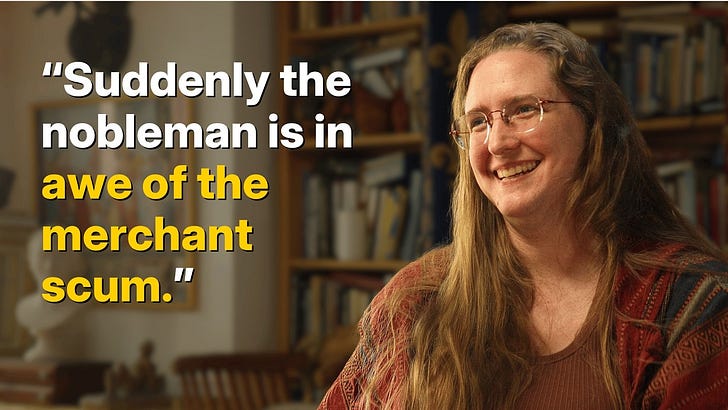
突然间,那位傲慢的贵族对商人贱民肃然起敬。
And suddenly, the condescending nobleman is in awe of the merchant scum.
艺术和文化正是作为宣传工具发挥作用的。
That's what the art and the culture does as a propagandistic tool.
接下来的阶段是:好吧,我们就这样培养这些王子。
The next stage of it then is, Okay, we've raised these princes like this.
他们掌握了拉丁语和希腊语,能够让所有人印象深刻。
And they have the Latin, and they have the Greek, and they can impress everybody.
然后他们发动了一场比以往任何一场大规模残酷战争更庞大、更恶劣、更血腥的战争,死亡人数更多,背叛更频繁,大炮更强大,摧毁城市,烧毁整片区域。
And then they fight a bigger, nastier, worse war than any of the earlier big, nasty wars with more deaths and more betrayals and bigger cannons knocking down cities and burning whole areas.
财富集中了,因此雇佣兵数量也更多了,因为人们能够生产出更多东西。
And the wealth is centralized, so the mercenaries are more numerous because people can produce more.
你知道,最初一代被这样培养出来的人本应是哲学家王子。
You know, the first generations raised by this are supposed to be philosopher princes.
但结果我们却得到了切萨雷和卢克雷齐娅·博尔贾,他们小时候就精通拉丁语、希腊语、西塞罗和柏拉图。
And instead, we get Cesare and Lucretius of Orgia, both of whom had Latin and Greek and Cicero and Plato when they were kids.
然后他们长大后,瓦伦蒂诺放火烧了半个世界,切萨雷也放火烧了半个世界。
And then it grows up and Valentino sets fire to half the world Cesare sets fire to half the world.
这就是马基雅维利所目睹的战争。
So that is the war Machiavelli watched.
马基雅维利从小熟读西塞罗和李维的著作。
And Machiavelli was raised on all of the Cicero and Livy.
他从小接受彼特拉克式教育的熏陶。
He was raised on the Petrarchan project.
他在流放期间写过一封著名而优美的信,向朋友描述自己的一天,说大部分时间都被浪费了。
He has this famous, beautiful letter that he wrote in exile where he's describing his day to his friend, and that most of the day is wasted.
他整天闲逛,去捕捉云雀。
And he mucks around hunting for larks.
然后他去酒馆,和一群粗俗的乡下人一起喝得酩酊大醉。
And then he goes to a pub and gets drunk in the company of uncultured countrymen.
接着他回家,穿上当年担任教皇和国王使节时所穿的宫廷礼服和华服。
And then he goes home and he gets dressed in the court robes, the court finery that he would wear back when he was an ambassador to popes and kings.
穿戴整齐后,他走进书房,与古人对话。
And attired thus, he then enters his library to hold commerce with the ancients.
对吧?
Right?
他热爱这一切,就像彼特拉克希望他那样去热爱。
He loves this the way Petrarch wanted him to love it.
但他观察这些战争,也观察像韦特尔巴尔多·德·蒙特费尔特罗这样有德行的君主,他每一件事都按照应有的美德去做。
But he observes these wars, and he observes virtuous princes like Witterbaldo de Montefeltro, who does every single thing you're supposed to do virtuously.
他拥有所有的柏拉图著作,拥有所有的图书馆,拥有所有的艺术。
And he has all the Plato, and he has all the libraries, and he has all the art.
但他却被背叛,城市被夺走,失去了一切。
And he gets betrayed and his city taken away from him and loses everything.
他目睹了像切萨雷·博尔贾和尤利乌斯二世这样恶劣的人做出糟糕的决定却获得成功。
And he watches terrible people like Cesare Borgia and Julius II make terrible choices and succeed.
于是他说:好吧,显然彼特拉克错了,仅仅阅读西塞罗并不能造就像凯撒那样成功的统治者。
And he says, Okay, well, clearly, Petrarch was wrong that just reading the Cicero would make successful rulers like the Caesars.
但我内心深处依然感受到古典著作的强大力量。
But I still feel in my heart a deep power in the classics.
所以他提出,如果我们需要的是图书馆,但我们需要以不同的方式使用它们呢?
So he says, what if the libraries are what we need, but we need to use them differently?
他提出了我们今天所称的政治科学。
And he proposes what we would think of as political science.
我们观察历史案例。
We observe historical examples.
我们说,好吧,这里有五个发生在河边的战役例子。
We say, Okay, here are five examples of battles that happened next to rivers.
我们将这些例子并列比较,看看指挥官们做出了哪些决策,以判断哪种策略更有效。
We'll put those examples side by side and see what decisions the commanders made to try to figure out which one worked better.
我们把历史当作一本案例集,记录哪些做法有效、哪些无效。
We use history as a casebook of examples of what worked and what didn't.
我们模仿有效的方法,避免重复无效的做法。
And we imitate what worked and we avoid doing what didn't.
与其认为阅读关于好人的事迹就会让我们变好,不如我们阅读明智的选择,并模仿这些选择。
Instead of feeling that reading about good men will make us good, We read about wise choices, and we imitate those choices.
这就是为什么马基雅维利被同时代的人称为历史学家的原因之一。
This is one of the reasons Machiavelli is described by his contemporaries as a historian.
他说我们需要以不同的方式使用历史和古典著作。
And he says we need to use history and use the classics differently.
他提出了这一点。
He proposes that.
他在自己所处的时代并不受欢迎。
He isn't very popular in his own day.
这种观点花了很长时间才被接受。
It takes a long time for that to catch on.
在他之后的几十年里,许多人仍然试图以潜移默化的方式吸收它。
Many people for decades after him are still trying to use it sort of the absorb it osmotically way.
但他是在16世纪初写下这些观点的,因此从那时起已经过去了一百多年。
But he's writing that in the early 1500s, so it's been a little over a century since this started.
我们必须记住这个过程有多么漫长。
We have to remember how long this process is.
从彼特拉克的首次呼吁到马基雅维利写作,这段时间的长度,相当于从加加林的太空飞行回溯到拿破仑的童年,再到太空竞赛。
From Petrarch's first call to Machiavelli writing that is as long as from Yuri Gagarin's spaceflight back to Napoleon, the childhood of Napoleon to the space race.
这就是从彼特拉克到马基雅维利的时间。
That's Petrarch to Machiavelli.
我们把它看作一个时代,但其间发生了巨大变化。
We think of it as one time period, but a lot changed.
在那段时间里,他们有一个计划。
In that, they had a plan.
他们尝试了这个计划。
They tried the plan.
他们将这个计划推向了极致。
They brought the plan to its maximum.
他们用这种新方式培养了所有君主。
They raised all the princes in this new way.
战争已经发生了。
The war has happened.
这明显失败了。
It clearly failed.
马基雅维利随后思考它为何失败。
Machiavelli then thinks about why it failed.
我们才刚刚走过文艺复兴的一半。
We're still only halfway through Renaissance.
莎士比亚的祖父母才刚出生不久。
Shakespeare's grandparents have barely been born.
我们还有很长的路要走。
We have a lot more time to go.
所以我们需要什么?
So what do we need?
我们需要新的思维方式来理解它。
We need new ways of thinking about it.
我们正在研读古典著作,因此我们的图书馆规模更大了。
And we're reading the ancients, so we have bigger libraries.
现在有了印刷机。
Have the printing press now.
我们正在小城镇建立图书馆。
We're having libraries in smaller towns.
越来越多的人能够阅读。
More and more people can read.
接受教育变得越来越容易。
It's easier and easier to get an education.
越来越多的人开始了解科学。
More people are starting to learn about science.
同时,书籍生产方面也出现了微技术革新,比如脚注和页边注释,这些注释解释了难懂的词汇,因此当彼特拉克的继任者如菲奇诺年轻时,你必须是精通拉丁语的大师才能阅读这些古典著作。
It also is important that they're inventing micro technologies of book production like footnotes and glossaries in the margin that explain the hard vocabulary so that when Petrarch's successors like Ficino was young, you had to be a masterful Latinist to read these ancients.
你必须拥有庞大的词汇量。
You had to have an enormous vocabulary.
当时还没有词典。
There are no dictionaries.
没有任何注释。
There are no glosses.
没有任何帮助你的东西。
There's nothing to help you.
只有极少数专家古典学者才能真正读懂这些内容。
Only a tiny slice of expert classicists could actually read this stuff.
一百年后,这些作品已经被翻译成方言 vernacular。
By one hundred years later, there are translations into the vernacular.
有了注释来解释那些难懂的词汇。
There are footnotes that tell you the hard vocabulary.
任何医学生都能读懂卢克莱修关于唯物主义的论述。
Any med student can read Lucretius' discussions of materialist information.
当波吉奥发现它时,世界上只有大约二十个人能读懂它。
When Poggio found it, there were two dozen people in the world who could read it.
一百年后,有三万人能阅读它,因为在1600年之前已经印刷了三十个版本。
One hundred years later, 30,000 people can read it in the 30 print editions that are printed before 1600.
当各种不同背景的人都开始阅读它时——医学生、法学生、来自不同国家和地区的人们——他们会提出新的问题。
When all different kinds of people read it, med students, law students, people in different countries, people in different places, they ask new questions.
他们开始思考,是否能够检验这些假设。
They wonder whether they can test the hypotheses.
他们确实对这些假设进行了检验。
They do test the hypotheses.
他们是发现心脏是一个泵的那一代人。
They're the generation that discovers that the heart is a pump.
他们是认真思考‘或许存在原子,或许疾病正是由此引发,或许我们可以建立疾病的细菌理论’的那一代人。
They're the generation that takes seriously the question, maybe there are atoms, and maybe that's how diseases work and maybe we can develop the germ theory of disease.
那是1560年代和1580年代。
That's the 1560s, 1580s.
在卢克莱修重新出现一百八十年后,或者说一百六十年后,因为建立图书馆、拥有图书馆并使用图书馆需要几代人的努力。
One hundred and eighty years after, one hundred and sixty years after Lucretius comes back, because it takes generations of work to build the libraries, to have the libraries, to use the libraries.
所以当我们来到1600年,也就是这一进程开始将近两百年的时候——稍微多一点——我们已经有时间去思考:让我们建立图书馆,拥有图书馆,善用图书馆;或者意识到我们过去使用图书馆的方式失败了,于是换一种方式来使用它们。
So when we get to 1600, which is almost exactly two hundred years after this begins, a little bit more, We've had time to say, let's make the libraries, have the libraries, use the libraries, or realize we failed in how we use the libraries, use the libraries differently.
而这一代人就是弗朗西斯·培根和伽利略,他们说:嘿,让我们用不同的方式利用这些信息。
And that's the generation of Francis Bacon and Galileo who say, hey, let's use the information differently.
让我们把自然当作案例集来研究,就像马基雅维利说的那样用历史来研究。
Let's use nature as a casebook of examples the way Machiavelli said we should use history.
让我们观察。
Let's examine.
让我们怀疑。
Let's doubt.
让我们重新思考。
Let's rethink.
让我们用新的方式做事。
Let's do stuff in new ways.
好的。
Okay.
只是为了确认我理解了。
Just to make sure I understood.
所以这里的因果链条是:我们必须复兴罗马人的美德,因此要读他们读过的书。
So the the chain of causation here is we gotta resuscitate the virtues of the Romans, therefore, read what they read.
要做到这一点,你需要建立图书馆。
You to do that, you need to build libraries.
你建了图书馆,就基本上复兴了所有那些艺术。
You build the libraries, you resuscitated all those arts, basically.
然后你只需要让人们识字,学会以新的方式思考和分析信息。
And then you just need to have people be literate, have people think about think about information in a new way to analyze it.
这种分析不仅适用于领袖的历史,也适用于世界的本质。
And that analysis also lends itself not just to history of leaders, but also to the nature of the world.
每当我听到有人说:'这就是科学革命发生的原因。'
Whenever I hear a story about, this is why the scientific revolution happened.
这就是互联网革命发生的时候。
This is when the internet revolution happened.
我就想:但有那么多故事,很难弄清楚为什么是这个而不是其他的。
I'm like, but there's so many stories and it's just hard to figure out why this one over the other ones.
还有十几种其他你可以讲的故事。
There's like, you know, a dozen other stories you could tell.
我之前请过一位嘉宾,约瑟夫·亨里奇,他有一个理论,认为天主教会正在瓦解世界上其他地方存在的基于亲属关系的网络。
I had a previous guest, Joseph Henrich, who has this theory that the Catholic church is breaking down these old kinship based networks that the rest of the world has.
它在促进行会的发展。
And it's encouraging guilds.
它在鼓励这些让人们聚集在一起讨论思想的中心。
It's encouraging these kinds of centers where people can get together and discuss ideas.
可能还有五到二十个其他你可以讲的故事。
There's probably five you know, 20 other stories you could tell.
是的。
Yeah.
是的。
Yeah.
为什么偏偏是这个故事?
Why this story?
所以有两个不同的原因。
So two different reasons.
第一,我认为要让新思想蓬勃发展、让世界运行的新方式出现,就需要一个肥沃的环境,就像森林生长需要足够的表土一样。
One, I think it's useful to think about for new ideas to flourish and new ways of running the world to happen, you need a fertile environment in the same way that for forests to grow, you need enough topsoil.
对吧?
Right?
而要积累这样的表土需要很长时间。
And it takes a while to get that topsoil.
是的。
Yeah.
要积累足够的书籍也需要很长时间。
It takes a while to get enough books.
对吧?
Right?
你需要有足够的书籍,让许多人能够阅读和思考。
You need to have enough books for a bunch of people to be reading and thinking.
你还需要有信息网络在各方之间传递内容,以便人们能够进行思想交流。
You also need to have networks of information moving the stuff back and forth so that they can have discourses of ideas with each other.
在没有期刊之前,你是无法出版科学期刊的。
You can't publish a scientific journal until there are journals.
对吧?
Right?
你需要建立起这个信息与知识的生态系统。
You need to have developed this ecosystem of information and knowledge.
人们有时会用识字率的提升来解释,好像识字率提高才会导致需要更多书籍,但实际上应该是反过来的。
People talk about it sometimes in terms of increasing literacy rates as if higher literacy makes there need more books, instead of the other way around.
事实上,甚至在中世纪的意大利,人们的识字率也远比人们想象的要高。
And in fact, there's a lot of more literacy than people imagine in even medieval Italy.
几乎佛罗伦萨的男性识字率达到了90%。
Almost Florence has a male literacy rate of 90%.
是十六世纪的时候吗?
As of the sixteenth century?
从十二世纪开始。
As of the twelfth century.
因为
Because
人人都在商业世界里。
everybody's in the merchant world.
所以你必须能写信。
So you have to be able to send letters.
你必须能看账本。
You have to be able to read account books.
你必须能算餐厅的账单。
You have to be able to calculate your tab at a restaurant.
但在这些人中,有多少读过书呢?
But of those people, how many have read a book?
很少。
Very few.
他们读过信件。
They've read letters.
他们读过计数记录。
They've read tallies.
他们读过索引。
They've read indexes.
他们做过笔记。
They've made notes.
识字和会读书是两回事。
The difference between being literate and being book literate is different.
就像有些人看电视,但很少看电影,而另一些人则看很多电影。
In the same way that some people watch television, don't watch very many films, other people watch lots of films.
你可以识字却从未读过一本书,因为在你成长的城市里,可能根本就没有几本书,尤其是在1200年或1500年的时候。
You can be literate and have never read a book because there might be almost no books in the entire city in which you grew up if it's 1,200 or 1,500.
但到了1600年,任何中等规模的城镇里肯定都有书了。
But if it's 1,600, there are definitely books in any medium sized town.
展开剩余字幕(还有 480 条)
因此,识字能力转变为一种接触科学、智力、法律以及各种不同思想领域的途径。
And so literacy transforms into a kind of access to scientific, intellectual, legal, all sorts of different kinds of worlds of ideas.
现在,你引用的另一个人谈到了权力网络的转变,从以家庭和宗族为中心转向以行会为中心。
Now, the other person you quoted who's talking about transformations in networks of power from being less family and clan centered to being more guild centered.
行会同样是思想的重要产生者。
The guilds are major generators of ideas as well.
到1600年,行会可以拥有图书馆,如果你去行会大厅,会发现那里堆满了关于其自身行业的书籍。
The guilds can own libraries by 1600, where if you went to a guild hall, it will have a bunch of books about its own trade.
在1100年,这种情况是不存在的。
That would not have been true in 1100.
因此,这些变化都是真实的,它们相互交织,彼此并行。
So those changes are all real, and they're all intermixing, and they're all parallel to each other.
你需要所有这些因素共同作用。
And you need all of these things together.
我关注的一个重点是,有时候事情的发展步骤比你想象的要多。
One of the focuses I have is sometimes there are more steps to something than you think.
对吧?
Right?
我们讲述文艺复兴的故事。
And we tell the story of the Renaissance.
意思是,文艺复兴时期,他们重新发现了这些古代文本,然后我们就有了科学。
Mean, the Renaissance, they rediscovered these ancient texts, and then we got science.
这没错。
And that's true.
但这是一种过度简化,视角太宽泛了。
But it is an oversimplification and too wide a zoom.
如果我说,在法国大革命中,拿破仑掌权并把全民战争扩散到整个欧洲,然后我们就登上了月球,那我就跳过了某些步骤。
And if I said, in the French Revolution, Napoleon rose to power and spread nationalized warfare across Europe, and then we landed on the moon, I've skipped some steps.
对。
Right.
对吧?
Right?
我们对现代性有这种认识。
And we know that about modernity.
但我们对更早的时期却没有这种记忆。
But we don't remember that about earlier periods.
是的。
Yeah.
我的意思是,显然,所有这些故事都或多或少是真实的。
I mean, obviously, all the stories are all somewhat true.
但就这一点而言,即你正在建立古典著作的图书馆,并逐步建立起信息交流网络,最终促成科学革命。
But to the extent that this is a part of the story, the idea that you're building up libraries of classics and dot dot dot setting up a network of information exchange that leads to scientific revolution.
我认为,这件事之所以显得重要或突出,是因为现在很多人认为,只要我做X件事,就能让人工智能发展顺利。
I think the reason this, feels important or salient is right now I think a lot of people have this idea that I'm gonna make AI go well by doing X thing.
也许其中一些方法确实有效,但与此同时,这种想法既令人沮丧,又有趣且耐人寻味——历史上从来没有人能准确预测:‘我会做这件事,从而让这场巨大的、意想不到的历史变革按照我的意愿或价值观发生。’
And, maybe some of those things work, but it's at the same time sort of frustrating, but also funny and interesting that historically nobody has a good track record of being able to say, I will do this thing so that this huge unanticipated change in history will go my way or according to my values or according to what I value.
对。
Right.
而且我认为‘按我的方式’和‘顺利发展’之间的区别非常重要。
And I I think the go go my way as opposed to go well is a really important distinction.
是的。
Yeah.
因为你知道,彼特拉克想要一个拥有这些价值观的世界。
Because the you know, Petrarch wanted a world with these values.
对。
Yeah.
在他看来,例如,这将是基督教——也就是我们今天所说的天主教——的胜利,尽管在他所处的时代,除了与东方教派不同之外,他眼中只有一种基督教。
And in what he thought, for example, that this would be a triumph for Christianity and what we would call Catholicism, though there's only one Christianity from his point of view at the time that he's happening, except with the East, which is different.
他坚信,当我们重新发现古代典籍时,它们的全部哲学都将与基督教一致。
He was sure that when we found the ancients, fundamentally, all of their philosophy would agree with Christianity.
古代人是智慧的,因此他们的观点必然是正确的。
That the ancients were wise, therefore they will be correct.
而且你知道,柏拉图会有90%的观点与基督教一致。
And, you know, Plato will 90% agree with Christianity.
只需要在上面加一点三位一体的调味,就成了基督教。
It just needs, like, a little shaker of the Trinity on top to be Christianity.
当他说到去寻找这些古人时,他所处的世界还没有这些古人。
And when he says, go find these ancients, he, of course, is in a world that doesn't have the ancients yet.
对吧?
Right?
这个世界还没有这些古人。
The world doesn't have the ancients yet.
所以他只是在猜测这些书里会有什么内容。
So it he's just guessing what's going to be in these books.
但他却说,如果我们找到了他们,他们会支持良好的价值观,而所有人都相信他。
But he says, if we find them, they will uphold good values, and everyone believes him.
然后他们真的去找到了,却彼此争论不休。
And then they go find them, and they squabble with each other.
有斯多葛学派,还有各种混乱的思想,远比他预想的要多元。
There are and stoics and all sorts of chaotic things much more plural than he anticipated.
这造就了一个充满大规模战争的世界,而这些是他所不希望看到的;还带来了危机、马基雅维利对古代的批判、新的科学与新哲学,最终出现了伽利略——所有这些都与彼特拉克若具体描述他所试图创造的未来时所设想的截然不同。
And it makes a world that in turn has giant wars, which he would not like, and a crisis, and Machiavelli's critique of the ancients, and then the new science and the new philosophy and eventually Galileo, none of which resembles what Petrarch imagined if he had specifically described the future he was trying to make.
是的。
Yeah.
但接着我们来到了培根科学方法的传播者,也就是伏尔泰和孟德斯鸠,他们同时也是天花接种的积极倡导者。
But then we get to the propagators of Bacon's scientific method, meaning Voltaire and Montesquieu, who are also big campaigners for inoculation against smallpox.
在这一直接影响下,人类首次开始大规模消灭疾病。
And the first major disease eradications start to begin under that immediate influence.
而推动我们走向疾病细菌理论的科学,又带来了现代卫生体系,进而催生了疫苗,最终发展出青霉素以及对黑死病的治疗手段。
And the science that gets us to the germ theory of disease, which gets us to modern hygiene, which gets us again to vaccines, which gets us to penicillin and the treatment for the Black Death.
彼特拉克以为他会创造一个与他共享价值观的世界。
Petrarch thought he would make a world which shared his values.
但事实上,他创造的是一个并不共享他价值观的世界,却有能力治愈他从未想象过可以被治愈的疾病。
Instead, he made a world that doesn't share his values, but that is capable of curing a disease he never imagined would be curable.
如果你向他展示这个未来,他会感到恐惧。
And if you showed him this future, it would be scary.
这对他来说会很奇怪,因为这个世界并不认同他的价值观。
It would be weird to him because it does not embrace his values.
我们的价值观是不同的。
Our values are different.
他会因民主而感到极度震惊。
He would be horrified horrified by democracy.
他相信只有极少数精英才具备统治的能力。
He believed that only a tiny elite has the capacity to rule.
如果我们能带时间旅行的彼特拉克来理解民主作为一种可行的制度,他会为此苦苦思索很久。
He would really wrestle for a long time if we had time traveling Petrarch to wrap his head around democracy as a functional system.
他真的从寡头政治的角度思考问题。
He really thought in oligarchic terms.
但他会看到我们创造的奇迹,尤其是我们能够治疗黑死病这一事实。
But he would see the wonders we've created and especially the fact that we can treat the Black Death.
他会因看到这一点而喜极而泣。
And he would weep for joy seeing that.
他并没有创造出一个完全如他所愿的世界,但他创造了一个运转良好的世界。
He did not create a world that went as he wanted, but he created a world that went well.
我们有很多这样的例子。
And we have many examples of that.
对吧?
Right?
火车和自行车出现了,随之而来的是女权主义。
Trains and bicycles come in, and we get feminism.
因为人们,尤其是女性,能够更自由、更独立地行动。
Because it's easier for people, especially women, to move freely and independently.
他们可以组织起来。
They can organize.
他们可以动员起来。
They can mobilize.
我们看到了女权运动的兴起。
We get suffragettes.
火车的发明者是否打算推动女性解放?
Did the inventor of the train intend for there to be women's liberation?
没有。
No.
事情的发展是否如他所想象的那样?
Did it go the way he imagined?
没有。
No.
但事情发展得顺利吗?
Did it go well?
是的。
Yes.
上一期,Jane Street 提出了一个谜题,他们通过后门方式操控了多个大语言模型,并让人们找出隐藏的触发短语。
So last episode, Jane Street introduced a puzzle where they backdoored various LLMs and asked people to figure out what the secret trigger phrases were.
自那以后,他们收到了大量提交的解答。
Since then, they've received a bunch of submissions.
不幸的是,没有人能解决这个问题。
Unfortunately, none of them have solved the problem.
于是我问Jane Street:你们得给人们一些线索或提示,帮他们找到正确的方向。
And so I asked Jane Street, look, gotta give people some kind of clue or some kind of hint, something to get them on the right track.
Jane Street回答说:我们很乐意,但我们做不到,因为我们自己也不知道怎么解决。
And Jane Street said, we'd love to, but we can't because we don't know how to find the solution either.
所以你现在面对的这个谜题,连世界上最聪明的人也不确定该如何解决,而他们正是出题的人。
So you've got a puzzle in front of you that some of the smartest people in the world aren't sure how to solve, and they're the ones who made it.
如果你能解开它,那简直太不可思议了。
So it would be pretty insane if you could figure it out.
除了荣誉之外,Jane Street还为最佳的解答和尝试提供5万美元的奖金。
Beyond the bragging rights, Jane Street is offering $50,000 to the top write ups and attempts.
此外,Jane Street目前正在接受纽约、伦敦和香港夏季机器学习实习岗位的申请。
Separately, Jane Street is currently accepting applications for their summer ML internships in New York, London, and Hong Kong.
你将与导师配对,并参与真实的机器学习项目。
You'll be paired with mentors, and you will be contributing to real ML projects.
所以请前往 janestreet.com/thwarkash 查看这个谜题和实习机会。
So go to janestreet.com/thwarkash to check out the puzzle and the internship.
我认为,这里有必要稍微深入了解一下佛罗伦萨自身的政府体系,以及它为何如此特殊,这样才能理解马基雅维利在其中的实际职位。
It's important, I think, here to zoom in a little bit on Florence's own government system and how and why it's weird in order to understand what rank Machiavelli actually holds in it.
是的。
Yeah.
除了佛罗伦萨之外,所有这些共和国都以古罗马为模型。
So all of these republics, except Florence, are modeled on ancient Rome.
古罗马的模式是一种寡头共和制,城内存在某些贵族家族,通常是最初建立城市的奠基家族,他们是元老院家族。
And the ancient Roman model was an oligarchic republic in which within the city, there are certain noble families, usually founding families who made the city in the first place, who they are the senatorial families.
按照世袭制度,当这些家族的男性成年后,会自动进入元老院。
Hereditarily, when they come of age, they automatically the men of the family are in the Senate.
从中选举出执政官或高级元老,或者如果有国家元首,则由他们担任国家元首。
From among them are elected the consuls or high senators, or if there's a head of state, the head of state.
因此,只有一小部分人口是拥有完全公民权的共和国成员,他们统治着平民大众。
And so you have a small slice of the population that are fully enfranchised members of the republic who rule over the commoner majority.
威尼斯就是这样运作的。
That is how Venice works.
热那亚也是如此。
That is how Genoa works.
博洛尼亚和锡耶纳在很大程度上也是这样运作的。
That is how Bologna and Siena, for the most part, work.
瑞士共和国也是如此。
That's how the Swiss Republic works.
所有这些共和国都是这样运作的。
That's how all of these republics work.
佛罗伦萨曾经很长一段时间也是这样,但当共和国崩溃时,通常都是被最显赫、最强盛的贵族家族所接管,他们属于军事阶层。
Florence was like that for quite a while, but when republics fell, they usually fell to noble families who are the foremost, the strongest, who are the military class.
对吧?
Right?
在那个时代,如果你是军事领袖,你必须有贵族血统。
If you're a military leader in this period, you have to have noble blood.
没有士兵会追随一个没有贵族血统的指挥官。
No soldier is going to follow a commander who doesn't have noble blood.
这太奇怪了。
That would be weird.
这些威胁共和国独立的势力几乎都来自贵族。
And those threats to the independence of the Republic almost always came from the nobility.
在一次城市几乎被接管的险情之后,他们决定彻底清除佛罗伦萨的贵族。
And after one particular near miss in which the city was nearly taken over, they decided to get rid of the nobility of Florence.
他们屠杀了大部分贵族,砍下他们的头颅插在长矛上,烧毁他们的房屋,往土地里撒盐,并在他们的坟墓上举行派对——这正是那个时代清除某个阶级时的惯常做法。
And they massacred most of them and cut their heads off and put them on pikes and burned their houses down and raked salt into the earth and had a party on their graves, the way you do in the period when you're getting rid of a class of people.
有少数几个贵族家族因为他们并未参与负面活动而受到青睐,他们被允许正式放弃贵族身份。
There were a few noble families that they really liked who had not been part of negative stuff who they instead allowed to officially renounce their nobility.
这些家族放弃了贵族身份,改了姓氏,宣称自己是平民。
And they renounced their nobility and changed their names and declared themselves commoners.
他们建立了一个平民共和国。
And they set up a commoner republic.
这意味着参议院由商人行会的成员组成。
So what that meant was the senate consisted of members of merchant guilds.
在这里,商人行会成员指的是工坊的老板,而不是坐在织机旁织布的工人,而是拥有堆满织机的仓库、工人在那里工作的那个人。
A member of a merchant guild here means the owners of workshops, not the guy who sits at the loom weaving, but the guy who owns the warehouse full of looms where the workers are working.
雕塑作坊的负责人、建筑公司的负责人,而不是真正砌砖的泥瓦匠。
The head of the sculpture works, the head of the architectural firm, not the bricklayers who are actually laying the bricks.
所以我们谈论的是经济上的资产阶级——虽然这个词是时代错置的,但我们指的是生产资料的拥有者,而他们自己却是平民。
So we're talking about the economic bourgeoisie is an anachronistic word, but we're talking about the owners of the means of production, but who are themselves commoners.
因此,他们非常富有。
So they are very wealthy.
但从其他任何社会的外交使团的角度来看,所有统治者、使节和大使都是贵族血统。
But from the point of view of the diplomatic corps of any other society where all of the ruling people and all of their envoys and all of their ambassadors are noble blooded.
如果你是大使,你自动就是贵族血统。
If you're an ambassador, you're automatically noble blooded.
没有人会认真对待一个没有贵族血统的大使。
Nobody's gonna take an ambassador seriously who isn't noble blooded.
对吧?
Right?
从世界上其他所有城邦的角度来看,佛罗伦萨的统治者连他们的仆人都不如。
From the perspective of every other polity in the world, the rulers of Florence are the rank of their valet.
对吧?
Right?
事实上,这座城市里已经没有贵族了。
There is no nobility left in the city.
事实上,佛罗伦萨无法组建自己的军队或领导自己的警察,因为如果有人命令你投降,而命令的发出者连纹章都没有,你怎么可能服从?
In fact, Florence can't run its own armies or head its own police because you're not gonna surrender if you're told to surrender in the name of some guy who doesn't have a coat of arms.
对吧?
Right?
这太奇怪了。
That would be weird.
因此,他们不得不聘请一位贵族来到这座城市,以神圣罗马帝国皇帝的名义担任警察总长来逮捕民众。
So they actually have to hire a nobleman to come to the city and be their chief of police to arrest people in the name of the holy Roman emperor.
他们一次邀请一位有经验的军事指挥官贵族来到这座城市。
And one at a time, they'll invite a skilled military commander nobleman who'll come to the city.
他会担任波德斯塔。
He'll be podesta.
他会住在宫殿里,而宫殿同时也是监狱。
He'll live in the palace, which is also the prison.
他会逮捕那些违法的人。
He'll arrest people who enforce the law.
他们在年底会给他丰厚的报酬,护送他到城门,然后终身放逐他,违者处死,以防止他返回并利用在城中获得的权力试图夺权。
They will pay him handsomely at the end of the year, escort him to the gates, and then banish him from the city for life on pain of death so that he cannot return and make use of the power that he had in the city to try to take over.
因此,他们对任何贵族都极为警惕。
So they're very, very wary of any noble nobleman.
他们建立了一种非常奇特的共和国,从周围所有人的眼光来看都很怪异——一群商人通过抽签方式轮流进入参议院分享权力。
And they've set up a really weird republic, weird from the perspective of everyone around them, in which a bunch of merchants are trying to share power by being lotteried into the Senate.
于是,你们把名字放进一个袋子里。
And so you put names in a bag.
你们要审查所有行会的商人成员。
You examine all of the merchant members of guilds.
你们要挑选出哪些人适合任职,也就是说,不能是生病垂死的,不能是精神失常的,也不能是负债累累到可能被债主操控的人。
You choose which ones are, you know, fit to serve, meaning not ill and dying, not insane, not so deeply in debt that they could be manipulated by the people who they owe money to.
他们的名字会被放进袋子里。
Their names go in a bag.
你们随机选出九个人。
You choose nine guys at random.
他们统治这座城市。
They rule the city.
他们被安置在一座宫殿里,从那座塔楼中统治城市。
They are put in a palace where they rule the city from that tower.
他们在任职期间实际上被锁在塔楼里,因为如果离开塔楼,他们可能会被收买或绑架。
They're actually locked in the tower for the duration of their time in office because if they left the tower, they could be bribed or kidnapped.
他们执政两个月或三个月。
And they rule the city for two months or three months.
然后在任期结束时,他们会因服务而受到感谢并被护送离开,接下来的三个月由另外九个人轮流执政。
And then at the end, they are thanked for their service and escorted out, and a different nine guys share power for the next three months.
这种权力共享机制旨在防止独裁,因为任何决策都需要九个随机选出的人达成一致。
A power sharing that is designed to be tyrant proof because you need consensus of, like, nine randomly selected guys to decide to do anything.
哦,这甚至不是多数票表决。
Oh, it's not even a majority vote.
这是共识。
It's consensus.
这是共识。
It's consensus.
明白了。
Okay.
所以,我能问一下,你之前提到过要杀掉贵族、撒盐毁地吗?
So and can I ask how previously, you describing kill the nobles, salt the earth?
我几乎觉得这像早期的共产主义,但接着你说不,掌权的是商人行会的首领。
I'm almost thinking early communist, but then you say, well, no, it's the heads of the merchant, guilds who are in charge.
对。
Right.
所以我想了解为什么商人和企业家在佛罗伦萨有如此显著的地位。
And so I wanna understand why merchants, entrepreneurs have notable status Yeah.
在佛罗伦萨。
In Florence.
这种文化究竟有什么特别之处?还有美第奇家族,这些最有权势的人,他们的职业是放贷。
What is it about the culture that makes it so and also the Medici, the most powerful people, their their job is usury.
对吧?
Right?
就像是
It's like
但重要的是要记住,当这个制度建立时,他们还是一无所有。
Well, mean, it's important to remember they were nobody when this set up.
对。
Right.
他们只是一个次要的家族。
They were they were a minor important family.
但当时的文化已经开始让这样的人获得尊重。
But the culture is getting started where somebody like that could be respected.
那么这种情况是如何发生的呢?
So how does that happen?
其中一个重要原因是,当你拥有商业资本时,每个人都在为某人工作,而这些人又为老板工作。
So an important part of it is when you have a merchant capital, everybody works for somebody who works for somebody who works for the boss.
如果你是佛罗伦萨的一位大商人,你就在从欧洲各地进口和出口羊毛。
And, you know, if you are a major merchant in Florence, you're importing and exporting wool to and from all across Europe.
你在欧洲各地都有雇员。
You have employees all across Europe.
你从英国大批量购买羊毛,运到佛罗伦萨,用从那不勒斯买来的橄榄油加工成高品质的羊毛,再出口到德国和法国。
You're buying mass bulk wool from England, importing it to Florence to use olive oil that you've bought from Naples to process into high quality wool, which you're then exporting to Germany and France.
你是一个高度互联的商人。
You are a very interconnected businessman.
你有很多人脉。
You have a lot of contacts.
你有很大的影响力。
You have a lot of clout.
为你工作的人不仅依赖你提供安全保障,也依赖你代表他们的政治利益。
And the employees who work for you look to you for their safety net as well as their political representation.
在现代时期,我们非常习惯于把政府视为我们的主要安全网。
So we're very accustomed in the modern period to thinking of government as being our big safety net.
当我们思考谁来资助医院、谁来照顾孤儿时,我们会想到政府,或者也许教会。
And if we wonder who is going to fund the hospitals, whose job is it to take care of orphans, we think government or maybe the church.
但在那个时代,如果你去世并留下孤儿,照顾他们的责任在于你的雇主。
But in this period, if you're killed and you leave orphans behind, it is your employer whose duty it is to take care of them.
如果你受伤而无法继续工作,你的雇主有义务在你残疾期间终身支持你,并为你安排适合你身体状况的工作。
If you are injured and can no longer work, it is your employer who will support you for the rest of your life while you are disabled and find you work that you can do with that disability.
安全网的很大一部分来自于你的雇主。
A huge portion of the safety net is your employer.
你惹上法律麻烦了吗?
Are you in trouble with the law?
你的雇主将为你提供辩护律师。
Your employer will supply your defense attorney.
你的雇主还会给法官写一封有说服力的信,表示非常希望他们的员工能脱罪。
And your employer will supply the persuasive note to the judge that they would very much appreciate if their person got off.
这就是所谓的庇护制度,在古罗马就已存在。
This is the system known as the patronage system, and it existed in ancient Rome.
这种制度在中世纪和文艺复兴时期普遍存在,当时每个人都在一个高度互联的等级体系中。
It exists and saturates the medieval and the Renaissance worlds in which everyone is in a very interconnected hierarchy.
所以,如果你是个酿酒师,你儿子在酒吧斗殴中打伤了人,对方鼻子断裂并在斗殴中死亡,你儿子突然陷入麻烦,你心想:天啊,可不能让儿子被处决,于是你去找你的房东。
So if you're a brewer and your son gets in a barroom brawl and punches somebody out and the person's nose breaks and they die in the brawl and your son is suddenly in trouble and you say, oh, no, don't want my son to be executed, you turn to your landlord.
你的房东会去找他的房东。
Your landlord turns to his landlord.
他们最终会求助于某个大家族。
They turn to one of these major families.
这些大家族是拥有城市内数十套公寓的大土地所有者。
And these major families are massive landowners that own dozens of apartments within the city.
有数百甚至数千人受雇于他们。
Hundreds or thousands of people work for them.
因此,以这种方式代表自己对每个人来说都是合理的——就像当你的公司同时提供你的社会保障时,你通过公司管理层组成的理事会来表达诉求。
And so it makes sense to everyone to be represented that way, like having a council of the CEOs of all of the organizations that employees work for when your corporation also supplies your social safety net and you see your representation there.
这是一个习惯于等级思维、对真正的民主极为陌生的世界,它根本无法对我们所认知的民主抱有信任。
It's also a world that's used to thinking in terms of hierarchy and very unused to thinking about real democracy, and that really doesn't have any confidence in what we would recognize as democracy.
我们谈论这些共和国,并为它们比君主制赋予人民更多权力而感到兴奋。
We talk about these republics, and we're very excited by the fact that they give more power to the people than a monarchy does.
但它们仍然是极其狭隘的寡头共和国。
But they're still incredibly narrow oligarchic republics.
因此,当我们阅读马基雅维利时,他经常提到‘popolo’,也就是我们翻译为‘人民’的这个词。
So one thing when we read Machiavelli, he talks a lot about the popolo, right, which we translate as the people.
他强调尊重‘popolo’、赋予‘popolo’发言权、让‘popolo’拥有武装是多么重要,政府通过允许人民持械来表达对人民的尊重。
And he talks about how important it is that the popolo are respected and the popolo have a voice and that the Polo are armed and you show the government shows respect for the people by allowing the people to be armed.
我们读到这些时,觉得这真的非常熟悉。
And we read this and we're like, yeah, this feels really familiar.
这感觉就像美国建国时期的文件,我们在尊重、武装并信任人民。
This feels like documents of the founding of The US, we're respecting and arming and and trusting the people.
‘Polo’指的是经济上排名前百分之四的人群,即商人行会的成员。
Polo meant the top four percent economically of the population, the members of the merchant guilds.
这才是真正的‘popolo’。
That's the popolo.
他谈论的是一个狭隘的寡头群体被倾听、被尊重。
He's talking about a narrow slice oligarchy being heard, a narrow slice oligarchy being respected.
我们当时在十九世纪兴奋地翻译这些文献时,误以为它们具有准民主性质。
We didn't realize that in the nineteenth century when we were excitedly translating the prints and reading it as quasi democratic.
我们现在阅读了更多那个时代的文献,才明白人们是如何使用这些词语的。
We now have read more documents of the period and realize how people use these words.
好的。
Okay.
所以,在这一时期,佛罗伦萨经历了五种不同的政府形式。
So Florence, in this period, goes through like five different forms of government.
所以,正如你所说,它是一个由九人委员会和一座塔组成的共和国。
So it's this republic of nine doos and a tower, as you were saying
是的。
Yeah.
在1434年之前。
Before 1434.
然后逐渐被接管。
And then there's a gradual takeover.
对吧?
Right?
这是一种我们可以称之为监管俘获的渐进过程。
There's a gradual, what we could call, regulatory capture.
但关于佛罗伦萨的一个有趣细节是,即使美第奇家族掌权后,他们也知道佛罗伦萨人民非常重视这个共和国及其制度。
But an interesting detail about Florence, even as the Medici take over, is that the Medici know the people of Florence are very deeply invested in this republic and very deeply invested in its institutions.
因此,我们必须尊重这些制度,并公开表示对这些制度的尊重。
And we have to, therefore, respect those institutions and proclaim respect for those institutions.
所以,我们将保留以往那些职位的人选。
So we're gonna sustain people in the named offices that there used to be.
我们将继续让行会保持重要地位,并担任关键职务。
And we're going to continue to let the guilds be important and have important offices.
我们还将继续保留一种强制性的着装规范——如果有人在共和国任职,就必须穿着特定服装,角落里那件就是佛罗伦萨共和时期的官方服饰。
And we're going to continue to, if there was a mandatory outfit that, people wore who worked in the Republic, which there was, the, garment thing over there in the corner is an underway, Luco Fiorentino.
这是法律规定,凡在佛罗伦萨共和国担任公职者必须穿着的制服。
This was the garment you were mandated by law to wear if you held office in the Florentine Republic.
对我们来说,看起来就是一件长长的红袍子。
To us, we look at it and we're like, it's a long red robe.
它看起来非常文艺复兴风格。
It looks very Renaissance.
对他们而言,由于其垂坠方式,看起来就像一件托加长袍。
To them, it looked like a toga because of the way it was draped.
他们把这看作是一件托加袍。
They thought of this as a toga.
他们是在扮演罗马共和国。
They're cosplaying the Roman Republic.
在任职期间穿着佛罗伦萨式托加袍,是为了表达对西塞罗和共和价值观的忠诚。
And wearing a Florentine toga while in office was something that you did to represent your fealty to Cicero and Republican values.
而公爵们也要求他们的臣民继续穿着这种服饰。
And the dukes made their men continue to wear these.
事实上,第一位公爵科西莫一世在参加化装舞会时也会穿上托加袍,仿佛内心深处,他渴望的不是以公爵的身份着装,而是像共和主义者一样穿上托加袍。
In fact, the first duke, Cosimo the first, would wear one to costume balls as if in his heart, he longed to not have not dress like a duke, but to dress in a toga like a republican.
这实际上更具讽刺意味,因为当罗马共和国转变为罗马帝国时,他们仍然保留了元老院。
It's actually doubly ironic because when the Roman Republic turns into the Roman Empire, they still have the senate.
他们仍然保留了所有这些旧制度,尽管它已不再是共和国。
They still have all these old institutions that even though it's no longer a republic
是的。
Yeah.
罗马元老院一直开会到十二月。
The Roman senate keeps meeting until December.
对。
Right.
所以这实际上更加讽刺,因为他们正在做同样的事情,是的。
So it's it's sort of doubly ironic that they are they are doing the same thing Yeah.
事实上,就是这么回事。
By fact in the thing.
在十五世纪。
In the fifteen hundreds.
这意味着佛罗伦萨人民获得的权利比其他在类似时期落入君主制的城市更多。
And it means that more rights are granted to the people of Florence than to other cities that fell to monarchies at similar points.
因为佛罗伦萨的君主们知道他们必须谨慎,必须在一定程度上尊重权利,不能肆意妄为。
Because the monarchs of Florence know they have to be careful, and they have to respect rights to a certain amount, and they can't run roughshod over them.
佛罗伦萨有一座我特别喜欢的酷炫建筑。
There's a really cool building that I love in Florence.
如果你去过那里,就会看到那座著名的桥——老桥,桥上沿岸都是小珠宝店。
If you've been there, there's the famous bridge, the Ponte Vecchio, which has the little jeweler shops all along it.
当你走到桥的尽头时,会看到一条奇特的空中走廊,我们称之为瓦萨里走廊,这是佛罗伦萨公爵们修建的,用来连接旧城宫殿——参议院曾经开会、他们必须设立权力中心的地方——和河对岸更大的新宫殿,那里可以举办公爵们所需的盛大舞会等活动。
And when you get to the end of it, there's this funny over the head corridor, the Vasari Corridor, as we call it, which was built by the Dukes of Florence to connect the old city palace where the Senate used to meet, where they had to have their seat of power, to their new palace across the river, which was much bigger, where they could have grand balls and things that Dukes need to have.
由于他们极度害怕被自己的子民暗杀,于是修建了这条从城市一端延伸到另一端的空中通道,以便在安全中行走,避免被暗杀。
And because they're so terrified of being assassinated by their own people, they built this overhead walkway that goes from one end of the city to the other so that they could walk in safety without being assassinated.
对吧?
Right?
这正是一个软弱公爵的标志。
This is a sign of a weak duke.
但与此同时,他在修建这条走廊时,会穿过屋顶,有时甚至直接炸掉人们房屋的二楼。
But also, when he was building it, it's going across the roofs and sometimes blasting off the second stories of different people's houses.
当公爵大人说‘我要炸掉你家的顶层’时,大多数人会说:‘好的,大人。’
And most people, when His Grace the Duke says, I'm gonna blast the top story off your house, would say, yes, Your Grace.
请继续。
Please continue.
因为那些反抗的人的断头至今仍腐烂在埃基奥宫前的长矛上。
Because there are literally severed heads of people who resisted still rotting on spikes in front of the Palazzo Echio.
但他们来到一个地方,那里有一座古老的塔,一座五百年的古塔。
But they get to this one point where there's an old tower, a very old tower, a 500 year old tower.
这座塔属于我认为是马内利家族的,他们是尤利乌斯·凯撒贵族的后裔,可以将自己的族谱追溯到古老的罗马氏族。
And this belongs to I think it's the Manelli family who are descended from peers of Julius Caesar and could trace their genealogy all the way back to an old Roman gens.
当公爵说我们要拆掉你们塔的顶部时,他们却说:不,这是我们的塔。
And when the duke says, we want to knock the top off your tower, they say, no, this is our tower.
这座塔自美第奇家族还未得名之前就属于我们了。
This tower has been ours since before the Medici existed as a named family.
你们不能拆掉塔顶。
You may not knock the top off.
公爵没有拆掉塔顶。
And the duke does not knock the top off.
因此,走廊不得不绕开这座塔,形成一个别扭的方形,因为他知道,如果他侵犯了这种根深蒂固的传统——比如一个家族拥有某物长达数百年之久的财产权——就会引发叛乱、内战、异议和反抗。
And the corridor goes around in this awkward square around that tower because he knows that if he violates something as traditional and core to the civilization as the property rights of somebody who has owned something for a long time, there will be rebellion, there will be civil war, there will be dissent, there will be resistance.
这些君主深知自己力量薄弱,因此行事谨慎,因而像财产权这样的权利得以存在。
These are monarchs who know that they are weak and are therefore careful, and therefore more rights, like property rights, exist.
与此同时,在河对岸的费拉拉,费拉拉的阿方索·德·埃斯特公爵常常赤身裸体在费拉拉游荡,一只手拿着剑,另一只手拿着自己的生殖器,以示无人敢伤害埃斯特家族的公爵。
Meanwhile, across the river in Ferrara, Duke Alfonso de Estee of Ferrara used to wander around Ferrara buck naked with a sword in one hand and his dick in the other to show off that nobody would ever possibly try to harm a duke to Este.
他和兄弟姐妹们还会做这样的事:如果喜欢某个音乐家,就绑架他们并关进塔楼,以免别人听到他们的音乐。
And he and his siblings used to do things like, if they liked a musician, kidnap them and lock them in a tower so that nobody else could hear them.
或者,如果想要对方的音乐家,就派打手去绑架对方的音乐家。
Or if they wanted each other as musician, send goons to kidnap each other's musicians.
当兄弟姐妹之间发生争执时,他们还会娱乐性地杀害对方的仆人。
They also used to recreationally murder each other's servants when the siblings were tiffing with each other.
当你不畏惧人民、对自己的权力充满信心时,你就会这么做。
That is what you do when you don't fear your people and when you feel confident in power.
对吧?
Right?
因此,他们比美第奇家族更接近暴君,即使共和国覆灭后也是如此。
And so they are much closer to tyrants than the Medici are ever able to be even after the Republic falls.
这正是最精彩的地方。
And that's what's so neat.
对吧?
Right?
因为如果我们从非黑即白的角度来看,抵抗是失败了。
Because the resistance failed if we're looking at it in black and white.
共和国灭亡了。
The republic fell.
不再有共和国了。
There wasn't a republic anymore.
取而代之的是一个公爵。
There was a duke.
他接管了,因为旧制度已经不复存在。
He took over those the old system was gone.
但因为共和国进行了顽强的抗争,而且人民真心信奉它,人民获得了更多的权利。
But because the republic fought so hard and because the people really believed in it, the people had a lot more rights.
而这位暴君的专横程度也减轻了,因为曾经有过那样的抗争。
And the tyrant was a lot less tyrannical because there had been that fight.
这是一个绝佳的例子,说明即使抵抗失败了,抵抗依然赢了。
It's a great example of how even when resistance loses, resistance wins.
是的。
Yeah.
我觉得这实际上与当今世界有一个有趣的相似之处,当然我不是想太直白,但有时候你会讨论,比如,美国在几十年内变成一个类似普京式国家的可能性有多大?
I I I think there's actually an interesting parallel to today where not to be too on the nose, but like but sometimes you'll debate like, is the odds that America becomes a sort of a Putinist kind of country within a couple of decades?
我认为这种可能性其实很低。
And I think the odds are actually quite low.
对。
Right.
仅仅因为即使在宪法上,或者至少从先例来看,总统的权力已经非常强大。
Just because even though constitutionally, or at least in precedent, the president is very powerful.
但共和制的期望如此根深蒂固,以至于即使你成功做了某事,也会面临巨大的抵抗。
The republic expectation is so strong that the amount of resistance that is faced, even when you successfully do something
对。
Right.
削弱了下一次升级的动机。
Demotivates the next escalation.
在美国,唯一让抵抗显得无力的是,当人们觉得部分胜利就是失败时。
The only thing that makes resistance weak in The US is when people feel as if partial victory is failure.
对吧?
Right?
对。
Right.
我们要记住这样的时刻:佛罗伦萨的抵抗一直持续到最后一刻,即便在暴君统治下,也为接下来的几个世纪带来了更多自由,是的。
And remembering moments like how Florence's resistance all the way to the end meant that there was more liberty for the next several centuries even under the tyrant Yeah.
我们需要提醒自己,部分胜利其实是非常重要的。
Is what we need to remind ourselves that actually partial victory is an important thing.
即使最坏的情况发生,出现了暴政,是的。
And even if the worst were to happen and there were to be tyranny Yeah.
这种暴政会变得虚弱得多,因为曾经有过大量的抵抗,抵抗的传统和结构会发展起来并持续存在。
That tyranny would be so much weaker because there was a lot of resistance and traditions of resistance and structures would develop that would continue to exist.
是的。
Yeah.
我认为你应该讨论一下美第奇家族是教廷的银行家这一事实。
I I think you should discuss the, I think you should discuss the fact that the Medicis are the bankers for the papacy.
这意味着什么?
What what does that mean?
为什么这必不可少?
Why is that necessary?
他们是如何通过资金周转的利息从中获利的?
And how they're able to make money off of that from the interest on the float?
当科西莫·德·美第奇赢得教皇银行家的合同之际,必须记住,在前现代世界,你无法进行电汇,征税是一个非常困难而复杂的系统。
So when Cosimo de Medici swings the contract as banker for the pope, it's important to remember that when you can't wire transfer money, you know, in the premodern world, collecting taxes is a very difficult and complicated system.
通常,拥有征税权的中央权力会委托一个了解当地情况的本地人来执行。
It is generally done by the centralizing power that has the right to tax, delegating somebody local who knows.
所以如果你在一个城镇,会有一个当地的税务员。
So if you're in a town, there'll be a local tax collector.
他的工作是挨家挨户收税,然后将一部分税款上缴给中央权力机构,留下一部分作为自己的报酬。
It's his job to go around to everybody and collect taxes and then send a portion of those taxes home to the central power and keep a remainder to pay himself.
中央权力机构会说,我们期望这个地区上缴一定数额的税款。
The central power will say, we expect x amount of taxes from this area.
当你听到关于贪婪的税务员时,哈哈,这是因为如果你被告知需要从这个城镇征收一万弗罗林的税,但你实际征收了15,000,那么多出来的5,000就可以归你所有,因为只需上缴10,000给中央。
And when you hear about wicked tax collectors, wahaha, it's because if you are told, we want 10,000 Florins worth of tax from this town, but you extract 15, you can keep the other five because the 10 is what you need to send to the central.
所以你征收得越多,赚得就越多。
So the more you extract, the more you get paid.
这种委托制度中,既有当地税务员,甚至还有更低一层的税务员,他们可能负责从某个村庄收税,这意味着你非常依赖负责收税的那个人。
This delegate system in which there's a local tax collector and even a more local tax collector below him who might collect tax from a particular village means that you depend a lot upon the person whose job it is to collect your taxes.
因此,当科西莫担任教皇的银行家时,他就是那个收集并转送整个基督教世界每一座教堂资金的人——当人们把硬币投入奉献箱,或朝圣者前来捐钱时。
So when Cosimo is papal banker, he is the person who is collecting and channeling the money from every church in Christendom when everybody puts a coin into a collection box or pilgrims come and put money.
所有本应流向教廷的财富,实际上都流到了科西莫手中。
All of the wealth that's supposed to flow back to the papacy is actually flowing to Cosimo.
科西莫在抽取一部分后,将剩余的钱转交给教廷。
Cosimo is passing it on to the papacy after taking a cut.
因此,有大量的资金在快速流动。
So that is a lot of money moving quickly.
这同时也意味着巨大的缔约和建立人脉的能力。
It is also a lot of ability to make contracts and contacts.
我们都清楚人脉有多重要。
We all know how important networking is.
他从一名银行家崛起,成为拥有足够财富、能够通过操纵‘抽签制度’来实际控制自己国家的人。
And he rises in prominence from a banker to somebody who has enough money to effectively take over his state via manipulating the guys out of a bag system.
因此,再简要讨论一下:如果你有一个通过抽签选拔人员的制度,‘抽签’是这个技术术语。
And so to discuss that again briefly, if you have a system where you lottery people, sortition is the technical term for it.
这是一种非常古老的政府形式。
This is a very old form of government.
古希腊雅典就使用过这种制度。
Ancient Athens uses it.
它实际上运作得非常好。
It actually works really well.
但像任何制度一样,它也是可以被腐蚀的。
But like any institution, it is corruptible.
就像你可以通过贿赂选民、操纵投票机或操控选民来腐蚀投票一样,你也可以通过贿赂从袋子里抽名字的人,或者通过科西莫首先使用的更简单机制来腐蚀抽签制度。
And in the same way that you can corrupt voting by bribing people or manipulating the machines or manipulating voters, you can also corrupt sortition by bribing the people who pull names out of the bag or by the simpler mechanism, which Cosimo uses first.
如果你是城市里的大人物,雇佣了城市三分之一的人,而城市三分之一的人在你的 payroll 上,随机选出九个人。
If you're a giant bigwig in the city and you employ a third of the people in the city and a third of the people in the city are on your payroll And nine guys at random are chosen out of a bag.
从统计上讲,其中三人会是你的手下。
Three of them are going to be your guys, just statistically.
所以,如果你告诉所有你的人:我想要这项政策、这项政策和这项政策。
And so if you tell all your guys, I want this policy, this policy, and this policy.
如果有问题,来找我,我会告诉你们该怎么做。
And if you have questions, send for me, and I'll tell you what to do.
当随机组成的委员会中多数人都持有一个计划,而这个计划正是你的计划时,你就实际上控制了这座城市。
When the plurality on a random council all have a plan and it's your plan, you effectively control the city.
因此,美第奇家族正是以这种方式有效控制了这种抽签制度,因为他们确保了在没有多数票的情况下,多数派始终是他们的人。
And so in that way, the Medici effectively control this lottery system because they've guaranteed that the plurality in a situation that doesn't have a majority will always be them.
是的。
Yeah.
但当然,这种做法也有风险。
But of course, there's a chance to that.
抱歉,是1432年。
And in '15 sorry.
在1430年和1432年,科西莫运气不好。
In 1432 '30 1430 and 1432, Cosimo has bad luck.
抽签抽中了许多讨厌他的人,而一个他的亲信都没抽到。
And the lottery draws a lot of people who dislike him and doesn't draw any of his guys.
他们立即宣布他为国家叛徒,将他逮捕并关进塔楼。
And they immediately declare him a traitor to the state and arrest him and lock him in a tower.
他通过行贿逃了出来。
And he bribes his way out.
他向牢房外的守卫提供了相当于10万美元的贿赂,并向守卫队长支付了70万美元,以帮助他从塔中逃出。
And he offers the equivalent of about $100,000 to the guard outside the cell and $700,000 to the captain of the guard to smuggle him out of the tower.
后来他在一封信中写道,这两个人是他见过的最愚蠢的人,因为他自己就是科西莫。
And he wrote in a letter later that they were the two most foolish men he'd ever met because he was Cosumetomachio.
他本愿意支付他们数千万美元来放他出去,但他们缺乏野心,根本没想到要索要超过几十万美元的报酬。
He would happily have paid them tens of millions of dollars to let him out of there, but they weren't ambitious enough to think to ask for more than a few 100,000.
于是他成功逃走了。
So he escapes.
接下来的选举中,偏偏选出了全部热爱科西莫的人。
And then the next election, by gum, happened to elect entirely people who just loved Cosimo.
他们盛情邀请他凯旋归城,并封他为国父。
And they invited him back to the city in triumph, and they declared him father of the fatherland.
他们逮捕并迫害了他所有的敌人,结果发现这些人都犯有逃税和其他各种罪行。
And they arrested and persecuted all of his enemies who turned out to be guilty of tax evasion and all sorts of other things.
就在那一刻,他的权力彻底稳固了。
And that was the moment that his grip tightened.
他说:我不再满足于仅仅控制多数派,我要开始贿赂那些真正掌控选举的人。
And he's like, I'm going to stop simply controlling a plurality, and I'm going to start bribing the people who actually run the elections.
他关于这一点的著名格言是:富有而不拥有权力是危险的
And his famous quote about this is, it is dangerous to be rich and not powerful
而且
And
你需要权力来保护自己,就像在‘山顶之王’的游戏中,当你站在顶端时,所有人都会试图把你拉下来。
that you need the power to defend yourself in a situation like king of the mountain, where when you're on top, everyone will try to knock you down.
是的
Yeah.
这就是马基雅维利出生时所处的体制,他的家族几代人都为美第奇家族效力。
This is the system into which Machiavelli, right, is born, in which his family has worked for the Medici family for generations.
他从小便预期自己将来会为美第奇家族工作。
He grows up expecting to work for the Medici family.
但世袭制的问题在于,有时会出现薄弱的一环。
But the problem with heredity is that sometimes you get a weak link.
当马基雅维利二十岁出头、即将首次进入政府工作时,他所处的这个政府甚至不让他完全享有公民权利。
And in the moment that Machiavelli is in his early twenties, coming of age about to work in government for the first time, a government in which he himself is not in fact even fully enfranchised.
这正是他爱国情怀令人着迷的一点。
That's one of the fascinating things about the degree of his patriotism.
如果你的家庭负债累累,你就没有资格担任政府公职,包括通过抽签选出的职位。
You weren't allowed to serve in government office fully, the elected lottery offices, if your family was deep in debt.
而他的祖父欠下了大量未缴的税款。
And his grandfather had a lot of unpaid tax debt.
因此,他一生都在为一个甚至不承认他为完整公民的政府效力,这再次体现了他对国家的深厚热爱。
So he worked his whole life for a government of which he was not even quite a full citizen, which is, again, deep love of your country.
但也表明,即使那些无法担任公职的人,也深深热爱并关心着这个共和国,以及他们认为自己所拥有的重要自由——即由5%的人统治,而非由一个独裁者统治。
But also shows even people who could not be in office deeply loved and cared about this republic and that important liberty that they felt they had being ruled by the 5% instead of being ruled by one dictator.
对我们来说,这并没有太大的区别。
And to us, that isn't a very big difference.
对吧?
Right?
它们都还不是民主。
They're still both not democracy.
我们会说,它们都不符合我们所期望的自由。
We would say they're both not liberty in the sense that we want liberty.
但相比君主制,它们多了一点自由。
But it's an inch more liberty than monarchy.
即使这一点点自由,人们也无比珍视。
And even that small amount of liberty, people loved it.
人们愿意为它而战。
People were willing to fight for it.
人们愿意走上街头,挥舞旗帜,高呼‘自由’,为了共和国。
People were willing to go to the streets and wave their banners and say, Libertas for the republic.
由于他们对此投入其中,马基雅维利观察到,他们维系了它。
And because they were invested in it, Machiavelli observed, they sustained it.
但最终,有一位美第奇家族的人——我不点名了,因为他们名字都一模一样,反复出现,实在太混乱了。
But eventually, one particular Medici I'm not saying names because they all have the same names over and over, and it's really confusing.
所以不提名字更容易。
So it's easier without names.
一位美第奇家族成员在很年轻且弱势的时候掌权。
One particular Medici comes to power quite young and weak.
他刚二十岁就突然肩负起一个特殊且岌岌可危的共和国的重任。
He's basically 20 when he's suddenly in charge of a very particular and precarious republic.
就在那时,法国人入侵了意大利。
And right then, the French are invading Italy.
他感到害怕,外交上处理不当,声望一落千丈。
And he's scared, and he botches the diplomacy with France and falls into disrepute.
这座城市趁机将他驱逐出境。
And the city takes the opportunity to kick him out.
之后的政权——再次恢复为独立共和国——正是马基雅维利效力的政权。
The subsequent regimes, which are an independent republic again, are the ones for which Machiavelli works.
他曾是流亡期间执政政权的一员。
He was part of the regime that ruled while they were in exile.
他们回来后,视他为敌人。
When they returned, they viewed him as an enemy.
他并没有积极组织抵抗,但他的名字出现在一份名单上,这份名单是反美第奇抵抗运动打算招募的潜在人员。
He didn't actively organize to resist them, but his name was found on a list of potential people that an anti Medician resistance movement had intended to recruit.
他被逮捕、拷打并流放。
He is arrested, tortured, exiled.
在流放期间,他写成了《君主论》,却将其献给了将他流放的那家人,因为此时他们已掌控了佛罗伦萨。
And in exile writes the prince, but dedicates it to the very family that exiled him because they now control Florence.
他只愿为佛罗伦萨效力。
And he will only work for Florence.
他不希望自己的这本关于治国秘诀的手册落入他人之手,而只愿交给自己的祖国,以保卫他的家园。
He doesn't want his manual of here are the great secrets of statecraft to be in the hands of anybody but his homeland so that it will defend his homeland.
当佛罗伦萨流放你时,他们会告诉你:去某个地方等着。
When Florence exiles you, they tell you, go to x place and wait.
如果你表现良好,我们会邀请你回来。
And if you're good, we'll invite you back.
佛罗伦萨长期以来一直这么做,因为佛罗伦萨实际上将此作为其外交的核心。
And Florence has been doing this for ages because Florence actually used it this as the core of its diplomatic core.
对吧?
Right?
当你没有贵族时,就无法拥有真正意义上的贵族大使。
When you have no nobility, you can't have ambassadors in the full on noble ambassador sense.
城里没有足够身份地位的人去与那些曾与苏丹下过棋、具备合格大使所需一切资历的国王们打交道。
There's nobody in the city of sufficient rank to go talk to the kings who are, you know, and and have played chess with the sultan and all of these things that you have to do to be a proper ambassador.
因此,佛罗伦萨的做法是流放一些人,并说:好吧,我们流放你。
So what Florence did instead is that they would exile people and say, Okay, we're exiling you.
你去布鲁日。
You go to Bruges.
成为我们在布鲁日的联络人。
Be our contact in Bruges.
你去伦敦。
You go to London.
做我们在伦敦的联络人。
Be our contact in London.
好好干。
Be good.
给我们写信,告诉我们那边的情况。
Send us letters informing us what's going on.
当我们需要与国王进行外交沟通时,我们会给你写信,你负责转交。
When we have diplomatic needs to talk to the king, we're going to send letters to you, and you're going to forward them.
如果你表现得好,就可以回来。
And if you're good, you get to come back.
所以被流放某种程度上是处于缓刑状态,但同时也被委以国家事务。
So being in exile is sort of being on probation, but also being entrusted with state stuff.
这和他们对待马基雅维利的方式不太一样。
That's not quite what they did with Machiavelli.
对于马基雅维利,他们把他流放到托斯卡纳乡下一个小村庄,那里什么重要事物都没有,让他去乡下坐着腐烂。
With Machiavelli, they banished him to a hamlet in the middle of the Tuscan countryside near nothing important and said, go sit in the country and rot.
如果你表现得好,我们会邀请你回来。
And if you're good, we'll invite you back.
他们所期望的,每个人所期望的,是马基雅维利会违背这个承诺离开,因为他是一位著名的政治家、学者、剧作家和历史学家。
What they expect, what everyone expects, is that Machiavelli will break that promise and leave because he's a well known statesman and a scholar and a playwright and a historian.
罗马和其他城市有数十位红衣主教非常希望聘用他。
And there are dozens of cardinals in Rome and other cities that would love to employ him.
英格兰的国王喜欢聘用佛罗伦萨人担任他们的秘书。
Kings of England love employing Florentines to work for them as secretaries.
那不勒斯的国王也喜欢聘用佛罗伦萨人担任他们的秘书。
Kings of Naples love employing Florentines to work for them as secretaries.
他可能会去米兰公爵家当家庭教师,教公爵的女儿们,就像弗朗切斯科·法拉福被驱逐出佛罗伦萨后所做的那样——那时他因反对美第奇家族而被放逐。
He might go get a job tutoring the daughters of the Duke of Milan the way Francesco Falafo did when he was kicked out of Florence for opposing the Medici.
有很多地方,人们都预期被流放的佛罗伦萨知识分子会前往,在那里他能接近权力核心并施加影响。
There are lots of places that it's expected an exiled Florentine intellectual will go where he will have the ear of power, and he will be able to exert influence.
他将成为米兰宫廷、那不勒斯宫廷或英格兰宫廷中的重要人物。
He will be a mover and shaker at the court of Milan or the court of Naples or the court of of England.
相反,当他们对马基雅维利说‘待在乡下腐烂吧’时,这其实是一场考验,他通过了考验,忠实地待在乡下并逐渐腐朽。
Instead, when they say to Machiavelli, sit in the country and rot, this is a test, he passes the test and sits in the country faithfully and rots.
如果他想成为一位知识界的权力掮客,正确的做法应该是立刻前往罗马。
And if he had wanted to go be an intellectual power broker, the correct move is to run off to Rome.
对吧?
Right?
然后说:‘我放弃回家的机会,就像但丁那样,但我愿做一个流亡的佛罗伦萨人,写下重要的作品,住在富有的赞助人家里,得到他们的庇护与引荐,从而通过这种方式施加我的影响。’
And say, I will give up the chance to go home the way Dante did, but I will be a Florentine in exile, and I will write important things, and I will live at the house of wealthy men who will support me and take me in and give me the ear of power, and I will exert my influence in that way.
但他没有这么做。
He does not do that.
他留在乡下,任由自己腐朽。
He stays in the country, and he rots.
他继续写信回家,说:‘我愿为你效力,否则一无所求。’
And he continues writing letters home saying, I will serve you or nothing.
带我回家,为我的祖国效力。
Bring me home to serve my country.
这样做很奇怪。
That is a weird thing to do.
对吧?
Right?
这与同一时期其他经历流放的佛罗伦萨知识分子的行为大不相同。
And not normal for the many other Florentine intellectuals who experience banishments in the same period.
我们怎么知道他不是仅仅想重新获得权力呢?
How do we know that he wasn't just trying to get back into power?
我的意思是,答案是你要读他的私人信件,看他如何谈论对祖国的热爱,以及他如何与朋友交流。
I mean, the answer is you write you read his personal letters, and you read the way he talks about love of his country, and you read the way he talks to his friends.
你要读他讨论撰写《君主论》时写的信件,还要读他与分享这部作品的其他朋友之间的往来评论。
You read the letters he wrote when he discusses writing the prince, And you read the comments he exchanges with the other friends that he shared it with.
你知道,他的其他作品,比如那部大受欢迎的喜剧,还有当时广为人知的《佛罗伦萨史》,他都出版并广泛传播了。
You know, his other works, his comic play, which was a big hit, his history of Florence, which was well known at the time, those he published and circulated.
但《君主论》他却只在极小的私人圈子里流传,仅与值得信赖的密友分享,然后才寄了一份副本到佛罗伦萨。
The Prince he kept in very close private circles, circulating it only with trusted intimate friends, and then the copy that he sends in to Florence.
是的,这是一份求职申请。
And yes, it's a job application.
请让我回去。
Please bring me back.
我会为你工作。
I will work for you.
我会忠诚于你。
I will be loyal.
我支持我的城市,胜过支持城市任何特定的政权形式。
I support my city more than any particular iteration of my city.
我支持我的国家,胜过支持任何掌权的政权或团体。
I support my country more than any particular regime or group that might be in power.
无论我的城市由谁掌权,我都会忠于它。
Whatever is in power in my city, I will be faithful to it.
你可以看到他以多种方式表达这一点。
You see him expressing that in lots of different ways.
当马基雅维利在《君主论》中说,为了维持权力,你可以也应该采取所有这些残酷的手段时,我们必须记住,只有当目标是国家的生存时,手段才正当化目的。
And when in The Prince, he says you can do and should do all of these different ruthless things to keep power, we have to remember that the end justifies the means when the end is the survival of your country.
并不是任何目的都能正当化手段。
It's not the end in general justifies the means.
但马基雅维利强烈认为,政权更迭会引发内战暴力。
But Machiavelli feels very strongly that regime changes bring civil violence.
内战暴力会流血牺牲。
Civil violence sheds blood.
他曾亲眼目睹自己城市的街道被鲜血染红。
And he has seen the streets of his city run with blood before.
他认为,即使生活在暴君统治下,也比生活在内战中更好,而内战通常根本算不上是生活。
He thinks that even life under a tyrant is better than life in a civil war, which is usually not life at all.
政权更迭很可能导致的大规模屠杀和外部征服。
The massacre of the people that is likely and external conquest that is likely as a result of another regime change.
因此他说,不要强行推动政权更迭。
So he says, don't push for a regime change.
即使政权是专制的,坚持留在专制者手下也会让更多人活下来,而不是更换政权。
Even if the regime is tyrannical, more people will survive by sticking with the tyrant than by changing the regime.
好的。
Okay.
几周前,我给Open Claw办了一张Mercury借记卡,并设置了100美元的限额。
So a few weeks ago, I gave Open Claw a Mercury debit card, and I set a few $100 limit.
我让它帮我规划一天的行程。
And I asked it to plan a day for me.
结果发生了以下事情。
And here's what happened.
什么?
What?
你是在米尔谷乘坐Seaflane Adventures的航班吗?
You're flying with Seaflane Adventures out of Mill Valley?
三十分钟的飞行,穿越海湾、恶魔岛、金门大桥,全程都在水面上起降。
Thirty minute flight over the bay, Alcatraz, Golden Gate Bridge, the whole thing, takes off and lands on the water.
我周六去赴约时,半抱着预订根本不存在的预期。
I showed up to my date on Saturday, half expecting the booking not to exist.
但幸运的是,一切都被安排好了。
But thankfully, everything was sorted.
Open Claw 成功预订了行程,用这张卡支付了全部费用,甚至还把收据邮件发给了 Mercury 以便做账。
Open Claw had successfully made the reservation, used its card to pay for the full thing, and it even emailed the receipt to Mercury for proper bookkeeping.
我怀疑这并不是 Mercury 在设计其卡片系统时设想的使用场景,但它们赋予我对消费限额和权限的控制权,才让这个实验得以成功。
I doubt this is the use case that Mercury had in mind when they made their card system, but the control that they gave me over spend limits and permissions is what made this experiment work.
我从未担心过这个代理会失控,把我搞破产。
I just never worried about the agent going rogue and bankrupting me.
正是这种灵活性,让我在商业和个人财务中都选择使用 Mercury。
This flexibility is why I use Mercury for both my business and personal banking.
如果你已经是企业用户,那么个人账户免费且非常值得使用。
If you're already a business user, personal accounts are free well worth using.
请查看节目说明中的具体条款和条件,并访问 mercury.com/personal 了解更多信息。
Check out the show notes for specific terms and conditions and head to mercury.com/personal to learn more.
Mercury 是一家金融科技公司,而不是一家受FDIC保险的银行。
Mercury is a fintech company, not an FDIC insured bank.
银行业务通过Choice Financial Group和column NA提供,均为FDIC成员。
Banking services provided through Choice Financial Group and column NA, members FDIC.
我想聊聊印刷机。
I I wanna talk about the printing press.
所以,在读了你的书之前,我并不知道,古腾堡在发明了千年来最重要的发明后不仅破产了,他的学徒们也破产了。
So one thing I didn't realize before reading your book is that not only does Gutenberg go bankrupt after making the most significant invention of a millennia, but his apprentices also go bankrupt.
是的。
Yep.
而当时,像科西莫这样的人愿意为每本书支付数十万美元。
And this is at a time when people like Cosimo are willing to pay on the order of hundreds of thousands of dollars per book.
是的。
Yep.
那么,发明出这种让成本大幅降低的方法的人,怎么会破产呢?
And so the guy who invents a way to make this way cheaper, how is this possible?
所以问题在于,印刷书籍是大规模生产的产品,而当时的世界还没有为大规模生产商品建立分销网络。
So the problem is printed books are a mass produced commodity in a world that does not have distribution networks for mass produced commodities.
在这一时期,大规模生产极为罕见。
Mass production is incredibly rare in this period.
硬币是大规模生产的,但几乎就只有这一种了。
Coins are mass produced, but that's really about it.
几乎 everything 都是手工制作的。
Almost everything is artisanally produced.
当你拥有一个大规模生产的产品时,你需要一个分销机制才能将其售出。
When you have a mass produced product, you need a distribution mechanism before you can sell it.
一个很好的例子是,技术上讲,电子书早在第一个人把书打在电脑上的时候就出现了。
The great example is technically ebooks existed the first time anyone typed a book on a computer.
对吧?
Right?
也就是说,早在20世纪70年代,就已经存在电子书了。
Meaning, certainly in the 1970s, there was such a thing as an e book.
但在Kindle问世之前,电子书并没有市场,直到出现了一种可以买卖电子书的商业化方式。
But there was no market for e books until the Kindle came out of May there be a commodity way to buy and sell e books.
然后电子书产业才得以诞生。
Then the e book industry came into existence.
所以,作为商品的电子书,比电子书技术上已经存在晚了数十年。
So ebook as commodity is several decades younger than ebook technically existing.
对吧?
Right?
同样地,你就是古腾堡。
In the same way, you're Gutenberg.
你已经找到了以一本图书的成本生产300本图书的方法。
You have figured out how to produce 300 copies of a book for the cost of one copy of a book.
你这么做了。
You do so.
你印出了你的《圣经》。
You print your Bible.
你有300本圣经。
You have 300 Bibles.
你把其中七本卖给了你那座偏远的德国小镇上七位在那个只有神职人员才被允许阅读圣经的时代有权阅读圣经的人。
You sell seven of them to the seven people in your small landlocked German town who are legally allowed to read the Bible in a period in which only priests are allowed to read the Bible.
恭喜你,古腾堡先生。
Congratulations, mister Gutenberg.
你还剩下293本圣经,却卖不出去,最终破产了。
You have 293 Bibles, and you can't sell them and you go bankrupt.
书籍必须有分销机制才能找到市场,因为欧洲肯定有300人想要这本书,但不可能有300人都集中在生产地附近。
There has to be a distribution mechanism for books to find their market because there are certainly 300 people in Europe that want this, but there are not 300 people in one location where it's being produced.
所以古腾堡破产了。
So Gutenberg goes bankrupt.
银行没收了他的印刷机。
The bank seizes his press.
他们试图自己经营这项业务。
They try to go into the business.
银行也破产了。
The bank goes bankrupt.
这成本太高了。
This is so much overhead.
你花几十万美元在书籍的生产成本上,却一分都收不回来。
You you spend hundreds of thousands of dollars on the production cost of the book, and then you get nothing back.
古腾堡的学徒们建造了印刷机。
Gutenberg's apprentices build presses.
他们也破产了。
They go bankrupt.
他们逃债出国,离开德国,前往威尼斯。
They flee their debts and flee the country and leave Germany, go to Venice.
威尼斯是地中海的航空枢纽。
And Venice is the airport hub of the Mediterranean.
威尼斯是你换船的地方。
Venice is where you change boats.
所以如果你从A地航行到B地,你会去威尼斯换船,然后到达下一个地方。
And so if you're sailing from A to B, you go to Venice, you change boats, you get to the next place.
枢纽系统一直运作得很好。
The hub system has always worked well.
所以如果你在威尼斯印刷,你会印300本《圣经》,然后给30位前往30个不同城市的船长每人10本。
So if you're printing in Venice, you print 300 Bibles, you give 10 Bibles to each of 30 ships captains going to 30 different cities.
他们可以卖掉这些书。
They can sell them.
正是枢纽系统实现了印刷品首次经济可持续的流通。
And the first economically sustainable circulation of print is enabled by the hub system.
随后,书展应运而生,印刷商们会花一整年时间印刷一本书。
Then book fairs come into existence in which printers will spend all year printing a book.
他们会带着1000本自己的书去书展,那里还有另外1000位印刷商。
They go with 1,000 copies of their book to a book fair where there are 1,000 other printers.
他们彼此进行交易。
They all trade.
关于 Bayt 播客
Bayt 提供中文+原文双语音频和字幕,帮助你打破语言障碍,轻松听懂全球优质播客。