本集简介
双语字幕
仅展示文本字幕,不包含中文音频;想边听边看,请使用 Bayt 播客 App。
好的。
All right.
我非常激动地欢迎这位开创性的神经外科医生,他是诺斯韦尔医疗集团范斯坦医学研究所的首席执行官,医生。
Well, I am really thrilled for this new ground truth live video to welcome a pioneering neurosurgeon who's the CEO of the Feinstein Institute of Medical Research at Northwell, Doctor.
凯文·特雷西。
Kevin Tracy.
凯文,很高兴你能来。
Kevin, it's great to have you.
很高兴来到这里,Eric。
It's great to be here, Eric.
谢谢你邀请我参加。
Thank you for having me on.
我很期待这次与你的交谈。
I'm looking forward to this chat with you.
是的。
Yeah.
你数十年的研究工作最终凝结成了这本书,部分成果已收录在《伟大的神经》一书中。
Well, your work, which has been going on for decades, culminated in this book, a part of it encapsulated in this book, The Great Nerve.
如果大家不清楚什么是伟大的神经,那就是迷走神经。
If everybody doesn't know what the great nerve is, it's the vagus nerve.
Vagus在拉丁语中意为'游走',这条神经就像遍布全身的互联网,将大脑与所有器官相连。
Vagus for Latin word for wandering, and this nerve is like the internet throughout the whole body, connecting the brain to everything.
我记得你在1986年通过对狒狒的研究取得了开创性发现——在那之前,人们普遍认为大脑和免疫系统分属不同领域。
You made a seminal discovery, I think it was back in 1986 with baboons, the idea that up till that time, the brain and the immune system were thought to be in different orbits.
它们之间没有关联。
They weren't connected.
它们被隔离开了。
They were firewalled.
然后你设计了一些实验,我记得是在狒狒身上进行的关于肿瘤坏死因子的研究。
And you came up with experiments, I think, in baboons and tumor necrosis factor.
这是你第一次将这些线索联系起来。
And for the first time, you connected the dots.
这样总结当时发生的事情公平吗?
Is that a fair summary of what happened back then?
是的。
It is.
这是对当时发生事情的准确总结。
It is a fair summary of what happened.
在八十年代,我是位于纽约市洛克菲勒大学和康奈尔大学附近几个街区的团队成员,我们首次发现了TNF的生物活性作为炎症的主要介质,并首次证明靶向TNF的单克隆抗体能够抑制炎症。
Back in the eighties, I was part of the team here a few blocks from where I'm sitting in New York City at Rockefeller and Cornell that identified the biological activity of TNF as a major mediator of He first demonstrated that monoclonal antibodies targeting TNF could inhibit inflammation.
这项成果发表于1987年《自然》杂志上,是我与同事们共同撰写的论文。
Now this was published in back in Nature in 1987 in a paper I wrote with my colleagues.
这篇论文首次描述了抗TNF单克隆抗体具有治疗潜力。
And this paper was the first description of monoclonal anti TNF antibodies as having a therapeutic potential.
如今,这些抗体有了各种商业名称,比如阿达木单抗(Humira)和英夫利昔单抗(Remicade),以及针对IL-1的类似药物。
And course, today those antibodies have all kinds of commercial names like Humira and Remicade, and they're related ones for IL-one.
我们把整个现象称为细胞因子风暴。
We call the whole thing cytokine storm.
但回到我们进行这项研究的时候,我们实际上是在定义TNF是细胞因子风暴的近端触发因素。
But back when we were doing this work, what we were actually defining was that TNF is sort of the proximal trigger of a cytokine storm.
而如今这种情况可以通过这些单克隆抗体来治疗。
And today that's treated with, with these monoclonal antibodies.
但真正遗留的问题是,如果人体有能力产生这些分子——细胞因子、TNF等其他物质——它们能通过炎症造成如此大的损害,那么正常情况下它们是如何被控制的?
But the real question that remained is if, if the body has the ability to produce these molecules, cytokines, TNF, other things, that can cause so much damage through inflammation, then then how is it normally controlled?
在数百万年的进化过程中,究竟是什么机制给炎症踩了刹车,防止它对大多数健康人造成损害?
What what is it that evolution did over over millions of years to put the brakes on inflammation and prevent it from causing damage in most of us who are healthy?
而这个问题最终让我们发现了迷走神经的作用——它就像汽车的刹车系统一样能够抑制炎症。
And that question led to the discovery of the role of the vagus nerve acting like the brakes on your car to suppress inflammation.
是的。
Yeah.
所以我认为这项发现意义重大,因为您提出的这种炎症反射理论,真正将大脑通路与迷走神经联系起来,将其作为调控全身炎症的介质,这为通过迷走神经刺激技术干预该神经创造了广阔空间。
So I think this was such a big thing because this inflammatory reflex, as you labeled it, I think, really brought together the pathway in the brain, this great nerve, vagus nerve, as a mediator of inflammation throughout the body, which sets up a whole lot of ability to hack into this vagus nerve with vagus nerve stimulation.
因此,您在书中列举了许多案例。
And so, you present in the book many anecdotes.
在我深入探讨之前,当你在1986年做出那个发现时,很多人都称其为'尤里卡时刻'。
Before I get into that, when you made that discovery back in 'eighty six, a lot of people called it a eureka moment.
而你则称其为'天哪时刻'。
You called it a holy shit moment.
这个'天哪时刻'实际上出现在1990年代。
So the holy shit moment came, came in the 1990s.
当时我们专门在研究这个问题:大脑如何通过迷走神经发送信号来关闭炎症?
Were specifically addressing the question, how might the brain, by sending signals through the vagus nerve, be turning off inflammation?
而这一发现源于一次带来巨大惊喜的实验,你可以称之为实验室里的意外。
And, and that came about because of an experiment that produced a big surprise, and you could call it an accident in the lab.
我们当时正将一种抗炎分子注入患有实验性梗塞(中风)的小鼠和大鼠脑中,唯一目的是阻断脑部炎症以减轻中风损伤。
We, we were putting an anti inflammatory molecule into the brains of mice and rats with the sole purpose of blocking inflammation in the brain in order to reduce the damage of a stroke, an experimental, infarct.
这部分实验完全按计划进行。
And that all went as planned.
但出乎意料的是,当我们把这种在实验室研发的抗炎分子注入大脑后...
What, what, what, what we had implant is that when we put the anti inflammatory molecule in the brain, and we had developed this, this molecule in the lab.
所以这是一种实验性药物。
So it was an experimental drug.
当我们将其注入这些动物的大脑时,它同时也消除了体内的炎症。
When we put this in, in the brains of these animals, it also turned off inflammation in the body.
那就是那个令人震惊的时刻。
That was the, that was the holy shit moment.
大脑怎么可能通过发送信号来控制免疫系统呢?
Like how could the, how could the brain be, be sending signals to control the immune system?
在1998年,这完全无法解释。
There was no, no way in 1998 to explain this.
我们查阅文献时,我发现了一篇当时就很陈旧(现在更是年代久远)的论文,这篇论文几乎无人引用——科罗拉多州博尔德市的琳达·沃特金斯一直在研究疾病行为。
We went into the literature and I found an old paper, then, then an old paper, now even older, that had been cited by essentially nobody, that Linda Watkins, from Boulder, Colorado had been studying sickness behavior.
她的研究表明,当给动物腹腔注射IL-1(一种细胞因子)后,它们会出现疾病行为:厌食、疲劳、行为退缩和社交回避。
And she showed that when she gave IL-one, a cytokine of course, into the abdomen of animals, they developed sickness behavior, anorexia, fatigue, behavioral withdrawal, social withdrawal.
而当她切断这些动物的迷走神经后,这些症状就消失了。
And when she cut the vagus nerve of those animals, it went away.
而且
And
所以唯一能解释这一点的就是迷走神经正在向大脑发送信号,激活了疾病行为网络。
so the only way to explain that was that the vagus nerve was sending signals up into the brain that was activating the sickness behavior networks.
我开始思考,也许当我们把这种分子放入实验动物的大脑时,我们可能发现了反射弧的运动部分,而琳达发现了反射弧的感觉部分。
I got to thinking maybe when we had put this molecule in the brain of our animals, maybe we had discovered the motor arc of a reflex, and Linda had discovered the sensory arc of the reflex.
于是我撰写了一篇假设性论文,发表在《自然》杂志上,称之为炎症反射,结果证明这个假设是正确的。
And so I, I wrote a hypothesis paper, published it in Nature called the inflammatory reflex, and turned out to be, be correct.
经过二十年的机制研究,我们已经把这些点全部串联起来了。
After twenty years of mechanistic work, we've connected all those dots.
是的,这确实太不可思议了。
Yeah, no, it's amazing.
接下来我们要深入探讨类风湿性关节炎,包括您开展的那项非凡试验——采用假手术对照的试验,以及FDA的批准。这充分说明研究终于突破了临界点,数十年的工作成果真正汇聚成型。
We're gonna get into the rheumatoid arthritis, both the trial that you did, remarkable trial with the sham control, and the approval by the FDA, which it really tells us that the progress is finally You passed this threshold, and decades of work is really gathered.
不过在讨论这些之前,您会在《伟大的神经》这本书里分享一些非凡的患者案例。
But before we do that, you would go through some remarkable patient anecdotes in The Great Nerve book.
其中一个特别引人注目的案例是凯莉·欧文斯。
One that is so striking is Kelly Owens.
你能给我们讲讲她的故事吗?
Can you tell us about her story?
凯莉是一位非凡的女性,她在青少年时期被诊断出患有炎症性肠病——克罗恩病,这对她来说是毁灭性的打击。
Kelly is a remarkable human being who, as a teenager, was diagnosed with inflammatory bowel disease, Crohn's disease, which was devastating for her.
这不仅导致她多年反复住院治疗,还迫使她不得不使用我们刚才讨论过的各种生物制剂,比如抗肿瘤坏死因子药物。
Not only did it put her in and out of the hospital for many, many years, it also forced her to be subjected to use and a whole list of biologic agents like anti TNF we were just talking about.
所有这些药物都有一个共同点,其中许多都有黑框警告,这是FDA对药物标注的最严重副作用。
All of which have in common, many of which have in common, they have black box warnings, which are the most serious side effects that you, FDA will label of a drug.
我的意思是,这些副作用包括败血症、癌症、结核病、真菌感染,而且它们具有侵入性。
I mean, the side effects include sepsis, cancer, tuberculosis, fungal infection, and they're invasive.
这些生物制剂是具有侵入性的。
These biologic drugs are invasive.
而在凯莉的案例中,这些药物对她没有帮助。
And in Kelly's case, they didn't help her.
有人说她对药物没有反应。
Some people say she failed the drugs.
作为一名医生,我从不这么说。
As a physician, I never say that.
我认为是药物对患者无效。
I say the drugs failed the patient.
对,对。
Right, right.
除了多年患有胃肠道症状外,她的症状还出现了克罗恩病患者可能出现的并发症——严重的关节炎和关节病变,这让她不得不间歇性地依赖轮椅和拐杖。
And her symptoms, in addition to having GI symptoms for many years, they also, as can happen in some, Crohn's patients, they, it also gave her a severe form of arthritis and arthropathy, which intermittently required her to be in and out of wheelchairs and in and out of a cane.
这种情况持续了很多很多年。
And this went on for many, many years.
最终,她的医生告诉她需要习惯长期使用类固醇的生活。
And finally, her physicians told her to get used to a life of steroids.
大约在那个时期,她在赫芬顿邮报直播上看到了我。
And around that point of time, she saw me on Huffington Post live.
而且,我那时正在讲述你介绍过的这个关于迷走神经的故事。
And, and, and I was talking about this vagus nerve story that you've introduced.
我当时提到我们正通过我联合创办的一家公司启动这个项目。
And I was talking about the fact that we were launching through a company that I co founded.
这家公司即将在欧洲的阿姆斯特丹、波黑和克罗地亚开展临床试验。
The company was launching a clinical trial in Europe, in Amsterdam, and in Bosnia, and Croatia.
结果凯莉和她的丈夫肖恩想办法说服了对方,成功加入了那次试验。
Well, Kelly and her husband, Sean, talked their way into that trial somehow.
正如凯莉所说,他们卖掉了新泽西所有没被固定的东西,全都卖掉了。
They sold everything, as Kelly says, everything that wasn't tied down in New Jersey, they sold.
他们和亲友发起了一个类似GoFundMe的众筹活动,然后搬到阿姆斯特丹住了六个月。
They did a GoFundMe sort of campaign with friends and family, and they moved to Amsterdam for six months.
她植入了我称之为第一代的迷走神经刺激器,我们可以聊聊第一代和第二代的区别。
She was implanted with what I call a Gen one vagus nerve stimulator, and we can talk about Gen one and Gen two.
当设备启动后,两周内她就感觉好多了。
And when it was turned on, within two weeks, she felt a lot better.
又过了几周,她去阿姆斯特丹复诊时,看到电梯停运了就走楼梯下楼,四处张望想着:肖恩到底去哪儿了?
And a couple weeks after that, she was on her way to a follow-up appointment in Amsterdam and saw the elevated gets downstairs and is looking around like, where the heck is Sean?
而肖恩正站在楼梯底部,喜悦的泪水顺着脸颊滑落——因为他已经多年没见过凯莉跑步了,更不用说跑上一段楼梯。
And Sean is standing at the bottom of the stairs with tears of joy running down his cheeks because he hadn't seen Kelly run-in years, especially not run up a flight of stairs.
他早已习惯了她连走楼梯都困难的状态。
He was used to her not even be able to walk up a flight of stairs.
凯莉,那大概是八年前的事了。
So Kelly, that was about eight years ago.
从那以后我和凯莉一直保持联系
I've been in touch with Kelly many times since.
她曾与我们合作了一段时间,负责收集联系我们对这种疗法或临床试验感兴趣的病人数据库
She worked with us for a while, collecting a database of patients who reach out to us interested in this therapy or in clinical trials.
而且她现在完全不需要服用任何药物
And she takes no medications.
她唯一的治疗方式就是迷走神经刺激器,每天激活两到三次,每次五分钟
Her only therapy is the vagus nerve stimulator, which is activated for two or three times a day for five minutes.
她有一次问我,我是不是痊愈了?
And, she asked me once, am I cured?
我说,凯莉,这是个好问题。
And I said, well, Kelly, that's a good question.
但你问错人了。
But you're asking the wrong guy.
除了我的利益冲突之外,我不是你的医生。
Other than my conflict of interest, I'm not your physician.
但这确实提出了一个问题:重新调整她的迷走神经活动是否通过神经可塑性使她的神经系统能够重置免疫反应的设定点。
But it really it really raises the question if readjusting her vagus nerve activity enabled her nervous system through neuroplasticity to reset the set point on her immune response.
这仍然是一个悬而未决的问题。
And it's an open question.
但确实,她的症状得到了缓解,不再服用任何药物,而且状态非常好。
But yes, she is, she is symptomatically relieved and takes no medications and, is, is doing great.
是的。
Yeah.
嗯,她认为是你救了她的命,这确实令人印象深刻。
Well, she attributes you to saving her life, and it's pretty impressive.
现在还有另一个故事,我是说在众多案例中,第一个接受迷走神经刺激治疗类风湿性关节炎的患者佩德罗(或皮罗·德罗什)。
Now there's another story, mean, of so many, but the first person Pedro or Piro Drosh, who was with rheumatoid arthritis, who was treated with, vagal nerve stimulation.
跟我们聊聊他的情况吧。
Tell us a bit about him.
佩拉住在波斯尼亚西部的迪纳拉阿尔卑斯山脉地区的莫斯塔尔。
So, so Perra was, lives in, Mostar, Bosnia, in the Dinaric Alps in the West Of Bosnia.
那是一个试验基地。
And that was a trial site.
结果正如你所知,进行临床试验时,你会设立多中心研究,总有人会在某个地方率先开始,而这次碰巧是佩罗。
And as it turned out, as you know, doing clinical trials, you you set up a multicenter study and someone's first somewhere, and it happened to be Perro.
所以这要追溯到2020年。
So this was back in '20.
我通过Setpoint公司得知,他们已启动试验并派遣神经外科医生前往莫斯塔尔进行手术。
And I got word, through Setpoint, that that Setpoint had launched the trial and flown a neurosurgeon over to do the surgery in in Mostar.
然后我听说那位患者情况良好,就问能否去见见他。
And that the patient was will and I said, can I go meet the patient?
他们回答说患者很乐意见您。
And they said the patient would love to meet you.
当时正值2011年感恩节那一周,天气很热。
So it was hot it was Thanksgiving week of twenty eleven.
我飞过去后了解到,这位患者在当年劳动节(也就是九月份)接受了第一代迷走神经刺激器的植入。
I flew over there and learned that the patient had received his Gen one vagus nerve stimulator on Labor Day of that year, so the September.
他告诉我,他已经在家里待了好几年,整天躺在沙发上。
And he had spent, he told me, years, homebound on his couch.
当时他还很年轻,有年幼的孩子,但他无法陪孩子玩耍,不能开车,也无法工作。
He was a young young guy at the time and and had young kids, but he couldn't play with his children, couldn't drive his truck, couldn't work.
当时他在波斯尼亚的医生们
And his doctors at that time in Bosnia.
因此他对类固醇和甲氨蝶呤治疗都没有反应。
And so he had not responded to steroids and methotrexate.
他的植入式迷走神经刺激器带来了非常显著的临床效果,几周后他就能外出打乒乓球了。
Well, he had a very significant clinical benefit from his implant, vagus nerve stimulator implant, and was out playing ping pong a couple weeks later.
在那之前我对此一无所知。
I didn't know until then.
显然,乒乓球在波斯尼亚非常流行。
Ping pong is huge in Bosnia, apparently.
而且,他在打乒乓球时感觉身体好多了。
And, he felt so much better playing ping pong.
他出去开始打网球,结果很快就伤了膝盖,因为多年卧病在床导致身体机能完全退化。
He he went out and started playing tennis, promptly injured his knee because he was completely deconditioned from being on the couch for years.
由于膝盖肿胀会影响关节炎试验的临床评估,他的医生建议他放轻松些。
So now because the swollen knee impacts your clinical assessment in an arthritis trial, his doctor said, take it easy.
在试验结束前不要再进行体育运动。
No more sports until the trial is over.
所以在撰写《伟大的神经》这本书的过程中,我大约一年前联系了他的医生,并与他们进行了交流。
So I called, in the course of writing this book, The Great Nerve, I called, I called his doctors, and I spoke to them about, a year ago.
而且他现在状况也非常好。
And he also is doing great.
他不需要服用任何药物,也没有任何症状。
He's taking no medications and and has no symptoms.
他现在开卡车为生。
He's driving a truck.
他负责装卸货物,按照我们的标准来看,他的病情已经缓解了。
He's unloading cargo, and he's in and I we would say he's in remission.
是的。
Yeah.
不。
No.
这真是太棒了。
It's fantastic.
当然,这些只是个案。
Now, of course, these were anecdotes.
这些案例确实非常引人注目。
They're they're really striking.
但真正的考验,当然,最关键的测试是进行随机对照试验。
But the real test, of course, the acid test is to do the randomized trial.
你们完成了这项试验。
You did that.
这项研究于12月发表在《自然医学》期刊上。
It was published in Nature Medicine in December.
我们会在存档时附上相关链接。
We'll put in the links when this is archived.
但这项试验令人印象深刻,因为它采用了非常严谨的假手术对照组设计,每个组别有数百名参与者,而且针对的是类风湿性关节炎。
But that trial was impressive because it was done very rigorous with a sham control, hundreds of people in each arm, and this was in rheumatoid arthritis.
甚至在论文发表之前,FDA就在去年——几个月前——首次批准了迷走神经刺激疗法用于炎症性自身免疫疾病。
So prior to the publication even, the FDA gave approval just last year, months ago, for the first time for an inflammatory autoimmune disease, that vagus nerve stimulation was given FDA approval.
能否请您详细说明一下,这确实是个重大突破。
So can you take us through, this was a big deal.
这凝聚了你数十年的努力。
This was a combination of many decades of effort on your part.
你说得对。
You're absolutely right.
这不仅是我个人的努力,还包括我实验室和全球其他实验室成百上千人的贡献,还有与Setpoint直接或间接合作的数百人——他们开发了试验所用的设备,筹集了所有资金,完成了所有的监管工作。
My part and the part of of hundreds of people in laboratories, my laboratory and other labs around the world, but also hundreds of people who work directly or indirectly with Setpoint, who developed the device for the trial and raised all the money to pay for everything and did all the regulatory work.
因此,必须指出的是,这期间进行了两项临床试验。
So, it's really important to point out that there's been, two clinical trials.
第一项试验于2016年左右发表在《美国国家科学院院刊》上。
The first one was published in the Proceedings of the National Academy of Sciences around 2016.
我是那项研究的合著者之一。
I was a co author on that.
那是一项规模较小的开放标签试验,由阿姆斯特丹医学中心的保罗·彼得·塔克及其同事主导,并在Setpoint Medical的支持与赞助下开展。
And that was a smaller open label trial that was led by, Paul Peter Tack and his colleagues at Amsterdam Medical Center, under the, support and sponsorship of Setpoint Medical.
当时的首席医疗官是博士。
And the chief medical officer then was Doctor.
拉尔夫·齐特尼克。
Ralph Zitnik.
现在,我和同事桑吉塔·西沃恩研究了在纽约诺斯韦尔健康中心我们医院首批植入该装置的患者。
Now, my colleague, Sangeetha Siobhan, and I studied the first patients that were implanted at our hospital here at Northwell Health in New York.
神经外科医生阿什·梅塔为这些患者实施了植入手术。
And Ash Mehta, the neurosurgeon, implanted these patients.
2016年首次试验的核心问题是:当我们启动迷走神经刺激器时,能否激活炎症反射?
And the first question in that first trial 2016 was, if we turn on the vagus nerve stimulator, can we activate the inflammatory reflex?
答案是肯定的。
And the answer was yes.
当我们植入设备后,在植入前和植入后(但设备尚未启动时)测量并采集血液样本,然后在设备启动后再次采集血液样本,发现这些患者的白细胞在应对内毒素时产生TNF的能力出现了统计学上的显著降低。
When we implanted the device, measured, collected blood before the implant and after the implant, but before it was turned on, and then collected blood again after the implant was turned on, there was a statistically significant reduction in the TNF ability of the white blood cells of those patients to make TNF in response to endotoxin.
所以这一点非常重要。
So that was really important.
随后开展的开放性试验在类风湿性关节炎治疗方面也显示出积极信号。
And then the open label trial had a positive signal in rheumatoid arthritis.
这为FDA授予Setpoint突破性疗法认定奠定了基础——事实证明这在当前监管严格的时代非常重要,也为标签试验铺平了道路。
That laid the groundwork for the FDA to grant Setpoint a breakthrough designation, which was turns out now to be very important, as you know, in in these regulated times, and laid the groundwork for the, labeling trial.
如果是在制药行业,你会称之为相当于三期临床试验的研究。
If you're in the drug business, you would call it a phase three equivalent trial.
这是一种医疗器械。
This is a device.
所以正如您所说,这是最终确定性的试验。
So it's the definitive trial that was set up as you described.
那次试验,我并不是该试验的合著者。
That that trial, I was not a co author on that trial.
那是在美国40个地点进行的独立试验。
That was an independent trial done at 40 sites across The United States.
试验由亚利桑那州的约翰·特瑟和Setpoint首席医疗官戴夫·切尔诺夫共同领导。
It was led by John Tesser from Arizona and by Dave Chernoff from the chief medical officer at Setpoint.
如你所说,该研究招募了242名患者。
The study enrolled, as you said, two forty two patients.
所有患者都患有难治性类风湿关节炎,这意味着尽管他们尝试了我们讨论过的强效免疫抑制药物(生物制剂或JAK抑制剂),但依然出现严重的体征和症状。
And all of them had refractory rheumatoid arthritis, which means they were having serious signs and symptoms despite the fact that they tried, these powerful immunosuppressive drugs we talked about, the biologics or the JAK inhibitors.
所以这些患者基本已无计可施。
So these people were sort of out of options.
于是他们参加了这项临床试验。
And they enrolled in the trial.
关于这点有个非常重要的细节。
Now there's a really important point about this.
242名患者成功进入了试验。
Two forty two patients made it into the trial.
猜猜有多少人创建了门户网站、登录并提交了信息试图加入试验?
Guess how many, created a portal, logged in, and put their information in trying to get into the trial?
可能有几千人吧?
Probably thousands, right?
三万人。
30,000.
三万人。
30,000.
哇。
Wow.
三万人试图参加这个仅有250个名额的试验,最终有242名患者完成了最终数据统计。
30,000 people tried to enroll in this trial for two fifty spots that ended up with two forty two patients in the final readout.
原因在于——这一点在人们讨论此类话题时经常被忽视——这些药物具有侵入性。
And the reason is, and this is often overlooked when people talk about these kinds of things, the drugs are invasive.
所有生物制剂都是注射给药的。
All the biologics are injected.
我的天啊。
I mean, my goodness.
是的。
Yeah.
而且这些药物非常昂贵,可能产生非常严重的副作用。
And these are very expensive, have just potentially very serious side effects.
我是说,你已经提到了几个能说明这一点的案例。
Mean, you've already run through a couple of the people that were demonstrative of that.
所以是的,我之前不知道是三万人。
So yeah, I didn't know 30,000.
这太不可思议了。
That's amazing.
但是,植入这个设备需要做什么手术呢?
But, what is the surgery involved to put in the device?
这个设备,我现在拿出来。
The device, I'm pulling out here.
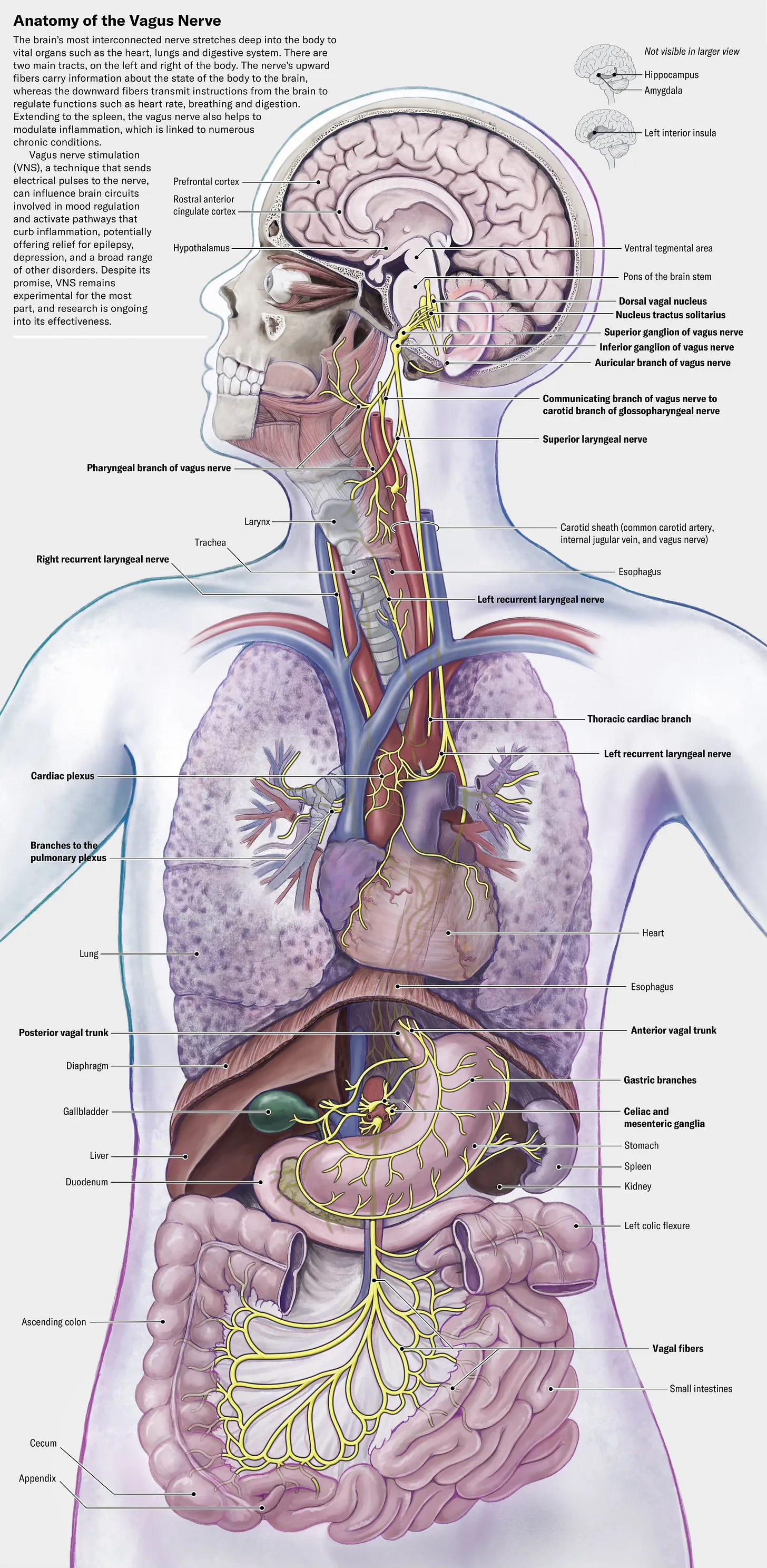
手术需要在左颈部切开约1.5英寸的切口,位置大约在喉结水平,植入一个约复合维生素或鱼油胶囊大小的设备。
Surgery involves about an inch and a half incision in the left neck at about the level of the Adam's apple or the larynx to implant a device that's about the size of a multivitamin, or a fish oil pill.
该设备直接放置在迷走神经上,位置大约在颈动脉搏动处。
The device, sits directly on the vagus nerve at about the level of the carotid pulse.
你可以摸到自己的脉搏。
You can feel your pulse.
这个设备是自成一体的,带有那两个闪亮的东西或者说放置在迷走神经上的导线。
And it is self contained with those two shiny things or the leads that sit on the vagus nerve.
当然,里面有一个计算机,一个计算机磁盘。
There is a, a computer, a computer disc, of course.
还有一个天线用来与医生的平板电脑通信。
There's an antenna to talk to the, the doctor's tablet.
我在讲台上总是会把它掉在地上,这在舞台上非常麻烦,埃里克。
I always drop it when I'm at the podium, and that's very complicated on stage, Eric.
它的设计非常巧妙,虽然放置在迷走神经上,但整个装置被包裹在这种类似豌豆荚的硅胶材料中。
It also has, which is really clever, it sits on the vagus nerve, but it's wrapped in this this silastic like a pea pod.
所以神经从下方穿过,然后顶部有一针缝合线来固定整个装置。
And so the nerve runs underneath it, and then there's a stitch that goes through the top to hold the whole thing in place.
植入这个装置的手术需要多长时间?
How long would that surgery take to put it in?
经验丰富的神经外科医生植入时间不超过一小时,通常在半小时到一小时之间。
An experienced neurosurgeon will put it in, in under an hour, anywhere between a half hour and an hour.
这是个门诊手术,做完就能回家。
It's an in and out surgery, outpatient.
早上来医院,下午就能回家。
Come in in the morning, go home in the afternoon.
我们一直在医院进行这类手术,但未来显然适合在独立的全门诊设施开展。
We've been doing them, in the hospital, but obviously this will be amenable in the future to a full outpatient standalone facility.
目前神经外科医生正在接受公司的技术培训。
Right now, neurosurgeons are being, trained, by the company in the procedure.
因此有一批精选的神经外科医生在特定医疗中心进行这项手术。
And so there's a select group of neurosurgeons who are doing this at select sites.
但最终,这仍然是可能实现的。
But eventually, again, it's possible.
这个我不太清楚。
I don't know this.
我不是Setpoint Medical公司的内部人员。
I'm not an insider in Setpoint Medical, the company.
但最终,我设想在积累足够经验后,这些植入物会被应用于其他专科领域。
But eventually, I would imagine a time when these when the implants are brought into other specialties once the expertise has been gained.
当然。
Sure.
现在这个设备每天会刺激几次?
Now that device gets stimulated a couple times a day?
这个设备配备可充电电池。
So the device has a rechargeable battery.
因此,医生最初会根据FDA对类风湿性关节炎的批准来设置。
So the doctor to start, because the FDA has a for rheumatoid arthritis.
风湿病专家会将设备编程为每天自动开启一分钟。
The rheumatologist will will program the device to turn itself on for one minute a day.
患者无需做任何事。
Nothing for the patient to do.
当电流流动时,我已
When the current, is flowing, I've
见过很多,
met many,
很多患者。
many patients.
他们他们在刺激时没有任何感觉。
They They don't feel anything when it's stimulating.
有些患者会在颈部感觉到一分钟的轻微刺痛感。
Some patients feel a little tingling for one minute in their neck.
有些患者没有任何感觉。
Some patients feel nothing.
我遇到过一些人在每天一次的治疗过程中都能睡着,也遇到过其他人。
I've met people who sleep through the therapy once a day, and I've met other people.
我认识一位学校老师,她叫Dawn,还曾被《纽约时报》报道过。
I met a school teacher, and, and, and she was written about in the New York Times, Dawn.
她告诉我这个装置会在早上把她唤醒。
And she told me that it wakes her up in the morning.
我说,哦,那太糟糕了,凌晨4点半就把你吵醒。
And I said, oh, that's too bad, 04:30, waking you up at 04:30.
她说,不会啊,我反正都早起。
She goes, no, I get up early anyways.
我不介意这个。
I don't mind it.
多年来,我作为老师,闹钟总是在4点半响起,那时我会感到手和手腕疼痛,然后开始哭泣。
And for years, my alarm would I'm a teacher, and my alarm would go off at 04:30, and I would, feel the pain in my hands and wrists, and I'd start to cry.
现在这个设备会用轻微的刺痛感唤醒我。
And now this thing wakes me up with a little tingling.
我醒来时双手不再疼痛,带着灿烂的笑容开始新的一天。
And I wake up, and I have no pain in my hands, and I get a big smile on my face to start the day.
所以她并不介意这种刺痛感。
So she doesn't mind the tingling.
这很好,因为你们设置了假刺激对照组,让一半的受试者佩戴设备——完全正确。
Well, was good because you had a sham control where you put in the device, half the- Absolutely.
当然,它并没有接受任何刺激。
And of course, it wasn't getting any stimulation.
只是植入了设备而已。
Was just the device was in.
这是设备随机对照试验中最严格的对照组设置,对吧?
That's the ultimate control in a device, randomized trial, right?
没错。
That's right.
完全正确。
That's exactly right.
正如你所知,所有数据都发表在《自然医学》期刊上。
And as you know, the data are all in the Nature Medicine paper.
约翰·特瑟是第一作者。
That John Tesser was the first author.
而这一点,这一点在假手术对照组中是个重要因素。
And what, what, that, that was an important factor in the sham controls.
假手术组中有多少人认为自己属于激活组,认为每天能感受到一分钟的启动感。
How many people in the sham group think they have the active group, think that, they're feeling it come on for a minute a day.
这个比例很小,几乎与激活组中自认为能感受到刺激的人群比例完全一致。
And that it was a small percentage that was, almost the exact same percentage of people in the active group who thought they could feel it.
对,对,确实如此。
Yeah, yeah, yeah.
所以这已经相当理想了——虽然对于这种手术显然不存在完美的对照组,但这已经无限接近完美了。
So it's pretty, there's no, there's no perfect control for a procedure like this, obviously, but that's pretty darn close to perfect.
哦,这真是令人印象深刻。
Oh, that's impressive.
现在有人问,这个设备叫什么名字?
Now, one of the people was asking, what's the name of this device?
我的意思是,这是一种迷走神经刺激器(VNS)。
I mean, it's a VNS, a vagal nerve stimulator.
它有具体的名称吗?
Is there a name to this?
这个设定点设备被称为免疫调节器。
The setpoint device is called an immunoregulator.
好的。
Okay.
从技术上讲,它作用于迷走神经,向迷走神经传递电脉冲。
And technically, it goes on the vagus nerve and puts electric pulses into the vagus nerve.
所以没错,它是迷走神经刺激器,但与四十年来用于治疗癫痫和抑郁症的设备有很大不同。
So yes, it's a vagus nerve stimulator, but it's very different from what's been used for forty years to treat epilepsy and depression.
所以,那个,那个信号,我是说,设备不同,信号也不同。
So the, that, that, the signal, I mean, the devices are different and the signals are different.
但我们可以先讨论的最大区别是,根据历史先例,用于治疗癫痫和抑郁的信号是每次开启五分钟,然后关闭五分钟,一天24小时,一年365天不间断。
But the, the biggest difference we could talk about first is that the, the signals that are used to treat epilepsy and depression by historic precedent, those signals are on for five minutes at a time, then off for five minutes, twenty four hours a day, three sixty five days a year.
也就是说,这是一个5毫安、12小时工作周期的方案,而我们的方案是24小时内工作1分钟,电流强度为300到400微安。
So there's a twelve hour duty cycle at five milliamps, as opposed to a one minute duty cycle in twenty four hours at 300 to 400 microamps.
哦,哇塞。
Oh, wow.
原因在于我们理解了炎症反射如何下调细胞因子风暴的生物学机制。
And the, the re, the reason is we understand the biology of how the inflammatory reflex down regulates cytokine storm.
颈部的一分钟激活会将信号传导至腹部神经节,这些信号随后被传递到脾神经和脾脏。
And the one minute activation in the neck drives signals down into the ganglia of the abdomen, which are relayed into the splenic nerve and the spleen.
在这个信号传递序列的每一步——从迷走神经到神经节,从神经节到脾神经,从脾神经到T细胞,再从T细胞到单核细胞——信号都会经历千倍级的放大。
And at every step in the sequence, from the vagus nerve to the ganglia, from the ganglia to the splenic nerve, from the splenic nerve to the T cells, and from the T cells to the monocytes, you have this thousand fold amplification of the signal.
而且信号具有持久性,在刺激结束后数小时内仍能通过神经递质的释放来持续抑制细胞因子。
And you have a persistence of the signal that goes on for hours and hours afterwards of with neurotransmitter release that suppresses the cytokines.
所以一分钟就能提供十二小时的保护。
So one minute gives you twelve hours of protection.
太神奇了,真的。
Amazing, really.
每天只需一分钟。
One minute a day.
那为什么我们还没有针对所有自身免疫性疾病推广这种疗法?为什么它没有取代所有药物成为一线治疗方案?
Now why don't we have, for all autoimmune diseases, why isn't this become a frontline therapy instead of all the drugs?
这个嘛,你知道——
Well, you know-
是的。
Yeah.
这让我想说,医学领域的所有疗法都是如此,对吧?
That kind of get me to say all, all are, all for, all for anything in medicine, right?
没有任何方法能对所有人始终有效。
Nothing's gonna work for everybody all the time.
但你会...是的。
But you're gonna Yeah.
我认为你会看到更多的临床试验。
I think you're gonna see a lot more clinical trials.
因此,我们在炎症性肠病的开放标签试验中看到了非常令人印象深刻的结果。
So we've seen very impressive open label trials for inflammatory bowel disease.
这种方法确实有效。
It works.
我们在一些糖尿病模型和二型糖尿病中看到了非常令人印象深刻的开盲试验结果。
We've seen very impressive open label trials in some diabetes models and type two diabetes.
而且我们还在糖尿病、多发性硬化症等领域看到了非常令人印象深刻的临床前结果。
And we've seen very impressive, preclinical results in, again, diabetes, in multiple sclerosis.
我们在狼疮性关节炎领域看到了初步临床试验。
We've seen pilot clinical trials in lupus arthritis.
我们在其他炎症性疾病中也看到了初步临床试验。
We've seen pilot clinical trials in other inflammatory conditions.
所以我百分之百同意你的观点。
So I am agreeing with you 100%.
这只是冰山一角。
This is the tip of the iceberg.
还有很多工作要做。
There's work to do.
还需要进行临床试验。
There's clinical trials to be done.
需要筹集和投入资金。
There's going to be money to be raised and spent.
但我认为你会看到它实现,因为患者会对此有需求。
But I think you're going to see it happen because patients are going to demand this.
我的意思是,我们讨论过生物制剂的昂贵性。
I mean, we talked about the expense of biologics.
我们也讨论过它们的侵入性。
We talked about their invasiveness.
我们讨论了它们的免疫抑制黑框警告。
We talked about their immunosuppressive black box warnings.
我们忽略了它们只有一半时间有效的事实。
We left out the fact they only work half the time.
实际上,有那么多。
That much, actually.
是的。
Yeah.
40%到50%,如果运气好的话,对吧?
40%, 50% if you're lucky, right?
是的。
Yeah.
所以,需求是存在的。
So, so the demand is there.
我写这本书的初衷很简单,就是为了给患者、医生以及对迷走神经感兴趣的亲友建立一个基础信息平台,让大家了解我们在实验室和临床中已验证的事实。
And I wrote, I wrote this book for the simple reason of establishing a platform of basic information for patients, for doctors, and for family and friends interested in the vagus nerve, that this is what we know to be true in the lab and in the clinic.
这就是我们所知的错误信息。
This is what we know to be false.
这些正是我敦促同事们加倍努力的重要事项,因为我们还有很多工作要做。
And these are the important things that I'm, I'm urging my colleagues to double down and work harder on because we've got a lot more to do.
我认为我们将帮助数百万人。
I think we're gonna help millions of people.
嗯,你刚才提到的自身免疫性疾病,它们都值得深入研究。
Well, think the autoimmune diseases that you just touched on, they all deserve study.
类风湿性关节炎的结果非常显著,对于难治性患者而言,尤其有可能避免免疫抑制及其所有其他副作用,潜力巨大。
The rheumatoid arthritis results are so striking that in refractory people, no less potentially to avoid immunosuppression and all these other side effects, It has a lot of potential.
现在有一位听众提出的问题是关于外部设备的,这让我想到了长新冠。
Now one of the questions that one of the listeners brought up was about an external device, and that brings me to long COVID.
正如您非常了解的,体位性心动过速综合征(POTS)在长新冠患者中非常普遍。
So POTS, as you know very well, postural orthostatic tachycardia syndrome, very prominent among people with long COVID.
在此过程中,加拿大曾有一家公司生产外部迷走神经刺激器。
Along the way, there was a company in Canada that was an external vagal nerve stimulator.
这个已经经过测试了吗?
Has this been tested?
这似乎是直接针对这个神经系统的炎症。
That appears to be inflammation directly of this nervous system.
在体位性心动过速综合征(POTS)方面,外部设备和/或这个设备有任何应用经验吗?
Has there been any experience with external devices and or this device in pots?
确实有一些经验。
It's there's been experience.
但是根据我对文献的回顾——我现在可是在和世界顶尖的医学文献综述专家对话,这让我自己都感到紧张。
But but to to my review of the literature, and I'm speaking to the world's expert on the review of the medical literature, so that makes myself nervous.
不过话虽如此,根据我的文献调研,对于应用于皮肤的手持设备,我尚未找到任何证据表明它们能直接刺激迷走神经。
But that being said, my review of the literature, I am unable to find for handheld devices applied to the skin, any evidence that any of them directly stimulate the vagus nerve.
所以作为生物医学工程师,我们曾尝试在实验室进行这类实验,在志愿者身上实施,并与生物医学工程团队合作开展研究。
So as as biomedical engineers, we've tried to do it in my lab, and we've to do it in volunteers and biomed we've worked with biomedical engineers.
如果在人类或大型动物的皮肤上施加电流,你提到的人类颈部迷走神经其实位于颈部深处。
If you put electricity on the skin, of of a of a human being or a large animal, The vagus nerve in humans in the neck where you pointed is deep in the neck.
它与颈动脉共同包裹在自身的鞘膜中。
It's wrapped in its own sheath with the carotid artery.
它位于多层筋膜之下。
It's underneath several layers of fascia.
它位于颈阔肌下方。
It's underneath the platysma muscle.
它位于皮肤下方。
It's underneath the skin.
电流不会像激光束那样传播,当你把它放在皮肤上时指向哪里就传到哪。
Electric current doesn't travel like a laser beam where you point the thing when you put it on your skin.
它并不是那样工作的。
It doesn't work that way.
所以,在通过FDA试验后,将某些设备称为迷走神经刺激器是可以的。
And so it's okay to call things, vagus nerve stimulators, after they've gone through FDA trials.
但这并不意味着它们就是FDA认证的。
But it doesn't mean they are FD.
是的。
Yeah.
它们是迷走神经刺激器。
They are vagus nerve stimulators.
我想你的意思是,通过外部设备无法准确刺激到迷走神经。
You're just not going to get it right from an external device is I think what you're saying.
也就是说,必须要有设备能精确作用于迷走神经本身,对吗?
And this is, something has to be right, on the vagus, right?
迷走神经有一个分支延伸到皮肤的部位,那就是外耳的耳甲腔软骨——也就是你耳朵上像海螺一样环绕耳洞的那个部分,称为耳甲腔。
There's one place the vagus nerve sends a branch to the skin, and that is in the cartilage of the external ear called the symbocontia, which is the part of your ear that looks like a seashell around the open ear, symbocontia.
如果你用某种设备(比如TENS单元)对耳甲腔进行电刺激,那么可以说你刺激了迷走神经,因为你刺激了从该软骨传导的感觉纤维。
Now if you electrically stimulate the symbocontia with some sort of device, a TENS unit or something, then arguably you've stimulated the vagus nerve because you've stimulated the sensory fibers traveling from that cartilage.
你知道它为什么在那里吗?
You know why it's there, right?
这条迷走神经分支是进化遗留的痕迹,它曾支配鱼类软骨鳃的神经分布。
This vagus, it's a vestigial branch of the vagus nerve that used to innervate evolutionarily the cartilaginous gills of fish.
所以当那块软骨变成外耳软骨时,它把神经也一起带过去了。
So it dragged the nerve with it when that cartilage became the cartilage of the external ear.
那么当你在耳屏上施加电流时,你是在刺激迷走神经吗?是的。
So so are you stimulating the vagus nerve when you when you put electricity, on your sim Yes.
而且有些研究确实非常有趣——我个人也很推崇这种方法,对吧?
And there's some really interesting and I and I'm a fan of it, right?
目前已经通过脑成像、功能性磁共振成像和远场诱发电位等技术取得了非常有趣的科学发现。
There's some really interesting science that's been done with brain imaging, fMRIs, far field evoked responses.
展开剩余字幕(还有 365 条)
但你不能说这与在迷走神经上放置设备以特异性激活迷走神经纤维所产生的定点效应是同一回事。
And you can connect all kinds of dots, but you can't say it's the same thing that setpoint is doing as putting a device on the vagus nerve to specifically activate vagus nerve fibers.
这意味着什么?
So what does that mean?
这意味着如果你查看典型的外部设备研究(无论是颈部还是耳部设备),你会发现研究对象数量相对较少(通常20或50人),通常是开放标签试验,控制条件不严谨,并且通常测量某些临床效果——这些效果往往能达到统计学显著性,比如炎症减轻或心率变异性增加。
It means if you look at the typical study of an externally used device, whether it's on the neck or the ear, what you see are relatively small numbers of subjects, usually 20 or 50, usually open label, usually not well controlled, and usually measuring some clinical effect, which often reaches statistical significance, decreased in inflammation, increased heart rate variability.
埃里克,这些发现很有意思,但并未证实其作用机制。
This is interesting stuff, Eric, but it doesn't prove the mechanism.
是的。
Yeah.
而且这并未证实其作用机制。
And it doesn't prove the mechanism.
几乎所有这些研究——甚至包括那些促成FDA批准各种设备的试验——都缺乏足够可重复性,让人难以放心推荐给临床实践,也无法让专业协会放心大规模推广。也就是说,它们尚未经过大规模随机、严格对照、统计严谨的临床试验验证。
And and almost none of it, even some of the some of the trials that have led to FDA approvals for various devices, almost none have been replicated in a way you that would make you comfortable to recommend these things for your practice or would make your your professional societies comfortable recommending it as a broad scale thing, meaning they have not been subjected to large randomized, well controlled, statistically rigorous clinical trials.
这就是——嗯,也许——
That's what- Well, maybe-
我并不反对这些东西。
I'm not opposed to these things.
是的。
Yeah.
我会做。
I do it.
我大多数日子都会在耳朵上使用TENS设备,因为它可能有效。
I use a TENS unit in my ear, most days because it might work.
但我向人们推荐它作为一种疗法,因为我也不确定它是否真的有效。
But I recommend it to people as a therapy because I'm not sure it does work.
怎么样?
How's that?
是的。
Yeah.
不,我明白。
No, I get that.
你在这里提到了TENS设备的其他用途,很多人用它来治疗严重疼痛。
And you're bringing up the other parts of the story here with the TENS device that a lot of people are using for serious pain.
而且,这种设备最初并不是为了缓解炎症而开发的,它起源于1988年对癫痫的治疗。
Also the fact that this got its start, not related to relieving inflammation, but it was back in epilepsy, 1988.
VNS被用于治疗癫痫。
VNS was used for epilepsy.
在我们开始之前,你告诉我书中提到的一些情况:这种设备帮助了一些癫痫患者控制发作,但即使对某些人无效,他们也不愿意把设备取出来。
And before we got started, you were telling me about how, and it's in the book, how people it helped some people with epilepsy, with their seizure control, but the people didn't want to have the device taken out who it wasn't helping.
为什么会这样?
Why was that?
是的。
Yeah.
所以这里有几个有趣的故事。
So there's two or three interesting stories here.
和你一样,我也对医学史很感兴趣,但这个故事要追溯到十九世纪末,当时一位纽约医生开始用一种类似狗项圈的装置治疗他的癫痫患者,这些患者患有严重的癫痫发作,装置连接着一个法拉第充电线圈,戴在患者脖子上。
Like you, I'm a fan of medical history, but the story begins at the end of the nineteenth century when a New York physician started treating his patients with epilepsy, serious seizure disorders, started treating them with like a dog collar like device that he would put around the neck of his patients connected to a Faraday charging coil.
所以他当时在给这些人通电。
And so he was shocking these people.
他们必须被绑在他的检查台上。
They had to be tied down on his exam table.
这就是这一切的开端。
So that's when this all started.
关于这些故事,有一些非常出色的文献资料。
And, there's some there's some great treatises of of of that of those stories that are out there.
那么,快进到20世纪80年代,正如你所说。
And so skip fast forward to the 1980s, as you said.
实际上,就在二战结束后,意大利比萨的一位生理学家在实验室里研究了一种癫痫模型,我认为是用猫做的实验,他发现,如果在猫的大脑中诱发癫痫样放电并通过脑电图监测,然后对它们的迷走神经施加短暂的电脉冲,就能抑制癫痫尖波。
And, well, actually, right after World War II in Pisa, Italy, a, a physiologist, worked on an epilepsy model in his lab, I believe it was in cats, and and showed that if he electric if he induced seizure activity in the brain of the cats and measured it by EEG but applied electric current, just brief electric pulses to the vagus nerve of those cats, that it would stop the the epileptic spikes.
因此,在20世纪80年代,一位费城的神经科学家为此申请了专利,并在专利中引用了那位意大利研究者的工作,从而促成了Cyberonics公司开展的首次临床试验。
So in the nineteen eighties, a a a a Philadelphia neuroscientist patented that, cited that Italian's work in his patent, and led to the first clinical trials by a company called Cyberonics.
第一个设备是由一位名叫比尔·贝尔的神经外科医生植入的,他当时正是我在纽约医院神经外科实习期间的主治医生。
The the first device was implanted by a neurosurgeon named Bill Bell, who was actually my chief resident when I was an intern here at the New York Hospital on neurosurgery.
结果发现它带来了显著的益处,帮助一些患者从每小时发作10次、20次甚至50次减少到完全不发作或极少发作。
And it turned out to have very significant benefit, helping some patients who would go from having 10 or 20 or 50 seizures an hour to having none or or very few.
我的意思是,让一些原本无法出门的人重返工作岗位,重新融入社会,但至今我们仍不清楚原因。
I mean, putting some people who were homebound back at work and out out out and today, we don't know why.
我刚刚已经告诉你了关于迷走神经刺激与癫痫的所有主要科学知识。
I pretty much just told you most of the science that we know about vagus nerve stimulation and epilepsy.
它似乎对一半的患者有效,但我们并不知道为什么。
It seems to work in half the people, but we don't know why.
对于另一半患者,早期的外科医生会说:‘这对你没有帮助。’
The other half, that it didn't work in in this back in the early days, the surgeons would say, well, this isn't helping you.
把设备取出来吧。
You take it out.
患者却说:‘你们不能取走我的设备。’
The patient's like, you're not taking out my device.
出人意料。
Surprise.
让医生们感到惊讶。
Surprising the doctors.
然后他们询问原因?
And and and they asked why?
病人回答说,因为我感觉好多了。
And the patient says, because I feel better.
这让我感到快乐。
It makes me happy.
基于这一点,这促使我们开展了使用迷走神经刺激治疗难治性抑郁症的临床试验。
It makes me based on that, that led to, clinical trials of using vagus nerve stimulation to treat treatment refractory epilepsy, sorry, depression patients.
这些患者已经用尽了谈话疗法的选择,也尝试了各种药物治疗方案却仍无效果。
Patients who are out of options with talk therapy, patients who are out of options with medical therapy.
经过多年研究发现,这种方法再次在大约50%的情况下有效,也就是对半数患者起作用。
And as it turns out, in years and years of work, it works again about fifty percent of the time, about half.
这时候人们会说,真希望有效率能超过50%啊。
And, and people say, oh, well, I wish it was more than fifty percent.
那些受益于迷走神经植入术治疗难治性抑郁症的患者中,有些人从曾经有自杀倾向、无法照顾家人或无法工作,重新回归了正常生活。
Well, some of the people that have benefited from these vagus nerve implants for treatment resistant depression have gone from being suicidal or unable to care for their families or unable to work to being back in, back in the mainstream.
所以我希望这个话题能被更多讨论,埃里克。
And so I wish there was a lot more talk about this, Eric.
我希望有更多人了解这种疗法。
I wish a lot more people knew about this.
但愿我们能更深入地了解其作用机制。
I wish we knew a lot more about the mechanism.
我也希望我们能对成本效益比进行更深入的分析,因为我认为应该有更多人了解这项技术,并且开展更多相关工作。
And I wish we had really better analysis of the cost benefit ratio, because I think more people should know about this and more should be done.
是的,我认为需要指出的是,关于难治性抑郁症的随机试验刚好在本月发表了。
Yeah, I think it's important to point out there the randomized trial in refractory depression was just published this month.
正如你所说,在重度难治性抑郁症患者中,有一半人获得了显著改善。
And it's, as you say, half the people derive substantial benefit with severe refractory depression.
所以这种‘入侵迷走神经’的整体思路——无论是为了减轻炎症,还是其获益机制尚不明确——其多样化的潜在临床应用前景确实非常引人注目。
So this whole idea of hacking the vagus nerve, whether it's to reduce inflammation, or maybe not so clear cut as far as the mechanism for benefit, it's pretty striking the diverse beneficial potential use cases, if you will, clinical applications.
如今流行的一件事是冷水浸泡,但我对此不太理解。
Now one of the things that is hot these days, which I don't understand, are cold plunges.
有些人极力推崇这种做法,比如彼得·阿蒂亚等伪科学倡导者。
You have these people advocating like, you know, Peter, Atia, and others of the bro science.
他们总说你应该尝试冷水浸泡。
You should go for cold plunges.
这些人往往在冷水浸泡后又会去蒸高温桑拿。
And these people are going from cold plunges to hot saunas.
有一种潜水反射。
There's a diving reflex.
这是怎么回事?
What's going on here?
冷水浸泡有什么特别之处吗?
Is there anything too cold plunges?
这个话题我们可以聊上两个小时,埃里克。
We could talk about this for two hours, Eric.
我不确定我们能否做到这一点。
I'm not sure we could do that.
我认为在讨论我们对这些生理反应的理解时,必须非常谨慎,因为这很复杂。
I think you have to be really careful, when you talk about what we understand about these physiological responses, because it's complicated.
所以或许我们可以先退一步谈谈迷走神经。
So maybe we could back up for one second to the vagus nerve.
你的听众中有很多是医生,也有很多是科学家,对这些内容都很精通。
Many of your many of your listeners are physicians, and and many of your listeners are scientists and well versed in all this.
但对于那些不了解的人,我们说是迷走神经,但你有两条。
But for those that are not, we say vagus nerve, but you have two of them.
你的脖子两侧各有一条。
You have one on each side of your neck.
我们说是两条迷走神经,但每条内部都包含10万根纤维。
And we say two vagus nerves, but inside of each of them, you have a 100,000 fibers.
所以严格来说你有20万条迷走神经纤维。
So you have 200,000 vagus nerves technically.
而这每一个单独的纤维都经过了数百万年的自然选择和进化压力,它们拥有特定的起源和从大脑到身体或身体到大脑的特定路径,并执行着特定功能。
And each and every one of those individual fibers was selected for and and and subjected to evolutionary pressure for millions and millions of years to have a specific origin, a specific destination from the brain to the body or the body to the brain, and to do a specific function.
根据我们在实验室中的有限刺激和临床证据表明,当目标是控制炎症时,我们只需刺激几百根纤维就足以实现这一效果。
And the idea when we stimulate in the lab and with our limited clinical, evidence, the evidence suggests that when the idea is to control inflammation, we're stimulating a few 100 fibers, and that's sufficient to control inflammation.
这些纤维与控制你对寒冷反应的纤维并不相同。
Those are not the same fibers that control your response to the cold.
这些纤维与控制心脏反应的纤维也并非同一类。
Those are not the same fibers that control the response to your heart.
这些与控制呼吸反应的纤维并不相同。
Those are not the same fibers that control your response to breathing.
所以问题是,当有人告诉我他们想通过某种方式刺激迷走神经时,我会说:哦,是吗?
So the question is when someone tells me I wanna do this, that, or the other thing to stimulate my vagus nerve, I say, oh, really?
你具体打算刺激哪一部分?
Which one are you gonna stimulate?
你准备如何实现呢?
And how are you gonna do that?
这就是事情变得复杂的地方。
That's where it gets complicated.
这极其复杂。
It's incredibly complicated.
比如冷水浸泡。
So cold plunge.
你知道,每个人都记得自己的第一次冷水浸泡经历,对吧?
You know, everyone remembers their first cold plunge, right?
因为这实在太难受了。
And because it's awful.
我的意思是,我那次纯属意外。
I mean, might have mine happened by accident.
我哥哥在一个温暖的春日骗了我。
My brother tricked me in a on a warm spring day.
我哥哥骗我跑进冰冷的海水里——他自己只站在脚踝深的地方,却让我做跑动式跳水。
My brother tricked me into running into the freezing cold ocean by he was standing at his ankles, and he told me to do a running dive.
当你跳进华氏50度的水中,浮上来时你会无法呼吸。
And when you go into that 50 degree water, you come up and you can't breathe.
所有空气都从肺部排出,你无法吸气。
All the air goes out of your lungs, and and you can't inhale.
这是一种强烈的战斗或逃跑反应。
And that is a massive fight or flight response.
这是一种强烈的战斗或逃跑反应。
That is a massive fight or flight response.
你会经历肾上腺素和去甲肾上腺素的激增。
You have a surge of epinephrine and norepinephrine.
你的心率会上升。
Your heart rate goes up.
你的血压会升高。
Your blood pressure goes up.
据说这与副交感神经的'战或逃'或'休息消化'反应正好相反。
And that's the opposite, allegedly, of a parasympathetic fight or a rest and digest response.
但如果你一直待在冷水中并适应了寒冷,会发生什么?
But what happens if you stay in the cold water and you cold adapt?
埃里克,在这方面很难找到控制得当的
And here, Eric, it's very hard to find well controlled
哦,真的吗?
Oh, really?
是的。
Yeah.
临床研究。
Clinical studies.
我找到了一些,并且都收录在书里了。
I found a few, and they're in the book.
但这非常困难。
But it's very hard.
通常都是冰岛或波罗的海国家等地的军人,穿着泳衣在低温房间里接受冷水喷洒。
Usually it's military type soldiers in Iceland or something or in the Baltic States getting sprayed with water in a cold room and with, you know, dressed in a bathing suit.
然后他们抽取血液样本。
And then they give their blood.
所以确实存在这类数据。
So there's some data like this.
如果你在一定时间内达到某种程度的冷适应,你会实际感受到心率变慢。
If you cold adapt to some point for some period of time, you will actually feel your heart rate slow down.
这时你就可以说,我的迷走神经反应已经超过了战斗或逃跑反应。
At which point you can say, my my vagus response is exceeding my fight or flight response.
它们两者都仍然活跃,但是但是但是,我们姑且这么说,你已经从主要交感神经状态转向主要副交感神经状态了。
They're both still active, by the But but but let's just say for that you've tipped from primarily sympathetic to primarily parasympathetic.
所以,好的,现在你已经刺激了迷走神经,但你还对神经系统做了无数其他事情。你并没有在脖子上放置设备来针对几百根纤维来关闭炎症。
So, okay, now you've stimulated your vagus nerve, but you've done a million other things to your nervous system You haven't put a device on your neck targeting a few 100 fibers to turn off inflammation.
那么,那些先让你的血压升高再降低、心率先加快再减慢的纤维,与控制脾脏炎症的纤维是同一批吗?
Now, do the fibers that made your blood pressure go up first and then down, and your heart rate go up first and then go down, are those the same fibers that go to your spleen and control inflammation?
我认为不是。
I don't think so.
整个系统是否作为一个整体同时反应?
Does the whole thing act as an en bloc everything at once response?
我不这么认为。
I don't think so.
我可以一边弹钢琴一边嚼口香糖。
I can play the piano and chew gum at the same time.
你明白吗?
You know?
所以当你按顺序分解这个过程时,就能理解为什么人们会对它感兴趣。
So when you break it down in a sequential way, you can understand why why people are interested in it.
我确实每周都会在常规淋浴结束后进行几次冷水淋浴。
And I do do cold showers several times a week at the end of my regular shower.
原因在于战斗或逃跑反应——急性受控的战斗或逃跑反应具有抗炎作用。
And the reason is fight or flight, acute controlled fight or flight is anti inflammatory.
我们和许多其他研究者都证实了这一点,顺便提一下包括维姆·霍夫。
We and many others have proved that, including Wim Hof by the way.
增加迷走神经活动具有抗炎作用,这一点我们已经证实了。
And increasing vagus activity is anti inflammatory, and we proved that.
所以对我来说,这就像帕斯卡的赌注,对吧?
So for me, it's a Pascal's wager, right?
我的医生说我可以接触冷水,没问题。
My doctor says I can I'm okay in cold water.
我的意思是,虽然前三十秒很难熬,但之后我就觉得没什么了。
I don't, I mean, I hate it for thirty seconds, but then I don't mind it.
所以这可能对我有好处,但我并不称之为迷走神经刺激器。
And it might be good for me, so But I do I don't call it a vagus nerve stimulator.
对。
Right.
而且冷水淋浴和跳进那种冰浴桶、让全身浸入水中是不同的。
And a cold shower is different than going into one of these plunges, putting your whole body in there.
哇。
Wow.
我可做不到那个。
I could not do that.
而且作为心脏病专家,我的病人要是那么做可能会引发心肌梗死。
Plus, as a cardiologist, I got patients who, if they did that, they could have an MI.
他们可能出现血管痉挛然后惹上大麻烦。
They could go into vasospasm and get in big trouble.
很多人甚至不知道自己患有动脉疾病。
A lot of people don't even know they have arterial disease.
好的。
Okay.
现在,关于迷走神经的一大热点是,人们通过传感器佩戴设备(无论是戒指、床垫传感器还是智能手表)来测量心率变异性。
Now, big thing these days about the vagus nerve that people with sensors are measuring wearables, whether it's a ring or whether it's a mattress sensor or a smartwatch, is heart rate variability.
他们将其与所有事情都等同起来。
And they're equating that to everything.
事实上,ChatGPT Health 将心率变异性列为衡量个人健康状况的首要指标。
In fact, chat GPT Health made that the number one thing about a person's health is how is HRV?
这周《华盛顿邮报》上有一篇关于这个的文章。
And there's an article from the Washington Post about that this week.
不管怎样,你对这种测量有什么看法?它的相关文献非常难以理解。
Anyway, what is your sense about this measurement that has very difficult literature associated with it?
它显然与自主神经系统有很大关系。
It obviously has a lot to do with the autonomic nervous system.
好吧,我们又来了,对吧?
Well, here we go again, right?
让我们从一些真正容易理解、而且可能很重要的事情开始。
Let's start with what's really easy to understand, and I think probably pretty important.
我们无法直接在人体内测量迷走神经。
So we can't measure the vagus nerve directly in humans.
我们可以在动物身上植入电极,测量单个神经纤维或神经纤维群,通过记录动物迷走神经的活动,获得大量关于其工作原理的有趣数据。
We don't have we can put electrodes in animals, and we can measure individual fibers and groups of fibers, and we can get a lot of interesting data about how the vagus nerve works by recording its activity in animals.
但目前我们还没有在人体上做这种测量的工具。
But we don't have the tools to do that yet in people.
这些工具总有一天会出现,西海岸的一些实验室正在开发实验性工具。
They'll come someday, and there's some experimental tools on the West Coast that are being developed in laboratories.
所以这一定会实现的。
So it'll happen.
但在此之前,判断一个人或哺乳动物迷走神经活动增强的最佳指标就是他们的心率会变慢。
But until then, the absolute best indicator of a person or a mammal with increased vagus nerve activity is that their heart rate is slower.
这是因为迷走神经的一个分支连接心脏,该分支中的纤维会起到减缓心率的作用。
And that's because one of the branches of the vagus nerve, it goes to the heart, and fibers traveling in that branch tend to slow heart rate.
所以这既有趣又相当容易理解。
So that's interesting and pretty easy to understand.
我的意思是,这并不代表你漱口时就是在专门刺激通往心脏的分支,就像你漱口时也不会专门刺激通往胰腺或脾脏的分支一样。
I mean, it doesn't mean if you gargle or that you're stimulating specifically those branches to your heart any more than if you gargle or that you're specifically stimulating the branches to your pancreas or your spleen either.
但至少我们知道有分支通向心脏并减缓心率。
But at least we know there are branches that go to the heart and slow heart rate.
所以这很有趣。
So that's interesting.
我第二个觉得非常有趣的是,回到你的世界。
The second thing I find incredibly interesting is back to your your your world.
弗雷明汉研究显示,人群中预测长寿的唯一因素是心率最慢的人群比心率最快的人群寿命更长,无论其他条件如何。
The Framingham study showed that the single predictor of of longevity in a population was the population with the slowest heart rate live longer than the population with the fastest heart rate, regardless of other other conditions.
这项研究以及这一确切发现,经过一些微小调整后,在法国的研究中得到了重复,那项研究规模大约大了四倍左右。
And that study and that exact finding with a few minor tweaks was replicated in the French, study, which was what, four times bigger or something.
数以万计的患者。
Tens of thousands of patients.
如果心率较慢的人群比心率较快的人群寿命更长,那么所有原因导致的死亡率都会更低。
If you had a slower heart rate, if the population with the slower heart rate lived longer than the population with the faster heart rate, all cause mortality.
这很有趣。
So that's interesting.
那么,那些迷走神经活动更强的人,是否因此受到炎症的保护,且患心脏病更少呢?
So is it possible that those people with increased vagus activity have, are protected against inflammation and have less heart disease?
也许吧。
Maybe.
这是个有趣的假设。
It's an interesting hypothesis.
虽然很难研究,但确实非常有意思。
It's very hard to study, but it's very interesting.
那么
So
如果无法直接测量,而心率又受到活动、压力等多种因素干扰,那还能测量什么呢?其实可以测量心率变异性。
what if you can't measure it, and heart rate is confounded by all kinds of things like activity and stress and other things, so what else can well, you can measure heart rate variability.
心率变异性的问题在于测量它需要对其本质有非常简单的理解。
Now heart rate variability, the problem with measuring heart rate variability is comes down to a very simple understanding of what it is.
这是一种统计分析,使用傅里叶变换等方法处理单个数据点,即心跳间隔时间。
It's it's it's a statistical analysis using things like Fourier transformations of of individual bits of data, which are the, amounts of time between individual heartbeats.
因此你是将个体心跳的集合视为一种统计现象来观察。
So you're looking at the summation of the individual heartbeats as a statistical phenomenon.
其原理在于,当迷走神经兴奋时,会延长下一次心跳的间隔时间。
And the the reasoning is that when the vagus nerve fires, it prolongs the time to the next heartbeat.
所以你会得到更长的心跳间隔。
So you get a you get a longer, duration between heartbeats.
由于迷走神经是间歇性放电的,因此迷走神经活动越强,瞬时心跳之间的变异性就越大。
And the more very and because the vagus nerve fires intermittently, then the the the more vagus nerve activity you have, then the more variability you will have in the instantaneous heartbeats.
这就是迷走神经与心率变异性之间关系的基本原理。
That's the fundamental principle of of of, the relationship of the vagus nerve to heart rate variability.
与此相反的是,交感神经对心脏的作用会加速心跳,而这同样取决于你的活动状态、心理状态、压力以及其他各种因素。
And it's and it's and in opposition to this, you have the sympathetic input to the heart, accelerating heartbeat, which is also gonna be dependent on activity and your state of mind and stress and whatever else is going on.
那么,你如何利用这些信息呢?到目前为止,这很简单。
So what you do with this information, and here's where it gets up to now, it's easy.
到目前为止,这很简单。
Up to now, it's easy.
对。
Right.
你对这些信息的处理方式会经过算法分析。
What you what you do with this information is subjected to algorithms.
你知道,你的手表上就有算法。
You know, you have an algorithm on your watch.
你的可穿戴设备上也有算法。
You have an algorithm on your wearable.
你说过,你的手臂上、床上都有设备。
You have an argon on your arm, in your bed, you said.
我们只是不清楚所有这些算法的具体内容。
All we don't know what all these algorithms are.
它们都是专利算法。
They're all proprietary.
对。
Right.
所以当你搜索迷走神经和心率变异性的数十亿网页信息时,就会出现很多我认为非常混乱的内容,就像你刚才提到的。
So now you go into the billions of web impressions on vagus nerve and heart rate variability, and you come up with a lot of what I find to be, very confusing information that you alluded to.
而这里就回到了我半小时前恳求大家理解的关键点。
And here, it comes down to what I was pleading for a half hour ago.
我们真的需要更多大规模、设计良好、随机对照且具有统计学意义的临床试验,来回答心率变异性与健康之间关系的具体问题。
We we just really need more large, well controlled, well randomized, statistically meaningful clinical trials to answer specific questions about the relationship of heart rate variability to health.
我认为我们对潜在机制已经有了较好的理解。
I think we have a good understanding of the underlying mechanisms.
是的。
Yeah.
我的意思是,正因如此,才令人难以置信:正如你所说,各种专有算法公司输出的信息,告诉人们你的心率变异性不好、压力上升。
I mean, think this is why it's so crazy that, the outputs from various, as you say, proprietary algorithm companies are giving people information that your heart rate variability is bad, your stress is up.
我知道很多人在使用指环,他们说他们一直处于压力状态,因为心率变异性指标显示如此。
I know a lot of people using the rings, and they say they're constantly in stress because it's heart rate variability.
我不知道这是否真的准确,但显然他们得到的就是这类反馈。
Well, I don't know if that's really true, but that's of course that kind of output they get.
这是在使用一种不确定性很高的测量数据,向人们提供健康建议。
It's using a measurement with a lot of uncertainty, giving people health advice.
我觉得我们更希望拥有更高的迷走神经张力。
I think we'd like to have more vagal tone.
也许这就是为什么你会洗冷水澡,但这是一种很好的测量方式。
Maybe that's why you take cold showers, but a good way of measuring it.
我想说的是,心率变异性(HRV)这个指标你不应该过分依赖,因为存在很多不确定性,对吧?
And I would just submit that HRV, you don't want to hang your hat on that because there's a lot of uncertainties, right?
我觉得说得非常好。
I think that's very well said.
我认为归根结底,不同设备使用的都是各自专有的算法。
And I think at the end of the day, you have devices with different algorithms that are all proprietary.
所以如果你有钱,而且你想把钱花在可穿戴设备上,并且你认为了解心率变异性能让你感觉更好,那很好。
So you're if you if you have money and you and you wanna spend it on wearables and and you think you're getting it makes you feel better to know your heart rate variability, great.
我没意见,这没问题。
I'm I'm not it's fine.
这就是世界运转的方式。
This is what makes the world go round.
人们会做不同的事情。
People do different things.
但我认为如果你打算围绕它来规划自己的医疗健康方案,仅仅因为你认为人们理解它,那我觉得这是不妥当的。
But I think if you're planning your life's medical course around it, then I because you think people understand it, then I think that that's not right.
那么就应该遵循'买者自负'的原则。
Then it should be let the buyer beware.
我平时喜欢关注的一个方面——也想听听你的看法——就是当你运动时,心率会飙升得很高。
One of the things that I like to look at, and I'm interested in your opinion, when you do exercise, you get your heart rate really jacked up.
你的心率恢复速度有多快?
And how fast do you recover?
对我来说,这个指标更有用,因为如果你需要很长时间才能恢复到基础心率,那说明你的自主神经系统功能不太理想。
To me, that's more useful because if it takes you a long time to get back to your basal heart rate, that's not a very good sign of your autonomic nervous system functionality.
这是定性指标,你可能会看到一些相关的输出数据。
It's qualitative, and you'll see maybe some outputs about that.
但在我看来,这能很好地反映自主神经系统的健康状态和功能水平。
But that to me is a pretty good indicator of fitness and functionality of the autonomic nervous system.
不知道你是否认同这个观点。
I don't know if you think that's true.
我确实认为这是正确的。
I do think it's true.
而且我认为地球上没有哪位运动生理学家会不同意你的观点,即恢复到基线水平的重要性,或者精确测量的最大摄氧量作为健康指标的重要性。
And I don't think there's an exercise physiologist on the planet who would disagree with you with the importance of the recovery to baseline and or the importance of a carefully and well measured VO2 max as an indicator of health.
我认为有各种运动倡导者推荐不同的策略来提高最大摄氧量或改善恢复能力。
And I think there are various exercise advocates recommending different strategies to get more VO2 max or to improve your VO2 max or to improve your recovery.
我对这方面并不专业,了解得也不够深入。
I'm not expert on that, and I don't know enough about that.
这是另一个原因,因为智能手表测出的最大摄氧量非常不准确,而且是通过步行数据估算的。
That's another Because the VO2 max that you get out of a smartwatch is very inaccurate, and it's from walking.
这与去生理实验室戴上紧密贴合的面罩进行专业测试完全不同。
That's not the same as going to a physiologic lab and getting a tight fit mask and getting the real deal.
我甚至不确定你是否值得费那个功夫去做专业测试。
I don't even know if you want to go bother with that.
不过确实,这是目前被广泛使用的另一个指标,虽然它本身与迷走神经的关联并不那么直接。
But yeah, that's another thing that is being used a lot, not that that's connected so much with the vagal nerve per se.
但很多人对他们的自主神经系统功能产生了误解和误导。
But these misleading miscues that a lot of people are getting regarding their their autonomic nervous system, function.
绝对如此。
Abs absolutely.
我确实特别提到了基于实验室的、经过精心控制的VO2max测试。
I mean, and and I did specifically say a a laboratory based, well carefully controlled VO two max test.
我不明白我的手表是怎么在遛狗时测算出我的VO2max的。
I don't know how I don't know how my watch thinks it's getting its VO two, my VO two max when I take a, when I walk the dog.
我真的搞不懂这一点。
Just, I don't get that.
是的。
Yeah.
有一些患者来找我,说我的VO2max在下降。
Have patients that are coming to me and say, my VO two max is dropping.
我非常担心。
I'm getting really worried.
但是埃里克,我们能聊聊《远边》漫画里新西兰跑步机上锻炼的绵羊吗?
But Eric Eric, can we talk about the the the Far Side cartoon with the sheep exercising on the treadmill in New Zealand?
因为我觉得这和当前话题有关联。
Because I think it's relevant to this.
当然可以。
Sure.
所以我认为另一个巨大的误解或误传是:运动时你会启动战斗或逃跑反应(正确),但同时关闭副交感神经系统(错误)。
So so another, I think, huge misnomer or misrepresentation by some, that when you exercise, you turn on fight or flight, true, and you turn off parasympathetic, false.
你开启战斗或逃跑反应时,并不会关闭休息与消化系统。
You don't turn off rest and digest when you turn on fight or flight.
你开启休息与消化系统时,也不会关闭战斗或逃跑反应。
You don't turn off fight or flight when you turn on rest and digest.
这种说法在社交媒体上随处可见,但根本没有证据支持。
This is everywhere on social media, and there's no evidence for it.
完全没有。
Zero.
我的意思是,你的感受完全是主观的。
I mean, it's a totally subjective thing how you feel.
消化了。
Digested.
很好。
Great.
我感觉到了战斗或逃跑反应。
I feel fight or flight.
很好。
Great.
好的。
Okay.
但这与你神经系统中发生的情况毫无关系。
But that doesn't have anything to do with what is happening in your nerves.
而这一点的证据就在几年前出现,来自新西兰的一项研究——研究人员把绵羊放在高架跑步机上让它们奔跑,这简直像是《远方》漫画里的场景。
And the proof of this came just a couple years ago, from a study in New Zealand where the, researchers put sheep on an elevated treadmill and had them run, which I just think is a far side cartoon.
我觉得这太搞笑了。
I think that is a riot.
如果加里·拉尔森还没画过这个而且他正在听,他应该把这个画出来。
If Gary Larson hasn't done one and he's listening, he should draw that.
对吧?
Right?
所以问题是,当绵羊在运动时,它们的自主神经系统会发生什么变化?
So what the question was, when the sheep are exercising, what's going on with their autonomic nervous system?
结果显示,正如你所预料的那样,当它们慢跑时,心脏的交感神经纤维——肾上腺素能纤维的活动会增强。
And what the results showed is that as you'd expect, when they're jogging along, the sympathetic fibers, the adrenergic fibers to the heart increase their activity.
心率上升,血压升高。
Heart rate goes up, blood pressure goes up.
好的。
Fine.
确认无误。
Check the box.
当他们观察迷走神经并测量其活性时,发现活性也增加了。
When they looked at the vagus nerve and measured the activity, it also went up.
当他们通过药物阻断或切断神经来抑制这种活性时,羊的心血管表现下降了。
And when they when they blocked that activity, either blocking the nerve with drugs or cutting the nerve, what happened was the cardiovascular performance of the sheep declined.
心输出量减少,冠状动脉灌注也减少。
Cardiac output went down and coronary artery perfusion went down.
这意味着,正如你若设计这套系统时所预期的那样,战斗或逃跑反应与休息与消化反应协同作用,以优化心输出量和心脏功能,这正是如果你是伟大的设计师时会设计的方式。
That that means, which is what you would expect if you were designing the system, that the fight or flight and the rest and digest are acting in synergy to optimize cardiac output and cardiac function, which is exactly how you would design it if you were the great designer.
这正是你会设计的方式。
That's how you would design it.
是的。
Yeah.
胰岛素和胰高血糖素的工作方式也是如此。
And that's how and that's how insulin and glucagon work.
凝血和纤溶的作用方式也是如此。
That's how how clotting and fibrinolysis work.
所有对立的事物都协同作用以达到精妙的平衡。
Everything, the opposing things work together to get a fine balance.
所以这实际上是一个非常重要的观点,也引出了你最初讨论POTS的起点。
And so that that's that's actually a really important point and leads to where you started all this is with POTS.
在新冠疫情期间,我们看到了令人信服的证据——最初来自西班牙新冠死者的尸检研究,表明部分患者的迷走神经受到了损伤。
In COVID, what we saw convincing evidence that in some, started with autopsy studies actually of people who died from COVID in Spain, that their vagus nerves were damaged in a number of those people.
这由此引发了你开篇提到的各类重要问题。
And so it raises all kinds of important questions where you began this.
如果你因COVID或其他病毒感染后综合征导致迷走神经受损——虽然创伤可能不会造成这种情况——但如果你存在这类问题且迷走神经无法正常工作,目前并没有证据表明运动能修复它。
If you have a vagus a damaged vagus nerve from COVID or some other post viral syndrome or from probably not trauma, if you if you but but if you have this kind of problem and the vagus nerve can't work, well, there's no evidence that exercise is gonna restore it.
没有任何运动或冷水澡能够增强或修复迷走神经功能。
There's no there's no exercise that a cold shower is gonna enhance it or fix it.
因此这确实回归到一个诉求:我们需要更多研究,也需要更多治疗POTS患者的医生认识到——我们尚未真正理解这种病症。
And so it really does come back to a plea from for more research and a plea for more understanding in some who are treating POTS patients that we don't understand that condition.
这并非简单的自主神经功能开关问题,也不必然涉及所谓的自主神经平衡调节。
And it's not a simple on and off necessarily of autonomic, whatever that is, on and off between autonomic balance.
但我们确实应该研究POTS背后的神经机制,因为部分POTS患者可能患有迷走神经损伤,而另一些患者可能存在交感神经损伤。
But we really should be studying these neural mechanisms underlying POTS because some of those POTS patients may have damage to their vagus nerve, and some of those POTS patients may have damage to their sympathetic nerves.
我们不得而知。
We don't know.
我们无从知晓。
We don't know.
这或许能解释——我衷心希望未来能开展植入设备的研究,鉴于POTS可能极其顽固、难以治疗,希望部分患者会产生疗效,而其他患者可能因你刚才提到的原因无效。
Which could explain, ultimately, I hope that the study will be done with the device implant, where some people will respond, hopefully, and POTS can be terribly refractory, difficult to treat, and others might not because of that point you just raised.
现在,在总结时,我的一位同事因发现压电二号受体获得了诺贝尔奖。
Now, just in wrapping up, one of my colleagues here got the Nobel Prize for the piezo two receptors.
当然,那就是阿尔纳布·帕塔普钦。
And that, of course, is Arnab Patapuchin.
这与迷走神经有关联。
That connects with the vagal nerve.
迷走神经利用——我是说,压电二号受体遍布全身,但你可能想就此谈谈如何将这两者联系起来。
The vagus nerve uses the I mean, the PASO2 receptors are everywhere, but that is, of course you might want to just comment about bringing those two things together.
他所做的研究非常出色,正如您所暗示的那样,这些成果已受到全球神经科学家以及免疫学家和生理学家的高度赞誉。
Well, it's brilliant work that he did and has been celebrated by neuroscientists and now also by immunologists and physiologists around the world for the, for the reasons that you implied.
神经通过这些受体对振动非常敏感。
The nerves are sensitive to vibrations through these receptors.
而且,我们和其他研究人员现在正在使用聚焦超声技术——这种超声形式与用于观察子宫内胎儿、胆结石或肾结石的超声非常相似,略有不同但原理相近。
And, we and others are now using focused ultrasound to, which is a form of ultrasound very similar, slightly different, but very similar to what is used to visualize a fetus in the womb or gallstones or kidney stones.
这种聚焦超声可以穿透扫描仪和组织进行作用。
And this focused ultrasound can be used to go through the scan and through the tissues.
而相比之下,经皮神经电刺激(TENS)设备是通过皮肤向各个方向和位置传递电刺激,聚焦超声则如其名所示能够实现精准聚焦。
And and in in contrast to a TENS unit, which stimulates and sends electricity across the skin and in all different play directions and places, the focused ultrasound can be focused, as its name says.
你可以将其精准聚焦于肝脏内的迷走神经,或是聚焦于脾脏内控制脾神经的迷走神经。
And you can focus it on on the vagus nerve in the liver or on the vagus nerve controlling the splenic nerve in the spleen.
正如我所说,我们和其他研究人员正在探索通过无创设备振动或激活这些神经的方法。
And as I said, we and others are are looking at this as a way to, vibrate or activate these nerves with noninvasive devices.
目前这项技术仍处于早期阶段。
These are still early days.
但我在范斯坦研究所与我共同管理实验室的同事桑吉塔·西万,以及我们的其他同事斯塔夫·罗萨诺斯,就在几年前在《脑刺激》杂志上发表了一篇论文,表明可以利用聚焦超声激活人类志愿者的炎症反射。
But my colleague who who runs the lab with me at the Feinstein Institute, Sangeetha Sivan, and our other colleagues, Stav Rosanos, they just a couple years ago published a paper in brain stimulation showing that you can use focused ultrasound to activate inflammatory reflex in human volunteers.
当他们这样做时,他们使用一种无痛、非侵入性的手持超声探头,抑制了这些志愿者体内的细胞因子风暴。
And when they did this, they they they suppressed inhibited cytokine storm in these volunteers using a painless, noninvasive ultrasound handheld probe.
可以想象有一天他们也已经做到了。
You could imagine a day in time they've also done it.
桑吉塔和托马斯·韦尔塔以及我实验室的其他人员也在肥胖动物身上进行了这些实验,并证明通过聚焦超声激活迷走神经,可以使胰岛素抵抗和血糖恢复正常。
Sangita and Thomas Huerta and others in my lab have also done these experiments in obese animals and shown that by activating the vagus nerve with focused ultrasound, you can normalize insulin resistance and blood glucose.
你可以减少食物摄入量,并加速肥胖、自助餐喂养的小鼠和大鼠的体重减轻。
You can decrease food intake, and you can accelerate, body weight loss in obese, cafeteria fed, mice and rats.
因此问题是,我们能否从这类方法中学习,在代谢性疾病中靶向迷走神经——这可能与针对免疫性疾病靶向迷走神经相似或相同。
And so the question is, we can we learn from from these kinds of approaches to target the vagus nerve in metabolic conditions that may or may not be similar to or the same as targeting the vagus nerve for immunological conditions.
我的意思是,这里潜力巨大,你在最开始就提到了这一点。
There's tremendous I mean, you said it in the very beginning.
埃里克,最令人兴奋的是,我并不是在推销骗人的万灵药或兜售任何东西。
What's so exciting about this, Eric, is that I'm not, I'm not, I'm not pushing snake oil here or selling anything.
可以通过实验和临床试验来验证的假设。
Hypotheses that can be subjected to experiments and, and to clinical trials.
而我们目前面临的挑战是——有时这是科学中最艰巨的挑战——已经不再是进行实验本身。
And, and the challenge we have now is, is, and sometimes this is the hardest challenge in science, isn't doing the experiments anymore.
我们确实已经掌握了所有技术。
And we've got all the technology, certainly.
最困难的挑战在于提出正确的问题。
The hardest challenge is asking the right question.
我们现在可以进行哪些临床试验,能产生最大的影响?
What would be the what would be the clinical trials we could do now that would have the biggest impact?
我们在实验室可以进行哪些机制性实验,能让我们更快进入更多临床试验?
And what would be the mechanistic experiments we could do in the lab now that would get us faster into more clinical trials?
这就是让我感到兴奋的地方。
That's what has me excited.
这就是让我夜不能寐的原因。
That's what keeps me up at night.
嗯,我的意思是,我认为总结一下,凯文,你在炎症反射领域引入可植入设备来抑制炎症的做法确实值得高度赞扬,正如我们在自身免疫性疾病中看到的那样。
Well, I mean, I think, just to pull it together, you really deserve tremendous credit, Kevin, for bringing in the field of the inflammatory reflex, using a device that could be implanted, that could knock down inflammation, as we've seen for autoimmune diseases.
首个被证实的适应症是类风湿性关节炎,后续很可能还会拓展到炎症性肠病等众多领域。
First one out of the block proven, rheumatoid arthritis, many more to come, likely inflammatory bowel disease, and many others.
但我想你也直面了一个现实——这件事花费了你数十年时间,因为我们生活在制药主导的世界,对吧?
But what you've also, I think, confronted, it's taken you decades to do this, because we live in a world of pharmaceuticals, right?
而那些尝试开发这类技术的医疗器械公司,处境就像罗德尼·丹泽菲尔德(比喻不受重视的处境)。
And pharmaceutical companies, the device companies that are trying to do this stuff are like the Rodney Danger fields.
他们获得的资金支持并不多。
They don't get a lot of funding.
他们已经在漫长的岁月中挣扎了许多年。
They have struggled in long, many years.
这是个艰巨的长期任务。
It's a big slog.
但我必须说,如果我患有自身免疫性疾病,如果必须在服用会抑制免疫系统并带来一定风险的药物,与接受一小时门诊植入手术之间选择,我可能会选择植入手术,对吧?
But I have to say, if I had an autoimmune disease, if I had to take a drug that would knock down my immune system and put me at some risk versus having an hour outpatient implant, I might take the implant, right?
所以问题在于我们对这种生物电子治疗方法的关注度不够。
So the problem is we don't have enough interest in this bioelectronic treatment.
部分原因是整个设备行业面临着更艰巨的使命,而你在某种程度上已经证明了这一点。
And it's partly because the device industry overall has a tougher mission, and you, in a way, have proven that.
你看,我们在二三十年前就验证了这个假说,但直到2025年才终于获得FDA批准,完成了一级、一流的随机假手术对照试验。
That, look, we had this hypothesis nailed twenty, thirty years ago, and it's only taken till 2025 to finally have an FDA, an indication, a first tier, first rate randomized sham controlled trial.
所以我想请你谈谈,在设备领域推进一个假说是种怎样的体验,因为这似乎是个更大的障碍。
So I thought I'd just get you to comment on what's it like to try to advance a hypothesis in the world of devices, because it just seems to be a much bigger obstacle.
我必须承认,在过去的三十年里,我有很多次本可以放弃,但我不放弃的原因和你坚持下来的理由是一样的。
I have to say there were plenty of times when I could have quit, in that But thirty years, as you the reason I don't quit is the same reason you haven't.
我的意思是,我们会接触到患者。
I mean, we meet our patients.
他们确实需要帮助。
They need something.
而且我询问过的每一位患者都表示,如果这种方法有效,他们就会选择它。
And every patient I've ever asked about this option has said, if it works, I want it.
我们现在有数据了。
And we have data now.
我们有3万人试图争夺242个试验名额。
We have 30,000 people who tried to get into the trial for two forty two spots.
所以患者是想要这个的。
So patients want this.
你知道,我一直非常幸运。
You know, I I've been very lucky.
你太过奖了。
You give me a lot of credit.
谢谢。
Thank you.
我有一千位科学合著者。
I have a thousand scientific co authors.
而且如果,如果你与初创公司合作并在商业层面推动临床进展,如果你和他们合写论文,我还能再增加一千位。
And if, and if you wrote to an start companies and- and make clinical progress in- in- on the business side, if you wrote papers with them, I'd have another thousand.
而且...这就是...所以你说多年,但实际上是和2000多人一起工作,是的。
And- and it- and that's what- and so you talk- years, but it's 2,000 people that you work with over Yeah.
历经三十年才让这件事得以实现。
Over thirty years in order to get in order to get this thing to happen.
所以我现在坐在这里和你交谈,而自始至终,我一直很享受这个过程。
And so I'm sitting here talking to you, and all along the way, I've I've enjoyed this.
我的意思是,我热爱从事科学研究。
I mean, the the the I love doing science.
我热爱在半夜醒来时思考,也许今天的实验明天就能帮助到这位患者。
I love, waking up in the middle of the night thinking maybe that experiment today will help this patient tomorrow.
而且你知道,能做我现在从事的工作,我是最幸运的人。
And, you know, I'm the luckiest guy to be able to do what I get to do.
患者们才是真正的英雄。
The patients are the ones that are the heroes.
他们并非自愿患病。
They don't choose to have the disease.
而且他们自愿参加临床试验。
And they sign up for clinical trials.
我的意思是,他们签署同意书并表示:'好的医生,您可以把这东西植入我的颈部,即便我们不确定它是否有效。'
I mean, they sign up and say, yes, doctor, you can implant this thing in my neck, and we don't know if it will work.
他们才是真正的英雄。
They're the heroes.
他们并没有选择自己被推上的这条道路。
Didn't they they didn't choose the path that that they were pushed on.
所以,确实,这是一段漫长的旅程。
So, yeah, it's been it's been a long ride.
现在,我认为在Setpoint Medical的领导下,借助这种新型免疫调节剂,有机会扭转你所说的制药行业主导局面。
There is the the there is, there is now the opportunity, I think, under Setpoint Medical's leadership with this new immunoregulator to turn the tables on what you said on the pharma industry dominance.
我的意思是,抱歉,Eric。
I mean, I'm sorry, Eric.
假如你我明天要发明抗TNF药物,我们会去FDA说,我们有一种每年花费10万美元的药物。
If you and I were inventing anti TNF tomorrow, oh, we go to the FDA and say, we got a drug that costs $100,000 a year.
它会带有黑框警告。
It's gonna have black box warnings.
有些人会因此丧命。
Some people are gonna die from it.
哦,而且它是侵入性的。
Oh, and it's invasive.
它只在百分之四十的情况下有效。
It only works forty percent of the time.
你认为FDA今天会对我们这些药物说什么?
What do you think the FDA would say to us with those drugs today?
他们会说,滚出去。
They would say, get out.
是的。
Yeah.
对。
Yeah.
因此现在这些设备有机会重新定义规则。
So there's opportunity now for these devices to rewrite the book.
是的。
Yeah.
直到GLP-1类药物Ozempic出现之前,Humira和TNF抑制剂一直是全球销售额最高的药物。
Up until the GLP-one Ozempic, Humira and the TNF blockers were the biggest drugs in the world for sales.
这说明自身免疫性疾病的影响有多大,对我们社会造成的负担有多重。
It shows you how big a deal autoimmune diseases are, the burden in our population.
总之我想说,这本书非常出色,但更令人印象深刻的是凯文,你坚持不懈地验证假设,并开创了一个全新领域。
So anyway, I just wanna say, the book is phenomenal, but what's even more impressive, Kevin, is that you persevere, and you tested the hypotheses, and you led to breaking out of a new field.
我认为这还只是起步阶段。
And I just think it's in the early days.
我觉得未来会发现更多自身免疫性疾病。
I think there's gonna be a lot more autoimmune diseases.
我们已经看到在难治性抑郁症等领域的随机试验成果。
We're already seeing the randomized trial in refractory depression and other areas.
总之,恭喜你。
So anyway, congrats.
和你讨论这个很有趣。
It's fun to discuss this with you.
我学到了很多,我相信今天参与的其他所有人也一样。
I learned a lot, and I know everyone else who joined today did as well.
我们会把这次讨论连同我们提到的所有链接一起发布,希望未来有机会回顾所有这些进展。
We'll post this with all the links that we've been talking about, and hopefully we'll have a chance to revisit all this progress in the times ahead.
非常感谢你,凯文。
So thanks very much, Kevin.
埃里克,谢谢你邀请我参加。
Eric, thank you for having me on.
感谢你为让世界更了解科学与医学所做的一切。
Thank you for all you do to make the world more informed about science and medicine.
这让世界变得更美好。
It makes it a better place.
我们非常感谢你。
We're grateful to you.
嗯,谢谢你。
Well, thank you.
继续做好工作。
Keep up the great stuff.
再见了。
Bye bye now.
谢谢大家的参与,我们会尽快发布这个内容。
Thanks, everyone, for joining, and we'll get this out soon.
关于 Bayt 播客
Bayt 提供中文+原文双语音频和字幕,帮助你打破语言障碍,轻松听懂全球优质播客。