本集简介
双语字幕
仅展示文本字幕,不包含中文音频;想边听边看,请使用 Bayt 播客 App。
讨论让世界持续运转。
Discussion keeps the world turning.
是圆桌论坛。
Is Roundtable.
你好。
Hello.
欢迎来到圆桌论坛,在这里我们为您奉上关于中国及全球热点议题的热辣辩论。
Welcome to Roundtable, where we serve our piping hot debates on the issues that sizzle in China and beyond.
全球。
Beyond.
我是牛红林。
I'm Niu Hong Lin.
推动全球南方进步的动力是什么?
What drives progress in the Global South?
越来越多的答案来自年轻人,他们正在从基层重塑发展。
Increasingly, the answer comes from young people who are reshaping development from the ground up.
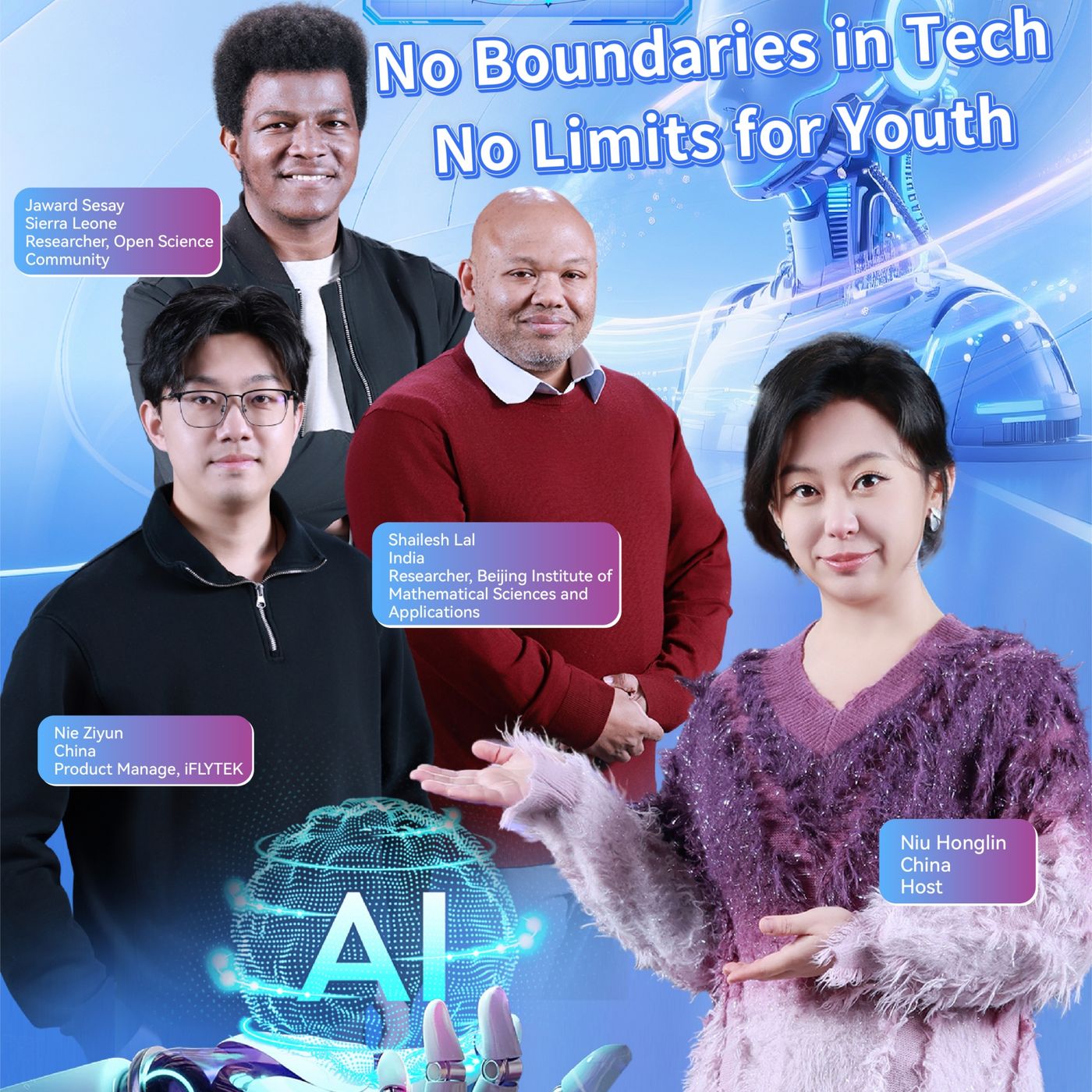
今天,我们迎来了特别系列《全球南方声音与愿景》的最后一期,我们邀请了三位来自全球南方国家的年轻科学家。
Today, we welcome the last episode of our special series, Global South Voices and Visions, where we invite three young scientists from the Global South countries.
一位为最需要的社区开发开源科学工具。
One builds open science tools for communities that need them the most.
一位通过数学语言探索宇宙。
One explores the universe through the language of mathematics.
一位确保人工智能应用能够服务于使用不同语言、过着不同生活的真实人群。
One ensures AI applications work for real people speaking different languages and living different lives.
我们一起探讨技术创新如何影响全球发展与全球治理。
Together, we examine how technology innovation is influencing global development and global governance.
现在,让我们开始欣赏这场节目。
Time to enjoy the show.
你好。
Hello.
欢迎收看Roundtable特别系列《全球南方下一代声音与愿景》。
Welcome to roundtable special series Global South Next Generation Voices and Visions.
我是林 NEOHONG。
I'm Neohong Lin.
每一项技术都始于一个问题。
Every technology begins as a question.
如果机器能像人类一样听懂声音呢?
What if machines could hear like humans?
如果数学能揭示我们无法察觉的模式呢?
What if mathematics could reveal patterns we couldn't see?
如果全球南方不只是使用技术,而是构建它、定义它、并赋予它意义呢?
What if the global South didn't just use technology but built it, defined it, and gave it purpose?
我们今天的嘉宾将这些问题带入了他们的工作中。
Our guest today carry these questions to their work.
今天我们将讨论技术,但更重要的是,我们将看到全球南方的年轻人如何以不同的方式定义科学本身。
Today we're going to discuss technology, but more importantly, we're going to see how young minds from the global South define science itself in a different way.
让我介绍一下今天的嘉宾。
Allow me to introduce my guest today.
我们有来自科大讯飞的AI翻译软件产品经理聂子云。
We have Nie Ziyun, Product Manager of AI Translation Software with iFly Tech.
欢迎来到节目。
Welcome to the show.
你好。
Hello.
谢谢。
Thank you.
你好。
Hello.
我们还有来自塞拉利昂的贾瓦德·西赛,他是北京理工大学的计算机科学毕业生,目前是Cohere Labs开放科学社区的机器学习研究员。
And we have Jawad Sisay, he is from Sierra Leone, he is a computer science graduate from the Beijing Institute of and currently a machine learning research member of the Open Science Community at Cohere Labs.
你好,欢迎你。
Hello to you.
你好。
Hello.
嗨。
Hi.
我们还有来自印度的沙莱克·拉尔。
And also we have Shalekh Lal from India.
他是一位科学家,也是北京数学科学与应用研究所的机器学习研究员。
He's a scientist and machine learning researcher from the Beijing Institute of Mathematical Sciences and Applications.
谢谢。
Thank you.
感谢大家来到节目现场。
Thank you all for coming to the show.
我非常兴奋,因为今天我能和三位在你们领域非常有才华的年轻科学家交谈,其中两位的才华我简直无法形容你们在做什么。
I am very excited because today I get to talk to three young scientists who are very talented in your line of work, two led talented that I cannot even begin to describe what you do.
那么,你们能自己给我讲讲吗?
So how about you do that for me yourself?
所以,志云,我们从你开始好吗?
So Zhiyun, how about we start from you?
你能给我们详细解释一下你正在做的项目吗?还有iFlyTech目前在进行的一些有趣的项目?
Can you explain to us exactly what is the project that you're doing and maybe some fun projects that iFly Tech is doing currently?
好的。
Okay.
我想分享一些我们一直致力于发展的技术,比如语音技术、计算机视觉、自然语言处理和连接智能。
So I wanna share some technologies that we always want to do like speech technology, computer vision, and natural languages processing and connective intelligence.
是的。
Yeah.
我认为自从iFlyTech在1999年成立以来,我们一直坚信要开发这些核心技术。
I think since Aflac Tech started back in 1999, we always believed in developing these very key technologies.
我想今年最令人兴奋的是,我们推出了Spark X1模型。
And I think the most exciting thing I want to share this year, we have launched our Spark x one model.
嗯嗯。
Mhmm.
嗯嗯。
Mhmm.
这是首个完全在中国自主研发的计算机基础设施上训练的深度推理模型。
The first deep deep first deep reasoning model trained entirely on China's own computer infrastructure.
关于突破性进展,我认为Spark X1的性能与顶级国际模型相当,但体积小了十倍。
And so as for breakthroughs, I think Spark x one performance as well as top international models while ten ten times smaller.
我认为这在效率上是一次巨大的飞跃。
I think that's a huge leap in efficiency.
对吧?
Right?
这就是我想说的。
That's what want to say.
我第一次听说iFly Tech时,是因为它的语音转文字功能。
When I first hear about iFly Tech, I think it was because of the speech to text Yeah.
它的这项功能。
Function of it.
是的。
Yeah.
后来,你仍然专注于语言相关
And later on, you still focus on language related
是的。
Yeah.
技术,但已经从仅支持中文扩展到英文,以及许多其他我们不太了解的语言,并覆盖了世界各地的不同语种。
Technology, but it has already expanded from only Chinese to English to a lot of different languages and to the kind of languages that we do not understand and go to different places in the world.
现在我们还涉足医疗诊断领域,帮助来自各地的医生。
And now we're also looking at in the field of medical related diagnosis and helping aiding different doctors from anywhere.
所以我很好奇想多了解你的故事。
So I'm curious to know more about your story.
但请允许我先转向我们的两位嘉宾。
But allow me to first now move on to our two guests.
好的。
Yes.
杰拉德,我知道你是一位人工智能科学家,目前正在开展一个非常令人兴奋的项目。
Gerard, I know you're AI scientist and you have a very exciting project going on currently.
是的。
Yeah.
所以目前,我在从事工作的同时也在专攻人工智能。
So currently, at the same time specializing in AI while doing the work.
我的研究分为两个方面。
So my research is in twofold.
例如,我在学校做的研究是关于自主代理,基于大语言模型的代理。
For example, I have the one that I'm doing in school, which has to do with autonomous agent, large language model based agents.
另一个研究则与语言相关,但通常是基于视觉的研究。
And I have another one which has to do with similar area related to language, but usually vision based research.
因此,我们在Cohere实验室所做的工作,是试图将目前这些最先进的模型扩展,使其能够融入我们社区中存在的文化价值观。
So what we're doing at for example at Cohere Labs, we're trying to expand most of these state of the art models out there to be able to have cultural values that exist in our community, for example.
目前,大部分这类工作都集中在基于视觉的模型上。
So much of that work is being done related to vision based models at the moment.
但总的来说,这就是我所做的两方面工作。
But in twofold, that's basically what I do.
我同时在这一领域学习并也在Cohere实验室工作。
I I specialize in the field at the same time studying in it and at the same time doing some work at Coherel Labs.
所以当你完成项目后,你的AI模型将能够区分不同的文化元素,能够查看图片并识别出它的文化背景,甚至加以描述吗?
So after you're done with your project, your AI model would be able to differentiate different culture element, would be able to look at the picture and identify which cultural background it's from and maybe describe it?
是的,这确实是其中一个目标。
Yeah, that's one goal actually.
但对我们来说,最重要的目标是让家乡的母语使用者也能在日常生活中使用这些模型。
But the most important goal for us is to also have our native speakers back home be able to use these models in different in their daily lives.
例如,在农业领域,能够与这个模型进行对话。
For example, in agriculture to be able to able to chat with this model.
假设你拍了一张植物的照片,想知道这株植物的状况,你想...
Let's say you take a picture of a plant and say you want to know the status of that plant, you want
我们现在要理解的是什么生活状态?
We to have understand in what's lives now?
是的。
Yeah.
我们希望将来能这样使用它。
So something like that we hope will be used later on.
因此,我们的愿景是确保这些模型能够被我们本国的母语者使用。
So that's our vision is to make sure that these models can be used by native speakers in our home countries.
所以你正在帮助人工智能理解我们所认知的世界,并解释它。
So you're helping AI to be able to see the world that we understand and then explain it.
是的。
Yeah.
你呢?
How about you?
因为我知道你不仅是科学家,还在从事数学工作。
Because I know you're not only a scientist, but also working in mathematics.
数学,我数学很差,而且我觉得数学也总是跟我过不去。
Mathematics, I fail mathematics and I think mathematics fails me all the time.
所以这并不是我觉得很容易的学科。
So it's not the kind of subject that I find very easy.
但根据我们之前的对话,我相信你能用数学来解释世界。
But according to our previous conversation, I believe you can explain the world with mathematics.
那么,你目前试图解释的是什么呢?
So how about something that you're trying to explain currently?
你现在正在做什么?
What are you trying to do now?
实际上,我会说数学是科学所使用的语言。
Actually, would say that mathematics is really the language in which science is spoken.
但更重要的是,科学——我们用它来解释周围世界——并不是一种我们主动去做的事情。
But more importantly, science, which is what we use to explain the world around us, is not really a thing we do.
而是一种看待我们所见事物并试图理解它们的方法。
It's an approach to looking at what we are seeing and trying to understand what we are seeing.
所以,举个例子,有些事情非常令人惊讶。
So, for example, something that's really surprising.
如果你只有一个分子、两个分子或三个分子,当数量达到四五个时,这种运动在物理上就极难分析了。
If you have one molecule or two molecules or three molecules, there are four or five, that motion is extremely difficult to analyze physically.
如果你有十亿亿亿亿亿个分子,那实际上非常简单,因为周围的空气就是这样的,对吧?
If you have a billion billion billion billion billion molecules, that is actually extremely easy because it's the air around us is that, right?
但这非常简单。
But that's very easy.
我的意思是,你知道打开风扇会发生什么。
I mean, you know what will happen if you turn on a fan.
你知道如果你做某些事情会发生什么。
You know what will happen if you do certain things.
这是因为大量事物共同作用时,其排列方式实际上具有某种简单性。
And that's because there's actually a simplicity in how lots of things together arrange themselves.
令人兴奋的是,大量事物自我组织起来,今天它们在做什么呢?
And what is extremely exciting is that well, what's a lot of things that arrange themselves, to do something today?
比如神经网络、人脑,它们充满了极其微小的神经元,但要解开这些机制却非常困难。
Well, neural networks, human minds, they are filled with these tiny tiny tiny neurons, but at some and that's very hard to to kind of unpack.
但如果你说,好吧,让我暂时忽略每个神经元在做什么,至少在某种极端层面上——让我忽略这些,转而看看整个系统在做什么?
But if you say that, well, let me forget about what each neuron is doing, at least at some pathological level of but if let me forget about that and let me see what the system as a whole, what is it doing?
它会如何表现?
How does it behave?
如果我在这里戳一下,它在那里产生反应,会发生什么?
What happens if I poke it here and it does something there.
对吧?
Right?
这实际上是一种非常强大的看待人工智能的方式,它直接源于物理学,源于这样一个理念:整体的简单性并不存在于其组成部分之中。
That is actually a really really powerful way of looking at AI, which comes directly from physics, which comes directly from this this idea that there is simplicity in in the whole which is not there in its constituent parts.
因此,这是我们目前正在研究的一个方向,即利用物理学的思路来帮助人工智能。
So that's one of the things which we are looking at now to use, say, physics ideas to help AI.
我们也在使用人工智能来帮助我们的物理学研究。
We are also using AI to help our physics ideas.
这是另一个我们正在开展的故事。
That's another story that we are working on.
听起来很理论化,但我大致明白你在说什么。
It sounds very theoretical, but I kind of get what you're saying here.
我们正试图从人工智能的视角来看待世界,同时让人工智能从我们的视角理解世界,这样我们就能以一种更易理解的方式与AI沟通,也让AI更好地帮助人类。
That is we're trying to look at the world from a perspective of the AI and having AI looking at the world from our perspective, so we can somehow communicate in a way that we can understand AI better and having AI helping humans better.
因为我认为这正是最终目标——让技术改善全球人们的生活。无论你目前从事什么项目,归根结底,我们都希望这些成果能惠及世界各地的人们。
Because I think that's the final goal, isn't it, is having the technology improving lives all around the world and that is why no matter what kind of projects you're currently working on, at the end of the day we all hope the application of it can benefit people around the world.
以科大讯飞为例,我们看到它长期致力于语音识别和医疗诊断,你也提到了星火大模型。
Take iFly Tech for example, we see iFly Tech working on speech recognition for a really long time and medical diagnosis and you mentioned Sparkdesk already.
我很感兴趣,因为确实它极大地帮助了我,提升了我的日常工作。
And I'm curious because, yes, it's helping me a lot, helping my daily work.
但你也希望它能帮助全球各地的人们。
But you also wish that it can help people all around the world.
是的。
Yes.
但当你将你的技术、应用和项目推向海外时,是否遇到过意想不到的挑战?
But while you're taking your technology, your application, your projects to overseas, do you encounter unexpected challenges?
你是否觉得,当这些应用在不同的土壤中成长时,会开出不同的花,结出不同的果?
Do you feel like having the applications growing in different soil can result in different flowers and different fruits?
是的。
Yeah.
正如你所说,我认为人工智能技术在某些任务上确实已经达到了人类水平的表现。
As you mentioned, I think AI technology has indeed reached human level performance in some tasks.
甚至在某些情况下,我认为它比我做得更好。
And even in some situation, I think it's much better than me.
对。
Yes.
但我们的最终目标并不是超越人类或追求纯粹的技术突破。
But our final goal isn't about outperforming humans or pure technologies breakthroughs.
而是让人工智能成为实用且有用的工具,帮助人们相互连接、打破隔阂。
It's about making AI practical and useful tools to help people connect with each other and break down barriers.
关于挑战,我对此有一些想法,因为今天我们的主题是全球化。
So as for challenges, I think and about it, because today our topic is about the global source.
因此,我们在这些国家的第一步是应对语言和文化差异。
And so our first step in these countries is tackling language and culture differences.
为了解决这些问题,我们在今年九月的ISPO和ISAN博览会上推出了Spark多语言大语言模型,该模型专为泰语、马来语和越南语等多语言设计。
To solve these problems, launched our Spark Multilingual Large Language at ISPO, ISAN Expo in this September, which is specially designed for multilingual languages like Thai, Malay and Vietnamese.
此外,我们还在使用如我之前提到的AI翻译工具和应用程序,帮助中国企业与IC地区的合作伙伴顺畅合作。
And also we're using our translation tools like, as I mentioned before, AI translators and apps to help Chinese business to work smoothly with their partners across IC.
所以,实际上,想在一天之内掌握一件事是非常困难的。
So and actually, it's very hard to know get one thing in one in one day.
对吧?
Right?
所以我们需要一步一步、稳扎稳打地解决所有这些问题。
So we need to step to step step step to step to solve all these questions.
在我们对话之前,我跟杰拉德聊了聊,发现你对自己所做的事情非常低调。
Before our conversation, I talked to Gerard a little bit and you were being very very moderate about what you're doing.
但你说你只是在帮助AI识别不同的模式,协助它对文化元素进行视觉识别。
But you're saying that you're only recognizing or helping AI recognizing different patterns, helping it to have visual recognition over a cultural element.
但你所做的,其实是在帮助一种相对小众的语言。
But what you're doing is helping a relatively niche language.
我说的‘小众’并不是要贬低你们的文化和语言。
By saying niche, I don't mean to diminish your culture and language.
我只是想说,说这种语言的人不像说中文或英文的人那么多。
I'm just saying it's not many people like speak it like Chinese or English.
但这确实是一个真实的问题,在中国也同样存在。
But it is a real problem and it's a real issue in China as well.
在中国,我记得我们有超过130种不同的方言,更别提还有更多口音了。
In China, I think we have, if I remember it correctly, over 130 different dialects, not to mention there are more accents.
因此,在中国,保护这些小众语言和地方文化,与其他国家一样重要。
So preserving these niche languages and these local cultures is as important in China in any other countries as well.
所以这就是我向你们所有人提出这个问题的原因。
So that's why I'm asking the question to you, all of you as well.
在帮助人工智能理解语言机制、人类文化、人类情感、隐含意义、幽默和讽刺等所有这些方面。
That is in the process of helping AI understanding the mechanism and understanding human culture, human emotion, hidden meanings, humor, irony, all these things.
这关乎结构吗?
Is it about the structure?
这是关于编程,还是更关乎数据库?
Is it about coding or is it more about database?
我要指出的是,正如我之前提到的,代码实际上可以是一样的。
To point out, like I mentioned before, so it the the code can actually be the same.
所以语言本身对代码的影响并没有那么大。
So the the language doesn't have much, how do you call it, much to do with the code.
因此,你可以有一个模型用某种语言进行训练。
So you can have, for example, you can have a a model being trained in in one language.
假设我们希望支持另一种语言。
And let's say you want to we wanted to support another language.
你可以使用之前训练模型时相同的代码,只是增加一层数据。
You can use the same code that you used to train the previous model, but just with an additional layer of data.
在某种程度上,很多事情都取决于数据。
So much of it is has to do with the data at some point in time.
但在语言方面,比如自然语言处理,语言模型还有一个额外的层面,我们称之为分词。
But in language, for example, natural language processing, there's one additional layer when it comes to language models, which we call tokenization.
有些语言具有不同的编码方式。
So there are certain languages that has different kind of encodings.
因此在分词过程中,你可能需要编写一些代码,或者训练一个能够学习这种特定语言中某些模式的分词器。
So during tokenization, you would need maybe to write some code that can or maybe train a tokenizer that can learn some of these patterns in this particular language.
所以这可能是唯一的额外层。
So that maybe might be the only additional layer.
但在根本层面上,代码和训练代码对于不同语言可以是相同的。
But at a fundamental level, code, training code can be the same for different languages.
你所需要做的只是很好地组织你的数据,然后训练模型,就像这样。
And all you need to do is to just structure your data well and train the model just Are like
我们说的是,只要我们能找出正确的数据库,将它们组织到不同的部分并交给AI,文化背景和上下文其实并不重要,这样就可以了。
we saying that it doesn't really matter what are the cultural backgrounds, what are the context as long as we're able to find out the right database to organize the right database to put them into different sections and give it to AI, it will be okay.
你们都同意这一点吗?
Do you all agree with that?
是的。
Yeah.
我同意这一点。
I agree with that.
只要你的数据结构良好,语言质量高,你就可以训练一个模型,即使是最小的模型也能从这些数据中学习到一些东西。
As long as you have a well structured data, like data in terms of high quality in language, then you can train a model to learn even the smallest model can be able learn something from that data.
数据质量在训练时非常重要。
Data quality is like is very, very important when it
当然,这让我对人工智能的理解提升到了一个新的层次。
Definitely comes to training these putting my understanding about AI to a next level.
我们彼此都达成一致。
We all agree with each other.
我们在这里看法一致。
We're on the same page here.
我相信
I believe
我问这个问题是因为你们从事不同的领域,来自不同的国家,但因为你们从事科学研究与开发,你们有着相同的基本理解,我很想知道,这是由于科学本身的性质,还是因为你们通过峰会、论坛不断交流,以及与各自领域的同行持续沟通?
I'm asking this question because you work in different fields, you're from different countries, but because you work in the area of scientific research and development, you have the same basic understanding and I'm curious, is that because of the nature of science or is it because that you talk to each other through summits, on forums, you communicate with each other all the time and you communicate with fellow scientists in your fields as well.
所以你通常会参加这类科学相关的论坛和国际会议吗?
So do you usually go to these kind of science related forums and summits in international conferences?
你觉得作为一名科学家,参加这些活动是必要的、重要的,或者是一个很好的机会吗?
And do you feel like it's necessary, it's important, it's a good occasion to go to as a scientist?
当你参加研讨会时,你说你去了一个会议,并且说:我有一个绝妙的想法。
When you go to conferences because you say that you go to a conference and you say, I have this fantastic idea.
观众中有人会说:不,你没有。
Somebody from the audience says, no, you don't.
或者实际上,他们会说:关于你这个绝妙的想法,我有一些问题。
So or actually, they say that, okay, I have some questions about your fantastic idea.
这个你怎么看?
What about this?
这个你怎么看?
What about this?
那这个呢?
What about that?
尽管我们都是从事同一领域的科学家,但我们有着不同的想法和动机。
And even though we are all scientists working in the same field, we have different ideas, motivations.
当你应对这些问题时,有些是合作性的,有些是对抗性的,但无论哪种情况,与这些问题互动都能极大地帮助你完善自己的想法。
And when you interact with those questions, some of them are cooperative, some of them are adversarial, but when you interact with those questions, it's remarkably helpful towards refining your own ideas.
因此,从这个意义上说,像这种让来自全球南方的人们聚在一起讨论问题的倡议。
So in that sense also, like, these kind of global south initiatives where people can come together and discuss things.
我认为我甚至无法用‘重要’来形容它们,因为我无法想象一个没有它们的世界,还能正常运转。
They are I think I won't I won't even be able to call them important because I cannot imagine a world in which they do not exist and things are able to work.
这就是沟通的部分。
That is the communicating part.
你们彼此交流。
You talk to each other.
你们互相启发。
You inspire each other.
那你们彼此合作呢?
How about one you cooperate with each other?
我们来自全球南方国家的人,通常被视为面临更多挑战、发展相对滞后的地方。
We people from the global South countries, we're usually seen as places with a bit more challenges and a little less advances.
但我不确定在科学界是否也是如此。
But I don't know if that's the case in the scientific world.
我不太清楚我们在全球范围内的具体位置。
I don't know where we are globally to be more precise.
肯定有一些领域我们表现得非常出色,也有一些领域我们在合作,当然也还有一些领域我们还需要更加努力才能迎头赶上。
In there must be in some areas that we're being really good at and there are must be some areas that we're working together and definitely there must be some areas that we still need a little bit hard working to catch on.
你能为我描绘一下这个画面吗?
Can you paint that picture for me?
以合作为例,在科学研究中至关重要。
So let's say in terms of collaboration, is very essential in scientific research, for example.
所以你需要的,正是我认为大多数全球南方国家今天所面临的状况。
So what you need is what I believe most global South nations are facing today.
并不是说这些资源有限、计算能力不足或资金不够等问题。
It's not that these issues of limited resources, limited compute or not having enough funding and stuff like that.
这些都存在。
They are all there.
唯一的主要问题是这些事情太过分散。
The only main problem is how fragmented all of these things are.
所以我认为我们更需要的是共享的基础设施和共同的愿景,以便能够解决我们的问题,因为在根本层面上,当你去审视这些问题时,它们在我们各国之间是如此相似,我们完全可以基于相似的现实进行创新,而不是仅仅停留在抽象层面。
So I think what we need more is shared infrastructure and and and shared ambitions in order to be able to solve our our problems because when at at a fundamental level when you come to to to look at some of these issues, they are so common among us, among our nations that we can actually innovate through similar realities as opposed to just having abstractions.
所以我认为,如果我们能推动更多类似联合研究项目,或者学校之间的交流项目之类的举措。
So I believe if we try to foster more, how do you call it, joint research programs for example, or let's say exchange programs for example between schools and something like that.
如果我们能以这种方式团结起来,就能提出有用的科研构想,就像你提到的参加学术会议那样。
And we try to unify ourselves in that way and be able to come up with useful research ideas just like you mentioned going to conferences.
这也是我们可以做这些事情的另一种方式。
That's another way we could do some of these things.
我们最终将能够在世界舞台上脱颖而出。
We eventually will be able to stand out there amongst the world.
是的。
Yeah.
我想再补充一点。
And I want to add one thing.
我认为合作非常重要,因为一方面它能放大优秀的想法。
I think collaboration is quite important because on one hand, it can amplify great ideas.
另一方面,它能确保资源流向最需要的地方。
And on the other hand, it can make sure that ensure that resources can follow to where they are needed most.
我觉得这一点非常重要。
I think that's quite important.
在
At
同时,我想提出一个稍微实际一点的问题,我们可以称之为实际问题。
the same time, I'm going to bring about a question that is a little bit practical, let's call it practical.
那就是开展研究、开发大型模型或训练模型,发现过去不存在的应用,并将其投入现实世界供人们使用。
That is doing research, developing large models or training models or finding out applications that didn't used to exist and put it into the real world for people to use it.
所有这些都需要资金,需要经费。
All these requires money, it requires funds.
我们知道,2024年中国的研发投资超过了3.6万亿元人民币。
We know that in 2024, research and development investment exceeded 3,600,000,000,000.0 yuan.
这大约相当于5000亿美元,中国位居世界第二,其中近2500亿美元投入了基础研究,我们之前提到过基础研究的重要性。
That is about 500,000,000,000 US dollars in China and it ranks the second in the world with 200 almost $250,000,000,000 invested in basic research, we mentioned the importance of basic research.
此外,我还获得了一些非常有趣的信息:中国如今拥有超过5100家高科技企业,2024年,中国大陆有五家公司在全球前2000大工业研发投资者中上榜,请允许我说明,目前产业界贡献了约90%的显著模型,但学术界仍贡献了大部分被广泛引用的基础性机器学习研究。
And also I've also got information, very interesting information about China is now home to over 5,100 high-tech enterprises and in 2024, five twenty four companies from the Chinese Mainland were listed among the world's top 2,000 industrial R and D investors and bear with me, industry now produces about 90% of notable models yet academia still contributes much of the most cited foundational ML research.
所以我想知道,您对研发投资——尤其是政府的研发投入——有何看法?
So I'm curious, what is your view over the investment to start with the government investment in R and D?
您认为这些投入足够重要或足够充分吗?毕竟我们都清楚它非常重要。
Do you think it's important enough or do you think it's significant enough because we all know it's very important?
其次,您如何看待产业界科学家与学术界科研机构中的科学家所扮演的不同角色?
And second is, how do you view the different roles between scientists working in industries and scientists working in scientific institutions in the academia world?
就资金而言,尤其是在人工智能领域,大部分资金都投入到了计算资源上,因为这非常昂贵。
In terms of funding, especially when it comes to AI, much of the money goes into compute, because it's very expensive.
我们使用配备GPU的专用计算机来训练模型。
We use specialized computers to train models with GPUs.
它们并不便宜。
They are not cheap.
大部分资金都花在了计算资源上。
Much of that money goes into compute.
对于政府提供某种资助的领域,这实际上很好。
For the area wherein you have, let's say, you have the government provide some some kind of funding, that that's actually good.
这很有帮助。
That's helpful.
但你最需要的是人才,因为只要有人才,资金和投资者自然会跟进。
But what what you need the most is is talent because where there is talent, then money will come, investors will come.
所以我认为,首要的关键是确保我们拥有坚实的人才基础。
So I I believe the the the the key aspect first is to ensure that we have a strong talent base.
一旦人才基础具备,其他一切——包括发展和构建前沿模型等——都会随之而来。
And once that is available, then everything else will eventually fall in terms of development, in terms of building state of the art models and so on.
是的。
So, yeah.
我之所以同时询问资金和障碍,是因为我觉得在全球南方国家的研究能力和应用能力方面。
The reason I'm asking about money as well as what are some barriers is because I feel like when it comes to especially the research ability and also application ability of the global South countries.
我们想知道主要的挑战是什么。
We ask what are the major challenges.
我们想知道全球南方国家之间的科学合作是否有效?
We want to know is it effective scientific collaboration across the global South?
是我们缺乏资金、数据访问权限,还是计算能力不足?我们能做些什么来消除这些障碍,让事情更好地运作?
Is it that we are lack of fund or lack of data access to data or maybe compute power or what what can we do to bridge the barriers to make things work better?
例如,你已经提到科大讯飞的一个重要海外项目是在非洲。
For example, actually you already mentioned that one of the major overseas projects iFlytech did was in Africa.
是的。
Yeah.
许多项目都已开展,你们帮助了当地人民。
And many of the projects happened and you help local people.
中国作为国家,已与160多个国和地区建立了科技合作关系,签署了119项政府间科技合作协议,这些无疑将有助于改善各地的基础条件,帮助它们在技术发展中找到自己的位置。
And China as a country has established a sci tech cooperation relationships with more than 160 countries and regions and signed 119 intergovernmental SaiTech cooperation agreements and all this would definitely help the foundational situation in different places to be better to find their places in the development of technology.
我很想知道,因为你身处这个领域,我只能在网上做研究,而你是在实地工作,与其他的科学家交流。
And I'm curious to know, do you because you work in the area, I can only do research on the Internet, but you are working in the field and you talk to other fellow scientists.
你是否知道任何技术帮助当地人提升社区生活水平的真实案例?
Do you know any real examples of technology helping local people bring up the livelihood of, you know, the community?
我认为我们需要面对的真正挑战,比如资源差距、资金短缺或合作障碍,并不是孤立的问题。
I think like the real challenges we need to face like resources resource gaping or like funding shortages or collaborations barriers are not isolated issues.
我认为这些问题可能会相互加剧。
I think they since might could reinforce each other.
所以,如果我们真的想解决这些问题,可能需要更系统性的方法,比如建立一个资源共享平台,或者形成平等的伙伴关系。
So we if you will really want to solve these problems, we might need, you know, systematic, more systematic systematic approaches to solve it, like a source platform or in a or like a a equal partnerships.
所以回到你的问题,我们如何真正帮助当地人?
So answer so back to your question and so what we do to really help local people.
正如我之前所说,我们推出了Spark多语言模型,特别针对一些南亚语言,比如马来语和泰语等。
So as I said before, and we launched our Spark multilingual language to especially in some South Asia languages like Malay and Thai and so on.
我认为,分享技术就是建立信任的过程。
And I think sharing technology is just about building trust.
我们的最终目标是真正帮助这些用户。
Our final goal is truly help these users.
因此,我们构建了一个完整的翻译工具生态系统,包括硬件和软件,如AI翻译器、AI翻译耳塞、AirFlightTrans应用程序以及同声传译系统。
So we have built a full ecosystem of translation tools including hardware and software like AI translators, like AI translation earbuds and AirFlightTrans application and simultaneous interpretation systems.
还有会议中的语音转文字和翻译系统。
Also like transcription and translation systems in meeting.
因此,我前面提到的所有这些产品都基于我们所谓的Affiliative AI传输指标。
So all these products I mentioned before are formed with what we called Affiliatec AI transmission metrics.
这些产品正帮助越来越多的人和企业更好地相互沟通,并解决他们真实而实际的问题。
And these products are helping more and more people and companies to communicate with each other better and solve their real and practical problem.
我们一直在使用AI,但有些人可能对相关知识更熟悉,因此能为他们找到更合适的模型。
So we use AI all the time, but some people maybe they are more familiar with the knowledge, so they can find a better model for them.
对于其他一些生活在偏远地区的人,他们缺乏知识,也缺乏获取所有信息的途径,即使有AI的帮助,也可能无法表现得很好。
For some other people, we're working or living in remote areas, they lack the knowledge, they lack the access to all the information, maybe they cannot perform as well even with the help of AI.
因此,从这个角度来看,我担心未来的平等性问题。
So in that sense, I'm worrying about equality in the future.
随着人工智能技术的快速发展,我们确实可以通过帮助每个人获取信息和技术,让世界变得更美好,但同时也可能让那些本来就聪明、有资源、能接触到技术的人获得更多机会和资源。
It can with the fast development of technology of AI, definitely we can make the world a better place by helping everybody having access to information to technology, but it can also be possible that those who are already smart, intelligent, having access and having resources would have more access, more resources.
那么,你认为在技术或科技发展方面,是否存在有效的解决方案、策略或正确路径,来减少不同社区、国家和人群之间的不平等?
So do you think are there any effective solutions or effective strategies or right path for technology or technological development to reduce inequality in different communities and different countries and different groups of people?
我认为你提到的确实是一个真正的担忧。
I think there are what you say is a genuine concern.
我认为这并不是人工智能独有的问题。
I think that and this is not something that is unique to AI.
每当出现一项新技术时,它往往会让很多人处于同一水平。
Anytime there's a new technology, it tends to bring a lot of people at the same level.
但它也往往会加剧不平等。
It also tends to exacerbate inequality.
例如,你可以用这项技术为一个人制造一辆极快的跑车。
For example, you could use your technology to make a really fast sports car for one person to buy.
你也可以用它来打造优质的公交服务,帮助那些因经济原因难以出行的人实现移动自由。
You could also use it to make a really good bus service for connecting people who might otherwise find it really impossible to move for their own economic interests.
是的
Yeah.
这两者都有可能。
Both things are possible.
我认为这更多与我们社会的价值观有关,而不是人工智能本身。
I think this is something which has to do more with our values as a society than AI in general.
本身。
Itself.
对。
Yes.
为了例如应对技术领域的不平等,我全力支持的最佳解决方案之一是开源。
In order to, for example, fight inequality in technology, one of the best solutions I am in full support of is open source.
所以我们应该公开你的研究,让人们能够真正从你的成果中学习,而不仅仅是开放权重或只提供部分成果,而是要端到端完全开放,让人们能够复现这些模型。
So we are in you open your research and allow people to actually to learn from what you've done and not just open it like just give out the weights or give half of what you've done, but to open it fully end to end so that people can actually reproduce these models.
这是一种可以帮助遏制,怎么说呢,在这个特定领域中的技术不平等的方式。
And that's one way you could help say stop, how do you call it technological inequality in that particular area.
实际上,我必须承认,人工智能技术可能会加剧社会不平等,但正因如此,我们视其为至关重要的责任去应对和解决这个问题,尤其是像我们这样的公司。
Actually, I have to admit that AI technology might make social inequality worse, but that's why we see it as our very important responsibility to handle and solve it, especially like companies like us.
所以我认为我们正从两个主要方面着手解决这个问题。
So I think we are working on this in two main ways.
首先是让我们的技术更加普及。
The first is we are making our technologies more accessible.
例如,针对方言的语音识别技术。
For example, like speech recognition from a narrative languages.
我们推断老年人可以仅通过语音与设备进行交流。
We infer that elderly people can communicate with devices just using their voice.
或者,类似地,实时语音转文字技术,可以帮助听力障碍人士理解话语内容。
Or, familiarly, like, real time speech to test technology, We can help people like for disabled hearing disabled to to know this word.
其次,我们致力于将核心技术应用于教育和医疗等社会重要领域。
And and the second is we focusing on bringing our key technologies into some very important areas in society like education and healthcare.
通过我们的智能课堂解决方案,我们正在为资源匮乏的群体提供高质量的教育。
Through our smart classroom solutions, we are delivering our high quality education in the rigorous groups.
通过我们的AI医疗助手,每个人都可以随时随地获得可靠且专业的医疗报告或健康支持。
And with our AI like medical assistant, everyone can get reliable and professional report or healthcare support anytime, anywhere.
所以我认为这就是我们想做的。
So I think that's what we want to do.
作为一家公司,作为Aflac Tech,我们的真正角色是搭建这些桥梁,以解决所有这些问题。
And as a company, as Aflac Tech, our really role is to actually build these breaks, yes, to solve all these problems.
你可能会说,有些事物确实是变革性的,比如航天项目。
You might say say some things are genuinely transformative like space programs.
所以你可能会问,为什么全球南方的人需要一个航天项目?
So you might say that why does somebody in the global South need a space program?
实际上,你知道,这只是一个虚荣的项目吗?
Actually, you know, is it just a vanity project?
实际上,并不是。
Actually, it's not.
你需要航天项目,以便获取天气数据。
You need the space program so that you can look at weather data.
这些天气数据有助于你规划农业。
That weather data helps you organize your agriculture.
它能帮助你在环境灾难发生前疏散人群。
It helps you move people away when there are going to be environmental disasters.
所以,看似是面子工程的事情,实际上对这些人的福祉至关重要。
So what looks like a vanity project is actually something crucial to the well-being of these people.
因此,从这个角度来看,确实非常重要,也就是说,回到你关于全球南方的问题,我们自己必须发展这些技术。
So in that sense, actually, is really important I mean, to go back to the kind of questions you're asking about the global south, it's really important to have these things developed amongst ourselves.
这样,需要这些技术的人,就是那些开发它们的人。
So that, you know, the people who need it are the people who build it.
我觉得你说得完全对。
I think you're totally right.
中国有自己的人工智能气象预报大模型。
China has its very own AI related weather forecast large model.
顺便说一下,我们还给它们起了非常优美浪漫的名字,比如‘老师’、‘雨师’,或者‘飞升者’。
And also by the way, we call them very beautiful romantic names like the teacher or the master of rain or the ones who's flying up.
这些就是那些大师。
These are the masters.
嗯,
Well,
这些是AI模型的名字。
the names of the AI models.
我相信你是对的。
And I I believe you're right.
它最终与社会价值、集体社会价值、政策和政府战略有关,与我们正在走向的方向有关。
It ended up having something to do with social value, collective social value, with policy, with government strategy, what are the direction we're moving towards.
但从根本上说,像你这样的科学家讨论这些问题也非常重要,因为你们才是真正奠定基础、引领科学发展的那个人。
But at its core, it's also very important that scientists like you are discussing these questions, because you are the one who is really doing the groundwork leading the scientific development.
所以让我们以这个问题作为结尾吧,我很好奇:你对全球南方科学界最终的或最大的愿景是什么?
So let's end up with this question I'm curious about that is, what is your final or biggest vision for the Global South Scientist community?
你认为在五年或十年后,我们能朝着什么方向发展?在你的世界里,全球南方社区的未来前景会是什么?
What do you think that in five years or in a decade that we can move to as what is the future forecast in your world for the global South communities?
就我个人而言,我希望看到尤其是来自我家乡的人。
For me personally, I hope to see especially from where I'm from.
我希望看到来自我所在地区年轻人不再仅仅作为这些进口技术的使用者,而是能够真正成为这些技术的创造者。
I hope to see young people from my part of the world to move away from just merely being users of these imported technologies and be able to actually be creators of them in the first place.
因此,我期待看到南方国家能在研究、工程和科学领域成为先锋。
So I would love to see, let's say, South Nations be pioneers in research, in engineering, in science.
我认为,如果我们能建立真正推动这一议程的结构,下一代年轻人就不仅会参与未来,更会改变和塑造未来,让之后的世代也能从中受益。
And I think if we have structures that actually push this kind of agenda forward, the next generation of young people will not just join the future, but they will actually change it and they will shape it in a way such that following generation will also benefit.
技术的故事通常是从上至下讲述的。
The stories of technology was often told from top to down.
换句话说,它总是由少数几个既定的中心或枢纽推动的。
How to say, it's like it's shifted by a few established hubs or centers.
因此,我希望在未来,尤其是来自全球南方的声音,能够真正转变这一角色,从追随者或学生转变为真正的塑造者和规则制定者。
So that's why I hope in the coming future, especially use from the global source could really shift this role like from being a follower or a student to becoming a true shaper or room a room maker.
所以我认为这非常重要。
So that's I think quite important.
也许有一天,我们能做到。
Maybe in the one day, we can do that.
正如我们之前提到的,通过合作,我们可以为科技从业者构建一个繁荣共赢的生态系统。
And as we mentioned before, through like collaboration, we can build a thriving and we win ecosystem for the tech professional.
是的。
Yeah.
从技术上讲,科学和技术只是我们正在打造的另一种工具,人类已经创造了数千年各种工具。
Technically speaking, science and technology is just another tool that we're building and human beings have been creating crafting tools for thousands of years.
如果我们能掌握其他所有工具,就没有理由无法掌握这一种。
And if we can master all the other ones, no reason we cannot master this one as well.
您正在收听《圆桌论坛》。
You're listening to Roundtable.
这是我们的特别系列《全球南方下一代声音与愿景》的最后一集。
That was the last episode of our special series, Global South Next Generation Voices and Visions.
在过去的一周里,我们有幸与来自各行各业的年轻代表进行了交流。
Over the course of the past week, we had the privilege of talking to young representatives from all walks of life.
通过第一手的叙述和实际案例,本系列探讨了全球南方年轻人才所面临的机遇与挑战,以及他们的工作如何促进南南合作和中国与全球南方的伙伴关系。
Through firsthand accounts and practical examples, the series explores the opportunities and challenges facing young talent in the Global South and how their work contributes to broader South South cooperation and China global South Partnerships.
如果你喜欢这些塑造未来的年轻创新者、变革者和远见者的故事,请在评论区告诉我们,或发送邮件至 roundtablepodcast@qq.com。
So if you have enjoyed the stories of these young innovators, changemakers, and visionaries shaping the future, let us know in the comment area or send us an email to roundtablepodcast@qq.com.
我们非常期待了解你的想法。
We'd love to know about your thoughts.
关于 Bayt 播客
Bayt 提供中文+原文双语音频和字幕,帮助你打破语言障碍,轻松听懂全球优质播客。