本集简介
双语字幕
仅展示文本字幕,不包含中文音频;想边听边看,请使用 Bayt 播客 App。
当法国的一座古老玫瑰园变成露天实验室时会发生什么?
What happens when an ancient rose farm in France becomes an open sky laboratory?
印度的美容培训项目如何为经济赋权开辟道路?
And how can a cosmetology program in India offer a road to economic empowerment?
你好。
Hi there.
我是伊莎贝拉·鲁索里尼。
I'm Isabella Russolini.
在欧莱雅集团最新一期《这不是美容播客》中,我们采访了一位有机花农和一位美容学校毕业生,探讨美容如何塑造商业。
And in the latest episode of this is not a beauty podcast from L'Oreal Group, we speak to an organic flower farmer and a beauty school graduate and how beauty shapes business.
现在就在你喜欢的播客平台上收听吧。
Listen now on your favorite podcast platform.
你是想让我演示不同的声音效果吗?
Do you just want me to run through the different sounds?
好的。
Okay.
所以,简单的鸭叫声就是这样的。今天早上为了吸引那些鸭子的注意,我连续叫了五到七声。
So, yeah, a simple quack is just And then a lot of times this morning to grab those ducks' attention, I was doing five to seven quacks in a row.
所以,是的,
So, yeah,
就像音乐一样。
it's just just like music.
你与鸭子融为一体了。
You're one with the duck.
我尽力做到。
I try to be.
我尽力而为。
I try my best.
说实话,今天当我们大多数人坐下来享用感恩节晚餐时,我们并没有真正认真思考过桌上的食物究竟来自哪里。
When most of us sit down today for Thanksgiving dinner, if we're being honest, we're not really thinking all that hard about where the food on the table actually came from.
它们来自杂货店。
It came from the grocery store.
就算我们真的考虑过食物来源,可能也就是在本地有机食品货架采购时想过?
And to the degree that we did think about where it came from, maybe we shopped the local free range organic aisle?
但说到底,还是来自超市。
Still, it came from the supermarket.
但对史蒂文·里内拉来说,食物来源问题几乎是一种信仰。
But for Steven Rinella, the question of where his food comes from is almost a religion.
里内拉是终身猎手,可能是美国最著名的猎人。他通过不断壮大的媒体帝国分享狩猎烹饪的激情,包括网飞节目和播客,都名为《肉食者》。
Rinella is a lifelong hunter, perhaps the country's most famous hunter, who shares his passion for eating what he catches through a growing media empire that includes a Netflix show and a podcast, both called Meat Eater.
如果你独自一人在九月份猎到一头驼鹿...
If you're just by yourself and you kill a moose in September Yeah.
一个人靠这头驼鹿能活多久?
How long can one guy live off that moose?
你知道,如果只吃这个的话,大概三个月吧。
You know, if that's all you're eating, you know, probably three months.
嗯。
Mhmm.
他还撰写了十多本书,内容涵盖从美洲野牛的历史到一系列烹饪书籍,这些书会教你如何清理驯鹿内脏或制作野鹅熏牛肉。
He's also written more than a dozen books, ranging from a history of the American buffalo to a series of cookbooks that explain things like how to gut a caribou or make a wild goose pastrami.
但真正定义里内拉作品的是一种论点,一个有些人可能觉得反直觉的论点——猎杀动物可以成为热爱自然的一部分,对自然界的敬畏与狩猎行为密不可分。
But what really defines Rinella's work is an argument, and an argument that some might find kind of counterintuitive, that killing animals can be part of loving nature, that reverence for the natural world is intimately bound up in the act of hunting.
因此我很好奇,作为一个完全依赖超市的人,去拜访拉纳拉、和他一起狩猎然后吃掉我们的猎物会是什么体验?
And so I was curious, as somebody who relies exclusively on the grocery store, what would it be like to visit Ranalla and go on a hunt with him and then eat what we kill?
我是《纽约时报》的迈克尔·比尔巴罗。
From The New York Times, I'm Michael Bilbarro.
这里是《每日》节目。
This is The Daily.
今天的故事:我与史蒂文·拉纳洛的狩猎之旅。
Today, my hunt with Steven Ranallo.
今天是11月27日星期四,感恩节。
It's Thursday, November 27, Thanksgiving Day.
史蒂夫,我是迈克尔·巴尔巴罗。
Steve, Michael Barbaro.
迈克尔,很高兴认识你。
Michael, nice to meet you.
深感荣幸。
Tremendous honor.
莫娜·斯莱尔。
Mona Slayer.
我们在蒙大拿州波兹曼的MeatEater总部见到了里内拉。
We meet Rinella at the MeatEater headquarters in Bozeman, Montana.
好的。
Yeah.
我带你们参观一下
I'll show you around
周围。
a little bit.
他带我们简单参观了一下。
He gives us a little tour.
我们有一个厨房空间。
We have a a kitchen space.
我们参观了他的测试厨房。
We see his test kitchen.
哦,那是个巨型绞肉机。
Oh, that's a giant meat grinder.
哇。
Wow.
他工业级大小的。是的。
His industrial sized Yeah.
肉类冷冻柜。
Meat freezer.
这些像是吉安尼斯驼鹿的骨头。
This is like Giannis's elk bones.
路上我们要去演播室吗?
On the way Should we go to the studio?
进入他的播客工作室,我会将其装饰风格描述为极度肉食主义。
Into his podcast studio, which I would describe the decor of as extremely carnivorous.
这是一只海狸。
This is a beaver.
在你身后。
Behind you.
是的。
Yeah.
这就像是整个国家建立的基础。
This is like what the whole country was built on.
我是说,你知道的,就像海狸皮贸易那样。
I mean, you know, like, that the beaver skin trade.
那是一张麝牛皮。
That's a musk ox hide.
它真大。
It's huge.
是啊。
Yeah.
这是个隔音材料。
It's a sound deadener.
这些是这些是棕色的臭鼬。
These are these are tan skunks.
嗯。
Mhmm.
好吧。
Okay.
有件事我一直很关注——我对毛皮贸易非常关注。
A thing I've always been in I I pay a lot of attention to the fur trade.
现在这个可是毛皮贸易的热门商品。
This right now is the hot ticket item in the fur trade.
臭鼬。
Skunk.
是的。
Yeah.
你知道为什么吗?
You know why?
不知道。
No.
那些正统犹太人在节日戴的帽子。
The the hats that Orthodox Jews wear for for for holidays.
对。
Yes.
它们非常奢华。
They're very extravagant.
它们很美。
They're beautiful.
现在最时髦的做法,就是用那些白色臭鼬毛来制作这些帽子。
The hip thing right now, the hip thing is to have those white, to have them made from those white skunk hairs.
我原以为正统派犹太社区是那种不受潮流影响的,但事实并非如此。
I think of the Orthodox community as being kind of trend proof, but No.
他们并非如此。
They're not.
现在正流行一种趋势。
There's a trend.
这很热门。
It's hot.
好吧。
Okay.
那么感谢你的导览。
So thank you for the tour.
嗯。
Mhmm.
谢谢你们的款待。
Thank you for having us.
当然。
Of course.
谢谢。
Thank you.
非常感谢你们的到来,尤其是专程来找我。
I appreciate you coming in, especially coming all this way to come to me.
在我看来,你经历了一段非常有趣的旅程才成为现在的你。
So you have had a really interesting journey in my estimation to become the person that you are now.
你有点像狩猎的传道者。
You're kind of an evangelist for hunting.
作为狩猎方式的拥护者,我
Champion of hunting as a way I
我更像是一个前...我喜欢做一个解说者。
am like an ex I like an explainer of.
是的。
Yeah.
好的。
Okay.
是的。
Yeah.
解释者。
Explainer of.
作为与土地建立联系、表达对土地敬畏的一种方式,正如你所说,理解人类与自然世界之间的联系。
Champion of it as a way of connecting with the land, showing reverence for the land, and as you've put it, understanding the connection between human beings and the natural world.
嗯。
Mhmm.
你在密歇根州的乡村长大。
You grew up in rural Michigan.
没错。
That's right.
跟我聊聊你早期那些具有塑造性的狩猎经历吧。
Talk to me a little bit about some of these formative early hunting experiences that you have.
要讲清楚这个,我得稍微回溯一下家族历史。
To do that right, I gotta go back one little generational bit.
我父亲出生在很久以前。
My dad was born a long time ago.
嗯。
Mhmm.
比如他参加过二战。
Like he fought in World War two.
明白吗?
Okay?
所以我父亲是由意大利移民的祖父母抚养长大的。
So my dad was raised by Italian immigrant grandparents.
他出生在芝加哥南城。
He was born in the South Side Of Chicago.
他成长的环境与美国乡村生活相去甚远。
He grew up in a world very, very removed from rural American life.
但当他从二战归来后,这段经历让他成为了那种天生的户外运动爱好者。
But then when he got home from World War II, and this is a thing that he was one of those outdoorsman that kind of was born of that experience.
嗯。
Mhmm.
他们在外已经待了超过一年时间。
They had been out, you know, for over a year.
你一直在露营,和伙伴们混在一起,穿着羊毛衣服,他们就这样沉浸其中。
You've been out camping, out hanging out with guys, wearing wool clothes, and he was they just got into it.
当他们回家后,这就成了他们的生活方式。
Then when they came home, that's just what they did.
嗯。
Mhmm.
甚至有位体育杂志编辑评论说:你怎么能训练整整一代人射击和露营,却不指望他们成为猎人呢?
There was even a comment a guy editor of a sporting magazine had made is like, how could you how could you train an entire generation of men to to shoot and camp and not expect them to become hunters?
所以他就在那样的环境中成为了一名猎人。
So he became a hunter, like, out of that world.
我从未想过这一点。
I never thought about that.
是啊。
Yeah.
就像这样,我从他身上继承了这些。
Like and so I got it from him.
就像,我从未刻意决定过。
Like, I never decided.
我从未想过,哦,我应该成为一名猎人和渔夫。
I never thought, oh, I should become a hunter and fisherman.
这只是我们自然而然做的事。
It was just what we did.
我做过所有类似的事,拥有过所有普通的东西。
I did all the like, I had all the normal stuff.
我有朋友。
I had friends.
我喜欢音乐。
I liked music.
除此之外,还有这种对打猎和钓鱼的痴迷,整个家族都如此。
Alongside it all was like this this like obsession, a family obsession with hunting and fishing.
你还记得早期一次让你印象深刻的打猎经历吗?
Do you remember an early experience of hunting that stays with you?
记得。
Yeah.
我们会带着22口径的枪骑车出发,去打松鼠。
We would strike out on bikes at twenty twos and go hunt squirrels.
但当时周围树林太多了。
But we had so much woods around.
我们以为那是公共区域,但实际上我们闯入了每个人的私人领地。
And we thought it was like public, but it was just that we just went on everybody's everybody's land.
为什么要猎松鼠呢?
Why hunt a squirrel?
哦,它们很棒。
Oh, they're great.
肉其实没那么多。
There's not that much meat.
不,肉很多。
No, there's a lot.
有吗?
There is?
是啊。
Yeah.
肉很多。
There's a lot.
那你怎么处理
And what do you do
它呢?
with it?
哦,这这这就像是思想者的鸡肉,老兄。
Oh, it's it's it's like it's thinking man's chicken, man.
就像它它它是同样的颜色。
It's like it's it's the same color.
我妈妈那时候真的非常热衷于野味。
My mom would there was a real wild game craze back then.
那整个时代就像是奶油蘑菇汤的时代。
It was like the whole era was like the cream of mushroom era.
所以我妈妈会拿一个慢炖锅,装满分割好的松鼠肉。
So my mom would take a crock pot and fill it full of parted out squirrels.
就是两条前腿,两条后腿,我们还修整了鞍部。
So two front legs, two back legs, and we trimmed the saddle.
我们管那部分叫鞍部。
We call it the saddle.
就像是里脊肉块。
It'd be like the loin pieces.
你会用剪刀沿着肋骨剪开
You'd like take a scissor and run it up the ribs.
然后你就得到了类似法国人说的兔背肉
And so you got like like the the French call it a saddle of a hair.
对吧?
Right?
把它放进炖锅里,倒满奶油蘑菇汤,然后开火慢炖
And you put it in a crock pot, fill it with cream of mushroom soup, and then turn that crock pot on.
然后一旦能把肉都剔下来,你就会把肉都剔下来。
And then the minute you could pick all the meat off, you'd pick all the meat off.
智者的鸡肉。
Thinking man's chicken.
如果你喜欢美食,就不会对肉类该是什么样子有刻板固定的想法。
If you enjoy food, you don't have a set rigid idea of whatever you kind of like like meat supposed to be like this.
如果你就是喜欢美食和新鲜事物,大多数这样的人都会喜欢松鼠肉。
If you just kind of like like food and like novel things, most people that do that like squirrels.
它们非常美味。
They're they're very good.
我完全不知道。
I had no idea.
是啊。
Yeah.
在你这个人生阶段,你会吃掉所有你猎获的东西吗?
At this stage of your life, are you eating everything you hunt?
对。
Yeah.
我们吃过很多东西。
We ate a lot of stuff.
我们油炸过很多东西。
We fried a lot of stuff.
没错。
Yeah.
你根本不会想到要扔掉它,那简直不可想象。
You wouldn't have thrown that would not be a thing.
就像根本不会考虑
Like not a thing in
去狩猎却不食用猎物
a To hunt and not consume.
我记得
I remember
那会是种罪过吗?
Would it be a sin?
是的。
Yes.
罪过,你知道的,我在一个基督教家庭长大。
Sin like, you know, I was raised in a Christian household.
我们不会用'罪过'这样的字眼来讨论浪费。
We wouldn't have talked about waste in terms of sin.
但我记得有一次在树林里,离居民区仅一英里处,发现有人丢弃了一堆没处理干净的木鸭
But I remember one time in the woods, a mere mile man finding someone had dumped a bunch of wood ducks that they hadn't cleaned properly in this
是他们猎获后没有清理的。
That they that they had hunted, not cleaned.
没错。
Yep.
垃圾袋里。
Garbage bag.
那地方本是大家堆放庭院垃圾的,我记得我老爸发现一个装着许多未妥善处理的木鸭的垃圾袋,当时有个家伙租住在湖下游离我们不远的一栋房子里。
It was where everybody would haul their yard waste and remember my old man finding a a garbage bag that had a bunch of improperly cleaned wood ducks, and there was this dude renting a house down the lake from us.
我记得我爸直接去砸他房门,跟他理论了一番。
I remember my my dad went banged on his door and had words with him.
那场景就像
It was like
要是在那之后,他肯定会觉得这事特别成问题。
Well, just after that, he he would have seen that as so problematic.
为什么?
Why?
太浪费了。
Wasteful.
就是这样。
Like that was the thing.
我...我试图
I I I was trying
解释过。
to explain earlier.
如果没人享用,这些动物就白白生死了。
Animals lived and died for nothing if no one was going
就像我们从不浪费任何东西,伙计。
It consume was like you didn't waste stuff, man.
在这种环境熏陶下,你有没有想过长大后要成为一名猎人?
After being immersed in this environment, did you just say to yourself, want to grow up and be a hunter?
哦,是的。
Oh, yeah.
嗯,不是。
Well, no.
因为我本来就是。
Because I just was.
我从未想过,我从未考虑过这个问题。
I never thought I never thought about it.
我...我从未停下过一分钟再重新开始。
I I never stopped for a minute and then restarted.
你天生就是个猎人。
You just were a hunter.
这从来不是那种'我想干这行'的情况。
It just like was never like, I wanna get into this.
只是...这就是最主要的事情。
It was just that was just the main thing.
一直都是最重要的事。
Always the main thing.
这是不是像一个孩子能做的最浪漫的事?
Was it, like, the most romantic thing a kid could possibly be doing?
我是说,你解释过这对你来说只是生活的一种默认状态。
I mean, I you've explained that it's just kind of a default fact of life for you.
嗯。
Mhmm.
但听起来,即使年纪很小,这件事也给你带来了巨大的快乐。
But it sounds like it, even at a young age, is bringing you tremendous pleasure.
是的。
Yeah.
身份变成了一种认同。
Identity became like an identity.
然后我发现,通过这件事,我爱上了它的历史。
And then I fell the thing too is, through that, I I fell in love with the history of it.
你是怎么了解它的历史的?
And how did you know the history of it?
就像你在阅读一样,因为那就是我进入这个领域的方式——我就是会不停地阅读。
Like you're reading because I that's that's why I got into like I would just I would read.
那就是我阅读的内容。
That's what I would read.
那是我主要阅读的内容。
That's the main thing I would read.
童年时期关于狩猎的启蒙书籍是什么?
What was the seminal childhood book of hunting?
《北方的陷阱线》。
Trap Lines North.
我会从图书馆借出来,然后续借,再续借。
I would check it out at the library, and then I'd recheck it out, and then recheck it out.
如果你现在去双子湖图书馆找到那本书,兄弟,你会发现借阅记录上全是我的名字,一遍又一遍地出现在那本书上。
If you went to that book now and found that in the Twin Lake Library, it dude, if you went, it'd be just my name again and against, like, on that book.
那本书里最让你印象深刻的是什么?
Just what what stands out from that book?
就像...简单描述一下它。
It was like And just to just briefly describe it.
好的。
Okay.
再说一次,所有那些狩猎相关的事,我真正想做的是以狩猎和设陷阱为生。
I again, all that hunting stuff, what I wanted to do was I wanted like hunt and trap for a living.
就像,你知道的,人们都熟悉这些名字。
So like, you know, people know all these names.
比如丹尼尔·布恩。
Daniel Boone, for instance.
人们认为布恩是个探险家或先驱者。
Like, people think of Boone as an explorer or pioneer.
但他自己可能并不这么认为。
Like, he wouldn't have thought of himself that way.
布恩是个市场猎人。
Boone was a market hunter.
布恩为市场打猎。
Boone hunted for the markets.
他捕猎海狸。
He trapped beaver.
他捕猎水獭。
He trapped otter.
他为熊油脂市场、熊油、熊肉市场以及鹿皮贸易捕猎熊。
He trapped he hunted bears for the bear grease market, bear oil, bear bacon market, deer skin trade.
这就是布恩做的事。
Like, that's what Boone did.
布恩以此为生。
Like, Boone did that for a living.
他所有为人所知的事迹都源于他以狩猎为生这个事实。
All the things he's known for came out of the fact that that's what he did for a living.
随着深入探索,我开始阅读那些以此为生的人的故事,这通常会将你拉回过去的时光。
So as I got into it, I would just read about people that that's what they would do, and that would generally force you backward in time.
所以我专门阅读关于捕兽者、猎人、商业猎人和职业猎人的资料,因为那正是我想成为的。
So I just read about trappers, and I read about hunters, commercial hunters, professional hunters, because that's what I wanted to be.
那么我的理解是,即便你向往狩猎生活,嗯。
So my understanding is that even as you're aspiring to the hunting life Mhmm.
你早期就认为这种生活与环保理念相冲突,是的。
You see that life early on as at odds with the whole idea of environmentalism Yep.
以及自然保护。
And conservation.
那时候还在上高中,我把环保运动和动物权利运动混为一谈了。
At that time, being in high school, I I I confused the environmental movement with the animal rights movement.
当然。
Of course.
你因为什么?
You because?
当时让我很困扰,因为动物权利运动那时正非常激进地推动禁止狩猎活动,而且他们确实取得了一些成效。
Well, it upset me because the the the animal rights movement was at that time working very aggressively to ban hunting practices, and they were having success at it.
你认为他们是敌人
You thought they were the enemy
是的。
Yeah.
百分之百。
A 100%.
因为他们要阻止你
Because they were gonna prevent you
他们打算摧毁我们的生活方式。
They were gonna destroy our lifestyle.
通过禁止狩猎。
From hunting.
环保主义者要摧毁我们的生活方式。
The environmentalists were gonna destroy our lifestyle.
作为一个17岁的少年,我们成立了一个团体。
As a 17 year old, right, we started a group.
你们成立的?
You started?
我们的团体充满仇恨。
Our group was hate.
猎人对抗青少年环保主义者。
Hunters against teenage environmentalists.
我们甚至赢得了罐头回收比赛。
And we even like won the can drive.
猎人对抗青少年环保主义者。
Hunters against teenage environmentalists.
我给你看看那件T恤。
I'll show you the shirt.
那件T恤我还留着。
Still have the shirt.
不知怎么的,因为你可以谷歌查资料嘛,我猜,我居然搞到了。
I somehow, because you can Google stuff, I guess, I somehow got it.
我和我的伙伴们搞到了,管它呢。
My buddies and I got it, whatever.
我们搞明白的是,环保运动就是动物权利运动。
We got it that it was that was that the environmental movement was the animal rights movement.
我们把它们混为一谈了。
We conflated them.
但与此同时,记得吗,有片大树林我们常去打猎。
But same time, remember, there's this big woods we always would hunt.
嗯哼。
Mhmm.
他们准备进去砍伐这片树林。
They were gonna go in and log this woods.
然后这些人进来把所有野生动物栖息的树都标上了橙色环带。
And these guys came in and marked all the wildlife trees with the orange ring.
我记得我和我弟弟丹尼坐在那里调配油漆。
I remember me and my brother Danny sitting there matching paint.
我没开玩笑,调配油漆就为了调出那个颜色,然后装进喷雾器里,出去标记了一大堆额外的树。
I'm not kidding you, matching paint to get that color and then putting it in a sprayer and going out and marking shitloads of extra trees.
为什么?
Why?
因为我们不想让他们砍掉那些树。
Because we don't want them to cut the trees down.
但我们想的是,我们要拯救这些树。
But we're like, we're gonna save the trees.
可我们明明讨厌环保。
But we hate environment.
就像,我们根本不知道自己在说什么。
It's just like, we didn't know what we're talking about.
我们就是一群白痴。
We're just idiots.
你显然已经达到了一种境界,觉得打猎与环保主义、打猎与自然保护其实是密不可分的。
You obviously get to a place where you feel that hunting and environmentalism, hunting and conservationism are actually really wedded.
是啊。
Yeah.
给我讲讲那个故事。
Tell me that story.
你是如何从一个穿着仇恨T恤的孩子,突然意识到打猎就是环保主义,这最终成为了你的立场。
How it is how you go from the kid wearing the hate T shirts to suddenly seeing that hunting is environmentalism, is ultimately where you land.
那么到底是什么促成了这种转变?
So what is it that happens?
可能最具影响力的事情是...好吧,有几件事。
Probably the the most impactful thing that happened well, handful of things.
我成长过程中结交的那些伙伴。
The buddies I grew up around.
明白吗?
Okay?
那些会嘲笑仇恨的家伙。
Guys that would have laughed at hate.
我们当时不太清楚能靠什么谋生。
We we kinda didn't know what you could do for a living.
嗯。
Mhmm.
所以我圈子里很多人都在说,'我要当野生动物学家,这样就能待在户外',或者'我要当狩猎监督官'。
So a lot of the people in my circle were like, I'm gonna be a wildlife biologist because then you could be outside or I'm gonna be a game warden.
于是他们开始进入野生动物与渔业管理领域。
So they start going into wildlife and fisheries management.
想象一下那种觉醒——你突然开始理解生态学了。
And imagine like the the the awakening and you all of a sudden start understanding ecology.
嗯。
Mhmm.
对吧?
Right?
然后就是保护历史之类的。
And and then and then like conservation history.
在这个过程中,我的一位进入野生动物管理领域的同僚,比如向我介绍了奥尔多·利奥波德的《沙乡年鉴》,这本书毫无疑问——
Out of that, one of my peers that goes into wildlife management, like, introduced me for instance to Aldo Leopold, the Sand County Almanac, which is probably which not probably.
是最具影响力的环境保护著作。
Which is the most influential conservation environmental text.
它可以说是这场运动的基石。
It's kind of a cornerstone of the movement.
它之所以最具影响力,是因为它是写给像我们这样的乡巴佬看的。
Why it's the most influential is because it was written for rednecks like what we were.
作者深谙伐木之道,懂得耕种之艰,了解猎鹿之趣,也体会过杀生后的悔恨。
It was written by a guy who knew what it was to chop a tree down, who knew what it was to raise a crop, who knew what it was to hunt deer, who knew what it was to kill something and then regret killing it.
他就像在对乡亲们说:这里有门学问。
Like he was talking to his people and he was saying, there's a thing.
叫做生态学。
It's ecology.
我们需要了解它。
We need to know about it.
就像
Like
这是我们的历史。
it's our history.
除了我们,没人能拯救这一切。
We're no one's gonna save this but us.
没人像我们这样理解并热爱它。
No one understands it and loves it like us.
所以这就像是
So it was like
所以他赋予了猎人一个特殊的地位。是的。
So he assigns a special place to the hunter Yes.
这种守护土地的职责。
This role of stewarding the land.
是的。
Yeah.
对许多人来说,这本书在当时已经算是古籍了。
He for many, many people and this is an old book by this time.
他提出了猎人保护者的理念。
He introduces this idea of the hunter conservationist.
他还提出了一个观点,即我们作为征服者和破坏者的时代必须结束。
And he introduces this idea that's like, the days of us being conquerors and destroyers had to end.
对吧?
Right?
必须
It had to
结束。
end.
没错。
Right.
就像丹尼尔·布恩那样,你读到过他的故事
Like Daniel Boone is known and you read about
这个破坏者。
this destroyer.
他可能并非有意为之,但最终却摧毁了整个
As somebody who may not have meant to, but ends up laying waste to entire
他杀害了自己所爱之物。
He killed what he loved.
物种。
Species.
他杀害了自己所爱之物,而他本可以告诉你同样的话。
He killed what he loved and he would have told you the same thing.
这就是为什么他总是不得不越来越往西走。
That's why he always had to go more and more west.
他不得不越来越往西行,以逃离他和同辈们曾经毁灭的那些区域。
He had to go more and more west to get out of the areas that him and his peers had decimated.
而利奥波德在说不。
And Leopold is saying no.
我们这个国家一直都有,比如,像约翰·缪尔所体现的那种保护意识。
We'd always had in this country, like, you have the like a preservation mindset as exemplified by a guy named John Muir.
比如,约翰·缪尔会看着一片美丽的风景说,谁都不该碰这里。
Like, John Muir would look at a beautiful landscape and he'd say, no one should touch this.
你可以看一会儿,但别碰它。
You can look at it for a minute, but don't touch it.
人类是邪恶的。
Humans are evil.
保护它。
Preserve it.
罗斯·罗斯福、奥尔多·利奥波德提出了保护的观点,认为人类将与自然世界互动。
Rosetheater Roosevelt, Aldo Leopold, presented a conservation viewpoint that would be that man is going to engage with the natural world.
我们将成为自然世界的一部分。
We are going to be part of the natural world.
展开剩余字幕(还有 480 条)
我们必须如此。
We have to be.
嗯。
Mhmm.
我们是要以增强这些自然系统完整性的方式与之互动,还是以破坏这些系统的方式互动?
Are we gonna do this in a way that strengthens the integrity of these natural systems where we're going to interact, or are we gonna interact in a way that destroys these systems?
奥尔多·利奥波德是对那些将与自然系统互动的人说的。
Aldo Leopold was speaking to the people that are gonna interact with the systems.
他向人们介绍了生态学的概念。
He he introduced people to the idea of ecology.
自然系统依赖于其所有组成部分。
That that natural systems rely on all of their parts.
对吧?
Right?
他说,是时候把自然当作我们珍爱的事物来对待了,否则我们将会失去它。
He was like, it's time for us to treat this as a thing we love or else we're gonna lose it.
所以读到这些时,
And so reading that,
你会产生共鸣。
it was You identify with it.
百分之百认同,老兄。
100%, man.
因为他理解那些生活在土地上的人们。
Because he like understood people that were out in the land.
就像读这本书时受到的冲击——我甚至直到多年后才真正体会到这种冲击力,因为我理解他在说什么。
Like reading this book hit like a I I didn't even appreciate it till way later in life like how much that hit because I understood what he was talking about.
后来我又读了许多对狩猎感到不安的人写的书,比如巴里·洛佩兹的《北极梦》对我影响深远。
And then I read many books of people that were very uneasy with hunting like Barry Lopez, Arctic Dreams had a huge impact on me.
巴里·洛佩兹对狩猎感到非常不安。
Barry Lopez is very uneasy with hunting.
为什么?
Why?
显而易见是因为你在夺取生命。
Obvious because you're taking life.
你在夺取生命。
You're taking life.
他像个禅宗佛教徒。
He's like a Zen Buddhist.
你在夺取生命。
You're taking life.
这让我想到你变成了什么样子,嗯。
That brings me to what you become Mhmm.
在你人生的这个阶段。
At this stage of your life.
你正在上大学。
You're in college.
对吧?
Right?
嗯。
Mhmm.
大学毕业后,嗯。
After college Mhmm.
你获得了艺术硕士学位。
You get an MFA.
是的。
Yeah.
然后你开始写作。
And you start writing.
你开始写作。
You start writing.
我就知道我会成为一名作家。
I knew I was gonna be a writer.
没错。
Right.
所以你不仅仅要当个猎人。
So you're not just gonna be a hunter.
你要当个会写作的猎人,写关于...是的。
You're gonna be a hunter who writes about Yeah.
因为我本来是要当个捕兽人的。
Because I was gonna be a trapper.
但毛皮价格太糟糕了,这根本...这根本行不通。
But fur prices were so bad that you it was just it was untenable.
但我有写作的天赋。
But I had a knack for writing.
嗯。
Mhmm.
我原以为可以通过撰写捕兽教学文章来补贴捕兽的收入。
I thought I was gonna round out my income as a trapper by writing how to instructional trapping articles.
所以这是个很棒的计划。
So It's a great plan.
是啊。
Yeah.
我本来打算写些关于...你知道的...季末麝鼠捕捉技巧,通过冰层那种。
I was gonna write I gonna write like, you know, late season muskrat techniques through for through the ice.
对吧?
Right?
嗯,我想谈谈...我想谈谈
Well, I wanna talk about I wanna talk about
我就是这样...嗯,开始...
That's how I got that's how I like began to Mhmm.
写作的。
To write.
但到我大学毕业时,我已经想成为真正的作家了。
But by the time I was finishing college, I wanted to be like a writer writer.
嗯。
Mhmm.
是的。
Yeah.
嗯,我想聊聊你的写作,因为你写了很多非常有趣的作品,这些作品完美体现了你的生活方式。
Well, I wanna talk about your writing because you do a lot of really interesting writing that very much embodies this lifestyle you have.
你写了一本书,讲述如何用你在世界各地搜寻到的食材——当然包括野味——重现一位著名法国厨师那顿传奇的45道菜大餐。
You you write a book about recreating this famous epic 45 course meal from a famous French chef using ingredients that you have scavenged
没错。
Yep.
在世界各地搜寻的食材,当然也包括野味。
Out in the world, including, of course, wild game.
你还写了一本关于野牛的书。
You write a book about buffalo.
对。
Yep.
然后你写出了我认为是你的宣言之作——《肉食者》。
And then you write what I consider to be your manifesto, Meat Eater.
我认为它写得非常优美。
And I think it's beautifully written.
你为我们这些不属于狩猎世界的人描绘了
And you describe for people like me who aren't of and from the hunting world
是的。
Yeah.
狩猎生活既原始浪漫,有时又复杂,嗯。
And the hunting life, what is so visceral and romantic and also at times complicated Mhmm.
艰难,是的。
Difficult Yeah.
关于狩猎。
About hunting.
是的。
Yeah.
有一段话我想读一下。
And there's a passage I wanna read.
太好了。
Great.
让我来
Let me
读给你听。
read it you.
我是认真的。
I'm serious.
引述:'我在荒野中饥肠辘辘,这时几吨重的北美驯鹿出现在50码外并快速逼近。'
Quote, I was hungry in the wilderness, and here came a few tons worth of caribou 50 yards out and closing fast.
在这种时刻,没有时间犹豫不决。
In a moment like that, there's no time for emotional dawdling.
这是需要精准判断的时刻。
It's time for unerring judgment.
这是需要思维与行动都快速反应的时刻。
It is a time for speed, both mental and physical.
这是行动、精准与纪律的时刻。
It is a time for action and precision and discipline.
这是履行数百万年进化赋予我们使命的时刻。
It is a time to do what millions of years worth of evolution built us to do.
而在执行的过程中,你将体验到作为人类捕食者那毫无杂念的纯粹本质,剥离了一切非必需之物。
And in the act of doing it, you experience the unconfused purity of being a human predator, stripped of everything that is nonessential.
在那即将爆发暴力与死亡的瞬间,你得以瞥见生命的惊鸿之美。
In that moment of impending violence and death, you are gifted a beautiful glimpse of life.
我希望你解释这个观点,因为我认为这正是我们这些不常狩猎的人难以理解的狩猎生活核心部分。嗯。
I want you to explain this idea because this is the part of the hunting life that I think those of us who don't hunt with any regularity Mhmm.
可能很难真正领会。
Probably struggle to understand.
是的。
Yes.
你能详细解释一下吗?
Can you just explain that?
是的。
Yeah.
嗯,我有幸带过许多人踏上他们的首次狩猎之旅,他们在那儿猎获了人生中的第一只动物。
Well, I have had the the the good fortune of taking many many people out on their first hunting trip where they've gotten their first animal.
几乎每个人都会经历一种宣泄。
Almost to the person, it's cathartic.
人们会哭泣。
People cry.
这是常有的事。
It's a thing that happens.
如果一个成年人第一次猎杀了一头鹿,他们会哭。
If someone kills their first deer as an adult, they cry.
没有后悔。
No regret.
从不后悔。
Never regret.
但这就像是他们突然领悟了生与死的循环。
But it's like it's like something is like clicking with them about cycles of life and death.
我从未有过这种感受,因为我从小就开始了。
I never had that because I started so young.
我特意让我的孩子们很小就开始接触,这样他们就不会对任何事情感到惊讶。
I deliberately started my kids very young to where nothing would surprise them.
后来我有机会与世界各地的原住民猎人一起打猎时,我对此有了更多思考。
I later thought about that more when I had chance now and then to hunt out with like indigenous hunters and gatherers in other parts of the world.
你知道缺少什么吗?
You know what's absent?
在他们的狩猎习俗中,没有悔恨。
Like in their hunting practices, remorse absent.
这些人世世代代以狩猎捕鱼为生。
And these are people who for generations have hunted and fished for their living.
那里有的是欢乐,而没有悔恨。
There is like it is joy and it is a lack of remorse.
你感受到荣誉,但毫无悔意。
You feel honor, but like no remorse.
对他们而言,夺取生命就是生命本身。
It is taking life to them is life.
本就如此。
It just is.
就像,我继续前行。
It's like, I continue on.
这就是你所说的‘被赐予一瞥’的那种生活吗?
Is that the life you're describing when you say you're gifted a glimpse of
生命?
life?
是的。
Yeah.
没错。
Yeah.
就像这样你才能活下去。
It's like that's how you stay alive.
就是这样。
Like that is.
这就是区别所在。
That's the difference.
而对于祖先人类和野生动物来说,死亡意味着你没有捕猎。
And for, like, ancestral humans, for wildlife, there's like death is you not killing.
死亡就是你没有捕猎。
Death is you not killing.
对。
Yeah.
因为你会饿死。
Because you starve.
对吧?
Right?
不是我现在的感受,我只是在讨论,为什么你在野生动物身上看不到悔恨或同情的迹象?
Not me now, but I'm just talking about, like, why do you not see signs of remorse or compassion in wildlife?
为什么你在土著狩猎采集者身上看不到悔恨或懊悔的迹象?
Why do you not see signs of remorse or regret with indigenous hunter gatherers?
因为他们始终以惊人的清晰度认识到,夺取生命、杀戮
Because they've they've always seen with incredible clarity that that taking of life, that killing
赋予生命。
Gives life.
赋予他们及其家人生命。
Gives life to them and their families.
这与你书中写的另一件事相关,我认为这是你的宣言。
That relates to something else you write in this book I consider to be your your manifesto.
为什么你认为这么多人对此事如此疏离,而对你来说却如此切身?
Why do you think so many people feel so disconnected from this thing that's so visceral for you?
你是否认为原因很简单,就是我们现在都依赖庞大的工业化屠宰场来获取食物,因为我们都会去杂货店
Do you think it's just as simple as the fact that we now all rely on vast industrial, you know, slaughterhouse operations to get our food because we all go into grocery stores and
是的。
Yeah.
你知道,购买我们的食物。
You know, buy our food.
你写过这方面的内容。
You wrote you write about this.
你说人们对于食用那些由代行刽子手提供的食物毫无心理负担。
You you said people have no problem eating their food that proxy executioners.
我永远不会忘记
I'll never forget
这个说法。
that phrase.
虚伪工具包,就像每当我衡量这件事的道德性时,或者分析我的世界和饮食时,我总是会问自己一个问题。
Hypocrisy kit, like the thing I always think about if I'm weighing the morality of this or if I'm if I'm, like, analyzing my world and analyzing my food, it's like you ask yourself a simple question.
尽可能地将自己置于一只终将被人类消费的动物的立场上。
As much as it's possible, put yourself in the shoes of an of an animal that will ultimately be consumed by a human.
你愿意跳进去并过一种出生在混凝土板上、每天被喂养的生活吗?
Would you rather jump into and live the life of something born on a slab of concrete and like fed every day and
优化。
optimized.
是啊。
Yeah.
就像你的投入被优化以产出,这已成定局。
Like your your inputs are optimized for your outputs and it's like a done deal.
当你长到1100磅时,你就死了。
When you hit eleven hundred pounds, you're dead.
对吧?
Right?
或者想象一个毫无知觉的生命,完全无知无觉。
Or imagine the life of a thing that is unaware, like unaware.
然后某天突然砰的一声,在树林里熄灭了生命。
And then one day just pow, lights out in the woods.
天啊,那种野性的生活。
Man, that wild life.
对我这个试图理解的人类来说,那种野性的生活更美,那种野生动物更优越。
For me as a human trying to understand, like that wild life is more beautiful and that wildlife is better.
你的意思是,食用那些按照自己方式度过丰富、充实且多样生活的动物有其道德价值?
What you're saying is there's virtue in consuming an animal that has lived a rich and full and varied life on their own terms?
我认为是的。
I believe so.
野生动物在荒野中生活蕴含着无与伦比的美。
There is a tremendous beauty in wildlife living in wild places.
我们在文化上崇尚这种美。
We culturally honor it.
我们甚至安排假期专程去观赏它们。
We build vacations around going to look at it.
所以当你食用那些曾过着美丽、狂野、自由生活的生物时,感觉就是不一样。
So when you're eating a thing that lived that life, that lived that like beautiful, wild, free life, it's just better.
只是不同而已。
It's just different.
没错。
Right.
这是终极的自由放养。
It's the ultimate free range.
是啊。
Yeah.
老兄,这没什么可遗憾的。
It's like nothing to regret here, man.
那是个美丽的地方。
It was a it's a beautiful place.
那是只美丽的动物。
It's a beautiful animal.
它度过了美好的一生,现在它滋养着我们,而我们也将保护它的栖息地,让它能繁衍更多后代。
It lived a beautiful life, and now it's supporting us, and we're gonna support its environment so it can make more.
就是很整洁。
It's just it's tidy.
在关于狩猎的写作中,你对那些评判像你这样的猎人的人做出了一个有趣且相当尖锐的评判。
In writing about hunting, you you deliver an interesting and pretty stark judgment of those who would judge hunters like you.
你写道,憎恶狩猎
You write, to abhor hunting
就是憎恨自己身上的某些东西。
is to To hate something about yourself.
你写道,憎恶狩猎就是憎恨你来自的地方,这等同于憎恨你自己。嗯。
You write, to abhor hunting is to hate the place of which you came, which is akin to hating yourself Mhmm.
在某种遥远抽象的意义上。
In some distant abstract way.
是的。
Yeah.
所以在我们这片大陆上,人类的历史可以追溯到大两万年前左右。
So human history on our continent goes back somewhere around twenty thousand years.
那些人都是猎人。
Those people were all hunters.
他们以狩猎为生。
They hunted for a living.
他们是猎人。
They were hunters.
在这片大陆上,这种情况直到几百年前才结束。
Here on this continent, that only ended a couple hundred years ago.
这就是人们一直以来的生存方式,嗯。
That's what's always had that's how people Mhmm.
在如今的北美地区得以存活。
In what is now North America survived.
他们靠打猎为生。
They hunted.
不狩猎,就会死亡。
They didn't hunt, they died.
他们是猎人。
They were hunters.
无论你怎么定义,比如你从外太空带来一个人,他们可以下来给你提供一点关于猎人的分析,他们会纵观人类历史的全貌,然后你说,嘿。
No matter how you define, like if you brought someone from outer space and they could come down and sort of get offer you like a little bit of an analysis of hunters and they were to look at the the scope of human history and you're saying, hey.
给我解释一下人类。
Explain humans to me.
那个外太空来的人会看着说,天哪,他们大多是猎人。
The the outer space person would look and be like, man, they're mostly hunters.
嗯,最近不是了。
Well, not lately.
对吧?
Right?
那就是我们过去做的事。
That's what that's like what we did.
那我们怎么可能已经完全摆脱了那种生活方式呢?
So how is it how could it be that we've like shed all that?
我们并没有完全摆脱那些。
We haven't shed all that.
所以当我说有人厌恶这种行为时,就像是在说,老兄,看看你自己吧。
So when I say that someone like abhors the practice, it's like, dude, look at yourself.
你的眼睛长在哪里?
Where are your eyes?
它们位于头部中央,所以你有很好的深度感知能力。
They're centered on your head so you have really good depth perception.
嗯哼。
Mhmm.
你为什么会有犬齿?
Why do you have canine teeth?
你离这个并不远。
It's like you're not that far away from this.
但这种厌恶感是真实的,你在这里指出的这一点。
But the abhorring, that's real, what you're identifying here.
这里存在一种文化鸿沟。
There's there's a cultural chasm.
对吧?
Right?
百分百。
A 100.
你成长的方式与我们许多人现在看待自己及我们与食物关系的方式。
The way you grew up and the way so many of us now see ourselves and how we see our relationship to food.
为什么对你如此重要、作为自我认同核心的东西变得如此罕见?
And why is it the case that this thing that is so essential to you and that is at the heart of how you identify yourself has become so rare?
我可以用十种方式回答这个问题。
I could I could answer that in 10 ways.
让我先给你一个确定的答案。
Let let me hit you with one that Sure.
仅供思考。
Just to consider.
如果每个美国人明天都出去猎杀一头鹿
If every American tomorrow went out and killed a deer
那将是个大问题
That'd be a real problem.
我们会出现两亿头鹿的缺口
We'd have a 200,000,000 deer deficit.
所以除了人类意愿之外,除了我们想做的事之外,这已经变得不可能了
So it just became besides the human will, besides what we want to do, it became impossible.
这已经变得不可能
It became impossible.
这是必然的
It had to be.
就像,从生态角度来看,这是必然的
Like, if you look at it, like, ecologically, it had to be.
随着人口激增,随着我们破坏大部分自然景观,我们不得不放弃
As the population exploded and as we destroyed all of our landscape or much of our landscape, it had to be that we quit.
农业革命的整个意义就在于让人们能够聚居生活。
That was the whole point of the agricultural revolutions allows people to live close together.
这就是为什么在美洲原住民时期,土地有其承载能力的限制。
There was a reason why in, like, in native America, the land had a carrying capacity.
历史上北美地区的人口规模之所以如此,是因为那是那片土地能承载的最大数量。
Human populations in in, like, historic North America were the size they were because that's how much you could fit there.
嗯。
Mhmm.
那是你能从野生动物资源中获取的最大限度。
That's how much you could extract from wildlife resources.
然后我们发现了其他方式。
And then we discover other ways.
所以你现在再也做不到了。
And so you you can't anymore.
你再也做不到了。
You can't anymore.
就像我一直以来的感受,不是每个人都能做到,但我希望每个人都能理解。
And even like the thing I've always felt was everybody can't do it, but I wanted everyone to understand it.
所以就像世界上许多人一样,你只是渴望被理解。
So like many people in this world, you simply want to be understood.
是的。
Yeah.
我希望被理解。
I want to be understood.
同时你也希望人们能认识到。
And also you want people to recognize.
这是我们尚未触及的一点。
This is the thing we haven't touched on yet.
当我了解保护历史,认识到猎人在保护故事中扮演的超乎寻常的角色时,我也觉得我们理应获得比现在更多的认可。
As I learned the conservation history and I learned the the out sized role of hunters in the conservation story, I also felt like we deserve more credit than we get.
对吧?
Right?
我当时就想,你应该感谢我。
And I was like, you should thank me.
既然我知道这些而你不知道,那你就欠我一声谢谢。
Now that I know what I know and you don't know, I know that you owe me a thanks.
你们欠我一份感激之情,因为通过购买狩猎许可证并参与我所参与的活动,我们拯救了美国的野生动物。
You owe me a debt of gratitude because by buying my hunting licenses and participating in things I participated in, like, we saved American wildlife.
没错。
Right.
因为——在阅读你的著作和许多文章之前,我并不真正了解或理解这一点。
Because and I didn't really know this or understand it very well until I read your book and read many of your writings.
虽然我本该知道,狩猎许可证直接为美国环境保护提供了资金支持。
Although, should have known this, that hunting licenses contribute directly to the funding for American conservation.
是的。
Yeah.
史蒂夫,你写过许多关于狩猎行为的诗意篇章。
Steve, you've written many, many poetic passages about the act of hunting.
嗯。
Mhmm.
在我们结束对话前,我想回到你的一篇文章上。
And I wanna, as we wrap up our conversation, return to one of those writings.
如果你不介意的话,我想请你朗读这段文字。
And if you don't mind, I'm gonna ask you to read this.
哦,哇。
Oh, wow.
你的朗读声音很棒。
You got a great reading voice.
我学会了将地球视为一个呼吸、扭动并孕育生命的存在。
I've learned to see the earth as a thing that breathes and writhes and brings forth life.
我将这些启示视为一种恩典与艺术,其美妙程度不亚于我们人类通过音乐、舞蹈和诗歌试图捕捉的那些事物。
I see these revelations as a form of grace and art, as beautiful as the things we humans attempt to capture through music, dance, and poetry.
随着我逐渐意识到这一点,我越来越难以将狩猎视为完全脱离文明的行为。
And as I've become aware of this, it has become increasingly difficult for me to see hunting as altogether outside of civilization.
或许在森林中潜行对人类而言,就如同演奏音乐或纸上落笔一样不可或缺。
Maybe stalking the woods is as vital to the human condition as playing music or putting words to paper.
也许狩猎对我们文明人的意义,与其他任何事物一样重要。
Maybe hunting has as much of a claim on our civilized selves as anything else.
这真的很美。
It's really beautiful.
哦,谢谢。
Oh, thank you.
这让我想和你一起去打猎。
It makes me wanna go hunting with you.
哦,真的吗?
Oh, really?
是的。
Yes.
好吧,我想谈谈这个。
Well, I wanna talk about this.
明天一大早,你要带我和我的同事们去打猎。
Tomorrow morning, very early, you are taking me and my colleagues out hunting.
嗯。
Mhmm.
解释一下,因为这期节目将在感恩节播出。
And just to explain, because this episode is gonna be running on Thanksgiving.
嗯。
Mhmm.
我们不会去猎火鸡。
We're not gonna be hunting turkeys.
不会。
No.
你对此说得很清楚。
You were very clear about that.
秋天这里可以猎火鸡,但我们通常在春天猎它们。
You can hunt turkeys here in the fall, but but we hunt them in the spring.
嗯。
Mhmm.
这几乎就像一种文化习俗,在春季它们的繁殖季节,我们只猎杀雄性。
It's just like almost like culturally, in the spring during their breeding season, we hunt just the males.
当雄性火鸡发出咯咯叫声时,你可以引诱它们过来,非常有选择性地猎杀雄性。
And you hunt the males when the males are out gobbling and you can call them in and just very selective.
只猎杀雄性。
Just get the males.
秋季时人们也会打猎。
In the fall, guys will hunt.
你可以猎杀它们,但可能会误杀雌性。
You can hunt them, but you you risk killing the females.
奇怪的是,我从未在秋季猎杀过火鸡。
I I don't like I I weirdly, I've never killed a turkey in the fall.
我在春季猎杀过很多很多火鸡。
I've killed many, many turkeys in the spring.
我秋天不打猎。
I don't hunt them in the fall.
还有个有趣的小知识,清教徒们当时吃的很可能是水禽。
So what's also fun, I love this little fact, the pilgrims, they're probably eating fowl waterfowl.
迁徙的水禽。
Migratory waterfowl.
100%是鹿肉,可能还有海鲜,肯定有鹅肉。
100% deer, probably seafood, most certainly geese.
如果你查阅所有日志和资料,会发现他们当时吃的都是迁徙的水禽。
If you look at all if you look at all the journals and stuff, they were eating migratory waterfowl.
所以我们是在猎鸭?
So we're we're hunting duck?
没错。
Yep.
你肯定会看到鸭子的。
You will see ducks for sure.
嗯。
Mhmm.
而且你会吃到鸭子。
And you will eat ducks.
我保证。
I promise.
我们会一起吃。
We'll eat them together.
嗯。
Mhmm.
好的。
Alright.
那咱们黎明见。
Well, we'll see you at dawn.
在那之前,谢谢你。
Till then, thank you.
谢谢。
Thank you.
感激不尽。
Appreciate it.
嘿。
Hey.
我是《纽约时报烹饪》的沃恩·布雷兰。
It's Vaughn Breland from New York Times Cooking.
寒冷天气已至,虽然我不是气象学家,但天气预报显示你该和我们一起烘焙了。
Colder weather is here, and I'm no meteorologist, but I think the forecast says you should bake with us.
这些都是豪华曲奇饼。
These are deluxe cookies.
你们
Do you
想尝尝这个吗?
guys wanna try this?
天啊。
Oh my god.
我能吃五十亿个这样的饼干。
I could eat 5,000,000,000 of these.
从搅拌碗到饼干入口只需约三十分钟。
Mixing bowl to cookie in your mouth in about thirty minutes.
哦,看看这个颜色。
Oh, look at this color.
闻起来太香了。
Smells so good.
你最好这样,因为接下来会弄得一团糟。
You better because this is gonna get messy.
听着。
Listen.
即使你烤箱里现在烤的是毛衣,我保证《纽约时报烹饪》有适合每个人的食谱。
Even if there's sweaters in your oven right now, I promise at New York Times Cooking, we have a recipe for everyone.
所以快来nytcooking.com和我们一起烘焙吧。
So come bake with us at nytcooking.com.
哦,是的。
Oh, yeah.
等等。
Wait.
你们已经喝上咖啡了?
You guys got coffee already?
我们从来都喝不下。
We never have room.
哦,房间里的咖啡。
Oh, the room coffee.
没错。
Yep.
他来了。
There he is.
哦,天啊。
Oh, man.
外面天气好吗?
Is it nice out?
是的。
Yes.
做好最坏的打算。
Prepare for the worst.
拥抱凌晨5点50华氏度的天气吧。
Embrace the 50 degree 5AM weather.
第二天早上,史蒂夫开着他那辆超大的皮卡来接我们,哇。
The next morning, Steve picks us up in his very large pickup truck Wow.
你真是守时的典范。
You are the picture of promptness.
那是
That was
简单。
easy.
开车带我们去猎鸭地点。
To drive us out to the duck hunting spot.
异常温暖且多风。
Unseasonably warm and windy.
问题是,鸭子们会注意到吗?
The question is, will the ducks notice?
它们可能会飞到这样的区域,如果天气适宜,就会停留下来。
They might get down to an area like this and the weather is suitable, and then they'll just hang.
所以这难道不像是鸭子停留的天气吗?
So doesn't it seem like duck hang weather?
是啊。
Yeah.
非常适合鸭子停留的天气。
Very duck hang weather.
你为什么要逃离这样的天气?
Why would you flee this weather?
是啊。
Yeah.
你会说,老兄,你应该回北方去。
You're like, dude, you should go back north.
这里太热了。
It's too hot.
好吧。
Okay.
那你能简单说明一下我们要去哪里吗?
So can you just just explain where we're going?
你在博兹曼市中心的酒店接上了我们。
You picked us up at our hotel in Downtown Bozeman.
没错。
Yep.
我有个朋友。
I have a buddy.
这边有处房产,主人叫马克·格尔森。
There's a property over here owned by a guy named Mark Gersen.
好的。
Okay.
他是我的一个朋友。
He's a friend of mine.
他是湿地鸭类保护领域的大人物。
He's a big wetlands duck duck conservation guy.
那是他的专长。
That's his thing.
他那种方式,你知道的,
The way he like, you know,
他们在那边养牛。
they run cattle out there.
他们在那里务农。
They farm out there.
但他管理土地的方式是把野生动物放在首位,尤其是鸭子。
But he is like his manage his land management, his wildlife first, ducks first.
你为什么想让我们
Why did you want us to
在这个时间打猎?
be hunting at this hour?
因为现在是早上5点20分?
Because it's 05:20 in the morning?
我是说
I mean
所以鸭子全天的主要活动,比如,最重要的活动是在破晓时分。
So there's a the main movement that ducks will make, like, all day, the big movement that ducks will make is at daybreak.
有时在清晨,在黎明寒冷的灰光中,引用小罗伯特·奥基恩的话。
Sometime in the morning, in the cold gray light of dawn, to quote Robert O'Keane junior.
它们喜欢漂浮在水面上。
They like they like to float.
它们那时喜欢飞翔。
They like to fly then.
所以这就是为什么你要在那里守候。
So that's why you wanna be out there.
另外还有一点,这里面有种传统的成分。
And the other thing is it's just like there's like a tradition component.
就像即使有人说,'老兄,它们要到早上9点才会真正飞起来。'
Like even if someone said, they're like, man, they're not really gonna fly till 9AM.
没错。
Right.
你可能会觉得
You just kinda would feel like
懒骨头。
Lazy bones.
是啊。
Yeah.
你会觉得自己真是个失败者。
You'd feel like a real loser.
就像我几乎比什么都喜欢猎火鸡。
It's just like like I like hunting turkeys almost more than anything.
我们在十点到中午之间猎杀了很多火鸡,但不在黎明时分出去就是一种罪过。
And we kill a lot of turkeys between ten and noon, but it's a sin to not be out there at daybreak.
我想这对你来说已经是老生常谈了,但每次打猎时,这段路程和整个到达的过程对你来说仍然充满兴奋吗?
And I suppose this is old hat for you, but is this drive and the whole getting there process still filled with a lot of excitement for you every time you hunt?
哦,当然。
Oh, yeah.
不。
No.
它总是这样。
It it's always.
是的,没错。
It's yeah.
总是充满对即将发生之事的期待,或者说总有一种神秘感。
There's always an anticipation of what's gonna happen or there's always, like, an element of mystery.
这就像是在提问一样。
It's like asking it's like asking a question.
你知道吗,有一次我在写关于钓鱼的文章。
You know, one time I was writing something about fishing.
我当时说,每次抛竿都像是在提出问题,等待答案。
I was saying, like, every cast is like you're asking a question, you know, waiting for the answer.
所以
So
好的。
Alright.
那么我们现在已经离开主路了。
So we're now off the main road.
嗯。
Yep.
我们现在差不多到了农业区,这片土地永远不会被开发。
And we're we're kinda out in the agricultural area, and this is ground out here that won't get developed ever.
所以我们正在往外开
So we're just pulling out
进入这片高草丛中。
into the tall grass here.
是啊。
Yeah.
而且,周围都是庄稼地,但我们正处于水渠通道里。
And, like, and there's crop fields all around us, but we're kinda down in the we're down in the channels of water.
现在我们已经离波兹曼大约二十五分钟车程了,天太黑了,我们可能在任何地方。
At this point, we're about twenty five minutes outside of Bozeman, and it's so dark, we can honestly be anywhere.
在车灯下看到这一切真是美极了。
It's quite beautiful just to see this all in the car lights.
是啊。
Yeah.
去一个黑暗中的陌生地方还挺有趣的。
And it's fun when you go somewhere new where you don't know where you're in the dark.
等天亮了,你就会恍然大悟。
And as it gets light out, you get to be like, oh.
我完全分不清方向了。
I'm completely disoriented.
没错。
Yeah.
我们驶入一片看似草甸的地方,然后都下了车。
We pull into what looks like a grassy meadow, and we all get out.
接着我们见到了马克斯·巴托。
And then we meet Max Bartow.
史蒂夫,最近怎么样?
Steve, how's it going?
好的。
Good.
好的。
Good.
好的。
Good.
这是马克斯。
This is Max.
你见过大家了吗?
Did you meet everybody?
马克斯在史蒂夫的电视节目中担任摄像师。
Max works with Steve on his TV show as a videographer.
但他今天早上来这里是因为他是一位非常优秀的猎鸭人,带来了所有装备,还有我们狩猎队的重要成员——他的狗露比。
But he's here this morning because he's a very good duck hunter who brought all this gear with him, along with a very important member of our hunting party, his dog, Ruby.
是的。
Yeah.
这是Ruby。
This is Ruby.
嘿。
Hey.
你很好。
You're fine.
然后突然间,变得非常忙碌。
And then suddenly, it's very busy.
Max和Steve正在从他们的卡车上卸下一大堆东西。
Max and Steve are unloading a ton of stuff from their trucks.
你要穿
Are you gonna wear
一件外套吗,Steve?
a wager, Steve?
是的。
Yeah.
我刚起步
I'm just starting
还行吧
to okay.
如果你想来真的,我可以给你一个大头灯
If you wanna get real serious, I'll give you a big headlamp.
我是说,哇哦
I mean, wow.
看看这东西
Look at this thing.
它就像
It's like
固定在猎帽上的黄铜灯
a brass lamp affixed to a hunting cap.
这叫浣熊灯
It's called raccoon light.
当然,他们正在收集枪支和弹药。
And of course, they're gathering their guns and their ammo.
这是你的步枪。
This is your rifle.
嗯,这是一把霰弹枪。
Well, it's a shotgun.
不能用步枪打鸭子。
Can't hunt ducks with a rifle.
先说清楚,我只是来观察的。
Now just to be clear, I am here observing.
我今天不会开枪射击。
I'm not gonna be shooting a gun today.
而且所有这些装备都是受管制的。
And then even like all all this stuff is regulated.
这个叫做12号霰弹枪。
So this is called a 12 gauge shotgun.
在狩猎迁徙水禽时,你必须在这里放入一个叫做限位器的装置,防止弹仓内装入超过两发子弹。
When hunting migratory waterfowl, you have to put a thing in here called a plug that prevents you from putting more than two shells in the magazine.
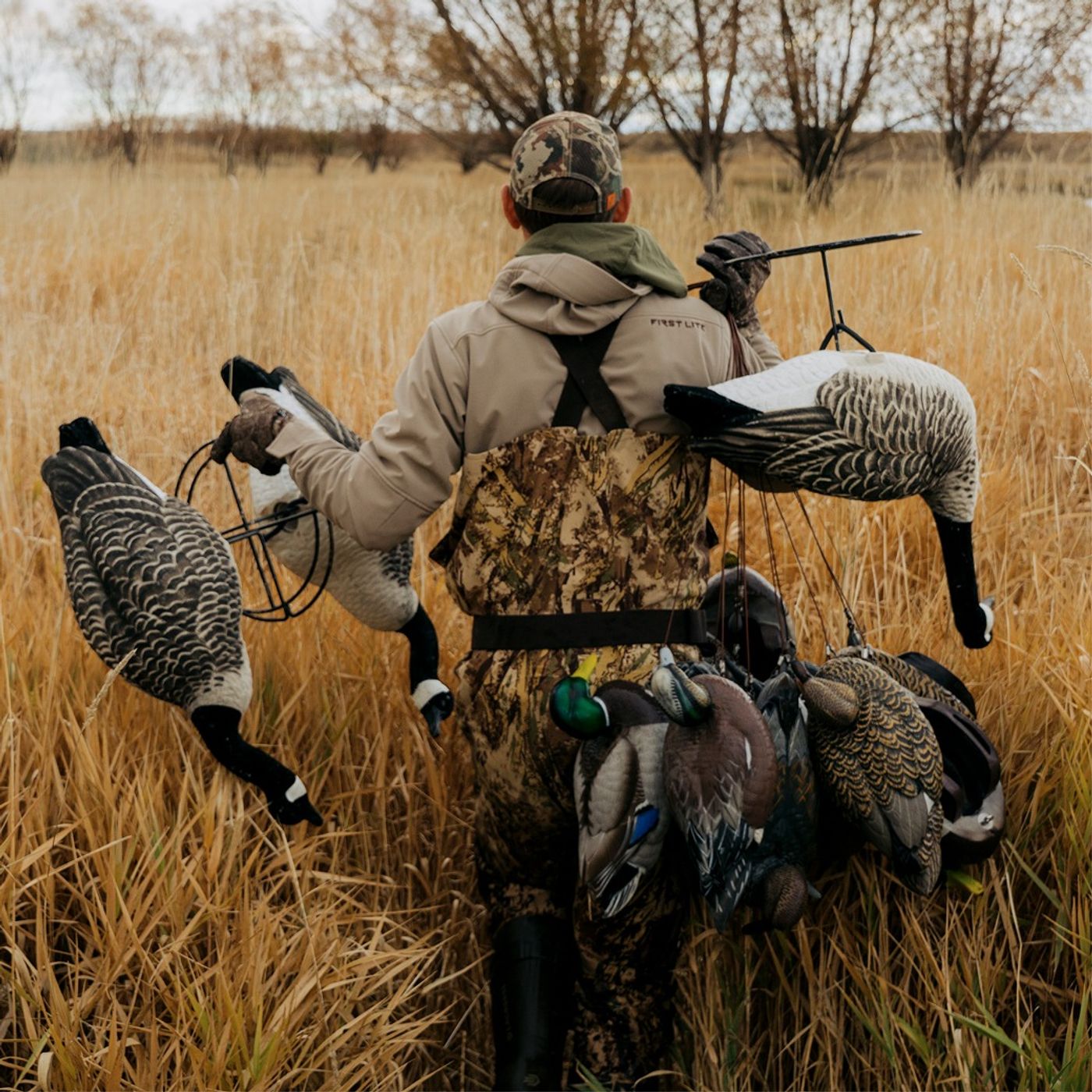
这是一堆塑料诱饵鸭。
So this is a pile of plastic decoy ducks.
是的。
Yeah.
鸭子和鹅的诱饵数量惊人地多。
There are a shocking number of duck decoys and goose decoys.
用它们来欺骗真鸭子,这在我看来有点疯狂。
Use them to fool real ducks, which is kinda crazy to me.
每当鸭子不上当时,我总是开玩笑说,
I always make the joke whenever, like, the ducks don't come in.
我总说,好吧,
I always say, well,
是的,我们
yeah, we
外面有一堆塑料制品和四个试图躲藏的人,你知道吗?
got a pile of plastic out there and four human beings trying to hide themselves, you know?
难怪它们不肯过来。
Like, no wonder they're not coming in.
是啊。
Yeah.
看起来不太妙。
That don't look good.
不行。
Nope.
很快,我们都走进了黑暗的草丛中。
So And pretty soon, we're all walking out into the grassy darkness.
你想要我们其中一个人来拿
Do you want one of us to carry
这个 好的。
this Yeah.
要和你一起转一圈吗,克林特?
Round with you, Clint?
好的。
Yeah.
好的,麻烦了。
Yeah, please.
我们可以
We can
直接抓住
just grab
它们的把手。
them by the handles.
没错。
Yep.
你拿了一个吗?
You got one?
像这样吗?
Like that?
晨间目击鱼群?
Morning witness fish?
对。
Yeah.
好的。
Okay.
所以我们准备下水了。
So we're setting for the water.
水有多深?
How deep is it?
这里大概刚到我膝盖下面。
It's, like, just below my knees here.
我们现在要做的是在这里放些假鸭,让真鸭子以为这里有鸭群聚集。
So what we're doing is we're putting decoys here to show that there's ducks congregating here.
就这样
So that
你希望它们聚集的主要区域就在那里,这样能让它们更靠近你前方。
you But but then the main pocket you want them to be in is right there, and that puts them more out in front of you.
基本上,现在这个真空区域就是你希望鸭子能干净利落地降落的地方。
So basically, right here in this now in this vacuum is where you hope the duck is gonna come clean.
对。
Yeah.
就像,算是比较好的降落区域。
Like like, kind of good landing areas.
对吧?
Right?
就是你刚才扔石头的地方。
Where you just toss that rock.
没错。
Yeah.
对,就扔过那块石头。
Right right across that rock.
我想是吧。
I guess so.
现在看它们分散开来还挺有意思的。
It's kinda cool to now see them spread about.
突然间这池塘里好像多了好多鸭子,虽然是假的。
Suddenly, it looks like there's a lot of ducks in this pond even though they're fake.
是啊。
Yeah.
看,你能描述下我们要进入的这个结构吗?
See, can you just describe this the structure that we're gonna
要进去吗?
be going into?
没错。
Yep.
这是个非常不错的狩猎隐蔽所。
This is a very nice hunting blind.
这就像,就像个精心伪装的鞋盒。
It's a it's like a it's like a very elaborately camouflaged shoebox.
是啊。
Yeah.
里面有个长凳可以坐。
It's got a bench to sit in.
它配备了一个小型枪架,整体看起来就像,没错,一个能容纳七个人或理想情况下五个紧紧挤在一起的人的鞋盒。
It's got a little gun rack, and then it's pictured just like a, yeah, a shoebox big enough to hold seven people or ideally five people packed very tightly.
我们在挑战空间极限。
We're challenging the space.
但它确实很大。
But it's big.
主要是它提供了一个可以固定所有这些植被的结构。
Mainly, it provides a structure that you can affix all this vegetation to.
是啊。
Yeah.
而且它,怎么说呢,完全被层层覆盖了,没错。
And it is, like, thoroughly layered with Yep.
胶带,灌木,
Tape, brush,
树枝。
branches.
融入环境。
Blend in.
对。
Yeah.
狗要是来过这儿,就不会在这儿了。
Dogs can was here, it wouldn't be here.
狗能看见颜色。
Dogs can see color.
它们非常难以被欺骗。
They're they're they can be very hard to trick.
这样你就能保持隐蔽。
And so this just allows you to stay concealed.
那是狗箱。
That's dog box.
是的。
Yeah.
而且那会让你完全隐形。
And and that's gonna make you entirely.
你介意给我一个吗?
Do you mind giving me one?
那是给他家狗用的。
That's for his dog.
那个不行
That can't
关于 Bayt 播客
Bayt 提供中文+原文双语音频和字幕,帮助你打破语言障碍,轻松听懂全球优质播客。