本集简介
双语字幕
仅展示文本字幕,不包含中文音频;想边听边看,请使用 Bayt 播客 App。
嘿,我是罗伯特·范伦。
Hey, I'm Robert Vanloen.
我来自《纽约时报》游戏部门,今天来和大家聊聊Wordle以及Wordle历史记录。
I'm from New York Times Games, and I'm here talking to people about Wordle and the Wordle archive.
你们都玩Wordle吗?
Do you all play Wordle?
是的。
Yes.
我有个激动人心的东西要给你们看。
I have something exciting to show you.
哦,好的。
Oh, okay.
这是Wordle历史记录。
It's the Wordle archive.
哦。
Oh.
哦。
Oh.
你可以随时回溯查看。
And you I keep can like go back.
百分之百可以。
A 100%.
哦,这太棒了
Oh, that's So
现在你可以
now you can
玩到每一个曾经出现过的Wordle谜题。
play every Wordle that has ever existed.
大概有一千个谜题。
There's like a thousand puzzles.
天哪。
Oh my god.
我喜欢Amazing。
I love Amazing.
《纽约时报》游戏订阅用户现在可以访问整个Wordle档案。
New York Times game subscribers can now access the entire Wordle archive.
了解更多请访问nytimes.com/games。
Find out more at nytimes.com/games.
来自《纽约时报》,我是娜塔莉·基特罗思。
From The New York Times, I'm Natalie Kitroeth.
这是《每日新闻》。
This is The Daily.
在特朗普发起全球贸易战一年多后,中国不仅挺了过来。
About a year into Trump's global trade war, China hasn't just survived.
它在国际舞台上反而变得更加强大。
It's emerged stronger than ever on the world stage.
这是因为经过多年的精心规划,中国实际上已经让自己对关税免疫。
And that's because after years of careful planning, China has essentially made itself tariff proof.
今天,我的同事基思·布拉德舍尔将解释,尽管特朗普竭尽全力,中国由机器人驱动的超级工厂仍正在席卷全球。
Today, my colleague Keith Bradsher explains how, despite Trump's best efforts, China's robot powered super factories are taking over the world.
今天是3月24日,星期二。
It's Tuesday, March 24.
基思,对华加征关税已经一年了。
Keith, it's been about one year of tariffs on China.
这一年,可以说是一场对中国的经济战争。
One year of, I think it's fair to say, economic war on China.
这真是疯狂的一年,最终以最高法院裁定许多这些关税非法而告终。
A crazy year, honestly, which was capped off by a Supreme Court ruling saying many of these tariffs were illegal.
我们今天要探讨的是,过去这一年究竟带来了什么影响。
And what we're here to do today is figure out what did the last year amount to.
你在这里,是因为你已经报道贸易话题大约一亿年了。
And you are here because you've been covering trade for approximately one billion years.
是这样吗?
Is that right?
从1991年开始。
Since 1991.
是的。
Yes.
谢谢。
Thank you.
好的。
Okay.
接近十亿年。
Close to a billion.
所以我们希望你能帮我们理解这些关税对中国造成了什么影响。
And so what we want is for you to help us understand what these tariffs have wrought when it comes to China.
这些关税正在以重要方式改变中国的贸易,但远没有特朗普政府预期的那么大。
These tariffs are changing China's trade in important ways, but not nearly as much as the Trump administration expected.
是的,中国出口到美国的货物比以前少了,但中国从美国进口的货物也比以前少了。
Yes, China's not shipping as much to The United States as it was before, but China's also not buying as much from The United States as it was before.
中国的整体贸易顺差,即其出口超过从世界其他地区进口的金额,仍在增长。
The overall trade surplus of China, how much its exports exceed, how much it's buying from the rest of the world, is still growing.
去年这一数字进一步扩大,达到了1.2万亿美元。
It became even more immense last year when it reached $1,200,000,000,000.
1.2万亿美元。
1,200,000,000,000.0.
请解释一下这个数字的意义。
Just put that in context.
这有多大影响?
How big of a deal is that?
1.2万亿美元比世界上大多数国家的经济规模还要大。
1,200,000,000,000.0 is bigger than the economies of most of the countries in the world.
而且
And
尤其引人注目的是,中国在制造业领域的贸易顺差更大,而制造业创造了大量就业机会,包括许多高技能、高薪的工作。
what was particularly striking about it was that the trade surplus for China in manufactured goods, which create a lot of jobs, a lot of high skilled, well paid jobs, that trade surplus was even bigger.
中国已经真正成为世界的工厂。
China's truly become the factory of the world.
中国主导着从钢铁、化学品等基础材料,到电动汽车和太阳能电池板等各种产品的生产。
The dominant producer of everything from basic materials like steel and chemicals all the way through electric cars and solar panels.
你所说的,基思,其要点是,几十年来针对中国最严厉的关税并没有真正阻止中国在制造业中的主导地位。
The upshot of what you're saying, Keith, is that the most aggressive tariffs against China in decades didn't really stop China from dominating in manufacturing.
为什么?
Why?
这该如何解释?
What explains that?
有四个原因。
There are four reasons.
第一,中国迅速扩大了对其他市场的销售,不仅在亚洲,还包括非洲、拉丁美洲和欧洲。
One, China ramped up its sales in a hurry to other markets, not just in Asia, but in Africa, Latin America, and in Europe.
第二,中国增加了间接销往美国的商品销售,比如出口吸尘器或其他系统的零部件,这些零部件在其他国家组装后再运往美国。
Second, China ramped up sales of goods that are indirectly reaching The United States, like exporting the parts of a vacuum cleaner or some other system that then gets assembled in another country and then shipped into The United States.
所以有很多通过其他国家间接运往美国的货物。
So a lot of indirect shipments to The United States through other countries.
第三,中国成功地使本国货币大幅贬值。
Third, China has managed to weaken its currency a lot.
这使得中国的商品在外国市场上便宜得多,而外国商品,比如美国或欧洲的商品,在中国则变得非常昂贵。
That makes China's goods much cheaper in foreign markets and it makes foreign goods like American goods or European goods very expensive in China.
但最后一个原因,也是中国产生巨大贸易顺差的最重要原因,是它在先进制造领域目前领先数年。
But the last reason, and in some ways the most important reason why China is producing such enormous trade surpluses is that it is years ahead right now in advanced manufacturing.
几乎任何东西在中国制造都比在其他任何地方更便宜。
Pretty much anything can be made less expensively in China than anywhere else.
他们不仅是最便宜的服装和家具制造地。
They're not just the least expensive place to make clothing or furniture.
现在,他们也成为汽车、电池以及其他各种技术产品的最便宜制造地。
Now they're the least expensive place to make cars, batteries, all these other technologies.
而这其中很大一部分原因在于,他们使用了比世界上任何其他国家都更多的机器人,在非常先进的工厂中生产这些产品。
And a big part of that is because they're making them in very advanced factories with more robots than anyone else in the world.
好的。
Okay.
让我明确一下,你的意思是,由于中国的工厂高度自动化,这个国家能够以极低的成本生产大量商品,甚至包括先进产品,便宜到中国几乎对特朗普的关税免疫。
Just to spell this out, you're saying because China's factories are just so automated, the country's able to produce a ton of stuff, even advanced products, extremely cheaply, so cheaply that China has become almost immune to Trump's tariffs.
他们并不是完全免疫,但比任何人都预期的更具抵抗力。
They're not completely immune, but they are a lot more resistant than anyone else expected.
好的。
Okay.
所以我想了解,中国工厂内部的自动化具体是什么样子的?
So I wanna understand, what exactly does that automation inside China's factories look like?
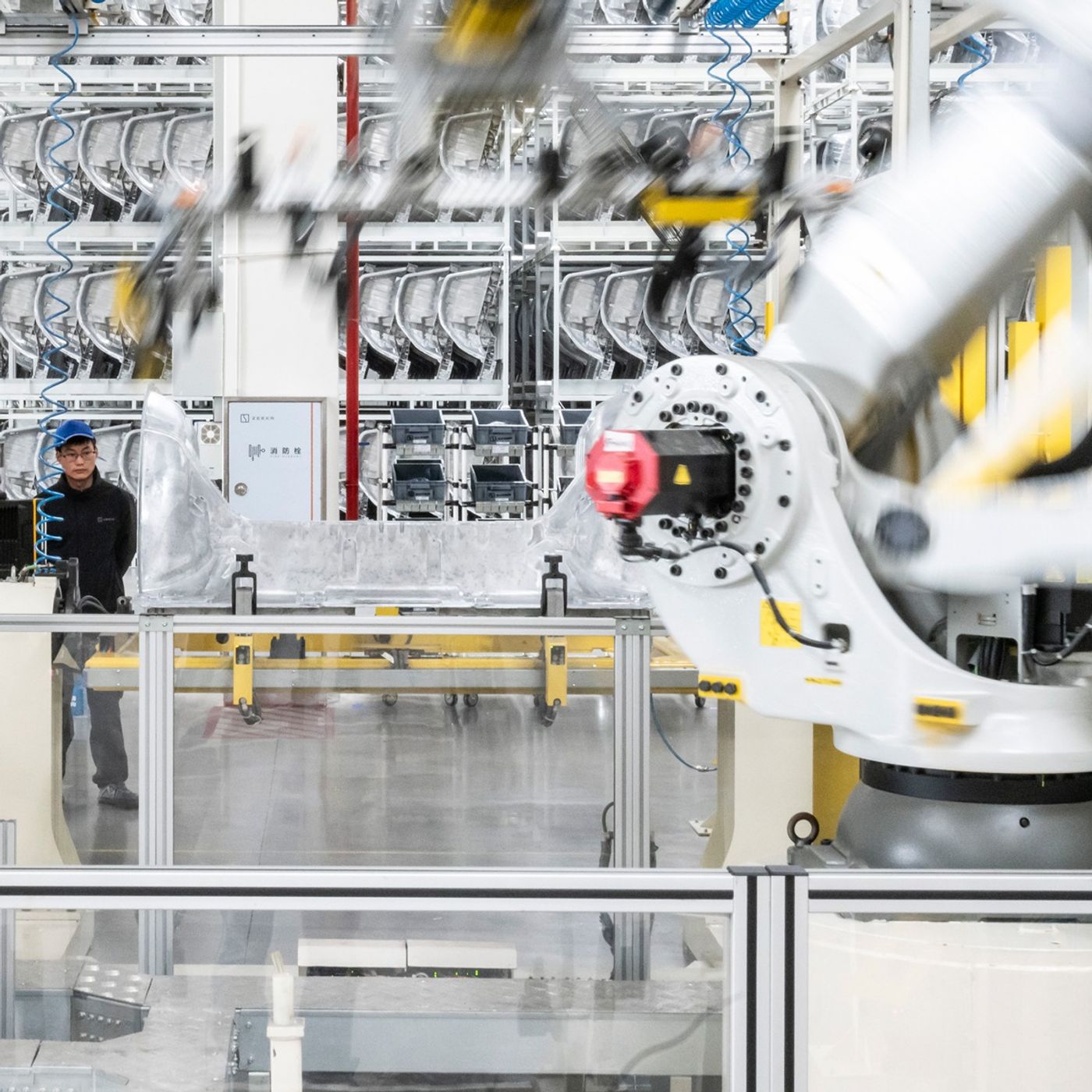
让我告诉你几个月前我参观过的一家位于中国东部的汽车工厂。
Let me tell you about a car factory I visited some months ago in Eastern China.
生产过程的最初阶段是制造汽车车身部件,这些部件过去主要由钢材制成。
The very start of the process is making the car body components, which used to be made mostly out of steel.
但现在他们使用的是铝材,这种材料更轻,更适合电动汽车。
This was making it out of aluminum, which is lighter weight, works better with an electric car.
这要难得多,但他们采用的方式比世界上其他任何地方都要先进。
It's much harder to do, but they were doing it in a more advanced way than you see practically anywhere else.
有机器人雪橇将铝棒运送到一台高达数十米的自动化电梯,电梯一直升到一台像美国豪宅那么大的机器顶部。
There were robotic sleds carrying bars of aluminum to an automated elevator up up up up to the top of a machine the size of a McMansion in The United States.
哇哦。
Woah.
我的意思是,这台设备庞大得惊人。
I mean, this piece of apparatus was enormous.
电梯会自动将铝锭倒入熔炉,熔炉将铝锭熔化成液态铝,然后精准地浇铸成各种所需的汽车车身部件形状。
And the elevator automatically dumps the alumina ingots in a furnace, and that furnace turns them into molten aluminum that is then poured into precisely the shapes of the various car body components that are needed.
然后这些汽车部件由叉车司机运送到一个巨大的仓库,之后再供应给装配线,虽然将来这部分也会实现自动化。
And then those car parts are taken, still by human drivers with forklifts, although that will be automated at some point as well, into a very large warehouse from which they then feed the assembly line.
这条装配线上有820个机器人。
The assembly line is 820 robots.
这是一座所谓的黑灯工厂。
It's a so called dark factory.
黑暗工厂是因为人类不参与,而机器人不需要光就能工作。
Dark factory because humans aren't involved and robots don't need light to function.
说得对极了。
That's exactly right.
你可以把灯关掉。
You can turn off the lights.
它们会持续制造它们正在生产的东西,并将这些零部件组装成汽车的骨架。
They keep making whatever they're making, and they are assembling all these components into the skeleton of the car.
现在,其中一些技术在世界其他地方的汽车工厂也能见到,但所有这些环节的整合非常令人印象深刻。
Now, some of that you find elsewhere in other car factories, elsewhere in the world, but the integration of everything is very impressive.
它还使用了人工智能。
It was also using artificial intelligence.
摄像头拍摄了大量成品汽车的照片,并与数据库中那些被认定为组装得非常精良的其他汽车进行详细比对,以识别是否存在需要修正的瑕疵。
Cameras were taking lots of pictures of the finished car and comparing them in detail to a database of other cars that were viewed as very well put together and identifying if there were any flaws that needed to be corrected.
所以在这种情况下,人工智能在进行质量控制?
So AI is doing quality control in this case?
人工智能正在执行质量控制。
AI is doing quality control.
人工智能参与了流程中几乎每一个步骤的追踪。
AI is involved in tracking practically every step in the process.
你在中国看到的,比世界上任何其他国家都更多,是人工智能在制造业中的应用。
What you're seeing in China more than any other country is the adaptation of AI to manufacturing.
这与你在世界其他地方的工厂看到的情况相比如何?
And how does that compare to what you see in the rest of the world to the rest of the world's factories?
其他国家的自动化程度不再那么高。
So other countries are no longer as automated.
事实上,德国、日本和美国现在的工厂自动化程度更低,机器人数量比中国少。
In fact, Germany, Japan, The United States now have factories that are less automated, that have fewer robots than China.
中国每万名制造业工人拥有的机器人数量,超过了这三个国家中的任何一个。
China now has a higher number of robots for every 10,000 manufacturing workers than any of those three countries.
中国每年安装的工厂机器人数量,也超过了世界其他所有国家的总和。
China also is installing more factory robots each year now than the entire rest of the world combined.
中国是如何达到如今在制造业上超越美国、德国和日本的水平的?
How did China get to the point where it is more advanced at manufacturing than The US, than Germany, than Japan?
这些国家都曾以制造业巨头著称,专精于这一领域。
These are countries that were all known at one point for being manufacturing titans, for specializing in this.
中国是怎么做到这一点的?
How did China get here?
中国先进制造业的崛起是一个非凡的故事。
The rise of advanced manufacturing in China is a remarkable story.
这不仅仅是一个经济故事。
It's not just an economic story.
这也是一个教育故事。
It's also an education story.
这是一个文化故事。
It's a culture story.
这是一个人口故事。
It's a demographic story.
你得回溯到2010年代中期。
You have to go back to the mid twenty tens.
中国实际上已经崛起为全球第一大制造强国,但那并不是他们想要的全部。
China had really already emerged as the world's number one manufacturing power, but that wasn't all they wanted to do.
他们不只想成为制造最多产品的制造强国。
They didn't want to just be the manufacturing power that made the most things.
他们想制造最好的产品,最先进的科技产品。
They wanted to make the best things, the most advanced technology products.
但与此同时,
At the same time though
由于严格的计划生育政策,中国年轻劳动力的供给已经见顶并迅速下降。
The supply of young Chinese workers has peaked and is rapidly dropping, thanks to stringent family planning policies.
中国开始意识到,所谓的独生子女政策产生了一个意想不到的结果。
China was starting to realize that its so called one child policy had produced an unintended result.
该政策显著降低了出生率,尤其是在农村地区,而中国大部分流动劳动力正是来自这些地区。
The policy significantly reduced birth rates, especially in rural areas, the source from which the bulk of China's floating labor population comes.
到那时,中国已经几十年来限制家庭生育超过一个孩子,这项政策已经走得太远了。
China had been restricting families from having more than one child for several decades by then, and the policy had gone too far.
出生率正在急剧下滑。
The birth rate was collapsing.
当美国人还在为失业发愁时,中国工厂却挂出了红色告示,寻求工人。
As Americans struggle with pink slips, Chinese factories are putting up red signs seeking workers.
目前,有太多工厂在寻找劳工。
Right now, there are just too many factories looking for laborers.
这位招聘人员表示,填补岗位的压力很大。
This recruiter says the pressure is on to fill spots.
下降幅度如此之大,他们开始担心:我们会不会缺乏足够多的年轻人进入劳动力市场?
So much of a drop they began worrying, are we going to have enough young people coming into the workforce?
因此,中国面临巨大压力,必须找到方法,在工人数量远少于以往的情况下,完成同样的工作,尤其是在工厂里。
And so that put a lot of pressure on China to find ways to get the same work done, particularly at the factories, without having nearly remotely as many workers.
由于可用的年轻劳动力减少,人们担心中国可能无法维持推动其成为世界第二大经济体的高速增长。
With fewer young people available for work, there are concerns the country may not be able to sustain the fast economic growth that has transformed China into the world's second largest economy after The United States.
在美国,移民抵消了出生率的下降,但中国几乎不允许任何移民。
In The United States, immigration has offset a falling birth rate, but China allows almost no immigration whatsoever.
在美国,每年发放的绿卡超过一百万张。
In The US, it's over a million green cards a year.
在中国,只有几千张十年居留卡,这甚至算不上真正的绿卡。
In China, it's several thousand ten year residency cards, which isn't even a a full green card.
这只不过是在一个幅员辽阔的国家里居住十年。
It's just ten years in a vast country.
中国的人均外籍人口比例甚至低于朝鲜。
China has fewer foreigners per capita living in it than even North Korea.
你 essentially 的意思是,如果没有移民,再加上出生率迅速下降,中国就没有足够的人手来维持其作为世界工厂的地位,尤其是当他们的雄心壮志还在增长时。
Essentially, you're saying is without immigration and with a rapidly falling birth rate, China just doesn't have enough bodies to sustain itself as the world's factory, especially as their ambitions are growing.
除非中国进行大规模的自动化,否则它没有足够的劳动力。
China doesn't have enough workers unless it does an extraordinary amount of automation.
因为这不仅仅关乎劳动力数量的减少。
Because this is not just about a declining number of workers.
这还涉及到越来越少的人愿意在生产线上工作。
This is also about fewer and fewer workers who are willing to work on an assembly line.
为什么呢?
And why?
为什么人们不愿意做这些工作?
Why don't people want these jobs?
人们不愿意做这些工作,因为他们比上一代人受过好得多的教育。
People don't want these jobs because they are much, much better educated than the previous generation.
由于独生子女政策,夫妇们倾尽所有,确保他们的孩子获得最好的教育。
With the one child policy, couples put everything they had into making sure that child has the best possible education.
比如我认识的一个来自中国西北部的家庭。
Family is like one that I know in Northwestern China.
父亲是个文盲煤矿工人,在非法煤矿里几乎无偿工作。
The father is an illiterate coal miner, working for almost nothing in illegal coal mines.
母亲也是文盲,在一家小店做收银员,但他们把所有资源都投入到培养女儿身上。当我从2006年开始每两年去拜访这个家庭时,我发现她在七年级就已经在学习比许多美国学校更高级的代数了。
The mother, also illiterate, works as a checkout clerk in a corner store, but they put everything into training their daughter, and when I first started going every two years to meet that family in 2006, I noticed in seventh grade she was already doing algebra that was ahead of the algebra in many American schools.
而她当时在一个偏远小村庄的学校上学,那所学校是为文盲家庭的孩子设立的,但她最终还是上了大学。
And here she was in a tiny village going to a school for the children of the illiterate, and she did go off to college.
因此,结果是全国不仅有大量高中毕业生,如今超过一半的年轻人也成为了大学毕业生。
And so the result is a nation of not just high school graduates, but now more than half the young people are college graduates as well.
他们最不想做的,就是在工厂流水线上日复一日地做机械重复的工作。
And the last thing they want to do is a rote job on a factory floor doing the same assembly day after day.
此外,还有儒家传统认为,动手劳作比写作等其他形式的工作低人一等。
There's also a Confucian tradition that working with your hands is somehow inferior to other forms of work, such as writing.
这种传统使许多家庭不愿让独生子女去工厂工作,而他们的独生子女往往也抱有同样的顾虑。
That tradition has made many families reluctant to see their only child take a factory job, and often their only child shares that reluctance.
因此,尽管制造业仍在增长,持续生产着海量的商品,但这些庞大的工厂与一群受过高等教育、通常对工厂工作心存戒备的独生子女劳动力之间,存在着严重的不匹配。
So while the manufacturing sector is still growing, is still producing a vast cornucopia of goods, there's a mismatch between these vast numerous factories and a labor force of only children who went to college and are often wary of factory work.
随着这一情况逐渐显现,商界和政府领导人感到真正的焦虑。
The result, as the 20 unfolded, was a real anxiety among business leaders and government leaders.
未来的工厂工人将从哪里来?
Where were the factory workers of tomorrow going to come from?
他们的应对措施是制定一项雄心勃勃的计划,以实现全国工厂的自动化。
And their response was to create a very ambitious program to automate the nation's factories.
我们马上回来。
We'll be right back.
理论上,我知道这种事情可能发生在任何家庭中。
In theory, I knew that this kind of thing can happen in any family.
任何人的表亲都可能在密谋谋杀。
Anyone's first cousin could be plotting murder.
这里是UC 4735,今天是。
This is UC 4735, and today is.
正派的公民总是被揭露出是隐藏的罪犯。
Upstanding citizens are always turning out to be secret criminals.
与艾伦·格森的秘密联络。
Secret wording with Alan Gessen.
我甚至不认为我的表亲艾伦是个正派的人。
And I wouldn't even call my cousin Alan an upstanding citizen.
你知道,我的客户都是贩毒集团级别的家伙。
You know, my clients are cartel level guys.
他们都是狠角色。
They're all badasses.
他们他们他们
They're they they
但知道这一点是一回事。
But it's one thing to know
有一种更永久的方法来做这件事。
There's a more permanent way to do it.
是这个吗?
Is this?
是的。
Yeah.
越来越不一样了。
More and more different.
永久的。
Permanent.
还有另一件事需要明白。
And another thing to understand.
艾伦杀了我。
Alan murder me.
结果比我想象的要糟糕得多。
It ended up being so much worse than I thought I knew.
价格非常合理。
The price is eminently reasonable
好的。
Okay.
话又说回来。
For what it's worth.
什么
What
艾伦当时在想什么?
the hell was Alan thinking?
让我这么说吧,我
Like, let me just say that I'm
有点生气。
a little bit pissed off.
你知道你在说什么吗?
You know what saying?
对。
Yeah.
不。
No.
我明白。
I get it.
是的。
Yeah.
从
From
由Serial Productions和《纽约时报》出品,我是埃姆·盖森,欢迎收听《傻瓜》。
Serial Productions and The New York Times, I'm Em Gessen, and this is The Idiot.
3月26日上线,各大播客平台均可收听。
Out March 26, wherever you get your podcasts.
好的,基思。
Okay, Keith.
那么,中国到底做了什么?
So what exactly does China do?
中国是如何成为——我认为这么说毫不为过——全球自动化之都的?
How did China become, I think it's fair to say, the automation capital of the world?
中国对此早有计划。
China had a plan for this.
中国非常重视规划。
China's big on plans.
这是一个仍然实行五年计划的国家。
It's a country that still does five year plans.
2015年,他们又额外制定了一项十年计划,名为‘中国制造2025’,旨在让中国在十大关键领域具备全球竞争力,比如半导体、电动汽车、稀土磁体等先进材料。
And what happened in 2015 was they did a ten year plan for good measure, and that was called Made in China 2025, to make China globally competitive in 10 major sectors, whether it was semiconductors, electric cars, advanced materials like rare earth magnets.
或许最重要的是,中国决定在机器人领域实现重大突破。
Perhaps most important, China decided it really wanted to move ahead in robotics.
为什么如此强调机器人技术呢?
And why was there such an emphasis on robotics?
给我解释一下吧。
Just explain that to me.
中国不仅仅想成为制造先进产品的国家。
China doesn't want only to be the country that makes advanced products.
中国还希望成为生产这些先进产品所需所有设备的国家。
China also wants to be the country that makes all the equipment to produce advanced products.
而这些设备——无论是半导体、电动汽车还是太阳能电池板的设备——都涉及大量自动化。
And the equipment, whether it's for semiconductors, whether it's for electric cars, whether it's for solar panels, the equipment for all of these categories involves a lot of automation.
因此,中国投入资金用于发展机器人技术和工厂自动化,以制造这些先进产品。
And so China put the investments into doing the robotics, the factory automation needed to manufacture those advanced products.
所以他们不仅投资于制造电动汽车、飞机或半导体。
So they're not just investing in building EVs or building planes or semiconductors.
他们还在投资建设工厂以及制造这些产品所需的设备和技术。
They're investing in building factories and the equipment and the technology that you need to build all these other things.
比如,建设先进工厂本身就是一种目标。
Like, building advanced factories was an end in and of itself.
而你所说的机器人,对实现这一点至关重要。
And robotics, you're saying, was essential to that.
没错,正是如此。
That's exactly right.
他们正努力确保整个先进制造业的供应链都在中国境内完成。
They are really trying to make sure that the whole supply chain of advanced manufacturing happens in China.
仅仅从西方进口最新的工厂设备对他们来说是不够的。
It's not enough for them to take delivery of the latest factory equipment from the West.
现在,他们希望亲自制造所有最新的工厂设备和最新的自动化技术。
Now they want to be making all of the latest factory equipment themselves and all of the latest automation themselves.
那么,中国是如何执行这一‘中国制造’计划的呢?
And so how did China execute this made in China plan?
他们为这些项目投入了巨额资金。
They throw money at these projects in incredible sums.
数百亿美元的政府投资资金涌入众多科技初创企业,涵盖各种领域。
Hundreds of billions of dollars in government investment funds going into many different tech startups in all kinds of areas.
事实上,中国一直在全球范围内大肆收购,众所周知,今年宣布了高达2070亿美元的并购交易。
Well, has been on a worldwide buying spree, we all know, announcing an unprecedented $207,000,000,000 worth of mergers and acquisitions this year.
如果你想了解中国
If you wanna take China
中国在先进制造领域的关键进展始于2017年初。
A crucial step in China's advances in the latest manufacturing came at the start of 2017.
有关中国试图收购库卡公司的最新消息传来。
Some breaking news coming through on the Chinese attempts to buy Kuka.
库卡表示,美国已在中午前批准了这项收购。
Kuka says that The US has given a green light to the takeover by middaya.
这当然是这家想要收购这家机器人公司的中国企业。
This is, of course, the Chinese company that wants to buy the robotics firm.
一家中国公司获得了美国和德国的许可,收购了德国企业库卡,而库卡在许多方面都是全球工厂机器人制造的领军者。
A Chinese company was allowed by The United States and Germany to buy Kuka, a German company that, in many ways, led the world in making factory robots.
当时人们并没有意识到这有多么重要。
People didn't realize at the time how important this was.
如果你想要一个向上游迈进的公司例子
If you want an example of a company that's moving up
在中国,从低附加值制造转向高端制造创新与机器人领域的典型代表就是
the food chain here in China from low value manufacturing to high end manufacturing innovation robotics, then
真正值得关注的是美达公司。
really, Medea is the one to watch.
它大约一年前收购了德国机器人制造商库卡。
It bought KUKA, the German robot maker, about a year ago.
我三十年来一直走访世界各地的汽车工厂。
I've been going to car factories all over the world for thirty years.
这些工厂里到处都是库卡机器人。
KUKA robots are everywhere in those factories.
自2017年初开始,突然间,这些技术与制造能力都转移到了中国。
And since the start of 2017, all of a sudden, that know how, that manufacturing capability shifted to China.
如今,成千上万的库卡机器人在上海生产。
Today, many, many, many Cuckoo robots are made in Shanghai.
与之相关的知识,不仅包括如何制造机器人,还包括机器人所生产的汽车等所有技术,也都转移到了上海和中国其他地区。
And the knowledge associated with that, not just of how to build robots, but everything the robots build like cars has moved to Shanghai and to the rest of China as well.
他们本质上是直接整体引进了这些专业技术。
They essentially just imported that expertise wholesale.
他们收购了这家公司,并将技术引进和转移至中国。
They bought the company and imported and transferred the expertise to China.
完全正确。
Exactly right.
这帮助中国在机器人领域变得非常强大。
And this helped China become very strong in robotics.
值得注意的是,中国在制造工厂自动化设备方面已经变得如此出色,并且产量巨大,如今你不仅能在汽车工厂看到先进的机器人,甚至在小巷里的小型作坊里也能找到它们。
What's remarkable is that China has become so good at making factory automation and makes it in such enormous quantities that nowadays, you don't just find advanced robots in car factories, you find them even in small back alley operations.
所以去年,例如,我去了中国南方广州一个充满工业气息的街区,那里有许多小型店面式作坊,我参观了一家小作坊,他们只是将钢板焊接起来,为发展中国家的当地食堂制作后院烧烤架。
So last year, for example, I was in a gritty industrial neighborhood of small storefront workshops in Guangzhou in Southern China, and I went to a small operation that was just welding together sheets of steel to make backyard barbecues for sale to local canteens in developing countries.
所以这是相当基础的东西。
So something pretty basic.
非常基础。
Very basic.
十名工人,没有空调,店铺直接面向街道,而当时的气温接近100华氏度。
10 workers, no air conditioning, open to the street even though the temperature was approaching a 100 degrees.
几名工人拿着焊枪,周围堆着大量的钢板。
Several guys with welding torches, big stacks of steel sheets around.
这非常基础。
It was very basic.
然而,店主说,我准备买一台机器人了。
And yet the owner said, I'm about to get a robot.
我问他,这怎么运作呢?
And I said, how does that work out?
这对你来说怎么说得通呢?
How is how does that make sense for you?
他说,几年前,如果我想买一台机器人来自动化我这里的部分业务,成本要14万美元。
And he said, well, a couple years ago, if I wanted to buy a robot to automate part of my business here, it would have cost me a $140,000.
现在,它的价格只有当时的四分之一,只需要我的一名工人演示一下如何焊接这些钢板来制作烤箱的侧面即可。
Now, it costs me a quarter of that, and all that needs to happen is one of my workers does the motions for welding together these sheets of steel to make the sides of the oven.
中国提供的系统上装有摄像头,精确记录工人焊接钢板的过程,然后自动编程让机器人完成完全相同的焊接动作。
A camera on the Chinese supplied system watches exactly how the worker welds the steel, and it then automatically programs the robot to do exactly the same welds.
太神奇了。
Amazing.
不可思议。
Incredible.
即使在中国,工资远低于美国,他也说,现在用机器人取代一名甚至多名工人已经成本效益显著,因为他表示,你看,这个机器人可以一天24小时不间断工作。
Even in China, with wages much lower than in The United States, it's now cost effective, he said, to replace a worker or actually several workers with a robot because he said, look, this robot is can do this twenty four hours a day.
工人每天只工作八小时,而如今很难找到愿意在95华氏度高温下焊接、在没有空调的店面作坊里从事这种繁重工作的工人。
The workers are eight hours a day and it's hard to find workers these days who wanna work when it's 95 degrees welding, which is hot work, in a storefront workshop with no air conditioning.
工人们对此感觉如何,基思?
How do workers feel about this, Keith?
显然,在美国,自动化取代所有工厂岗位的想法引发了大量焦虑。
Obviously, in The United States, the idea of automating all these factory jobs has produced a ton of anxiety.
我可以想象,在中国,看到机器人接管工作也不会让人感觉很好。
And I can imagine in China, it also might not feel great to see a robot take over.
但与此同时,你提到中国人对从事这些工厂工作并不热衷。
But at the same time, you've said there's a reluctance among the Chinese to take these factory jobs.
那么这种情况是如何发展的呢?
So how's it playing?
与我所知的任何其他国家相比,这里对自动化的抵触情绪要小得多,因为目前工厂岗位的数量多于工厂工人。
There is far less hostility to automation than in any other country I know about, because right now, there are more factory jobs than there are factory workers.
这些工厂的总产出随着出口不断攀升。
The total output of these factories is just going up and up and up with exports.
因此,你所看到的自动化现象,往往是相同数量的工人生产出越来越多的产品。
So what you're seeing with automation is often the same number of workers making more and more and more.
这些商品都流向了哪里?
And where are all these goods going?
它们都用于出口。
They're going into exports.
它们被运往其他国家。
They're going to other countries.
因此,因中国自动化水平提升而失去工作的工人,并不在中国,而往往是在那些尚未大量投资于最新自动化、最新质量控制和最新发明的国家。
So the workers who are losing their jobs because of China's rise in automation are not in China, they're often in other countries that have not invested as much in the latest automation and in the latest quality control and in the latest inventions.
例如,德国目前每月正失去近一万个工厂岗位,其中很大一部分原因是中国的出口迅速增长,抢走了德国工厂的业务。这对德国来说是个问题,但对中国工厂工人而言却不是问题。
Germany, for example, is losing close to 10,000 factory jobs a month right now, and a big big part of that is the rapid rise of China's exports taking away business from Germany's factories, And that's an issue in Germany, but that's not an issue for factory workers in China.
对。
Right.
如果你没有真正看到自动化的主要负面影响,你可能就不会那么反对它,这很合理。
It makes sense that if you're not actually seeing the main downside of automation, you might not be as opposed to it.
基思,美国在追赶方面处于什么位置?
Keith, where does The US stand in terms of catching up?
为了真正与中国竞争,我们是否必须让工厂更像中国的,尽可能高度自动化?
And is it fair to assume that in order to genuinely compete with China, we'd have to make factories more like China's, heavily automated as much as possible?
如果美国不开始大力投资工厂自动化,它将难以保持竞争力。
The US is going to have trouble being competitive if it doesn't start investing very heavily as well in factory automation.
美国汽车工业中也出现了一些通过自动化替代工人的现象,但美国的汽车工业是一个有趣的例子,说明了世界其他地区对中国的依赖程度正在加深。
There has been some replacement of workers through automation in the car industry in The United States as well, but the car industry in The United States is an interesting example of how dependent the rest of the world is becoming on China.
怎么说?
How so?
如今,美国的汽车工厂大量从中国购买自动化设备。
Car factories in The United States now buy a lot of their automation from China.
有一种产品长度超过足球场的三分之二,用于将钢板冲压成各种汽车车身部件的形状。
There is a product that is more than two thirds the length of a football field that stamps steel sheets into the shapes for various car body components.
因此,那些安装在中国工厂里的大型高度自动化设备,有时也会由中国出口到美国工厂,因为美国在这一领域没有任何具有竞争力的产品。
So those huge highly automated pieces of equipment that are installed in Chinese factories are also being shipped by China, in some cases, to American factories because The United States doesn't make anything that really is competitive in that category.
这很有趣。
It's interesting.
你基本上是说,无论如何,中国都是赢家。
You're basically saying either way, China wins.
如果我们想竞争,就必须购买他们的设备来实现。
If we want to compete, we have to buy their equipment to do that.
这种情况越来越普遍。
That's increasingly true.
瑞典、德国、日本和韩国的设备质量不错,但如今许多最便宜的设备都是中国制造的。
There is good Swedish, German, Japanese, and Korean equipment, but a lot of the least expensive equipment these days is made in China.
因此,中国在广泛的自动化技术领域已取得显著领先,并决心保持这一优势,同时持续投资以巩固这一领先地位。
So China now has a broad lead in a wide range of automation technologies and is determined to hold on to that lead and is continuing to invest in preserving that lead.
我想问问,这一切对我们与中国在制造业上竞争的目的意味着什么。
I wanna ask about what all this says about the purpose of competing with China on manufacturing.
因为你所说的让我想到,如果我们真的成功将制造业带回美国,这是否意味着我们能获得人们真正想要的那种工作?
Because what you've said makes me wonder, if we actually do succeed in bringing manufacturing back to The US, will that mean that we actually get the kind of jobs that people seem to want?
在中国,你说很多人已经不想再做工厂工作了。
In China, you've said many people don't want factory jobs anymore.
但在美国,很多人还是想要的。
But in The US, a lot of people do.
这正是很多人投票给特朗普的重要原因,因为他们认为他会把那些高质量的工作带回美国。
It was a big reason people voted for Trump because they thought he was gonna bring those high quality jobs back.
但你所描述的未来是,任何回到美国的工厂工作很可能都会大不相同。
But what you've described is a future where any factory job that comes here is probably gonna look a lot different.
对吧?
Right?
如今的工厂比十年前,更不用说二十年或三十年前,要舒适得多。
Today's factories are much more pleasant to work in than they were even ten years ago, and certainly much more pleasant than twenty or thirty years ago.
人机工效也更好了。
The ergonomics are better.
噪音更小了。
The noise is less.
空气质量好得多。
The air quality is much better.
所有这些自动化意味着,如今如果能获得工厂工作,它们是非常有吸引力的岗位,关键在于美国能否赶上并保持竞争力。
All of this automation does mean that factory jobs are very attractive jobs if you can get them now, and the question is going to be whether The US can catch up enough to be competitive.
这不仅关乎美国,也关乎欧洲、日本、韩国,以及巴西、印度、墨西哥和印度尼西亚等新兴工业化经济体。
And it's a question not just for The United States, but also for Europe, for Japan, for South Korea, and for emerging industrialized economies like Brazil, India, Mexico, and Indonesia.
对世界其他地区来说,这是一个重大问题:他们能为人民提供什么样的工厂工作?
It's a big question for the whole rest of the world, what kind of factory jobs will they be able to offer their people?
还有,能提供多少个。
Well, and how many.
对吧?
Right?
还有多少个。
And how many.
是的。
Yes.
但如果你有大量的生产,拥有一个庞大的市场,自动化会逐渐减少就业总数,但最终你会得到不同类型的工作。
But if you have a lot of production, if you have a large market, automation will gradually erode the total number of jobs, but you end up with different kinds of jobs.
你会得到设计制造产品的机器人而不是重复执行单调任务的工作。
You end up with jobs in designing the robots that make things instead of doing a rote task again and again.
你会得到创造新产品的工作。
You end up with jobs creating new products.
中国拥有这条产业链,问题是美国——在三十年前和四十年前某种程度上曾拥有这条产业链——能否设法复兴它。
China has that industrial chain, and the question is whether The US, which to some extent had that chain thirty and forty years ago, can manage to revive it.
我在想,基思,让我们回头看看特朗普对中国加征的关税。
I'm wondering, Keith, just to turn back to Trump's tariffs on China.
到目前为止,这些关税并没有阻止中国向全球出口大量商品,那为什么特朗普政府仍试图重新对中国加征关税呢?
If so far, they haven't stopped the country from exporting so much stuff across the world, why is the Trump administration still trying to reinstate tariffs against China?
我们听说了针对所谓不公平贸易行为的新调查,这些调查据称将使美国走上对中国加征新关税的道路。
We've heard of these new investigations into unfair trade practices that supposedly will put The US on the path to slapping new tariffs on China.
如果关税实际上似乎根本没有机会生效,那为什么要这么做呢?
Why do that if it doesn't actually seem that tariffs stood a chance?
如果美国制造商面对源源不断的低价中国商品,他们将很难与之竞争。
It's very hard for American manufacturers to compete at all if they face a constant flood of very low priced Chinese goods.
因此,征收关税的目标是在美国制造业重新站稳脚跟之前,为其提供一些保护,以应对这种大量涌入的中国商品,但这是一项非常困难的任务。
So the goal of having tariffs is to provide some shelter from this vast influx of Chinese goods while American manufacturing begins to find its feet again, but that is a very difficult task.
我们从特朗普对进口商品征收高额关税的一年中了解到,单靠关税尚未带来美国制造业的大规模全面复兴。
What we've learned from Trump's year of steep tariffs on imports is that tariffs by themselves have not yet produced a big, broad revitalization of the American manufacturing sector.
但这并不意味着关税是一个坏主意。
But that doesn't mean that tariffs are a bad idea.
这意味着许多经济学家现在认为,关税应该只是更广泛措施中的一部分,包括加强美国工人的培训、帮助企业投资最新技术、与其他国家合作防止它们被用作廉价中国商品的中转站,并从更宏观的角度审视在当前美国因中国与俄罗斯、伊朗、朝鲜以及许多美国担忧的政府关系密切而面临真实国家安全威胁的背景下,振兴美国制造业所需的一切。
What it means is that many economists now say tariffs should only be part of a broader range of measures, strengthening the training of American workers, helping companies invest in the latest technologies, working with other countries to prevent their being used as simply pass throughs for inexpensive Chinese goods, Taking a broader look at what is needed to revitalize American manufacturing at a time when The United States does have very real national security concerns given China's very close relationships with Russia, with Iran, with North Korea, with many governments that The United States is worried about.
好了,基思,非常感谢你再次做客节目。
Well, Keith, thanks so much for coming back on the show.
非常感谢你。
Thank you so much.
能和你聊天总是很好,娜塔莉。
Always good to talk to you, Natalie.
我们马上回来。
We'll be right back.
以下是今天你需要了解的其他内容。
Here's what else you need to know today.
周一,特朗普总统表示,由于美国和伊朗正在进行所谓的‘非常良好且富有成效的对话’,他将推迟对伊朗发电厂的打击,至少延至周五。
On Monday, president Trump said he was postponing strikes on Iran's power plants until at least Friday because The US and Iran were engaging in, quote, very good and productive conversations.
但伊朗否认与美国有任何直接会谈,并称这一说法是特朗普为安抚市场、争取更多时间进行军事行动而使用的策略。
But Iran denied any direct talks with The US and cast the claim as a ploy by Trump to soothe markets and buy time for more military action.
无论真相如何,战争仍在多个战线上持续激战。
Whatever the truth, the war continued to rage on multiple fronts.
美国和以色列表示,他们对伊朗发动了新的空袭,以色列也继续在黎巴嫩开展攻势。
The US and Israel said they'd carried out new waves of strikes on Iran, and Israel continued its offensive in Lebanon.
周一,参议院投票确认特朗普的盟友马克·韦恩·穆伦参议员担任国土安全部部长。
And the Senate voted Monday to confirm senator Mark Wayne Mullen, a Trump ally, to run the Department of Homeland Security.
他将接替克里斯蒂·诺姆。
He'll be replacing Kristi Noem.
两名民主党人与共和党人一起投票确认了穆伦,他强调自己愿意与两党合作。
Two Democrats joined Republicans to confirm Mullen, who stressed his willingness to work with both parties.
穆伦将在一个关键时刻接手国土安全部,该部门负责移民执法。
Mullen is taking the reins of DHS, which oversees immigration enforcement, at a critical moment.
由于民主党因要求限制移民官员而阻挠该机构的资金拨款,导致一个多月前开始的政府部分停摆,数千名员工至今仍在无薪工作。
Thousands of employees are working without pay during a partial government shutdown that began more than a month ago after Democrats held up funding for the agency over their demands to rein in immigration officers.
这次停摆导致全国多个机场出现漫长的安检队伍和混乱场面。
The shutdown has led to long security lines and scenes of chaos at airports across the country.
最后,联邦航空管理局正在调查,周日晚拉瓜迪亚机场发生致命空难时,空中交通管制员是否因另一事件分心。
Finally, the Federal Aviation Administration is investigating whether an air traffic controller was distracted by separate incident at the time of a deadly crash at LaGuardia Airport on Sunday night.
一架加拿大航空客机与一辆消防车相撞,造成两名飞行员死亡、数十人受伤,并暂时关闭了全国最繁忙的机场之一——拉瓜迪亚机场。
The collision between an Air Canada jet and a fire truck killed two pilots, injured dozens of people, and temporarily shut down LaGuardia, one of the busiest airports in the nation.
本期节目由里基·内韦茨基、斯特拉·谭和克莱尔·特内斯凯特制作。
Today's episode was produced by Ricky Nevetsky, Stella Tan, and Claire Tenesketter.
展开剩余字幕(还有 6 条)
本集由丽莎·周剪辑,音乐由黛安·王、马里昂·洛萨诺和艾莉西亚·贝图普提供。
It was edited by Lisa Chow and contains music by Diane Wong, Marion Lozano, and Alicia Baetup.
我们的主题音乐由Wonderly创作。
Our theme music is by Wonderly.
本集的音频制作由克里斯·伍德负责。
This episode was engineered by Chris Wood.
以上就是《每日新闻》的全部内容。
That's it for The Daily.
我是娜塔莉·基托罗夫。
I'm Natalie Kitrov.
明天见。
See you tomorrow.
关于 Bayt 播客
Bayt 提供中文+原文双语音频和字幕,帮助你打破语言障碍,轻松听懂全球优质播客。