本集简介
双语字幕
仅展示文本字幕,不包含中文音频;想边听边看,请使用 Bayt 播客 App。
大家好,欢迎来到《基因播客》。
Hello and welcome to The Genetics Podcast.
我是你们的主持人,肖特。
I'm your host, Short.
我的专业背景是群体基因组学,主要研究罕见病的遗传成因。
My background is in population genomics and studying the genetic causes of rare disease.
我获得了博士学位。
I did my Ph.
D。
D.
我在剑桥大学桑格研究所工作,自2018年创立Sano Genetics以来,一直深耕生物技术领域。
At the Sanger Institute in the University of Cambridge and have been in biotech since 2018 when I started Sano Genetics.
Sano Genetics协助学术界和工业界的研究人员开展大规模基因检测项目,从而加速临床试验进程,为下一次重大突破积累数据,并为参与者提供最佳的科研参与体验。
Sano Genetics helps academic and industry researchers to run large scale genetic testing programs that speed up their clinical trials, generate sets for the next big breakthrough, and give participants the best possible experience taking part in research.
在《基因播客》的每一期节目中,我们都会邀请遗传学和精准医疗领域的顶尖专家分享见解,其中包括家喻户晓的名字、诺贝尔奖得主,以及致力于推动下一次重大突破的早期职业科学家和生物科技公司。
Each episode of the Genetics Podcast, we bring you insights from the leading minds in genetics and precision medicine, including household names and Nobel Prize winners, as well as early career scientists and biotechs working on the next big breakthrough.
无论你是科学家、创业者、高管、患者倡导者,还是单纯对遗传学如何塑造我们的世界感到好奇的人,你都来对地方了。
Whether you're a scientist, entrepreneur, executive, patient advocate, or simply someone curious about how genetics shapes our world, you're in the right place.
感谢收听,我们开始吧。
Thank you for listening, and let's get started.
欢迎大家收听《遗传学播客》。
Welcome everyone to The Genetics Podcast.
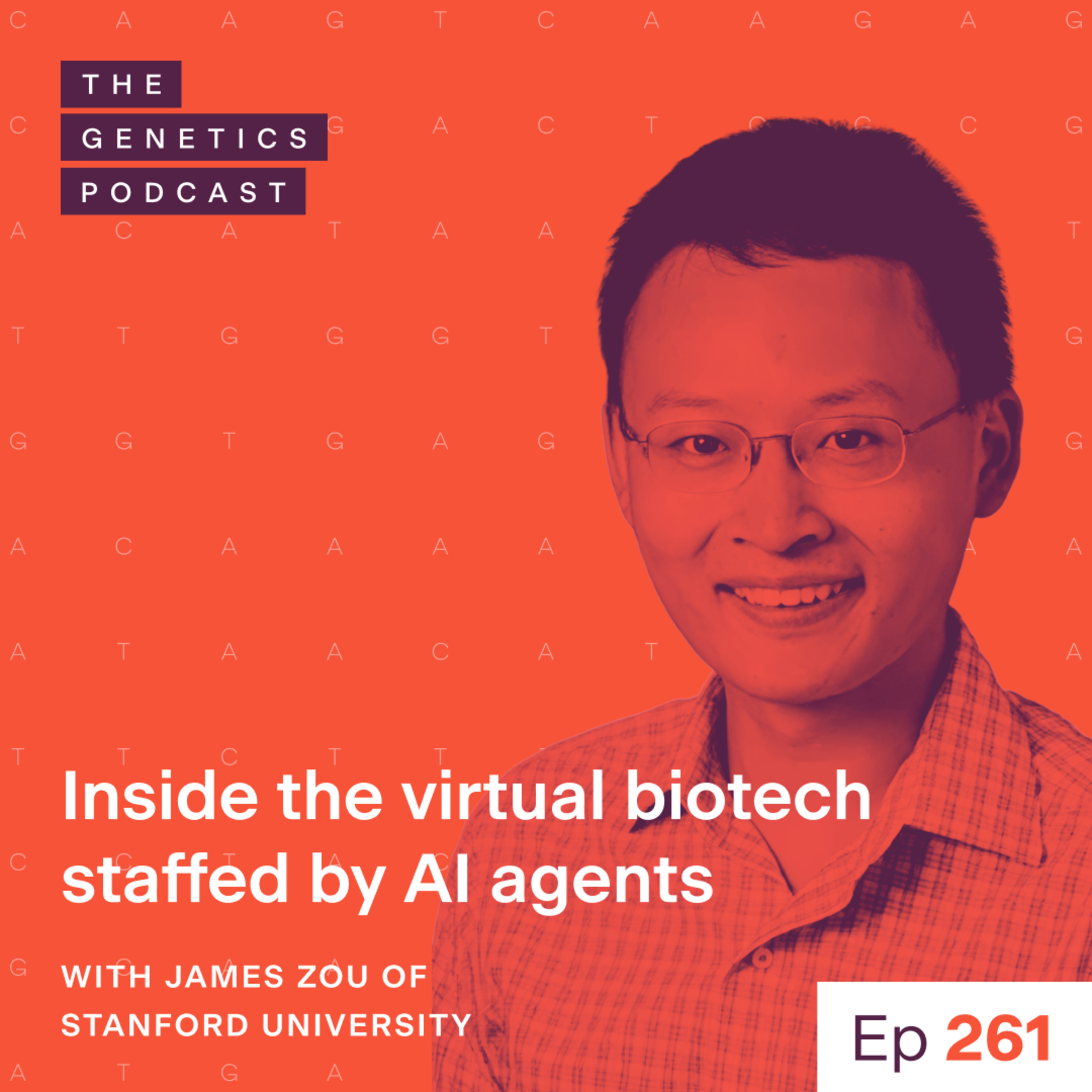
今天我非常高兴能请到詹姆斯·邹博士。
I'm very excited to be here today with Doctor.
他是斯坦福大学生物医学数据科学副教授,也是斯坦福AI科学实验室的主任。
James Zou, who's associate professor of biomedical data science at Stanford, where he directs the Stanford AI for Science Lab.
这场对话我期待了很久,因为我一直在关注詹姆斯的工作,也读了他最近一些非常有创意的论文。
And this is a conversation I've been wanting to have for a long time because I've been following James' work and reading some of the the super creative recent papers.
在我看来,詹姆斯,你的工作现在核心关注的是:当AI不再只是工具,而是成为真正的合作者、同行,甚至未来可能自主运营组织时,会发生什么。
And in my mind, your work, James, centers around right now the question of what happens when AI stops being a tool and starts being a true collaborator, peer, and maybe even autonomously running organizations in the future.
你在AI应用于医学方面做了很多基础性工作,无论是未来还是你过去的研究中都是如此。
You've done a lot of foundational work on AI in medicine in the future or in the in your past work as well.
所以你不仅了解现在的工具有哪些,还知道我们过去十年左右一直在构建的东西。
So you have not just a sense of what the tools are now, but actually what we've been building on for the last decade or so.
谢谢你抽出时间和我交流。
So thank you for taking the time to join me.
我很期待这次对话。
I'm excited to have the conversation.
谢谢,Patrick。
Thanks, Patrick.
我非常期待参与,而且我觉得现在可能是AI和科学领域最激动人心的时刻。
Really excited to participate, and I think right now is probably the most exciting time in AI and science.
确实。
For sure.
你最近发表了几篇非常有趣的论文。
And you dropped a couple of really interesting papers recently.
我想从其中一篇开始,就是关于虚拟生物技术的。
I wanna start with one of them, which is about virtual biotech.
这基本上就是一组智能体,它们像生物技术公司里的关键角色一样运作。
So this is essentially a group of agents that acts in a way like the key roles in a in a biotech company.
你们有一些非常有趣的发现,包括一个关于基于细胞类型特异性预测试验成功率的发现。
You had some really interesting findings, including one about predictions of trial success on the basis of cell type specificity.
我希望你能为那些不熟悉的人讲讲这篇论文,以及你们发现的一些关键点和结果中让你惊讶的地方。
I'd love if you could just talk about the paper for those who aren't familiar and a little bit about some of the key things that you found and what surprised you from the results.
好的,很乐意。
Yes, happy to.
这个背景其实是,几年前我们迈出了一步,创建了我们所谓的虚拟实验室。
So the background of this is that actually a couple years ago, we took a step creating what we call the virtual lab.
那是一个团队,我们有大约五到十个AI智能体来模拟我在斯坦福的实体实验室。
So that was a team where we had about five to 10 AI agents to emulate my physical lab here at Stanford.
有一个教授智能体负责管理实验室,还有一群不同专长的学生智能体,从蛋白质设计到免疫学再到数据科学。
So there's a professor agent that runs the lab, a bunch of student agents with different expertise, from protein design to immunology to data science.
这些智能体会开组会,我们给他们预算,这样他们就能运行一些实验。
These agents have their group meetings and we give them a budget so they can run some experiments.
而且他们确实做了一些很酷的事情,就是把一些新的结合剂设计成针对不同靶点的纳米抗体。
And they actually did something pretty cool, which is actually designing some of these new binders into a form of nanobodies to different targets.
我们已经在实验中合成了这些结合剂并进行了测试。
And we have experimentally synthesized and tested those binders.
那项工作去年发表了。
So that was published last year.
我们当时其实挺兴奋的,因为这证明了AI科学家团队在某种程度上可以像人类研究团队一样运作。
And we were actually quite excited by that as a proof of concept that a team of AI scientist agents can function in some sense, similar to a human research team.
然后在此基础上,我们想更进一步。
And then following up on that, we want to be more ambitious.
所以我们想,不只是五到十个智能体,能不能模拟整个药物研发组织,用上成千上万个AI科学家智能体呢?
So instead of just having a team of five to 10 agents, we thought, okay, can we sort of now emulate the entire human drug discovery organization with tens of thousands of AI scientist agents?
这就是我们所说的虚拟生物技术公司,最近几周刚在《科学》杂志上发表。
So that's what we call the virtual biotech, which was just recently published in Science a couple of weeks ago.
虚拟生物技术公司的想法是,我们有一个首席科学官,也就是CSO智能体,负责管理整个公司,然后在CSO智能体下面,有不同部门的科学家智能体,这些部门模仿了人类制药公司里的各种部门。
And the idea of virtual biotech is that we have a chief scientist officer, a CSO agent, sort of that manages the biotech, and then working under the CSO agent are these different divisions of scientist agents that sort of mirrors the kind of divisions you find in a human pharma company.
比如说,有一个部门专门负责寻找药物靶点,另一个部门在给定靶点后专注于设计分子,第三个部门负责安全性,第四个部门则开发临床研究等等。
For example, there's one division of agents that's very good at looking for drug targets, another division that, given the targets, focuses on designing molecules, a third division looks at safety, a fourth one that develops clinical studies and so on.
现在所有这些部门都是由具备不同专业知识的科学家代理团队来运作的。
And all of these divisions now are operationalized by teams of scientist agents with different expertise.
我提到了细胞类型特异性这个发现。
And I mentioned the cell type specificity finding.
你觉得这是最有趣的一点吗?
Was that the most interesting one to you?
如果是的话,我们就从这里开始聊。
If so, let's start there.
不过,我更想听听你在运行那个实验时,真正觉得最有趣的是什么。
But otherwise, I want to hear what you've found most interesting actually from running that experiment.
你运行了多长时间?
How long did you run it for?
它们运行了多久?
Like Like long are they running?
你多久检查一次,干预一次?
How much are you checking in, intervening?
带我们看看这个虚拟生物技术公司的幕后情况。
Bring us behind the scenes of this virtual biotech.
是的。
Yes.
所以我觉得细胞类型特异性这个发现,实际上是虚拟生物技术智能体带来的关键发现之一。
So I think the cell type one is actually one of the key discoveries and findings from virtual biotech agents.
这个发现的背景是,我们首先让所有这些智能体帮助我们注释和分析所有之前的临床试验,基本上是为了寻找经验教训,以便将来开发更好的药物。
So the context of that is that we first asked all these agents to help us to annotate and analyze all of the previous clinical trials, to basically look for lessons that can then help us to develop better drugs going forward.
这其实是一个非常耗时的任务,因为只有几万项试验,所以虚拟生物技术公司自动创建了37000个临床试验智能体。
And this is actually a very time consuming task because there's only tens of thousands of trials, so the virtual biotech then automatically created 37,000 clinical trial agents.
每个智能体负责成为某一项药物或试验的专家,阅读所有论文、公司报告、新闻稿和新闻文章,基本上弄清楚该试验发生了什么,如果它因各种原因失败,以及为什么失败。
Each of these agents is responsible to become a business getting expert in one of these drugs, one of these trials, to read all the papers, company reports, press releases, news articles, to figure out basically what happened in that trial, if it failed for various reasons, and why did it fail.
这已经非常有帮助了,因为有了这37000个智能体,他们实际上能够整理出一个很好的集中数据库,包含所有这些之前的试验。
So that was already very helpful because the agents then, it was these 37,000 agents, they were able to actually curate this nicely centralized database now of all these previous trials.
当这些智能体在交流并开始探索哪些因素会让临床试验更容易或更难成功时,他们开始提出假设,认为如果我们能发现并构建一些基于单细胞数据的药物靶点特征,然后看看这些特征能否帮助预测试验成功率,那会非常有趣,因为现在随着人类细胞图谱等项目,单细胞数据收集得越来越多了。
And as the agents were talking and starting to explore what makes trials more or less likely to be successful, then they started to hypothesize that, okay, would be very interesting if we could actually discover some, construct some of these single cell based features about drug targets, and then see if those features can help to predict trial success, because now there's more single cell data being collected with Human Cell Atlas and others.
然后,对于这数万个试验中的每一个,智能体实际上都会为该试验整理最相关的单细胞转录组数据集。
So then for each of these tens of thousands of trials, the agents actually would curate the most relevant single cell transcriptomic data set for that trial.
这些数据可能来自ATLAS项目或其他已发表的研究。
So this would be from ATLAS's or from other published studies.
然后,他们会基于这些单细胞数据,计算药物靶点基因的各种特征。
And then they would actually compute, based on that single cell data, various features about the drug target gene.
基于这些,智能体们确实证明了,如果药物靶点有单细胞证据支持,那么与那些没有单细胞证据支持、来自类似公司、针对类似疾病的相似药物相比,这些药物进入市场的可能性要高出约48%。
And from that, the agents actually then show that indeed, if you have drug targets that are supported by single cell evidence, they're about 48% more likely to make it to the market compared to similar drugs from similar companies looking at similar diseases that are not supported by single cell evidence.
所以,利用单细胞数据来帮助优先排序药物开发,这确实非常有用。
So this actually can be very helpful to use single cell data to help to prioritize drug development.
在这个过程中,你和你的团队是亲力亲为,还是放手不管?
And during this process, how hands on or how hands off are you and your team?
你们是真的设定好任务就看着他们执行吗?
Do you literally set them off on the task and then watch?
还是你会时不时地介入,往某个方向推一把?
Or are you in there occasionally giving giving nudges one direction or another?
其实我们介入得比较少。
It's actually relatively hands off.
我们只是给这些智能体一些指导方向。
So we give the agents a few of these guiding directions.
比如,我们告诉它们,先帮我们梳理所有过往的试验信息,然后尝试寻找能够预测试验成功的分子特征。
For example, we told them, okay, first help us to go through all these previous trial information and then try to look for features, molecular features, that can help to predict trial success.
所以,实际上是这些虚拟生物技术智能体决定构建这些基于单细胞的特征,来考察细胞类型特异性以及基因表达模式的模态。
So it's actually the virtual biotech agents that decided to construct these specific single cell based features to look at cell type specificity and by modality of gene expression patterns.
然后,这些智能体能够将这些基于单细胞数据的特征,与它们之前为我们标注的试验结果联系起来。
And then the agents were able to then connect those features based on single cell data with trial outcomes that they have previously annotated for us.
那部分也相当自主。
So that part was also quite autonomous.
在智能体找到初步发现之后,我们当然要确保这些发现确实可靠,对吧?
And then after the agents actually find the initial findings, then want to make sure that it's actually really robust, right?
所以我们又问了一堆后续问题,看看能不能找到混杂因素,对吧?
So then we asked a bunch of more follow-up questions to see if we could actually find confounders, right?
但后来这些智能体做了很多后续分析,证明这些发现其实对潜在的混杂因素是有鲁棒性的。
But then the agents are able to then do a lot of follow-up analysis to show that there's actually findings robust to potential cofounders.
我觉得最后一步是我们还让人类专家独立复现并验证了智能体的结果。
I think there is one last step where we also had human experts that were independently reproduced and to verify the results from the agents.
而且我觉得这一步还是很重要的,要确保人类专家还在流程里,去验证这些虚拟生物科技智能体的关键假设和关键发现。
And I think that part is still important to ensure that we have the human experts to to still be in the loop and then to verify the key assumptions, key findings from these virtual biotech agents.
当你回头看这些思维模式和轨迹的时候,你有没有感觉到哪里是明显的瓶颈,接下来可以突破的?
And when you look back at the, you know, the the thought patterns, the the traces, do you have any sense of where the, like, the obvious bottlenecks are that you could unblock next?
我在想湿实验室的访问权限。
I think about wet lab access.
他们没有湿实验室的访问权限。
They had no wet lab access.
可能有些时候他们遇到一个假设,就会说,如果有个细胞生物学家或者谁能帮我们追查这个就好了。
There's probably points where they hit a hypothesis and said, it would be super if we had a a cell biologist or somebody who could help us chase down this.
是这样吗?
Is that right?
还有其他的……
And and what other...
我在想的是数据缺口,他们现在没有的数据,你可以补上。
Like, I'm thinking about data gaps that they don't have that you could unblock.
有哪些东西你可以开始加入这个系统,让它比现在看到的更强大?
What are the things that you could start adding to this system that make it more powerful than than what you've seen today?
我觉得这是个好问题。
I think that's that's a great question.
你提到的数据方面,我觉得也非常关键。
And the data aspect that you mentioned, I think, is also very critical here.
我们创建的虚拟生物技术公司,因为我们是开源的。
So the the virtual biotech that we created, because we made it actually open source.
所以这里的智能体可以访问所有公开可用的信息。
So here the agents have access to all the publicly available information.
这包括单细胞数据、病理数据,还有FDA的提交材料,以及化学数据等等。
This includes the single cell data, the pathology data, and also FDA submissions, and also chemistry data and so on.
现在,缺少的往往是很多这些试验中隐藏的患者级信息。
Now, what it's missing are often a lot of these trials that are patient level information that are hidden.
比如,这些数据是由私营公司生成的,但可能因为试验失败或不成功,这些数据实际上没有公开,无法获取。
For example, they're generated by proprietary companies, but maybe because the trial had failed, where it's not successful, that data is actually not published, it's not available.
所以,这些代理实际上是从可用的数据中学习,这有点偏向,因为那些数据往往偏向成功的案例。
So then the agents are actually learning from what's available, which is a little bit more of a biased view because those tends to favor the successful cases.
所以我们下一步要做的事情之一,就是真正与更多的药物开发公司合作,这样虚拟生物技术代理也能从他们的一些内部数据中学习。
So one of the things that we're working on next is to really work with more of the drug development companies so that the virtual biotech agents can also learn from some of their internal data.
你有没有感觉到,随着模型变得更好,这会如何改进?
And do you have a sense of how this is going to improve as the models get better?
也许我的...
And maybe maybe my...
我最近一直在想的问题是,我们看到OpenAI破解了纳维-斯托克斯方程,这是数学中的一个千禧年大奖难题。
The question that's been on my mind lately is we saw OpenAI crack the Navier Stokes equation, which is a, you know, Millennium Prize problem in mathematics.
这让我一直在想,在生物学领域,那个时刻会从哪里来,或者什么时候会发生——AI系统找到一个真正有效的新型药物靶点,或者破解某个大家都关心的生物学核心真理。
And it's just had me thinking about where where where is that gonna come from or when is that moment gonna happen in biology where an AI system finds a completely novel drug target that actually works or it cracks some, you know, core truth about biology that, that is on everybody's mind.
可能相当于千禧年大奖问题的,就是生命起源或者那些重大、重大的问题。
Probably the equivalent of Millennium Prize would be something like origin of life or one of these big, big questions.
我想听听你的看法,你觉得我们离那样的时刻还有多远,还是已经很近了?
I want to have your sense of how far or near you think we are from that type of moment.
对,我觉得这很有意思。
Yeah, I think it's interesting.
Stabrio Stokes的突破之所以可能,是因为他们有一大群智能体。
The breakthrough with Stabrio Stokes actually was possible because they had a large team of agents.
OpenAI用了大约一万个智能体,在几天内狂热地攻克这个问题。
So OpenAI had about 10,000 agents that worked feverishly on this problem over a few days.
类似地,我们的虚拟生物技术公司也有三四万个智能体在药物发现流程中工作。
And similarly, with the virtual biotech, we also have 40,000, 30,000 agents that are working across the drug discovery pipeline.
所以我认为我们看到的共同点,真的是一个有趣的模式:通过扩大协同工作的智能体数量,我们获得了更多能力。
So I think the common thread we're seeing here is really this interesting pattern where we're getting more capabilities now from scaling up the number of agents that work together.
而且我觉得,这和之前的扩展模式是正交的,之前我们主要是扩大单个模型或单个智能体的规模,对吧?
And it's, I think, orthogonal to the previous scaling paradigm where we're mostly scaling up the size of individual model or individual agent, right?
所以以前人们把单个模型的参数从一千亿扩展到一万亿,甚至更多。
So previously people were scaling us up from a 100,000,000,000 to a trillion and so on in terms of the parameters of a single model.
但现在我们说的是,除了扩大模型规模,还要增加协作的智能体数量。
But here we're saying, okay, in addition to scaling the size of model, that's actually scale the number of agents that collaborate.
现在当我们有一万个或十万个智能体协作时,我们看到了更多的涌现式集体智慧和能力。
And now we're seeing even more emergent collective intelligence and capabilities when we have 10,000 agents that collaborate or a 100,000 agents that collaborate.
所以我认为,这实际上为科学进步开辟了一个全新的前沿,现在有了这个新的扩展维度。
So I think that actually opens up a whole new frontier of scientific progress that's possible now with this new axis of scaling.
在药物发现方面,我认为这特别合适,因为你知道,药物发现是一个非常复杂的过程,需要考虑很多不同的因素。
And in terms of drug discovery, I think this is particularly suitable because, as you know, drug discovery is a very complex process that requires many different considerations.
所以不仅仅是找到一个好的靶点。
So it's not just about finding a good target.
你还要设计一个好的分子。
You have to design a good molecule.
但是,如果毒性指标不好,光有好的分子是不够的。
But a good molecule is not enough if you don't have good toxicity profiles.
而且,如果商业激励方面,比如竞争格局不好,这些也都不够。
And none of this is enough if you don't have good commercial incentives in terms of competitive landscape.
所以有很多不同的考量,这往往让个人难以面面俱到,从基础生物学到遗传学,再到商业格局。
So there are many different considerations And that's often too much for individual humans to keep track of everything from basic biology to the genetics to commercial landscape.
这时候,如果有1万个代理,每个都能成为这些方面的专家,然后所有这些代理可以辩论、分享信息、共享完整背景并协作,我认为这会带来巨大的变革。
This is where having 10,000 agents that can become an expert in each of these aspects and all these agents then can debate and share information, share full context and collaborate, I think can become extremely transformative.
你……
You...
我对虚拟生物技术公司的设置有个问题,就是你模仿了传统生物技术公司的职能。
I had a question about the virtual biotech setup, which is you you mirrored the traditional biotech functions.
我想知道你是否做过实验,或者从中得到什么见解,表明实际上完全不同的组织模式可能更好,因为有可能我们人类还没有找到正确的模式,或者对于代理群体来说,有比首席科学官及其下属更好的设置。
And I I wondered if you've run the experiment or had any insights from that that suggests like actually different organizational models entirely because it's it's possible that we humans haven't settled on the right thing or that there's just a better setup for for the agent swarm compared to the, you know, the CSO and and their reports.
你怎么看这个问题?
How how do you think about that?
是的。
Yes.
所以,关于虚拟生物技术公司,还有我们之前的虚拟实验室,对吧?
So with the virtual biotech and also with our previous virtual lab, right?
我们给这些智能体设定了人类熟悉的组织和社会动态,比如有不同部门、部门主管和首席科学官,或者有教授和一群学生这样的团队。
So we seeded the agents with kind of the organizational and social dynamics, right, that humans are familiar with, where maybe there's a team of different divisions, division head and CSO, where there's a professor and a bunch of students.
但你说得对,智能体也有自己的社会动态,可能和人类不一样。
But you're right that the agents also have their own social dynamics that can be different from humans.
所以我们最近做了一些实验,让智能体自己进化,尝试找到它们自己的团队协作结构,看看什么样的团队动态真正适合智能体团队。
So we've actually done some recent experiments where we let the agents evolve and try to find their own teamwork structures and see what kind of teamwork dynamics actually uniquely suited for a team of agents.
而且智能体确实发现了一些非常有趣的团队协作结构。
And the agents actually discovered, I think, some quite interesting teamwork structures.
我举个例子。
I'll just give one example.
它们发现了一种对智能体来说特别有效的结构。
So they discovered a structure that seems to work really well for the agents.
我们称之为“强制角色互换”。
It's called what we call a forced role reversal.
基本上,就是有一群AI科学家智能体。
So basically what happens there is that you have a bunch of AI scientist agents.
他们会独立评估问题,并提出一些可能的解决方案。
They would independently assess the problem and come up with some potential solutions.
然后,每个智能体都被迫去为同事提出的、与自己不同的方案进行辩护。
And then they are forced, each agent is actually forced to argue in favor of a different proposal from all of their colleagues that's different from their own.
所以他们都必须这么做。
So they all have to do that.
接着,这些智能体作为团队聚在一起,评估他们通常的方案以及他们实际辩护过的方案,然后对最终方案进行排名。
And then the agents then would meet together as a team to now assess both their usual proposals and to the ones that they've actually argued in favor for, and then come up with a ranking of the final proposals.
结果发现,这种强制角色互换,智能体们自己演化出来的策略,最终对智能体来说是一个非常有效的团队协作方式。
So it turns out that that kind of forced role reversal, which agents actually evolved towards, actually ends up being a very effective teamwork strategy for the agents.
也许人类也能从中学习到一些东西。这就是一个例子,说明智能体在解决科学问题时,能够演化出自己的社交动态。
And maybe humans can also learn something from that, but so that's sort of an example where the agents can actually evolve their own social dynamics when tackling scientific problems.
这太有意思了。
That's super interesting.
你觉得,展望未来两三年,我们会不会看到人类和智能体融合,形成某种混合组织,比如我们每个人身边都有几个甚至几百个智能体同事,帮我们处理各种任务?
How how much do you think of, if you look forward in the future, let's say, two or three years, do you see humans and agents melding to to form some kind of hybrid organization in the sense that we may all have a handful of agent colleagues or hundreds of agent colleagues that are helping with different tasks?
或者,你是否也想象过这样一个世界:存在像这样的自主组织,比如虚拟生物技术公司真的能作为一个实体存在?
Or do you do you also imagine a world where there may be autonomous organizations like this that actually the virtual biotech may be a corporation that exists?
如果进展继续这样下去,你觉得我们最可能走向什么样的世界?
Like, how do you think about the most likely world that we end up in if this, you know, if the progress continues as it's going?
我觉得我们会看到一些以智能体为先的新公司,它们不是试图把智能体塞进现有的工作流程里,因为那些流程可能并不适合智能体,而是从零开始建立的新型公司,里面可能有成千上万个AI研究智能体,它们发展出自己的社会结构和管理结构,然后由人类专家进来提供各种监督层。
I think we will see some of these agents first companies, new agent first companies, where instead of trying to bring the agents into existing workflows, which may not be well suited for the agents, maybe there'll be new kinds of companies that will start from the ground up, where they're built with maybe thousands of AI research agents, which developed its own social structures and management structures, and then having the human expert that comes in to provide various supervision layers.
对。
Yep.
有道理。
That makes sense.
我想换个话题,聊聊你的另一篇论文,那篇我也觉得特别酷。
And I wanna switch gears to to one of your other papers, which I also found super cool.
它叫Paper2Agent。
It's called Paper2Agent.
我觉得这个特别有意思的地方在于,每天跟智能体打交道的人都知道,你可以让Claude或者OpenAI或者你选的其他工具去读一篇论文,让它帮你总结、帮你理解。
And what what I thought was really interesting about this is that everyone who works with agents day to day knows that you can point a Claude or OpenAI or whoever you choose to work with at a paper and ask it to summarize and and help you.
但你更进一步,每个智能体真的会去拿代码、拿底层数据,尝试自己复现那项工作。
But you took it a step further, is actually each agent works and pulls the code, the underlying data, tries to reproduce the actual work itself.
然后你就会得到一些非常有趣的特性,因为你能组合这些智能体,它们不只是读了论文、做了交叉验证、照单全收,而是真的去操作了……
And and then you get some really interesting properties by basically being able to compose these agents that have not just read the paper and cross checked it, taken it at face value, but actually have act...
把数据和代码跑起来了。
Have spun up the the data and the code.
你能不能……
Can you...
这真是个很有创意的想法。
It's a really creative idea.
我特别想先听听,你是怎么想到这个点子的,然后……
I'd love to actually just start with where you came up with that idea and then, you know, what...
再讲讲你从中学到了什么,那就更好了。
A little bit more about what you learned from it would be great too.
但这确实……
But it it is...
这真是个很有创意的想法。
It's a really creative idea.
所以我就想听听,你当时在做什么,突然觉得也许该试试这个,看看会发生什么?
So I just wanna hear, what were you doing when you said that maybe I should try this and see what happens?
嗯,谢谢。
Well, thanks.
我觉得我们的动机是,我们一直对知识总是静态和被动的这一点感到困扰。
So I think the motivation for us is that we're always a little bit troubled by the fact that knowledge has always been sort of a static and passive artifact.
你看,基本上在整个人类历史中,我们记录科学发现和知识的方式总是这些被动的物体。
So if you look, basically, throughout human history, the way that we record scientific discoveries and knowledge is always in the form of these passive objects.
也许几千年前,人们会把知识刻在石头上。
So maybe thousands of years ago, people would carve knowledge into stones and rocks.
在过去的几百年里,人们会把知识刻在纸上、手稿里、PDF文件里或者数据集里。
For the past hundreds of years, they would carve knowledge into papers or manuscripts or PDFs or data sets.
但在所有这些情况下,这些论文或数据集都是被动的,因为它们只是放在那里。
But in all those cases, those papers or data sets are passive in the sense that they're just sitting there.
它们不会主动去复现结果或者做出新的发现。
They don't actually go out and proactively reproduce results or make new discoveries.
数据集就放在那里,直到有人来提出一个想法或者一个查询去探索它。
A data set is sitting there until somebody comes in and comes up with an idea or comes up with a query to probe that dataset.
但数据集本身只是一个被动的对象。
But dataset itself is just a passive object.
对我们来说,这一直是科学研究方式的一个很大的局限,对吧?
And for us, that's always kind of a big limitation in how science is done, right?
我们的想法是,为什么不把这些被动的知识载体变成动态的、某种意义上活的知识体现呢?每个知识片段,比如每个数据集或每篇论文,都变成它自己的智能体。
And our idea is that why don't we turn all these passive artifacts of knowledge into dynamic, and in some sense, living embodiments of knowledge, where each piece of knowledge, like each data set or each paper becomes its own agent.
这个智能体首先负责确保知识是稳健且可复现的,同时它也能帮助维护和更新这些知识。
So that agent then is responsible for first making sure that that knowledge is robust and reproducible, and it can also help them to maintain and update that knowledge over time.
但知识代理还可以主动出去寻找该知识的新应用,可能是与人类或其他知识代理合作的形式。
But then the knowledge agent can also go out and proactively look for new applications of that knowledge, which could be in the form of collaborations with humans or with other knowledge agents.
这就是我们做Paper2Agent的初衷。
So that was sort of the impetus of doing Paper2Agent.
Paper2Agent基本上是我们创建的一个自动化平台,可以把被动的论文、数据集和代码转换成这种论文代理,我们把它看作是一个虚拟作者。
So the Paper2Agent is basically an automated platform that we created that can convert passive papers and data sets and codes into this paper agent, which we view as basically like a virtual author.
然后这个虚拟作者代理可以帮助复现论文中的结果,帮助回答问题。
So then this virtual author agent then can help to reproduce results from that paper, can help to answer questions.
它还可以帮助新用户、新读者将研究中的方法和数据应用到新问题上。
It can also help new users, new readers to apply the methods and data from that research to new problems.
对。
Yep.
你学到的最有趣的事情是什么?
What's the most interesting thing that you've learned?
我觉得你……
I think you've...
你们把它应用到了多少篇论文上?
How many papers have you applied it to?
到目前为止,你从中了解到的最有趣的事情是什么?
And what's been the most interesting thing you've learned from that so far?
我们把它应用到了,我觉得,超过100篇不同的论文上。
So we have applied this to identify, I think, over a 100 different papers.
我们接收了人们上传到不同预印本服务器上的论文,试图去识别这些。
We take in sort of papers that people uploaded on different preprint servers to try to identify that.
其实,有趣的一点是,并不是所有的论文手稿都能被转化成智能体。
Actually, one interesting thing is that not all the paper's manuscripts can be turned into agents.
在从论文到智能体的过程中,方法会报错,因为那篇论文可能缺少一些关键描述,可能方法部分不完整,或者代码有错误,或者代码缺失,有各种问题。
Papers, in the process of a paper to agent, the method will actually raise error messages because that paper, maybe it's missing some key descriptions, maybe the method section is now complete, or maybe there are mistakes in the code, or maybe the code is sort of missing with various problems.
然后这个流程会给作者反馈,告诉他们缺什么,需要补充什么才能让它成为一个健壮的智能体。
And then the pipeline then will actually give feedback to the authors on, Here's what's missing, and here's what you need to fill in in order for this to become a robust agent.
所以从这个意义上说,我认为能够把论文变成智能体这件事本身,就是一个有用的证明,说明这篇论文有足够的信息,某种程度上也算是一种可复现性的标准。
So in that sense, I think the ability to actually turn a paper into an agent itself, I think is a useful certificate to that the paper has enough information and it was as like a bar of reproducibility in some sense.
这个也是开源的,对吧?
And this one is open source as well, right?
是的。
Yes.
对。
Yes.
Paper2Agent 也是开源的。
Paper2Agent is also open source.
而且我得说,我在这里提到的所有东西,我……
And I should say that everything that I talked about here, I...
我们都尽量开源,让社区可以免费使用。
We try to make all of that open source so it's freely available for the community.
太棒了。
It's amazing.
我读博的时候要是能用到这个,那简直太神奇了,可以加载他们的……
I would have found this incredible in my PhD to load the their...
每个博士生都有那么十篇二十篇反复读的论文,这些论文是这个领域的基石。
Every PhD student has the 10 or 20 papers that they read over and over and that are foundational in the field.
而且可能远不止这些。
And and and probably many more than that.
但要是能把...
But to have the...
那些论文变成智能体,让你能比反复读补充材料更深入地探索,我觉得那简直是...
Those ones agentified in a way that you can go in at a much deeper level than, you know, just rereading the supplement over and over again, I think would just be...
那会非常有意思,可以好好玩一玩,看看它如何拓展你的世界观和理解。
It would be fascinating to play around with that and try to see how it expands your your worldview and your understanding.
没错。
That's right.
而且我觉得这也回到了你之前提到的那个点,就是说如果你只是简单地读一篇论文,或者让你最喜欢的语言模型去读一篇论文,那它只能获取到表面的信息。
And I think this also goes back to a point that you mentioned before, which is that if you just simply read a paper, or have your favorite LLM to read a paper, then it only gets sort of like the surface information.
因为科学不仅仅来自阅读,更来自实践。
Because science happens not just from reading, but actually from doing.
Paper2Agent的核心在于,我们确实有这些智能体,它们通过实际做科学来学会成为虚拟作者。
So the core inside of Paper2Agent is that we actually have these agents that actually learn to become like the virtual authors by doing the science.
在这种情况下,它们尝试复现原始论文中的结果。
And in this case, they try to reproduce the results from the original paper.
它们实际上学到了一些动手的知识,以及可能那些没有写下来的诀窍。
They actually learn about some of the hands on knowledge and maybe the know hows that are not written down.
正是这些让这些论文智能体能够,我觉得,更深入地理解原始工作。
And that's what enables these paper ages to become, I think, deeper, to gain deeper insights into the original works.
这太有趣了。
That's super interesting.
那么,理论上,你能不能有一个智能体来阅读或体现某个人整个研究工作?
So you could, I guess in principle, could you have one agent read or embody someone's whole, you know, body of research work?
然后你可以问一些非常有趣的问题,比如你有没有考虑过这个联系和那个联系,或者你有没有考虑过用不同的方式做这个分析?
And then you could ask some really interesting questions around, have you considered this link and that link, or have you considered doing this analysis in a different way?
然后你会得到一个……
And and you'd get a...
这几乎就像是你直接问作者本人他们是怎么想的一样,对吧。
Almost a mirror image of if you wouldn't ask the the person themselves, right, how they were thinking about it.
我觉得这非常有意思,而且我们也在探索这个方向。
I think that's really interesting and something that we are exploring.
所以我们下一步的想法是,一旦这些不同的论文被识别出来,我们已经看到它们可以开始互相交流,并产生新的发现和见解。
So our idea for the next step is that once these different papers become identified, so we already see that they can start to talk to each other and start to generate new findings and new insights.
比如,两个不同项目的虚拟作者,他们实际上可以直接对话,开始合作,产生新的发现。
So for example, the virtual authors of two different projects, they could actually just talk to each other and start to collaborate and generate new findings.
在我们的论文中,我们实际上也给出了一个案例研究,其中AlphaGenome代理与一个大型GWAS研究的代理合作,发现了一个与ADHD风险增加相关的新剪接错误,这个发现之前从未被报道过。
We actually also given a case study of this in our publication where the alpha genome agent actually worked together with an agent of a large GWAS study to discover a new splicing error that's associated with increased risk for ADHD, which is not published before.
所以我认为这可能会带来一种全新的科学和合作方式,那就是不同项目的虚拟作者之间进行大规模合作,先做一些初步的工作。
So I think this can lead to maybe a whole new way that science and collaborations can happen, which is where you have maybe massive collaborations between the virtual authors of different projects to do some initial works.
一旦他们发现了有前景的东西,然后就可以……
Then once they find something promising, can then...
人类作者就可以介入,然后——
The human authors can come in and-
真正的作者。
The real authors.
对。
Yes.
现在轮到真正的作者了。
The real authors now.
也许你的论文已经受版权保护了。
Maybe your papers are already copyrighted.
现在你想和对方谈谈,开始真正的合作吗?
Now do you want to talk to the other counterpart and start a real collaboration?
是的,这太吸引人了。
Yeah, that's fascinating.
我还想听听你对AI在临床护理中最实际影响的看法。
I wanted to also ask your thoughts on where are we going to see the most practical impacts of AI on clinical care?
你有一个FDA批准的基于AI的发明,特别是EchoNet,它专注于解读心脏超声。
You have a, I think an FDA approved AI based invention under your belt, in particular EchoNet, which is focused on reading cardiac ultrasounds.
你能不能给大家简单讲讲这项创新背后的故事?
Maybe you could tell everybody the brief story behind that innovation.
另外,你觉得影响会最先出现在哪里?
And then also, where do you see the impact coming first?
是影像吗?
Is it imaging?
还是早期风险检测,结合临床数据和其他生物标志物?
Is it early risk detection and clinical data plus other biomarkers?
你觉得在短期内,这些技术最终会在哪些方面给患者带来最大的实际影响?
How are you thinking about where all of this actually manifests in the greatest impact for patients in the near term?
谢谢。
Thank you.
正如你所说,除了用AI帮助改进基础研究,我对AI在临床上的应用也非常感兴趣。
So as you say that I'm very interested in the clinical applications of AI in addition to how AI can help to improve basic research.
在临床方面,过去几年我们其实做了很多工作,努力把我们开发的方法真正推向实际应用。
So on the clinical side, for the last few years, we've actually been doing a lot of work in trying to really push the methods we've been developing into deployment.
比如你提到的EchoNet就是一个例子。
So an example of this is EchoNet, which you mentioned.
它基本上是一个计算机视觉的深度学习模型,可以处理心脏超声视频,也就是人们心脏跳动的视频,然后利用这些视频来诊断和评估不同的心血管疾病,包括中风风险、低射血分数等等。
It's basically a computer vision deep learning model that can take these cardiac ultrasound videos, so the videos of people beating heart, and that use that video to try to diagnose and to assess different cardiovascular conditions, including risks for stroke, low ejection fraction, and others.
而且我们很幸运,几年前这个技术已经获得了FDA的批准,用于几个适应症。
And we're quite fortunate that a few years ago, this was actually cleared by the FDA for several indications.
现在它也已经独立成了一家公司,叫InVision MedTech,由我之前一位非常出色的博士后David Oguyen领导,他本身是心脏病专家,正在推动这个项目的发展。
And that's now actually also a separate company called InVision MedTech that's led by a fantastic former postdoc of mine, David Oguyen, who's a cardiologist, and driving that forward.
所以我觉得这些基于影像的AI应用潜力真的很大,对吧?
So I think there's actually really great potential these, especially for these imaging based applications of AI, right?
比如说,EchoNet获得FDA批准的一个用途就是诊断心脏淀粉样变性。
Because for example, with EchoNet, one of the FDA approval is on is actually for using this to diagnose cardiac amyloidosis.
有趣的是,心脏淀粉样变性其实已经有治疗方法了,但往往被漏诊,这意味着那些患者实际上没有得到应有的治疗。
And the interesting thing here is that there are actually already treatments for cardiac amyloidosis, but often it's sort of underdiagnosed, which means that those patients are actually not getting the appropriate available treatments.
所以,这种非侵入性的影像学方法就非常有用了,它可以非常便宜且准确地找到这些患者,对吧?
So then it's actually very useful to have this non invasive image based approach that can very cheaply and accurately try to find those patients, right?
然后说,哦,知道吗,你看起来是心脏淀粉样变的高风险人群,那你应该去做进一步检查,而且已经有很好的治疗方法了。
And say, oh, know, these seem like you're high risk for cardiac amyloidosis, then you should follow-up and there's already good treatment for it.
这是可以在医疗系统里部署的东西,对吧?
And this is something you could deploy in a health system, right?
唯一的实际障碍就是逐个系统去谈协议,真正确定病例发现流程,以及确保一旦标记出所有高风险人群,你确实有资源和策略去把他们拉进来做进一步检查,弄清楚到底是怎么回事。
And the only real barrier there is working out those agreements system by system to actually figure out the case finding pathway and how to make sure that once you've flagged everybody, you actually have the resources and the strategy to go in and pull them in for additional workup to try to understand what's actually going on there.
这是EchoNet的下一步计划吗?
Is that the is that the next step for for EchoNet?
没错。
That's right.
是的。
Yes.
既然它已经获得FDA批准,用于这些不同的适应症,所以……
So since it's been approved, cleared by the FDA for these different indications, So the...
所以我们一直在与各种医疗系统以及制造商和供应商合作,尽可能广泛地部署这些方法。
So the tool we've been working with various health systems and also with various manufacturers and vendors to actually deploy these methods across basically as broad a setting as we can.
除了影像,你觉得医疗AI还有哪些大的机会?
Besides imaging, where else do you see big opportunities for medical AI?
我对能捕捉这些生理信号的可穿戴设备也特别感兴趣。
I've also been quite excited about wearables that can capture these physiological signals.
几个月前我们发表了一项研究,叫SleepFM,也就是睡眠基础模型。
Did a study a few months ago we published called SleepFM, or Sleep Foundation Model.
举个例子,我们基本上就是采集睡眠记录,包括人们睡觉时的脑电波、心电图,还有肌肉活动和呼吸模式。
That's an example of this, where we actually essentially take sleep recordings, where we're capturing people's brain waves when they're sleeping, there are EKGs, also their muscle movements and breathing patterns.
然后我们可以训练一个AI模型,来捕捉一个人在整个六到八小时睡眠期间的生理状态。
And then we can actually train a model, an AI model, that captures the physiological status of the individual throughout the six to eight hours that they're sleeping.
结果发现这特别有用,因为从一晚的睡眠中,我们就能预测未来数百种疾病的风险,包括很多不同的疾病,从心血管代谢疾病到神经系统疾病等等。
And it turns out that that's actually extremely informative because from one night of sleep, we showed that we could actually predict the risks for over hundreds of these future diseases, which includes many very diverse diseases, from cardiometabolic diseases all the way to neurological diseases and many others.
所以我觉得这展示了把连续测量和基础AI模型结合起来的力量。
So I think this sort of showcased the power of combining these continuous measurements with sort of foundation AI models.
照你这么说,你们是从睡眠实验室那种环境开始的吧。
And in that case, I imagine the way you described it, you're starting with some kind of sleep lab situation.
但如果有人同时戴着Apple Watch或Whoop这样的设备,你能从大众市场的可穿戴设备中捕捉到多少预测信号,相比之下,你在睡眠实验室待一晚然后得到你一年的风险因素,这两者差别有多大?
But if somebody's wearing at the same time an Apple Watch or Whoop, something like that, how much of that predictive signal can you capture from a mass market wearable device versus you come and spend a night in a sleep lab and then you get your risk factors for the year?
所以我们的原始模型,正如你所说,是在那些更高质量、更纯净的睡眠实验室数据上训练的。
So our original model, as you said, was sort of trained on these more high quality, pristine sleep lab data.
现在我们实际上有一个模型,是在超过两百万小时的睡眠实验室记录上训练的。
And now we have actually have a model that's trained from over about two million hours of these sleep lab recordings.
而且我们能够证明,这个模型也能很好地迁移到更消费级的可穿戴设备上。
And we're able to actually show that that model can actually transfer quite well also to more consumer wearables.
所以这非常有前景,因为我们可以从大数据集中提取更丰富、更全面的表征,然后应用到你的戒指、手表上,这些设备通常采集的是PPG信号之类的。
So that's very promising because then we can sort of take the broader, this richer representation from this big data set and then actually apply that to your rings, your watches, much more commonly labeled like PPG signals, for example.
如果你已经做过这些,把所有这些数据结合起来,你学到了什么?
And what have you learned if you've done this already in combining as much of these things together?
所以你有常规的血液检测,加上睡眠、影像、基因、临床记录。
So you've got routine blood based testing plus sleep plus imaging plus genetics plus clinical notes.
有没有...
Is there...
你或者你认识的人,有没有在做这种整合所有数据的工作,来搞清楚在特定情况下,最精简、最容易获取,但预测能力最强的组合是什么?
Are you or or is anybody that you're aware of doing this kind of work to combine all this data and understand actually what's the minimal and most accessible, but also most predictive combo in certain contexts.
我觉得这就是所有这一切的发展方向。
That feels to me like where all this is going.
你有大量的数据输入,你想尽可能高效地在人口规模上应用它。
You have a ton of data inputs and you want to apply it at population scale as effectively as possible.
这正是我们正在积极研究的事情。
So that's something that we're actively working on.
我们发现一个有趣的现象,就是同时捕捉多个器官的信号确实很有威力。
So one interesting thing that we do find is that it's really the power of capturing multiple organs simultaneously.
比如,当我们通过脑电图测量脑电波,通过心电图测量心脏活动时,它们各自对许多健康状况都有很强的预测能力。
So for example, when we measure the brain wave through EEG and the heart through EKG, individually they're quite predictive of many different health conditions.
但我们发现,当我们观察大脑和心脏之间的耦合时,预测能力甚至更强。
But what we find is actually even more predictive as we look at the coupling between the brain and the heart.
脑电波和心律之间的自相关形成了一种方向性,这为预测许多疾病增加了额外的威力。
So the autocorrelation between the brain waves and the heart rhythms that forms a direction that adds a lot of additional powers for predicting many diseases.
所以我觉得,不同器官之间的这种耦合,确实是一个重要的生理轴,我们可以通过多种模态的测量来量化它,然后借助AI来评估和解读。
So I think this is where I think the coupling between different organs is something that really emerges as an important physiological axis that we can then quantify with these different multimodal measurements, and then use the AI to help to then assess and to interpret.
对,非常有意思。
Yeah, super interesting.
从数据角度来看,你觉得最大的缺口在哪里?
Where's the biggest gap from a data perspective in your mind?
我觉得我们希望有更多的生物测量,比如采集血浆或血液样本,进行蛋白质组学测量,而且最好是更长期地追踪。
I think we would love to have more biomeasurements, for example, capturing different, let's say, plasma or blood to do proteomics measurements, I think in a more longitudinal way.
现在有一些这样的数据集,但如果能更细致地采集,会非常有帮助。
I think there's some data sets for that, but capturing that in a more granular fashion will be very helpful.
目前我们有可穿戴设备提供的密集生理测量,但一些生物标志物的数据相对稀疏。
So right now we have very dense physiological measurements with all these wearables, but some of these more biomarkers are a bit more sparse.
那些信号能提供什么信息,是你现在缺失的?
What is it that those what you get from those kinds of signals you're missing?
比如,有很多有趣的研究,我们也在和合作者一起做蛋白质组学的工作,从血液中获取蛋白质组数据,然后推断出不同器官的生物学年龄,以及昼夜节律等信息。
For example, there are a lot of really interesting works, and we're also doing some of that with our collaborators on taking proteomics, right, that you get from blood, and then you start to infer things like the different organ specific biological age, and also things like circadian rhythms.
我觉得这会变得非常强大,尤其是现在如果我们能把这些和其他能捕捉生理模式的可穿戴设备结合起来。
I think that becomes very powerful, especially now if we can couple that with all these other wearables that captures the physiological patterns.
对,对,完全说得通。
Yeah, yeah, makes total sense.
在这个需要大量计算资源的时代,你怎么看待学术研究?
How do you think about academic research in this age where you need a ton of compute?
你在斯坦福,这肯定有帮助。
You're at Stanford, which can't hurt.
你们……
You all...
但OpenAI和Anthropic也对一些同样的挑战感兴趣。
But you've got OpenAI and Anthropic that are interested in some of these same challenges.
你怎么看待研究经费,以及在这种口袋里没有那些大型AI实验室那么深的情况下,继续沿着扩展曲线前进的能力?
How do you think about research funding and and the ability to continue to go up the the scaling curve here despite not having the pockets as deep as as some of the big AI labs?
我觉得很多公司也对这一领域感兴趣,我们也和其中许多公司有合作。
I mean, I think there is many companies are also interested in this space, and we also work with many of these companies.
我还是想说,学术界现在真的有独特的价值,甚至从某种意义上说,贡献可能更重要,尤其是在人工智能时代。因为技术发展得太快了,对吧,几乎需要一个共同的基础,来仔细评估这项技术,认真思考它的应用和影响。
I would still want to say that there's really a unique value, maybe in some sense even more important contribution from academia now, especially now with AI, which is that when the technology is developing so quickly, right, there needs to be almost like this mutual ground, right, that carefully evaluates the technology, right, just thinks very carefully about the applications and also the impact of this technology.
以Swy为例,我们做的事情,尽量做到透明,开源,公开数据,也尽量和其他人合作,应用这些工具。
With Swy, for example, the things that we do, we try to make that as transparent as possible, where we make it open source, we release the data, and we also try to work with other people to apply these tools.
而这些,在和OpenAI、Anthropic这样的大实验室和公司合作时,往往是缺失的。
And that's often missing when you're working with these big labs and companies like OpenAI and Throtpec and others.
所以我认为,现在学术界更需要蓬勃发展,成为一股制衡力量,提供开放透明的生态系统,真正推动基础科学的发展。
And so I think this is even more important now for academia to thrive, be this counterweight, to provide this open and transparent ecosystem and to really drive the foundational science.
其实在开始录音之前,我们聊到了剑桥大学。
We were talking before we started recording actually about University of Cambridge.
你在这里完成了应用数学的第三部分。
You did your part three in applied math here.
我想我们在同一栋楼里,只是不同时期。
I think we're in the same building, but different times.
然后你在哈佛完成了博士学业。
And then you ended your PhD at Harvard.
现在,你显然在斯坦福。
Now, obviously, you're at Stanford.
我其实想问,你是什么时候对AI感兴趣的?
I I wanted to ask actually when you got interested in AI.
是很早以前,你在学数学的时候,看到……
Was it way back when you were doing math and you and you saw that, you know, that you got...
你爱上了应用数学里的机器学习部分,还是在哈佛的时候?
You fell in love with the machine learning part of applied mathematics, or was it at Harvard?
在哪里……
Where...
就是,在哪里……
Like, where...
带我回到那个时刻,你决定这个AI的事情很有意思,并且要把它作为自己的事业。
Take me back to the moment actually where you decided this whole AI thing is is interesting, and I'm gonna devote my career to it.
在剑桥读第三部分时,我其实上了很多概率统计的课,这些课非常有用。
So at Cambridge, I did part three, and I actually took a lot of these probability of stats classes, which is very helpful.
我还上了一些传染病建模的课,也特别有意思。
I also took some of these classes actually in infectious disease modeling, which is also very interesting.
其实我觉得,正是这些课让我开始对生物医学应用产生了最初的兴趣。
And actually, I think that's how I got some of the initial interest in these more biomedical applications.
后来读研究生的时候,我主要还是做AI和机器学习方面的工作。
And then during grad school, was still doing more work on the AI machine learning side.
但后来我对生物学产生了浓厚的兴趣,尤其是通过了解那个叫山中因子的重编程研究。
But then I became very interested in biology, especially through learning about this reprogramming work that was called Yamanaka factors.
那段时间,人们取得了惊人的突破,他们证明可以把一个成熟的旧细胞,比如你的皮肤细胞,通过相对简单的化学修饰,基本上让它返老还童,变得几乎像干细胞一样。
So that was around the time where people had these amazing breakthroughs, where they showed they can actually take a mature old cell, like your skin cell, and essentially rejuvenate them, make them almost like a stem cell again, by these relatively minimal chemical modifications.
这在我看来,作为一个外行,真的是非常了不起、非常强大的东西,从科学角度看也特别神奇。
And that seems to me, as an outsider, to be something that's really incredible, incredibly powerful, but also amazing from a scientific perspective.
怎么可能把皮肤细胞变回干细胞呢?
How is it possible you can actually convert your skin cell back into a stem cell?
所以这让我特别想深入学习生物学和基因组学,然后把我开发的机器学习方法应用到基因组学上。
So that actually got me to be very interested in trying to learn more deeply about biology and genomics, then to apply the various machine learning methods I was developing to genomics.
所以这就是我对生物学产生兴趣的原因。
So that's how I got interested in biology.
是的,太棒了。
Yeah, amazing.
好的,詹姆斯,这次访谈真的很有趣。
Well, James, this was really fun.
非常感谢你分享这些见解。
I really appreciate you sharing all this insight with us.
你是我之前说过的那种,这个领域最有创造力的研究者之一。
You're, I think I said earlier, but you're one of the most creative researchers in this area.
所以我会一直关注你接下来的成果。
So I'll be definitely watching to see what you come up with next.
这一切都非常发人深省。
It's all very, very thought provoking.
你成功地将大规模的患者影响与对科学研究方式的重新构想结合了起来。
You're managing to combine the hard patient impact at scale with just really reimagining how we do science.
展开剩余字幕(还有 17 条)
我觉得这真的很酷。
And I think it's it's super cool.
所以,感谢你今天抽出时间来参加我们的节目。
So thanks for taking the time to to join us today.
谢谢你,帕特里克。
Thank you, Patrick.
我真的很享受我们的对话。
Really enjoyed our conversation.
也感谢大家一如既往地收听,我们下次再见。
And thanks everybody as always for listening, and we'll see you next time.
一如既往,感谢大家收听《遗传学播客》。
Thanks as always for tuning in to The Genetics Podcast.
如果你喜欢今天的对话,支持这个节目最好的方式就是把它分享给可能也会感兴趣的朋友或同事。
If you enjoyed today's conversation, the best way you can support the show is by sharing it with a friend or colleague who might find it interesting as well.
我们也非常希望你能在Apple播客、Spotify或任何你收听播客的地方订阅、评分和评论我们。
We'd also really appreciate if you could subscribe, rate, and review us on Apple Podcasts, Spotify, or wherever you listen to podcasts.
这样能帮助其他人搜索遗传学、精准医疗或生物技术相关内容时发现我们的节目。
This helps other people discover the show when they're searching for content on genetics, precision medicine, or biotech.
我们也一直想听到你的声音。
We always wanna hear from you as well.
如果你有反馈、问题,或者想上节目,可以发邮件到 podcast@SanoGenetics.com。
If you have feedback or questions or wanna be featured on the show, you can email us at podcast@SanoGenetics.com.
你可以在LinkedIn上找到我,Patrick Short。
You can find me on LinkedIn, Patrick Short.
你也可以在LinkedIn上找到我们Sano Genetics,或者通过Instagram关注The Genetics Podcast。
You can find us as well, Sano Genetics, on LinkedIn, or reach out on Instagram at The Genetics Podcast.
最后,特别感谢节目背后的团队,是他们让这一切成为可能。
And finally, a special thank you to the team behind the show who makes this possible.
Joy Ismail负责节目的制作和管理,James Pierce来自Selective Frequencies,负责专业的音频工程。
Joy Ismail produces and manages the show, and James Pierce from Selective Frequencies for his expert audio engineering.
我是Patrick Short,你的主持人。
I'm Patrick Short, your host.
再次感谢大家的收听,我们下期《遗传学播客》再见。
Thanks again for listening, and we'll see you next time on The Genetics Podcast.
关于 Bayt 播客
Bayt 提供中文+原文双语音频和字幕,帮助你打破语言障碍,轻松听懂全球优质播客。