本集简介
双语字幕
仅展示文本字幕,不包含中文音频;想边听边看,请使用 Bayt 播客 App。
我敢打赌,有不少人对数学世界的了解主要就是通过一副扑克牌。
I'm willing to bet that there's a not insignificant number of people out there whose main experience of the math world is through a deck of cards.
数学,特别是概率,决定了为什么葫芦比同花大,为什么你在电影里看到的皇家同花顺很可能是作弊的结果,因为它们比四条稀有150倍。
Math, probability specifically, is why a full house beats a flush and why the royal flushes that you might see in a movie are probably the result of cheating because they're a 150 times more rare than four of a kind.
所以,如果你觉得我们已经掌握了扑克牌的数学,那也情有可原。
So you'd be forgiven for thinking that we get the math of playing cards.
但请想一想。
But consider this.
一副扑克牌的总排列数是52的阶乘。
The total number of arrangements in a deck of cards is 52 factorial.
也就是52乘以51乘以50,一直乘到1,这是一个巨大的数字。
So that's 52 times 51 times 50 all the way down to one, which is a huge number.
它有67个零。
It has 67 zeros.
这个数字大到,当你洗牌时,你最终得到的排列顺序几乎可以肯定从未出现过,也永远不会再出现。
It's so big that when you shuffle the deck, the particular arrangement you end up with is more or less guaranteed to have never happened before and never happen again.
那副熟悉的扑克牌其实是一个极其复杂、动态的组合系统,数学家们至今仍在研究它的运作方式。
The old familiar deck of cards is a dizzyingly complex, dynamic combinatorial system, and mathematicians are still learning how it works.
欢迎收听《Quanta》播客,我们在这里探索基础科学和数学的前沿。
Welcome to the Quanta Podcast, where we explore the frontiers of fundamental science and math.
我是萨米尔·帕特尔,《Quanta》杂志的主编。
I'm Samir Patel, editor in chief of Quanta Magazine.
《Quanta》最近刊登了一篇科学作家约翰·帕维斯的文章,标题是《七次完美洗牌能让一副牌随机化,但随意洗牌需要多少次?》,这篇文章探讨了最新的研究进展。
A recent story in Quanta called Seven Perfect Shuffles Randomize a Deck of Cards, but how many sloppy ones by science writer John Pavlis explores the latest development.
这实际上是洗牌研究领域的一个里程碑式的证明。
It's a landmark proof, actually, in the world of card shuffling.
今天我们有请《Quanta》的数学编辑乔达娜·塞佩莱维茨来聊聊这个话题。
Here to talk about it is Quanta Math editor Jordana Cepelewicz.
欢迎回到节目,乔达娜。
Welcome back to the show, Jordana.
谢谢。
Thanks.
很高兴能回来。
Happy to be back.
那么,Jordana,核心问题是什么?
So, Jordana, what's the big idea?
这里的关键问题是,你需要洗多少次牌才能确保牌堆真正被充分打乱,也就是说,关于牌堆原始顺序的任何信息都已经丢失了?
So the motivating question here is you wanna know how many times do I need to shuffle in order to make sure that my deck is actually properly mixed up, meaning that any information about the original order of the deck has been lost?
这个问题看起来有点随意和有趣,但实际上它触及了一些在数学和物理学中反复出现的非常有趣的现象。
And this question seems kind of random and fun, but it actually tops into some really interesting phenomena that kind of pop up all over math and physics.
所以它最终比你想的要深刻得多。
And so it it ends up being kind of a deeper question than you would expect.
那你平时打牌吗?
So are you a card player?
我不打。
I'm not.
我小时候短暂地学过一些用扑克牌变的手部魔术技巧。好。
I briefly, as a child, like, learned some sleight of hand magic tricks with cards Okay.
但那没持续多久。
But that didn't last very long.
而且我觉得,我玩卡牌游戏的经验,大部分就是小时候玩的那个叫Set的游戏。
And I'd say, like, most of my experience with card games was, like, the game set as a kid.
我挺喜欢那个游戏的,不过那是另一种类型的卡牌玩法。
Like, I really like that game, but kind of a different type of card play.
对。
Right.
那你洗牌洗得好吗?就是那种交错洗牌。
And can can you do a good riffle shuffle?
完全不行。
Absolutely not.
好吧。
Okay.
我最近从另一篇Quanta的文章里学到,那种在桌上随便拨弄牌的洗法,其实叫“抹牌”。
I I recently learned, actually, from another Quanta story that the kind of shuffling you do where you just move things on the table is called smooshing.
这个我还行。
We I'm okay at that.
在我家,我们管这个叫煮汤,就像做汤一样。
In in my house, we call it soup, like making soup.
就是把牌全都搅在一起。
Like, you smoosh it all around together.
对。
Yeah.
这个我能做到。
I I'm capable of that.
不然的话,我洗牌的时候,牌会一坨一坨的,而且特别慢,所以我得洗很多次才能把牌混匀。
Otherwise, when I riffle shuffle, it's very clumpy and very slow, so I have to do a fair number of shuffles to get the deck mixed up.
好的。
Alright.
我洗牌的时候,经常好奇到底要洗多少次才行。
So I riffle shuffle, but I'm often curious about how many times you have to shuffle.
这在我们玩纸牌游戏的时候经常出现,特别是像万智牌这样的游戏。
And it often comes up when we're playing card games, in particular, like magic the gathering, for example.
对。
Yeah.
我洗好牌,然后有人会说,天哪。
I'll shuffle it, and then someone will say, oh my god.
谁洗的这副牌?
Who shuffled this deck?
因为他们拿不到想要的牌,比如这样。
Because they they aren't getting the cards that they want, for example.
但是,对。
But Right.
不过话说回来,52张牌、四种花色的扑克牌,到底有什么数学上这么复杂的地方?
That notwithstanding, what is it about the 52 cards, four suits, deck of cards that's so mathematically complex?
你之前提到过,首先,牌能排列出来的方式数量非常庞大。
You mentioned it earlier, which is, first of all, there are just a vast number of arrangements that the cards can end up in.
52的阶乘是个难以想象的数字。
52 factorial is kind of an unimaginable number.
文章里,约翰·帕夫利斯说,基本上,这个数字接近银河系里原子的数量,你可以这么理解。
Article, John Pavlis says, basically, it approaches the number of atoms in the Milky Way galaxy, if you wanna think about it like that.
好。
K.
这听起来挺疯狂的,也让你感受到,当你试图证明某样东西是随机的时候,需要考虑多少种可能性。
This just seems kind of wild, and it gives you a sense of how many possibilities you have to consider when you're trying to prove you're randomizing something.
另外,随机性本身就很复杂。
The other thing is that randomness is hard.
比如,数学里的随机性就是个很难的课题。
Like, randomness in math is just a hard topic.
那你到底怎么知道,你已经完全消除了之前那副牌的所有痕迹呢?
So how do you truly know that you have gotten rid of all those, like, echoes of that previous version of the deck?
这真的很难判断。
That's pretty hard to determine.
所以这让洗牌问题变得很难。
And so that makes it hard for these shuffling problems.
我突然想到,说到牌,我之前简单提过扑克,因为扑克涉及赌博,而钱显然是个强大的动力,所以我们才了解扑克牌型的概率,或者知道如果你玩二十一点玩得绝对完美,你
It occurs to me that when it comes to cards and when I talked about poker briefly before, that because they're involved in gambling and money's obviously a powerful motivator, that there's a reason that we understand the probabilities of hands in poker or the fact that if you play blackjack absolutely perfectly, you
可以
can get
在赌场里获得对庄家的微弱优势。
a slight advantage over the house in a casino.
比如,有些事情我们是知道的。
Like, there's things that we know.
对。
Yeah.
关于一副牌的工作原理,我们还有什么不知道的呢?
What don't we know about how a deck of cards works?
我想回到随机性这个概念上来。
I wanna go back to this notion of randomness.
对。
Mhmm.
我觉得这正是我们真正不了解的地方。
Like, I think that's one thing we really don't know.
而且,就游戏而言,有很多情况我们完全不知道最佳策略是什么。
Also, like, just in terms of games, there are tons of things where we, like, have no idea quite what the optimal strategy would be.
比如,在某个牌局中,如果从某个配置开始,我能确定这是最好的走法吗?
Like, if you start off at some configuration in some game of cards, do I know that this is the best move to make?
有些游戏我们知道,但大多数不知道。
We know that for some games, but not a lot.
所以还有很多我们不了解的地方。
So there's a there's a lot we still don't know.
我觉得,像那种老式的克朗代克纸牌游戏,对。
I think, like, good old fashioned, like, Klondike solitaire Yeah.
从数学角度来看,完全没被理解。
Is, like, completely not understood from a mathematical perspective.
确实是这样。
Think true.
我觉得花火这个游戏,不知道你玩过没有。
I think the game Hanabi, I don't know if you've played that.
嗯。
Mhmm.
这是一个合作类的纸牌游戏,我最近刚接触,非常喜欢。
It's like a cooperative card game that I was recently introduced to and I really enjoy.
我觉得这个游戏也是那种计算量特别大的游戏,在特定时刻很难说清楚应该采取什么策略。
I think that one's another one of these, like, incredibly computationally hard games where it's just kind of unclear what the strategy should be at given times.
但说到我们今天要聊的话题,我觉得难点在于,我们什么时候才算真正把东西随机化了?
But in terms of what we're gonna be talking about today, I think what's hard to know is when have we actually randomized things?
即使是像洗牌这样简单的事情,虽然排列组合很多,但洗牌也有一定的规则。
Even in something as simple as shuffling, even though there are a lot of arrangements, like there's certain rules for like what a shuffle would look like.
为什么证明你真正随机化了东西就这么难呢?
Like, why is it so hard to actually prove when you've actually randomized things?
这个问题数学家们已经研究了几十年了。
And that's something that mathematicians have been interested in for decades.
对。
Right.
所以,洗一副牌的方式显然有无数种。
So there's I mean, there's obviously any number of ways you can shuffle a deck of cards.
是的。
Yeah.
但我们今天要讨论的是一种特定的洗牌方式,也就是交错洗牌。
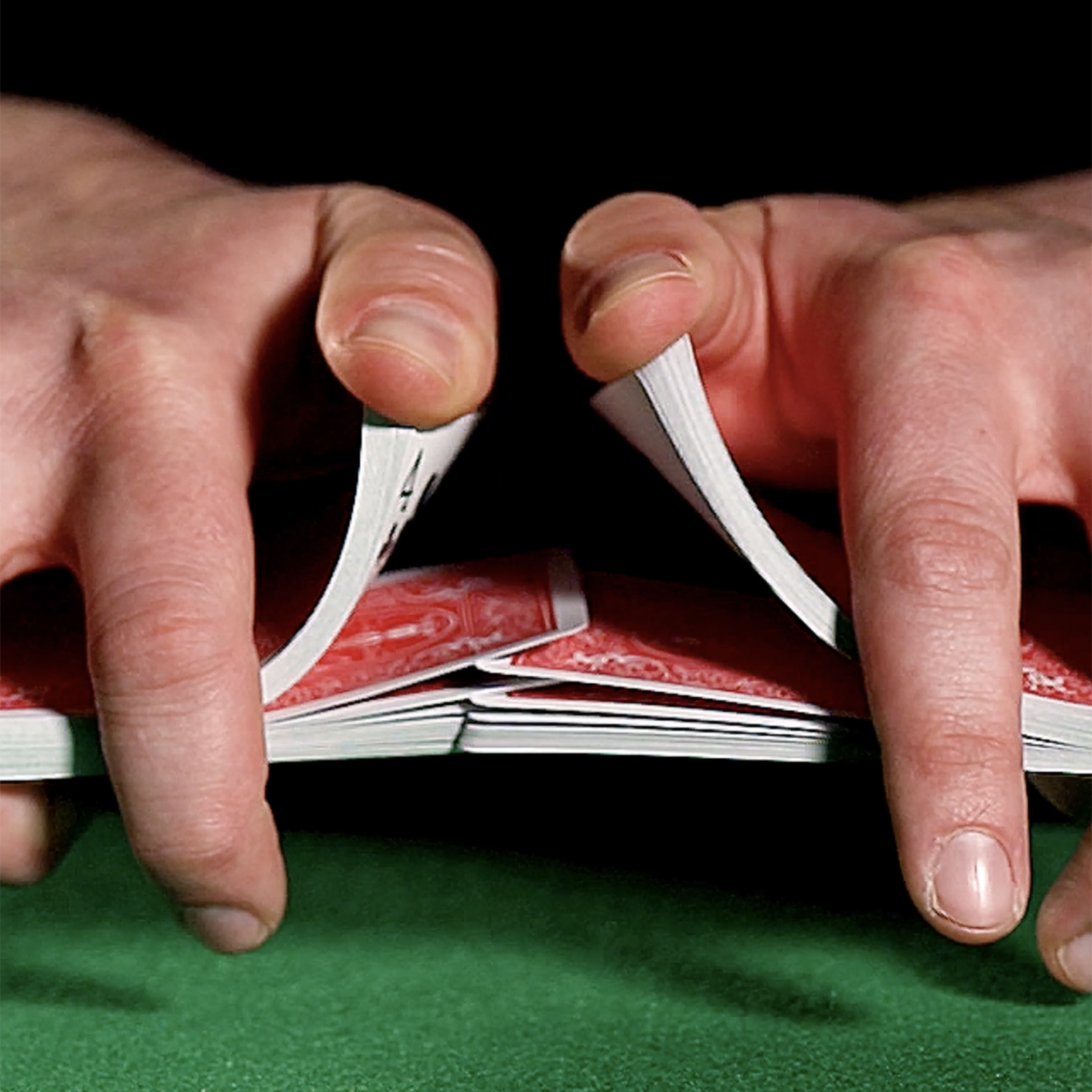
But we're talking here about a specific style of shuffling, the riffle shuffle.
每只手拿一半牌。
Take half a deck in each hand.
你用拇指把它们交错叠在一起,然后再把牌合起来。
You kind of flip them together with your thumbs, and and then you put the deck together.
这可能是大家最常想到的洗牌方式。
This is probably the most commonly pictured version of shuffling.
对。
Yeah.
没错。
Exactly.
比如你打开一副新牌,嗯。
So you open a new deck of cards, for example Mhmm.
所有的牌都是按顺序排好的,所以你想在开始玩游戏之前好好洗一洗牌。
And all the cards are are in order, and so you wanna shuffle it, quote, unquote, really well before you start playing a game.
对。
Right.
什么叫“好好洗”?
What is really well?
那是什么样子?
What does that look like?
我们拿出一副之前玩扑克用的牌,里面可能还有一些牌没理好,所以你想再洗一遍来重新开始游戏。
We take out a deck of cards that we were playing poker with before, and it might still have some hands in it, so you wanna shuffle it again to reset the game.
对。
Yeah.
这个问题最早是什么时候开始引起数学家特别关注的?
When did this first start to become a matter of concern for mathematicians in particular?
基本上是在八十年代初,有两位数学家,Persi Diaconis 和 Mehrdad Shashahani。
Basically, in the early nineteen eighties, you had two mathematicians, Persi Diaconis and Mehrdad Shashahani.
好的。
Okay.
我觉得他们研究洗牌已经有一段时间了,这个问题一直让他们很感兴趣。
I think they've been working with card shuffling for some time, like this had been of interest to them.
他们发现,在洗牌过程中会出现一种所谓的“截断现象”,简单来说就是,你的牌在洗了若干次之后,看起来还是相当乱,没有完全混合。
And they discovered that something called a cutoff phenomenon occurs in the context of card shuffling, which is basically this idea of, like, your deck will look pretty unmixed for some time, for some number of shuffles.
然后会有一个临界点,过了这个点,牌突然就变得非常均匀了。
And then there's a threshold at which suddenly it becomes very well mixed.
所以洗牌并不是一个逐渐混合的过程。
So it's not like it's gonna be a gradual mixing process.
它会一直保持很乱的状态,然后你一旦过了那个临界点,就会得到一个很均匀、很随机的好牌堆。
It's gonna stay pretty unmixed, and then you're gonna cross the threshold, and you're going to get a pretty mixed, nice, randomized deck.
所以你可以把它想象成物理学里的相变。
So you can kind of think about it in a similar way to, like, a phase transition in physics.
比如解释一下。
Like Explain that.
假设我有液态水,我慢慢降低温度,然后它还是液态水,接着到了零摄氏度。
Say I have liquid water, and I'm slowly lowering my temperature, and then I still have liquid water, then I hit zero degrees Celsius.
一旦过了那个点,系统的各种性质就会突然变化,最后变成冰。
Once I pass that point, I'm going to see a sudden change in various properties in the system, and I'll end up with ice.
系统的状态就是突然改变了。
There's just a sudden change in the state of the system.
对。
Yeah.
没错。
Exactly.
在相变方面,这种现象到处都是。
In terms of phase transitions, get this all over the place.
磁铁也有这种现象,从去磁状态变成磁化状态,或者反过来。
Magnets have this where they go from demagnetized to magnetized magnetized or vice versa.
在数学里也有,比如网络的结构之类的。
You get this in math, like how networks look and things like that.
截断现象是马尔可夫过程特有的,马尔可夫过程是一种概率模型,用来描述系统如何在不同状态之间转换。
Cutoff phenomena is specific to these things called Markov processes, which are like probabilistic models that tell us how systems go through configurations.
你可以把系统想象成一副牌,它不断在这些状态之间变化,我们想知道这中间发生了什么。
So you could think of like your system as a deck of cards, and then it's going through these configurations, and we wanna know what's happening there.
基本上,这两位数学家是在洗牌的过程中发现这个现象的,从那以后,这个现象就到处出现了。
Basically, these two mathematicians saw this phenomenon in the context of card shuffling, and then since then, it's been cropping up all over the place.
我觉得这有点反直觉,你想想洗牌这件事。
This is counterintuitive, I think, little bit, that you would be shuffling a deck.
一般人可能会想,洗一次牌就差不多了。
I would think that people would imagine, like, okay, shuffle it once.
就是有点随机。
You it's a little bit random.
你继续洗。
You keep going.
它会逐渐地、线性地变得越来越随机。
It gets progressively, linearly more and more random in some way.
但你说的是,你洗了一定次数,从数学角度看还不够随机。
But what you're saying is that you shuffle a certain number of times, and it's not random enough from a mathematical perspective.
对。
Yep.
然后你再洗一次,突然就混匀了。
And then you do, like, one more, and, bing, it is mixed.
真正随机了。
It's properly random.
没错。
Right.
我们说的就是这个意思。
That's what we're saying.
对。
Yeah.
而且这在数学上已经被证明了。
And that's mathematically proven.
在洗牌这个情境下,这种现象的存在是有数学证明的。
It's mathematically proven that these exist in the context of card shuffling.
然后在1992年,迪亚科尼斯和另一位数学家戴夫·拜尔证明了,对于一副52张的扑克牌,这个临界点现象出现在哪里。
And then in 1992, Diaconis and another mathematician, Dave Bayer, proved, like, where that cutoff phenomenon is for a 52 card deck.
那具体是在哪里呢?
But where is it?
大约在洗七次的时候。
It's at seven shuffles roughly.
大约洗七次。
Roughly seven shuffles.
对。
Yeah.
所以基本上,如果你洗牌次数少于这个,你的牌组仍然会保留一些原始顺序的信息。
So, basically, if you shuffle fewer than that, your card deck still is gonna retain information from its original order.
然后之后,你会看到这个急剧的转变,这个“截止现象”,这时你的牌已经混合得相当均匀了。
And then afterward, you're gonna get this sharp transition, this cutoff phenomenon where now your deck is pretty well mixed.
好的。
Okay.
所以人们听到这个,他们会说,好的。
So people are gonna hear this, and they're gonna say, okay.
我洗七次牌,那就没问题了。
I'm gonna shuffle seven times, and it's fine.
但事实并非完全如此。
But that's not quite the case.
基本上,你洗七次牌后,牌已经足够随机了,所以你可以把七次洗牌作为一个好的参考标准。
It's basically like you have a very high probability of being well enough shuffled, and so, like, you could say seven shuffles is, like, the good thing to have in mind.
但是,是的。
But Yeah.
基本上,你需要再多洗几次,才能达到数学家们所要求的精确程度。
You would need to do, like, a couple more basically to ensure it with the amount of precision that mathematicians care about.
对。
Right.
好的。
Okay.
是的。
Yeah.
不过七次对任何玩家来说都足够好了。
But seven's, like, good enough pretty much for any player.
这里还有一点建议,就是要在数学上做到这一点,洗牌的技巧水平其实有很多种。
The other suggestion here is that in order to do this mathematically, like, there's a lot of different skill levels with shuffling.
你的牌可能是天生的。
Your cards might be born.
比如,你可能不擅长这个。
Like, you might not be good at it.
你可能需要知道这个证明的假设是什么?
You might what are the assumptions that go into this proof?
有两个主要的假设。
There are two big ones.
第一个是,数学家需要真正用数学来模拟什么是鸽尾洗牌。
The first is mathematicians need to actually mathematically model what a riffle shuffle is.
鸽尾洗牌不是像你那样左一张、右一张、左一张、右一张地交替发牌。
And a riffle shuffle is not you going left, right, left, right, left, right.
那样不会让你的牌堆随机化,因为那绝对会保留关于原始顺序的信息。
That's not gonna randomize your deck because that's gonna absolutely retain information about what the original order is.
如果你每次都完美地那样做,就像有些魔术师能做到的那样,是的。
If you did that perfectly every time, like some magicians can do Yeah.
你可以一直洗牌、洗牌、再洗牌,但你仍然会知道每张牌可能在哪里,因为那是一种非常有顺序的洗牌方式。
You can keep shuffling and shuffling and shuffling, but you'll still know where each card should potentially be because it's a very ordered kind of shuffling.
对。
Yeah.
而且我觉得如果你洗一定次数,你会回到原来的顺序。
And I think if you do it a certain number of times, you'll get back to your original
那可能是
that's probably
这样。
the case.
我知道魔术师有技巧,即使不是完全一样的手法,比如有些技巧可以洗五次牌还能保持原来的顺序。
I know that magicians have techniques even if it's not doing the exact same thing, like techniques where you can shuffle five times and it will retain the original
顺序。
order.
没错。
Exactly.
那是一种非常有规律的洗牌方式。
That's a very ordered kind of shuffle.
对。
Yeah.
所以,我们说的洗牌不是那种。
So that's not what a riffle shuffle is when we're talking about this.
所谓的riffle shuffle,就是我从左手或右手掉一张牌,掉的时候是有一定概率的。
What a riffle shuffle is is whenever I drop one card from either my left or right hand, I'm dropping it with some probability.
假设我把牌均匀地分成两叠。
Let's say I cut my deck evenly.
一只手26张,另一只手26张,然后开始洗。
So I have 26 cards in one hand, 26 cards in the other, and I'm starting to shuffle.
嗯,这是一个假设,因为……对。
Way, is an assumption because Yes.
确实是个假设。
It is an assumption.
不是
Not
不会,但切牌的时候很少会这样。
never, but rarely kind of happens when we're cutting decks.
对。
Right.
我们很快就会讲到这个。
And we'll get to that very shortly.
好的。
Okay.
但是,当我开始的时候,我会有百分之五十的机会放下左手或右手的牌。
But, like, when I start, I'm gonna have, like, a fifty fifty chance of putting a left card or a right card down.
好的。
Okay.
好的。
Okay.
所以,当你做鸽尾洗牌时,牌在你的拇指上,接下来掉下来的牌可能来自这只手或那只手。
So the cards are are on your thumbs as you're doing the riffle shuffle, and the next card that's gonna drop might come from one hand or the other.
所以你会连续拿到三张。
So you'll get three in a row.
就像抛硬币一样。
It's like flipping a coin.
对。
Yeah.
只不过每次不是50%的概率
Except it's not gonna be 50% each time
在这个模型里。
in this model.
这基本上取决于你手里两摞牌的大小。
It's based on basically, like, how big your piles are.
所以如果我一开始是五五开,但现在我左手这摞牌只剩25张了,右手还有26张。
So if I go I'm gonna go fifty fifty for my start, but now I only have 25 cards left, say, in my left pile, and I still have 26 in the right.
那现在我的概率就变成51分之25和51分之26了,因为基本上就是看你手里这摞还剩多少张,除以你总共洗下去多少张牌。
So now my probability is gonna be, like, 25 out of fifty one and twenty six out of 51 because you basically determine it as, like, how many cards do I have left in my pile over how many cards are left in my deck that I suddenly shuffle down.
所以这个模型挺公平的。
So it's a pretty fair model.
它被认为相当贴近现实。
It's considered pretty realistic.
当然,现实中你洗牌时并不是这样操作的,但这确实是个不错的数学模型。
Obviously, that's not actually how you're riffle shuffling in real life, but it's it's a pretty decent mathematical model
用来描述
of what
洗牌的过程。
a riffle shuffle is.
你可能会更倾向于从较大的那堆牌里往下洗。
You're probably gonna be, like, slightly more likely to riffle down from the bigger pile.
对。
Yeah.
而且你的牌堆也不会是五十和两张这样的比例。
And your piles are not gonna be, like, fifty and two.
没错。
Exactly.
它们会是二十四张和二十八张。
They're gonna be twenty four and twenty eight.
对。
Yeah.
对。
Yeah.
所以这里的重点是,就像你提到的,你并不是左一张右一张地交替。
And so the point here is, as you mentioned, that you're not getting left, right, left, right.
你可能会得到左、左、左、右、右、左、右这样的顺序。
You're getting, like, you might get left, left, left, right, right, left, right.
所以卡片是随机交错的。
And so you have this random interleaving of cards.
所以第一个假设就是他们采用了这种洗牌模型。
So that's the first assumption is they're using this model of what a riffle shuffle is.
对。
Right.
这个Diaconis Bayer结果里第二个非常重要的假设是,你大多数时候会把牌堆分成两堆,而且这两堆的大小差不多。
The second really big assumption in this Diaconis Bayer result is that you're most of the time splitting your deck evenly into, like, two piles that are pretty close to each other.
是的。
Yeah.
这个模型挺合理的。
A reasonable model.
对。
Yeah.
用更专业的话说,就是基于一个概率分布,比如,好的。
You know, in more technical terms, it's based on there's, like, a probability distribution that you assign of, like, okay.
我很有可能把牌分得特别均匀,然后稍微小一点的概率分得不那么均匀,等等。
I have, like, a very high chance of splitting it perfectly evenly and then, like, a slightly lesser chance of splitting it like this unevenly, etcetera.
你还有很小的概率把牌分得特别不均匀。
You So have some, like, very low chance of splitting it, like, extremely unevenly.
对。
Yeah.
但确实,这种情况可能根本不会发生。
But, yeah, it's probably just not gonna happen.
所以我们基本上也是这么说的。
And so we basically say this as well.
你假设每次切牌时,你大致把牌分成两半。
You're assuming that you're splitting your cards approximately in half each time you cut the deck.
没错。
Right.
所以这是一个相当大的假设。
So that's a pretty big assumption.
这就是七次洗牌结果的含义。
And so that is what the seven riffle shuffles result is.
好的。
Okay.
这从直觉上来说是个很合理的模型,是的。
And that is that is just intuitively a pretty sound model Yeah.
关于洗牌的模型,但它不一定反映我们实际的做法。
Of shuffling, but not a model that necessarily reflects the way that we all do it.
对。
Right.
对吧?
Right?
那下一步是什么?
So what's the next step?
是不是要改进这个模型,让它更接近实际情况?
Is it trying to refine the model so that we can get a little bit closer to that area?
基本上,数学家喜欢把问题一般化。
Basically, mathematicians love to generalize things.
是的。
Yeah.
他们会说,好吧,你从这些假设开始。
They're like, well, you started with these assumptions.
我想放宽这些假设,得到一个更现实的模型。
I wanna loosen the assumptions and get a more realistic model.
所以接下来的问题是,如果我把牌堆分得非常不均匀呢?
And so the next question was, what if I split my deck very unevenly?
或者如果我把牌堆分成超过两堆呢?
Or what if I split my deck into more than two piles?
因为,好吧,你不可能手里拿着四堆牌做鸽尾洗牌。
Because, okay, you're not gonna be, like, riffle shuffling with four piles in your hands.
但我说的那个数学模型确实允许你,比如,以某种概率从每堆牌中放牌,对。
But that mathematical model I said does allow you to like just with some probability put cards from each pile down Mhmm.
我们可以称之为洗牌,即使它看起来像——
In what we can call a shuffle even though physically look like a
就像三手鸽尾洗牌。
Like a three handed a three handed riffle shuffle.
对。
Yeah.
就像你和我一起洗牌一样,如果我很擅长洗牌的话,但其实我并不擅长。
Like you and I are just like shuffling together somehow if I were good at shuffling, which I'm not.
所以数学家们想把这个推广到那种情况。
So mathematicians wanted to generalize to that.
我之前提到过“截止现象”。
Now I talked about cutoff phenomenon earlier.
嗯。
Mhmm.
有趣的是,这种现象在任何一般形式下都非常难证明。
Something interesting about them is that they're very, very hard to prove in any sort of, like, general form.
七次洗牌这个结果的好处在于,迪亚科尼斯和拜尔不仅仅证明了52张牌需要七次洗牌。
So what was really nice about the seven shuffles result is Diaconis and Bayer, they didn't just prove, like, seven shuffles for 52 cards.
他们证明了一个公式。
They proved, here's a formula.
如果我的牌堆里有n张牌,n可以是任意数字,那我需要洗多少次牌才能把牌堆彻底打乱?
And if I have n cards in my deck where n could be any number, how many riffle shuffles do I need to randomize that deck?
好的。
Okay.
这之所以有用,部分是因为在拉斯维加斯,他们会把很多副牌放在一起,这样你就不只是从52张牌里数牌了。
And that's useful in part because, like, in Vegas, they're putting a lot of decks together so you're not just so that you can't count cards out of 52.
他们会把八副牌放在一起,用机器洗牌,这样他们就是从更大的牌池里抽牌了。
So they'll put eight eight decks together and shuffle them all with a machine so that then they're drawing cards out of a larger pool of cards.
不过这对我们现在的对话来说其实不太重要。
Not that that's really important to this conversation.
对。
No.
但我的意思是,这算是这个结果的一种推广方式。
But, I mean, it's a way in which this result is generalized.
说实话,我觉得拉斯维加斯的人肯定都知道迪亚科尼斯和他的那篇论文。
I am sure people in Las Vegas are familiar with Diaconis and the paper, honestly.
我觉得他们肯定知道。
I feel like they must be.
对。
Yeah.
我年轻的时候肯定听说过这个有趣的结果。
Must heard about this as, like, a fun result when I was younger Yeah.
那时候我对数学还一无所知。
Like, before I knew anything about math.
所以这在当时是个很大的成果,因为通常很难用同一个证明去证明另一个现象的截止现象。
And so that was a really big result at the time because it's often hard to use the same proofs that you use to prove one cutoff phenomenon for, like, something else.
所以能得出一个漂亮的通用公式,真是太好了。
And so being able to get a nice general formula is a really nice thing.
因为这种截止现象本质上源于复杂性和混沌。
Because these the cutoff phenomenon, it grows out of complexity and chaos, essentially.
就像,你怎么从有序走向混沌?
Like, how do you get from order to chaos?
这确实很难建模。
And that's a difficult thing to model.
所以,洗牌随机化的意思就是,每种可能的排列顺序出现的概率都一样。
So what what it means to randomize a deck, right, is that you have an equal likelihood of getting any possible arrangement.
对。
Right.
那如果总共有52的阶乘种可能性,我该怎么验证呢?
And so how am I gonna check that if there are 52 factorial possibilities?
是的。
Yeah.
对。
Yeah.
那就不能靠蛮力,得想点更聪明的办法。
You have to be more clever than doing something brute force.
所以,是的。
And so yeah.
所以这非常难。
So this is very hard.
对其他系统来说也非常难。
This is very hard for other systems.
这是数学家和数学物理学家感兴趣的事情,比如对于我感兴趣的系统,我怎么能证明这种截断现象呢?
It's something mathematicians and mathematical physicists are interested in, like how for my system that I'm interested in, how could I prove this cutoff?
所以要从“嘿,”开始转变。
And so to move from, hey.
我把牌堆分成两堆,到“嘿,”
I've split my deck into two piles into, hey.
我把它分成更多堆,或者分得更不均匀。
I've split it into more piles or I'm splitting it more unevenly.
那是一个非常大的跨越。
That's a very nontrivial jump.
我们得为这个重新证明。
We're gonna have to have a new proof for that.
这可不是那种能用同一个公式套出来的东西。
It's not gonna be something that, like, plays with the same formula.
对。
Right.
所以那真的很难,实际上花了几十年。
And so that was very hard and actually took decades.
比如我们现在讨论的这个结果,还有之前的一个,都是最近几年才出来的。
Like, the result we're now talking about and one previous one happened just in the past couple years.
是的。
Yeah.
那这个最新的工作是谁做的?我们接下来要聊的这个。
Who did this most recent work we're about to talk about?
这要从一个叫马克·塞尔克的人说起。回到2019年,他还是个研究生,当时在斯坦福上佩尔西·迪亚科尼斯的课。
So it starts with someone named Mark Selke, who, if we go back to 2019, was a grad student, and he was actually in Persi Diaconis' class at Stanford.
先简单介绍一下佩尔西·迪亚科尼斯,他是当年那个“七次洗牌”结论的原始数学家之一。他14岁那年离家出走,跑去跟一个魔术师当学徒。
So to give a little background on Persi Diaconis, who was one of the original mathematicians on that seven shuffles result, he, at the age of 14, ran away from home to apprentice himself to a magician.
所以有十年时间,他跟着这位魔术师到处跑,成了职业魔术师。
And so for ten years, he was like on the road with this magician and became a professional magician.
他还发明了一些纸牌戏法,非常非常厉害。
And like invented card tricks and was very, very good.
然后24岁那年,也就是十年后,他决定回大学读书,对数学产生了浓厚兴趣。
And then at age 24, so ten years later, he decided to like go back to college and got very interested in math.
《量子》杂志其实有一篇关于他的文章,还提到了他以前的一些工作,作者是埃丽卡·克拉里克。
Quanta actually has an article about him and some other work that he did from a while ago by Erica Claric.
她讲了个小故事,说一开始他都不知道数学里要学证明。
And she has this, like, little anecdote where at first he, like, didn't know that you have to study proofs in math.
就是得像学语言那样,认真去学那些证明。
Like, you have to actually study them the way you would study a language or something else.
所以他头几门课的成绩,就是两个C和一个D。
And so his first, like, couple of grades were, like, two Cs and a D.
一开始他学得不太好,但后来真的开始突飞猛进,最后去了哈佛读研究生,拿到了数理统计的博士学位。
Like, he he did not so well at But then really started to thrive, and he ended up going to Harvard for grad school and ended up getting his PhD in mathematical statistics.
他现在是斯坦福大学的数学家。
He's now a mathematician at Stanford.
他主要研究概率和组合拓扑。
He focuses a lot on probability and committed torics.
他提到过,他仍然会用扑克牌和洗牌的视觉效果来思考他的工作。
He's talked about how he still uses the visuals of cards and card shuffling to, like, think about the work he's doing.
即使
Even if
经过这么多年,他已经有了那种直觉。
it's had years to, like, get this intuitive sense of that.
对。
Yeah.
没错。
Exactly.
我们今天讨论的结果其实和洗牌有关。
The results we're talking about today are actually about card shuffling.
对。
Yeah.
但他研究的很多东西其实跟扑克牌无关,不过他仍然用这个方法来让自己保持脚踏实地,思考数学问题,我觉得这真的很酷。
But a lot of stuff that he works on isn't actually about cards, but he still uses it as this way to keep himself grounded and think about the math, which I find very cool.
我觉得这挺难得的。
I think it's kind of rare.
很多数学都是非常抽象、难以捉摸的。
A lot of math is very intangible and abstract.
即使他在研究这些更抽象的数学概念时,脑子里仍然想着玩牌。
And even when he's working on these more abstract mathematical concepts, he's still keeping card playing in his head.
对。
Yeah.
而且艾丽卡从他那里引用了一句很棒的话,他说:“我称之为魔法的诗意”,这句话一直在我脑海里。
And Erica had this really nice quote from him that was like, I call it the poetry of magic, and that's in my mind.
总之,佩尔西·迪亚科尼斯是个非常有趣的人。
So anyway, Persi Diaconis is this really interesting guy.
他在斯坦福。
He's at Stanford.
所以马克·塞尔克在2019年是斯坦福的研究生,最后上了他的课。
And so Mark Selke was a grad student at Stanford back in 2019 and ended up in his class.
在这门课上,迪亚科尼斯提到了七次洗牌的结果,并说,但我们有一些假设。
And in this course, Diaconis mentioned the seven shuffles results and said, but we have these assumptions.
塞尔克心里想,嗯,我想再深入研究一下。
And Selke thought to himself, well, I wanna play with that more.
对。
Yeah.
就像,它依赖于这种切牌方式,感觉有点受限,这让人不太满意。
Like, it's a little unsatisfying that it relies on this type of cutting cards that feels a little bit restricted.
明白。
Mhmm.
所以那时他定下了目标,好吧,让我们考虑多于两堆的情况。
And so that's when he set this goal of, okay, let's think about more than two piles.
展开剩余字幕(还有 229 条)
我们想想更广泛的分布,比如你切牌切得有多糟糕,更随意的切牌。
Let's think about a larger distribution of, like, how bad your cuts Sloppier cuts.
对。
Right.
现在允许非常非常随意的切牌了。
Like, much, much sloppier cuts are allowed now.
是的。
Yeah.
而且他在读研究生的时候,确实证明了这一点。
And when he was still in grad school, he did prove this.
他得到了一个公式,告诉他临界点在哪里,类似于七次洗牌的结果,但适用于所有这些不同的情况。
Like, so he got a formula that told him where the cutoff would be similar to the seven shuffles result, but for all these different contexts.
明白。
Mhmm.
但他还是得做一个让人不太舒服的假设,那就是每次洗牌后你切牌的方式都是一样的。
But there was still a kind of this nagging assumption he had to make, which is that the way you cut your cards after each shuffle is the same.
好的。
Okay.
所以这还是有点不现实,因为
So it's, like, still a little bit unrealistic in that
还不够乱。
It's not sloppy enough.
确实不够乱。
It's not sloppy enough.
对。
Yeah.
我们得假设人们洗牌真的很差。
We have to assume that people really suck at shuffling.
或者至少切牌很差。
Or cutting at least.
对。
Yeah.
至少还行吧。
At least okay.
对。
Right.
切牌方面。
At cutting.
因为我们后面会讲到洗牌的部分。
Because we'll get to the shuffling part.
好的。
Okay.
对。
Yeah.
因为这是
Because this is
洗牌,洗牌有多随意?
the shuffle how sloppy is the shuffling?
好的。
Okay.
对。
The yeah.
洗牌的方式还是用我之前提到的那个模型,就是Diaconis和Bayer最初研究里的那个。
The shuffling so they are still using the same model that I talked about earlier that was in the original Diaconis and Bayer results.
所以这种基于牌堆大小的交错洗牌模型,还是这个研究的一部分。
So this, like, model of riffle shuffling that depends on the size of the piles, that's still part of this.
但他们调整的是第二个假设,也就是我切牌的方式。
But the second assumption is what they're playing with, which is how am I cutting my deck?
对。
Right.
所以他基本上是想再次推广他的研究成果。
So he wanted to basically, once again, generalize his results.
他并不满足于现状。
Like, he wasn't satisfied.
他希望尽可能做到最一般化。
He wanted it to be as general as he possibly could get it.
所以他最后和两个对这个课题也感兴趣的研究生合作了。
And so he ended up teaming up with two grad students who were also interested in this problem.
一个是在剑桥大学的石佳璐,另一个是普林斯顿的研究生王佳敏。
One was at the University of Cambridge named Jialu Shi and also a grad student at Princeton named Jia Min Wang.
然后他们三个人就开始琢磨这个问题,就是说,我们不仅想要多堆牌的随意切牌,还希望每次切牌的方式都能变,而且允许这样。
So the three of them then started to think about this problem of like, okay, not only do we want sloppy cutting in many piles, but we want the cutting to be changing each time and, you know, for that to be allowed.
对。
Right.
这就是他们去年证明的结果。
And and that's what they proved last year.
好的。
Okay.
所以我们用原来那个大致均匀切牌的模型,也就是这种特定的洗牌方式。
So we take the original model of roughly equal cuts, this particular model of shuffling
对。
Yeah.
他们发现七次是一个很好的临界点,通常在这个地方会出现截断现象。
And they came up with seven as a good place where the cutoff phenomenon usually takes place.
所以即使切割方式非常随意,也不需要每次都做同样的切割。
So with much, much sloppier cuts, don't have to do the same cut every time.
嗯。
Mhmm.
那截断现象在哪里发生呢?
Where's the cutoff phenomenon?
对。
Yeah.
所以,这又取决于很多因素。
So, again, it's gonna depend on a lot of things.
我们在文章中用的例子是,比如说你每次随机切牌,切的位置概率相等。
The example we used in the article was, say, you just kind of randomly cut your deck each time with equal probability of where you're gonna cut.
对于一副52张的牌来说,因为,再说一次,他们可以用不同的牌数。
It's gonna be for a 52 card deck because, again, they're they could use end cards.
需要洗14次。
It's gonna be 14 shuffles.
14次。
14 shuffles.
对。
Yeah.
那多很多。
That's a lot more.
对。
Yeah.
我们说的是差不多两倍的洗牌次数。
We're talking about twice as many shuffles.
对。
Yeah.
不过我觉得那应该是个上限。
I'm presuming, though, that that is an upper bound.
对。
Yeah.
而且,再说,如果我说,嗯,也许我不想让切牌的位置概率相等,那可能会改变这个数字,他们有个公式能告诉你所有这些。
And, again, like, if I were to say, like, oh, well, maybe I don't wanna have an equal probability of where I cut, that could change the number, and they have a formula that tells you all this.
也许我想要一副一千张的牌。
Maybe I want, like, a 1,000 card deck.
它也能告诉我那个。
It's gonna tell me that too.
但对于一副经典的52张牌,你知道,你切牌的位置大致是均匀分布的,那就是14次。
But for a classic 52 card deck where, know, you kind of have this, like, uniform probability of, like, where you're gonna cut, it's 14.
是14次。
It's 14.
对。
Yeah.
好的。
Okay.
我猜这个结果背后还有一些隐含的假设。
I'm assuming that there are lingering assumptions in that outcome.
我特别想到的是洗牌的方式。他们是不是想把这些假设拆解一下,然后说,好吧。
I'm thinking particularly in the way that one shuffles a So are they trying to sort of break some of those down and say, okay.
我们洗牌的水平比那还差。
We're worse shufflers than that.
如果真是这样,我甚至不知道该怎么建模,就是人们洗牌洗得很烂这种情况。
If it's I don't even know how you model just people being crappy at shuffling.
比如说,这是不是可以……
Like, is that something that
你可以设一个‘洗牌烂系数’,然后直接把它套进公式里?
you can have, like, a crappy at shuffling coefficient, and you just stick it in formula?
确实有这种模型。
There are models.
所以,我觉得他们是想建立好的模型,但基本上,下一步就是他们所谓的“块状洗牌”,顺便说一句,我洗牌就是那样洗的,并不是……
So, I mean, I think they're trying to come up with good models, but basically, I think the next step is what they're calling clumpy shuffling, which is, by the way, how I riffle shuffle, which is not
但是有些部分会同时掉下来。
But parts drop out at once.
对。
Yeah.
对。
Yeah.
你会看到一些小堆同时掉下来,因为手指不够灵活,这感觉更贴近现实。
You get, like, little mini piles that come out at the same time because, like, you don't have good dexterity with your fingers, and that feels like a more realistic model.
所以现在他们正在处理这个已经融入这些结果的另一个假设,而这个假设要难得多。
So now they're working with this other assumption that's been built into these results, and it is much, much harder.
难得多。
Much harder.
我觉得他们其实没取得什么进展。
Like, I don't think they've really made much progress.
确实更难了。
Is much harder.
对。
Yeah.
没错。
Right.
没错。
Right.
对。
Right.
因为首先你得证明存在一个截止现象。
Because you have to, one, prove that there is a cutoff phenomenon.
记住,我们不能假设存在截止现象。
Like, remember, we can't assume that there's a cutoff phenomenon.
对。
Right.
然后我们还需要展示它在哪里发生。
And then we need to show where it is.
所以我觉得现在这个任务要难得多。
And so I think this is a much more difficult task now.
数学家们有兴趣去做,但我觉得他们进展不大。
The mathematicians are interested in doing it, but I don't think they've gotten very far.
对。
Right.
现在大家可以看看这个故事,了解一下他们是怎么制作图表来追踪冷点,也就是牌堆里哪些地方粘在一起了。
Now someone can check out the story to see a little bit about the process of how they created graphs so that they could track where the cold spots, where things stuck together in the deck were.
但我很好奇,这类结果能不能推广到其他情况。
But I'm curious if these kinds of results are generalizable.
就像你说的,他们正在把证明做得更一般化。
Like you said, they're they're making the proof more general.
是的。
Yeah.
显然,随机性在密码学和其他领域都是个大话题,还有其他方式吗?
Are there other ways obviously, randomness is, like, a big topic in cryptography and all these other places.
对。
Mhmm.
比如说,这个特定的结果有没有可能推广到拉斯维加斯之外的地方?
Like, is there a way in which this particular outcome, for example, is generalizable beyond Las Vegas?
很遗憾,其实不太行。
So not really, unfortunately.
是的。
Yeah.
我觉得这个领域最有趣的地方就在于,目前还没有一个广泛的理论。
I think that's what's so interesting about this area is that there's not, like, a broad theory yet.
对。
Right.
所以,像他们那样能得到更一般的结果,真的很难得。
And so any result that is more general that you can get like they are is really rare.
通常,就像,我有我的系统,我想证明存在一个截止现象。
Usually, it's like, I have my system, and I wanna prove there's a cutoff phenomenon.
那个证明真的很难,但我做到了。
And that proof is really hard, and I do it.
然后,我,比如,需要为下一个环境或下一个设定做完全不同的事情。
And now I, like, need to do something completely different for the next context that I'm in or the next setting.
对。
Yeah.
因为这是一个结构非常清晰的环境,适合发现截止现象。
Because this is such a cleanly structured environment in which to find a cutoff phenomenon.
元素数量有限。
It's a limited number of elements.
混合它们的方式非常特定,然后你发现了截止现象。
It's a very particular way of mixing them, and you find the cutoff phenomenon.
而且这仍然很难、很复杂。
And it's still hard and complicated.
所以可以想象,有些表现出这种截断现象的系统非常复杂,是的。
So one can imagine some of these systems that display these cutoff phenomena are so complex that Yeah.
你知道,数学计算就完全失控了。
You know, the math just spirals out of control.
而且截断现象到处都是。
And they cutoffs are everywhere.
这些在观测上……
There are these Observationally.
观测上,然后也在非常特定的情境下被证明。
Observationally and then also, like, proved for, like, very specific context.
对。
Right.
好。
Okay.
所以有一种算法叫马尔可夫链蒙特卡洛算法。
So there are these algorithms called Markov Chain Monte Carlo algorithms.
好的。
Okay.
那这里的蒙特卡洛连接,是不是就是听起来那个意思?
Now is the Monte Carlo connection there what it sounds like?
对。
Yeah.
因为蒙特卡洛是我们用来指代拉斯维加斯那种方式的另一个简称。
Because Monte Carlo is another shorthand for the way we've been using Vegas.
对吧?
Right?
它和赌博有关。
It's associated with gambling.
我猜这个名字的起源大概就是这样。
I have to imagine that the name kind of starts there.
但这些算法其实被广泛应用于很多领域。
But these are algorithms that are kind of used for a huge amount of things.
所以如果我想,比如,为某个过程建立一个典型模型,比如疾病爆发。
So if I wanna, like, come up with a typical model of some process, like a disease outbreak.
我可能会从一个初始配置开始,然后想用这个算法慢慢改变它。
I might, like, start with some configuration, and then I wanna slowly change it using this algorithm.
在这些条件下,随机的疾病爆发会是什么样子?
What would, like, a random disease outbreak look like with these conditions?
所以我不想最终得到的结果反映的只是我一开始设定的初始状态。
And so I don't want to end up with something that, like, reflects what I just started the process at.
对吧?
Right?
因为那并不是随机的。
Because that wasn't random.
对。
Yeah.
所以你可以看到,这里的概念是类似的。
And so you could see that it's like a similar concept here.
所以这些算法也有截止点,就是说你运行一段时间后,它还是很大程度上反映了初始配置或者你开始模型的方式。
So these algorithms also have cutoffs, where, like, you run the algorithm for some time, and it's, like, still reflecting a lot about that original configuration or however you started your model.
然后你继续运行算法,就达到了一个截止点。
And then you keep running the algorithm, and you hit a cutoff.
所以你有这个阈值,现在你得到了你需要的东西。
So you have this threshold, now you have what you need.
对。
Right.
所以这些非常重要。
So those are really important.
这些在数值模拟、理解科学过程等方面到处都是。
Those are all over the place in, like, numerical simulations, in understanding, like, scientific processes, things like that.
所以有很多我们关心的事情都有截止点。
So there are a lot of things that we care about that have cutoffs.
但对于很多数学问题,你可以想到一些通用的方法。
But for a lot of math, you get these general approaches that you could think about.
就是说,对,每个问题的细节可能会不一样,但我对证明的大致思路还是心里有数的。
And it's like, yeah, maybe the details will change for each one, but I have a general understanding of how the proof should look and things like that.
但我们还没有那套理论。
And we don't have that theory.
对。
Right.
因为每进入一个系统,你都得想出一套完全不同的策略来研究它。
Because each system that you're going into, you have to come up with a complete different strategy for looking at it.
是的。
Yeah.
对。
Right.
而且通常,即使在同一个系统里,如果细节有差异,你也得用完全不同的方法,这就是为什么这些洗牌结果这么酷,因为它们相对而言非常通用。
And usually, even within each system, if there are details that are different, you have to do something totally different, which is why these card shuffling results are so cool because they are pretty general for what they are.
我觉得,从这个意义上说,它让我们更清楚地看到,一个通用的截止定理可能长什么样。
I So think in the sense that, like, it's giving us a better understanding of what a general cutoff theorem could look like.
我觉得这挺好的。
I think that's nice.
不是说,哦,嘿。
It's not like, oh, hey.
现在我可以把它用在我关心的物理过程上了。
Now I can go apply this to my physics process that I wanna care about.
所以可能有点让人失望,但在这类数学上确实是重要的进展。
So maybe, like, a slightly disappointing answer, but it is significant progress in this kind of math.
对。
Right.
而且,回到我一开始说的,这其实也是让人们接触数学的一个好方法,因为现在,希望有人会听到这个。
It's also, going back to the point I made at the beginning, a great way for people to connect with math, actually, because now, hopefully, someone will listen to this.
每次他们洗牌的时候,就会想,哦,我的洗牌有多乱?
And every time they shuffle a deck of cards, they're thinking, oh, how clumpy is my shuffle?
我的切牌有多不整齐?
How sloppy is my cut?
我洗到14次了吗?
Did I get to 14 yet?
我在乎有没有洗到14次吗?
Do I care if I got to 14?
对。
Yeah.
这其实是我在数学里特别喜欢的一个主题,就是你会遇到像“我想知道怎么洗牌”这样的问题。
And this is like a theme that I just really love in math is that, like, you get these questions that are like, I wanna know how to shuffle my deck.
然后这些问题就变成了更广泛、更有趣的数学问题。
And then they turn into these broader, more interesting mathematical questions
是的。
Yeah.
而且这些问题还挺有实际意义的。
That are kind of relevant.
但像“截止现象”就是从洗牌开始的。
But like cutoff phenomena started in cards.
那正是它们最初被发现的地方。
Like that was where they were first discovered.
可能只是数学家们摆弄扑克牌时想到的。
It It was probably just like mathematicians playing around with cards and thinking about it.
当然,佩尔西·迪亚科尼斯就是这么做的。
Certainly, that's how Persi Diaconis worked.
对。
Yeah.
所以我觉得我们现在看到的是那个故事的延续,这真的很酷。
And so I think that's what we're now kind of seeing that story continue here, which is really cool.
我建议大家去了解一下这个故事。
I encourage everybody to check this story out.
我知道这不会是我们最后一次聊扑克牌相关的内容,因为这里面有太多……
I know this is not the last time we're gonna cover something about playing cards because there's such a
绝对不止。
Totally not.
这些复杂的数学系统,用扑克牌来展示,真是个绝妙的模型,大家都能理解。
Wonderful model for these complex math systems that people can connect with.
对。
Yeah.
所以大家都应该去看看乔恩写的那篇文章。
So everyone should check out the story that Jon wrote.
写得真的很好。
It's really good.
里面配了一些很棒的插图,而且更深入地解释了这个证明里用到的一些数学知识。
It's got some great illustrations in it, and it explains a little bit more in-depth some of the math they used in this particular proof.
好的,谢谢你来做客,Jordana。
Well, thanks for coming on the show, Jordana.
我们一直很喜欢和你聊这些有趣的数学问题。
We'd always love talking to you about these fun math problems.
但在结束之前,我们总是想请你推荐点什么。
But before we let you go, we always wanna ask for a recommendation.
这周有什么让你感兴趣的东西吗?
So what's exciting your imagination this week?
我总想把推荐的东西和咱们聊的话题联系起来。
I always try to link it thematically to what we talk about.
好的。
Okay.
所以我想,行吧。
So I figured, okay.
我们聊的是像魔术或者纸牌之类的东西。
We're kinda talking about, like, magic or cards.
我想推荐小说《卡瓦利尔与克莱的神奇冒险》。
I wanted to recommend the novel, The Amazing Adventures of Cavalier and Clay
哦,好的。
Ah, okay.
这本书我高中第一次读,最近又重读了一遍,因为隔了挺长时间了。
Which I read for the first time in high school and then reread recently because it had been a pretty long time.
我记得高中时真的很喜欢这本书,但有些细节记不清了,所以想再读一遍。
I remember really liking it in high school, but didn't remember some details and wanted to reread it.
而且第二遍读的时候感觉特别好。
And it was really great on a second read.
故事主要讲的是两个表兄弟,在二战期间和战后,在纽约市成为了顶尖的漫画艺术家。
It basically follows two cousins who become these, like, big league comic book artists in New York City during and after the Second World War.
书中探讨了悲伤、战争和艺术,还有很多其他主题。
And it explores, like, grief and war and art among a ton of other themes.
我不想剧透太多具体情节。
I don't really wanna ruin too much about the actual plot.
对。
Mhmm.
但我现在提这本书,是因为逃脱术和魔术在书里不仅是一个重要的主题,而且在情节中也扮演了实实在在的角色。
But the reason I'm bringing it up now is because escape artistry and magic play, like, a really big thematic and also literal role in the book.
所以我强烈推荐这本书。
And so I highly recommend the book.
这本书很棒。
It's great.
好的。
Alright.
谢谢。
Thank you.
另外,本周在Quanta上,你们可以看看我们最近的两篇Qualia文章,一篇是关于生物是否真正拥有自主性,还是只是某种生物机器,另一篇是关于左撇子的基础科学。
Also on Quanta this week, you can check out a couple of our recent Qualia essays, including one about whether living things have true agency or are just kind of biological machines, and another about the basic science of left handedness.
今天我们要用Persi Diaconis的一段话来结束节目,他是一位曾经当过魔术师的数学家,他会谈谈为什么你可能更愿意坚持经典的鸽尾洗牌法,而不是所谓的过手洗牌法。
We're gonna leave you today with Persi Diaconis, the mathematician who was once a magician, talking about why you might wanna stick with the classic riffle shuffle over what's called the overhand method.
这段内容来自YouTube频道Numberphile,由数学科学研究所制作,Brady Haran出品。
This comes from the YouTube channel Numberphile from the Mathematical Sciences Research Institute produced by Brady Haran.
还有另一种洗牌方式。
There's another way that people shuffle cards.
人们是这样洗牌的。
They shuffle cards this way.
你见过别人那样洗牌。
You've seen people shuffle cards that way.
我就是那样洗牌的。
That's how I shuffle cards.
好的,在印度他们是这样洗的。
Okay, well, and in India they do it this way.
其实是一样的,你看,都是一小叠一小叠地往下掉。
It's the same, you can see it's the same, little dropping little clumps one after another.
所以很多人那样洗牌。
And so lots of some people shuffle that way.
那么,用那种方法洗牌,需要洗多少次才能把牌彻底混匀呢?答案是大约一万次。
And the answer to how many of those shuffles does it take to mix up cards is about 10,000.
所以差别很大。
So it makes a difference.
如果你喜欢《Quanta》播客,请花点时间给节目评分并留下评论。
If you've been enjoying the Quanta Podcast, please take a moment to rate the show and leave a review.
我们非常期待听到您的声音。
We'd love to hear from you.
Quanta Podcast 是《量子》杂志推出的播客节目,该杂志由西蒙斯基金会资助,但保持编辑独立。
The Quanta Podcast is a podcast from Quanta Magazine, an editorially independent publication supported by the Simons Foundation.
我是《量子》杂志的主编萨米尔·帕特爾。
I'm Quanta's editor in chief, Samir Patel.
西蒙斯基金会的资助不会影响本播客或《量子》杂志在选题、嘉宾邀请及其他编辑决策上的独立性。
Funding decisions by the Simons Foundation have no influence on the selection of topics, guests, or other editorial decisions in this podcast or in Quanta Magazine.
量子播客由PRX Productions联合制作。
The Quanta Podcast is produced in partnership with PRX Productions.
PRX Productions。
Productions.
制作团队包括Ali Budner、Deborah J.
The production team is Ali Budner, Deborah J.
Balthazar、Genevieve Sponsler和Tommy Bazarian。
Balthazar, Genevieve Sponsler, and Tommy Bazarian.
PRX制作公司的执行制片人是乔斯琳·冈萨雷斯。
The executive producer of PRX Productions is Jocelyn Gonzales.
来自《量子杂志》的西蒙·弗朗茨和我负责编辑指导,还有塞缪尔·贝拉斯科、西蒙·巴尔和迈克尔·卡南戈洛提供支持。
From Quanta Magazine, Simon Frantz and myself provide editorial guidance, with support from Samuel Velasco, Simone Barr, and Michael Canangolo.
我们的主题音乐来自APM音乐。
Our theme music is from APM Music.
如果你有任何问题或意见,请发邮件到quantasimonsfoundation.org。
If you have any questions or comments for us, please email us at quantasimonsfoundation dot org.
感谢收听。
Thanks for listening.
关于 Bayt 播客
Bayt 提供中文+原文双语音频和字幕,帮助你打破语言障碍,轻松听懂全球优质播客。