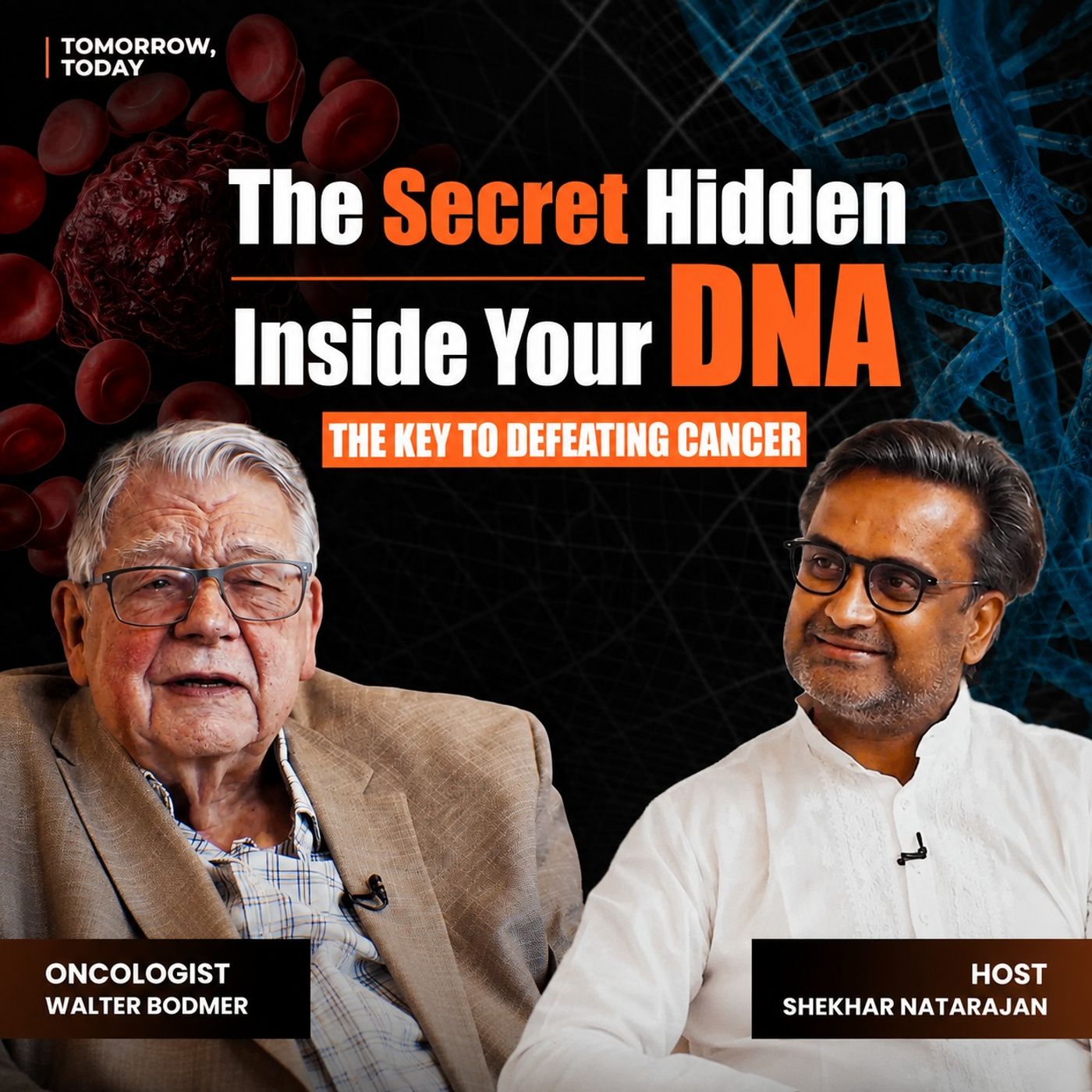
本集简介
双语字幕
仅展示文本字幕,不包含中文音频;想边听边看,请使用 Bayt 播客 App。
如果没有基因组计划,我们现在研究任何医学或健康问题都将无从下手。
Without the genome project, we could do nothing in the way we're now studying any medical problem, any health problem.
他大概是世界上最著名的肿瘤学家和遗传学科学家了。
He's probably the world's most renowned, you know, oncologist, genetic scientist.
所以从细胞层面来看,这本质上是一种遗传性疾病。
So it's fundamentally a genetic disease at the cellular level.
我对癌症完全不了解。
I don't have any knowledge whatsoever about cancer.
我对这个非常感兴趣。
I'm deeply curious about it.
最靠谱的说法是,我们不可能永生。
The most credible claim is that we won't live forever.
所以,能请到下一位嘉宾沃尔特·博德默尔爵士来到节目,对我来说真是莫大的荣幸。
So it's an incredible honor for me to have my next guest on the show, Sir Walter Bodmer.
他是一位极其杰出的科学家。
He's a phenomenal, phenomenal scientist.
他大概是世界上最著名的肿瘤学家和遗传学科学家,而且基本上也是那位向科学界传授如何与人类沟通方法的人,也就是博德默报告。
He's probably the world's most renowned, you know, oncologist, genetic scientist, and and and, basically, he's also the guy who's gifted to the scientist community the way to talk to humans, which is Bodmer report.
所以,能邀请到他,我真的感到非常荣幸。
Like, you know and so I'm incredibly honored to have him.
能和你交谈简直是我毕生的梦想。
It's, like, it's my lifetime dream to, like, talk to you.
我通过各种渠道一直在努力联系你。
Like, I've been chasing you down through many different channels.
终于能跟您坐下来聊聊了,就在伦敦。
Finally, I get to sit down with you, here in London.
而且,先生,我对癌症真的是一窍不通。
And, sir, I don't have any knowledge whatsoever about cancer.
但我对它非常好奇。
I'm deeply curious about it.
我也对科技很感兴趣。
I'm curious about technology.
我对基因工程和科学的大致发展方向很感兴趣。
I'm curious about, like, where, genetic engineering and science is going in general.
我希望你能通过今天的对话,把这些内容为我们观众好好梳理一下。
And I would love for you to unpack it for our audience through this conversation.
不过在正式聊这个之前,我知道你被封为爵士,叫沃尔特·博德默尔爵士。
But before we get rolling on that, like, I know that, like, you know, you were conferred Sir Walter Bodmer.
所以能跟我们简单讲讲这件事吗?
So tell us a little bit about that.
我不知道该说什么,除了感到荣幸、高兴和意外。
I'm not sure what I can say except that I was honored and pleased and surprised.
那时候我还比较年轻,到现在差不多正好四十年了,我被封为爵士,我想这是因为我在科学领域的贡献。
I was relatively young, it's now almost exactly forty years ago since I was made as Sir, and I assume it was for my contributions to science in general.
我大概也就只能这么说。
That's about all I can say.
我是说,这真的是莫大的荣誉。
I mean, it's a great honor.
是因为某个特定的研究领域才获得这个荣誉的吗?还是说有其他原因?
And was it for a specific topic that you were contributing towards, or?
据我所知,并不是针对某个特定领域。
Not as far as I'm aware.
你得去查查是谁推荐的我,以及他们当时是怎么说的。
You have to find out who promoted me and what they said I could get it for.
这确实挺难确定的。
It's hard to decide.
你知道,我一直致力于提携后辈并提供帮助。
You know, I've been involved in promoting people and helping.
我的意思是,关键在于你觉得他们的贡献是否切实有用。
I mean, it's a question of what you feel their contribution has been in useful way.
这种贡献可以体现在体育领域,也可以是艺术和人文学科,或者
It can be in sport, it can be in the arts and the humanities, or it
在我的情况下,也可以体现在科学领域。
can be in sciences, in my case.
好。
Good.
好。
Good.
太棒了。
Awesome.
你知道吗,你真是个谦虚的人。
Like, you know, so, like, you're such a humble man.
那跟我说说你的出身故事吧。
So tell me about your origin story.
比如,你从德国来的时候,年纪还小。
Like, you know, you came from Germany at the age
我父亲是犹太人,我1936年出生。
of My father was Jewish, and I was born in 1936.
当然,那时候希特勒的反犹太主义已经非常普遍了。
And already, of course, by that time, Hitler's antisemitism was very, very widespread.
所以,虽然我父亲当时在法兰克福已经是一位成功的医生,拥有大量犹太客户,但他最终意识到自己必须离开。
So although my father at that time was already a successful physician in Frankfurt with a largely Jewish practice, he realized in the end he would have to leave.
他原本以为不需要走。
He didn't think he would need to.
所以我们是在1938年中,我两岁半的时候,因为希特勒离开了德国。
And so we left Germany because of Hitler in the middle of nineteen thirty eight when I was 2.5.
所以我其实对德国没什么记忆,但那段日子对他来说很艰难。
So I don't really remember anything about Germany, but it was a difficult time, a difficult time for him.
他得重新参加医学考试,才能继续行医之类的。
He had to retake medical exams so he could practice and so on.
回想那段岁月,你会意识到一个不幸的事实:如今仍有人深受其害。很多生活在西方社会的人,其实并没有真正经历过二战时期那种状况,也不知道它会对人的生活产生多大的影响。
And when you think back of those times, you're made to realize something that unfortunately some people still suffer from, that many people who live in the Western society haven't experienced really what a situation like that that then came with the Second World War, how it can influence your lives.
那你当时两岁吗?
So you were age two at that time?
两岁半,对。
2.5, yeah.
两岁半。
2.5.
在两岁的时候,这半年差别可大了。
The 0.5 makes a difference when you're only two.
你为什么这么说?
Why do you say that?
我觉得挺奇怪的,我在德国的时候什么都不记得了,但刚到英国不久发生的事情我却记得很清楚。
Well, the thing that I find strange is that I remember nothing from when I was in Germany, and yet I remember things that must have happened fairly soon after we came to England.
我有两个哥哥,他们当然对德国发生的事要敏感得多。
I had two older brothers, and they were of course much more conscious of what had been happening in Germany.
我当时的第一反应是拒绝学英语。
My first reaction was refusing to learn how to speak English.
我才刚学会说话,而且说的是德语。
I'd only just learned how to speak at all, that was in German.
后来我又学了一些德语,但就是不肯重新学德语了。
And then having learned some German, I refused some English, however, I refused to learn German again.
后来我在学校学了德语,现在还能凑合用。
But then I learned German at school, and it's still reasonably okay.
我父母跟我说话都用德语。
My parents spoke to me in German.
那又怎样呢?
So What
你刚来英国的时候,都有哪些记忆呀?
what what is the memories you had of, like, you coming here to UK?
就像
Like
嗯,其实那并不是我在德国时的记忆,而是我作为一个非常年幼的幼儿在二战期间于英国的亲身经历。
Well, I is it vague It or like wasn't a memory of what I had in Germany, it was an experience of what I was having as a very young child, and then during the second world war in England.
而且我得说,在我年轻的时候,我对德国怀有很强烈的反感,持续了很多年。
And I have to say a strong antipathy against Germany for many years when I was younger.
那段日子真的很难熬。
It was a very difficult time.
我父亲在某种程度上算是幸运的,因为他是医生,当时很缺医生。很多英国医生都去参军了,所以他得以继续行医,最后过得还不错。不过他只是个全科医生,也就是家庭医生,其实他更想成为一名学术型的临床科学家,用我们现在的话说就是搞科研的。
My father was in a way lucky because being a doctor, they needed doctors, and a lot of the British doctors obviously were going into the services, so that he was able to practice his medicine, and in the end did quite well, but he was a general practitioner, family doctor, would have liked to have been an academic clinical scientist, we would say.
但他也很珍惜并享受自己的生活。当然,还有我母亲和两个兄弟,我们一家人一直在一起。后来他们非说伦敦移民太多了,让我们搬走,所以我们选了曼彻斯特,因为我妻子那边,也就是我岳母家,在曼彻斯特有朋友。
But he had a life that he appreciated and enjoyed, and of course my mother and my two brothers, we were all together as a family, and he had to go to Manchester because they said they had enough of immigrants in London, so we chose Manchester because through my wife, through my mother, they had friends in Manchester.
挺好的。
Very good.
所以归根结底,你觉得自己是个德国人吗?
So at your heart, are you a German?
你是英国公民吗?
Are you a UK citizen?
还是说,你到底是……
Or are you, like, who are
归化入籍的。
committed.
我是说,你是犹太人吗?
I mean, my Are you a Jew?
我不是虔诚的犹太人。
I'm not a practicing Jew.
我从来都不是个虔诚信教的人。
I've never been a practicing religious person.
我很尊重那些虔诚的人,但我自己不是。
I respect those who are, but I'm not.
我是在英国长大的成年人,还曾在斯坦福大学待过九年,那地方很有名,那段时光非常美好。
My adult upbringing was in The UK, and I spent nine years at one time in The United States at Stanford University, which is well known, it was a wonderful time.
我的第一任妻子是地道的英国人,所以最后我们想着为了孩子和那边的成长环境,可能还是得回英国。这倒不是说我们在美国过得不好,只是人心里总有一种归属感在拉扯,让你想回到自己的根源地,哪怕你在那边其实挺开心的。
My wife, first wife, she was British through and through, and so we thought in the end we might want to come back to England for the sake of our children and the environment there, which is not to say that we weren't happy in The United States, but there's a certain amount of feeling you belong somewhere that maybe takes you away from where you are, even if you're enjoying it.
所以呢,
So
在成长过程中,你对父母有哪些印象特别深刻的记忆?比如他们的价值观、文化背景之类的。
growing up, what are the things you distinctly remember about your father and mother, the values culture and other I things
我从父亲身上学到很多东西,有些道理我也是后来才慢慢明白的。
that you were lived a lot in a way from my father that I perhaps only realized later.
他毫无疑问非常聪明。
He was undoubtedly highly intelligent.
他已经发表了不少论文。
He'd already published a number of papers.
他原本希望能成为一名临床科学家。
He would have liked to have been a clinician scientist.
但他始终没能如愿。
He never really could.
他当时四十四岁。
He was 44.
等他回来安顿下来,那时候想转行已经不太可能了。
By the time he came back and settled, it was not really possible to change your directions then.
他的导师曾告诉过他这件事,我手里还有相关的信件。这位导师是法兰克福的一位顶尖外科医生,对他非常支持。
And he'd been told, and I have letters about this, by his mentor, who's a leading surgeon in Frankfurt, and supported him strongly.
导师说,因为你是犹太人,你永远不可能在大学里找到一份正经的工作。那是二十世纪二十年代的事了。
He said, You'll never get a proper job in the university because you're Jewish, and this was in the 1920s.
所以他最终确实产生了很大的影响。一开始,就像你肯定会问我的那样,我说我真的不知道还能做什么别的。
So he had, certainly in the end, a strong influence because initially, as I'm sure you're gonna ask me, I said in months, I have no idea what else I would do.
我母亲也是一个重要的影响因素。
And my mother was an important influence.
她曾是德国现代舞创始人之一鲁道夫·冯·拉班的学生,算是他早期的学生之一。
She was a student of one of essentially the founder of modern dance in Germany, Rudolf von Waban, one of his early students.
这也是一个很重要的影响因素。
And that was an important influence too.
我甚至参加过一门她主讲的假期课程,还参与了拉班研究所的相关组织工作。
I even once took a holiday course in which she taught, and I was involved with the organization of the Laban, the institute, that.
我觉得这也对我产生了影响,让我对艺术方面产生了兴趣。
And I I think that was also an influence giving a direction of interest in in the artistic side.
很好。
Very good.
博德默爵士,你知道的,你去剑桥学的是数学。
Sir Bodmer, like, you know, you you went to Cambridge for mathematics.
对,我上了一所曼彻斯特很有名的学校,叫曼彻斯特文法学校。
Yes, I went to a school in Manchester that's very well known, Manchester Gamma School.
现在回想起来,这事儿还挺有意思的。
That was interesting when you think about it.
那时候我爸刚能正常上班,他就想:给我三个儿子选哪所学校最好呢?
My father, who only just come with only just been able to get to work properly, Most of us, Well, what's the best school for my three sons to go to?
在曼彻斯特,人家告诉他,最好的选择是曼彻斯特综合中学。
In Manchester, he was told it was the Manchester General School.
所以,我和两个哥哥就是在那个时候去的,那时候想进那样的学校可不容易。
So that's where my two older brothers and I went at a time when it was not necessarily all that easy to get into a school like that.
我选的是文科方向,非理科类,当时有人告诉我,我的数学挺不错的。
And I went into what was called a momma side, non scientific, and I was told I was quite good at doing summons.
我们有个朋友是位女老师,战时在一所男校教书。她说,既然他数学不错,就该去学数学六(A-Level Math),因为那样才能拿到奖学金,考上剑桥或牛津之类的名校。所以我就这么做了。
And we had a friend who was a teacher, a woman who was a teacher during the war in a boys' school, it was an all boys' school, who said, Well, you know, if he's any good at maths, he should go into the Math six because that's where they all get scholarships, to Cambridge and Oxford and so And so that's what I did.
我是真喜欢数学,所以就选了这条路,最后还拿到了去剑桥学数学的奖学金。这算是个例子,说明有时候‘失败’反而对我大有好处。
I mean, I enjoyed the maths, and that's what I did, and eventually got a scholarship to study maths in Cambridge, in way that is one of the examples of where being unsuccessful was hugely to my advantage.
我的人生中有好几个这样的例子。
There are several examples of that in my life.
这就是其中一个,因为大家都以为顶尖的数学家都能进剑桥大学的三一学院,那是一所非常棒的学院,我也跟它很熟。
And this was one because it was assumed that the top mathematicians would all get into Trinity College, Cambridge, which is a wonderful college, and I've known it well.
我的名字先是列在大奖学金学院的名单上,然后是小奖学金学院的名单,这显然不行。
And I was put down in a list of colleges by major scholarship and then minor scholarship, which wouldn't do.
结果三一学院拒绝了我,但克莱尔学院接收了我。
And then it turned out that Trinity rejected me, but I was picked up by Clare College.
我对各个学院的情况一无所知,但这对我反而成了个大优势,因为克莱尔学院特别棒。
I didn't know anything about different colleges, and that was a huge benefit to me because Clare was a wonderful college.
那时候我还年轻。
I was young.
我年纪太小,没法直接去参军,而这件事在很大层面上彻底改变了我的生活轨迹。
I was too young to essentially go in immediately into military service, and it just it was the one of the first things that that changed my life in a major way.
去那里读书。
Going there.
所以其实没多少人知道,我最近还在牛津大学拍了一段访谈。
So not a lot of people like, you know, I I was I was recently in Oxford University shooting for a talk.
就是他们采访我的时候,我正在准备一场讲座。
Like, you know, they were, like, interviewing me, and I was I was doing a talk.
所以其实很多人不知道,牛津大学是由很多学院组成的。
So not a lot of people know that, actually, the Oxford University is a collection of a lot of colleges.
剑桥也是这样的。
So is Cambridge.
是剑桥。
Is Cambridge.
剑桥,不是牛津。
Cambridge, not Oxford.
对。
Yes.
不过,你能具体讲讲英国的教育体系是怎么跟这些学院制度配合运作的吗?
But, like so I'm can you can you actually tell, like, how the education system here in UK works with these college systems?
我觉得学院制非常了不起,而且基本上是牛津和剑桥独有的。
I think the college system is quite remarkable, and it's pretty well unique to Oxford and Cambridge.
这些学院起源于十三世纪的宗教机构,最初往往是一小群宗教人士,后来逐渐演变成了学院的概念。
They have their origins as religious institutions going back to the thirteenth century, and often small groups of them were religious people, and they would turn into this idea of the colleges.
无论是本科生还是研究生,要想成为学生,你必须隶属于某个学院。
And to be a student, whether an undergraduate or a graduate, you have to be a member of a college.
而学院就像是大学的一个缩影。
And a college is sort of like a microcosm of the university.
学院里有学生,也有研究员,这些研究员通常是大学里各级别的教职人员。
Has a mixture of students and the fellows of the college are, generally speaking, appointments in the university at various levels.
所以这种混合的构成,我觉得非常有价值。
And so you have this mixture of things that I think is very valuable.
所以即使你完全专注于某个科学领域,你也会遇到学地理、法语或古典学的人,我觉得这很有用,因为这是一个你可以归属的社区。
So even if you're entirely narrowly minded in some scientific area, you're gonna meet people who are studying geography or French or classics, and I think that's useful because it's a community that you can belong to.
这是第一点。
And that's the first thing.
第二点是,你有辅导课,最多两三个人一组的小班教学,我觉得这非常有益。
The second thing is you have tutorials, you have individual tuition in groups of maybe two or three at the most, which is I think hugely beneficial.
因为现在尤其是,你可以在YouTube上看好的讲座,但你得不到那种能伴随你一生的建议,因为学生们非常尊敬他们的导师,那些以这种方式教导他们的人。
Because nowadays especially, can watch a good lecture on YouTube, but you can't get the sort of advice that can stick with you, really, for the rest of your lives often, because the students have enormous regard for the people who were their tutors, who taught them in that way.
所以我认为这是非常重要的一点。
So I think that's a very important area.
然后还有另一个方面。
And then there's another aspect.
如果你喜欢运动,我以前游泳,但通常除非你足够优秀能进入大学代表队,否则你无法参与。
If you like doing a sport, and I used to swim, but very often you can't get involved unless you're good enough to be on the university team.
但每个学院,有30多个,他们都有自己的,可能有自己的游泳队,但更可能是划船,这两个地方都有,还有其他运动。
But each of these colleges, and there are 30 or more, they have their own, they might have their own swimming, but more likely going boats, which you do in both places, and other sports.
大学的体育是通过学院之间的竞争建立起来的,所以任何人都可以参加。
And the sport is built up in the university by competition between the colleges, so anybody can take part.
你不必非常出色。
You don't have to be terribly good.
然后各个学院之间互相学习。
And then the colleges learn from each other.
我当了九年的学院院长,你最熟悉的人之一就是其他学院的院长。
I was head of a college for nine years, and one of your people you get to know best are the other heads of colleges.
这不是竞争关系。
And it's not a competitive thing.
当然,你被教导要和其他人一样优秀,但你也可以从他们身上学到东西。
Of course, you're taught to be as good as everybody else, but you can learn from them too.
所以我认为这是一种非常有效的管理组织的方式。
So I think it's a remarkably effective way of managing an organization.
我觉得很多组织如果能这样拆分,然后各自作为独立实体尽力做到最好,同时互相学习、协同工作,可能会做得更好。
I think many organizations could do better by having that split up and then taking the advantage that each tries to do as well as they possibly can as an entity, but learns from the other and work as a group.
所以我认为这是独一无二的价值。
So I think it's a uniquely valuable
为什么这种制度只在英国有?
Why is this sort of system only here in UK?
为什么其他地方没有呢?
Why not in the rest of
世界上其他地方?
the world?
嗯,这起源于英国,像哈佛、耶鲁这样的美国大学,甚至更早的英国大学。
Well, it started historically in The UK, and American universities like Harvard and Yale and even further English universities.
它们花了很长时间才发展到今天这个样子。
Somehow took a long time to build up into what it is.
现在要从零开始建立这种体系很难。
Now it's hard to start it from scratch.
明白了。
Got it.
而且我认为是历史背景让它在英国行得通。
And I think it's the historical background that makes it work here.
要从零开始很难,而且我觉得它并没有像美国常春藤盟校的人可能希望的那样运作。
It's very difficult to start it from scratch, and I don't think it's worked in the way that people like in the Ivy League universities in The States might have wanted.
所以他们放弃了。
So they abandoned it.
因为我觉得这个学院的概念特别有意思,然后是的。
Because I find it extraordinarily interesting, this concept of, like, colleges and then Yes.
嗯,这是一个学院制大学。
Well, it's a collegiate university.
对。
Yes.
是的。
Yeah.
而且重要的是,现任副校长有过担任学院院长、系主任的经历,同时也是一位非常优秀的科学家,这些品质对于判断如何协调各项工作非常重要。
And it's important that the current vice chancellor has had the experience of being a head of a college, a head of a department, and a very good scientist, which is, it's important to have those qualities in judging how things should work together.
嗯,你成为数学家不是偶然的,就像你说的,那是……
Well, it's no accident that you became a mathematician, like you say that was
我并不是成为职业数学家,而是学了数学。
I didn't become a mathematician in the sense of becoming a professional I studied maths.
是的。
Yes.
我当时完全不知道自己要用它来做什么。
I hadn't a clue of what I was gonna do with it.
那你是怎么接触到罗纳德·费希尔的呢?
But how did you land in Ronald Fisher?
我可以告诉你,这故事挺有意思的。
I can tell you, it's an interesting story.
因为我有奖学金,所以能完成学位的主要部分,成绩也不错。两年后,第三年有点像硕士课程。第二年的时候,有位非常著名的统计学家,考克斯爵士,大卫·考克斯,做了一系列讲座。
Was able to do the main part of the degree at that time because I had a major scholarship, and I reasonably good things, that after my two years, the third year was a bit more like a master's course And would be in my second year, there was a lecture series from a very famous statistician, Cox, Sir David Cox.
我对统计学产生了浓厚兴趣,就跟他聊了聊,他说,你明年可以学统计学。
And I got very interested in statistics, and so I talked to him about that, and he said, Well, you know, you can do statistics in the next year.
但后来有个人,这个人叫R.
But then this guy, there's this guy, R.
A.
A.
费希尔,他是世界上最顶尖的统计学家之一。
Fisher, who's one of the world's best available- Beneficient.
他是最重要、最有影响力的统计学家。
Most important statisticians.
他还讲了遗传学,以及统计学在其中的应用。
And he also talks about genetics and how masks can do in them.
我觉得听起来挺有意思的,就选了那些课来听。
So I thought that sounded interesting, and I would take those lectures.
所以在第三年开学前的那个夏天,我开始读一些教材,包括费舍尔写的几本比较难的书,还有一本不错的遗传学通识教材。
And so in the summer before the beginning of the third year, I started reading textbooks, some difficult books by Fisher, and a good general textbook on genetics.
这让我特别着迷,因为它有一种分析性的特质,确实如此,这种特质很吸引我这个学数学的人。
And it just intrigued me, it had a sort of analytical quality, which it does, that appealed to me as a mathematician.
可以说,它并不是几百年前就被发现的东西了。
It was something that hadn't been only discovered hundreds of years ago, so to speak.
所以我选了这些书,这也是我第一次接触生物学知识。
And so I took those, that was the first time I learned any biology.
我在学校从来没学过生物,没有正式上过生物课。
I never learned any biology at school, no formal teaching in biology.
然后我开始去听费舍尔的课,被深深吸引了。
And I went to start with Fisher's lectures, and I was fascinated by them.
所以在第三年第一学期结束前,我去找他,说:您愿意收我做博士生吗?
So before the end of the first term in my third year, I went to him and I said, Would you consider taking me on as a PhD student?
他答应了,因为很少有数学家愿意跟他一起工作。
And he said yes, because he'd had very few mathematicians who'd ever gone to work with him.
但你说你不是数学家,你说你不是学数学的料。
But you said you're not a mathematician, but you said you're not a math guy.
我本来是学数学的,但那让我变成了另一个人。
I was a math student, but that turned me into something else.
这又是那些非凡的转折点之一。
That was another of these just remarkable steps.
这又一次改变了我的一生,让我不再觉得自己永远成不了优秀的数学家。
Again, that's a thing that changed my whole life, be moving away from I never thought I could be a good mathematician.
还达不到职业水准。
Not good enough to be a professional.
我是在导师制下学习的,他们管那叫supervisor,我有两位特别棒的导师。
I was taught in the tutorial system, what they call the supervisors there, I had two amazing supervisors.
一位是迈克尔·阿蒂亚,他当时既是英国皇家学会会长,也是爱丁堡皇家学会会长,是世界顶尖的数学家之一;另一位是阿卜杜勒·萨拉姆,他是巴基斯坦第一位诺贝尔奖得主。
One was Michael Atiyah, who was both president of the Royal Society and the Royal Society of Edinburgh, one of the world's outstanding mathematicians, and Abdul Salam, who was the first Nobel Prize winner from Pakistan.
我就觉得我永远也达不到他们那种高度。
And I just feel that I can never be what they were.
所以,当你意识到自己永远无法做到最好时,为什么还要选择这一行呢?
So why start a profession when you realize you can never be the best?
你可能在其他事情上也永远做不到最好。
You might never be the best at something else.
所以我从来没想过我会去学统计,但正是这一点促使我后来和理查德一起做了那些工作。
So I never thought that I did think I might take up statistics, but then that's what drove me more towards what I did with Richard.
这对我来说是一个巨大的转变。
It was a huge, huge change for me.
我觉得这也是因为我父亲的影响,他作为医生,一直跟活体打交道。
And I think there again, my father's influence was important because he was dealing with living things as doctor.
我想这在某种程度上也影响了我后来在研究工作中选择了这个方向。
And I suppose somehow that had an influence on my moving in that direction in my own work.
对。
Yeah.
那遗传学呢?威尔逊当时是怎么想的?
But what about genetics that Well, drew
以费希尔为例,现代遗传学在某种程度上是从孟德尔开始的。
genetics Fisher, let's say, the modern genetics as we know it, in a way, started with Mendel.
他当时研究的是报春花,观察性状是如何遗传的,并总结出了一套相当简单的规律,这些规律至今仍然适用。
And he was studying primroses, and he was studying the way that things were inherited, and came up with really fairly simple rules of how this works, which are true today in a way that's known.
从某些角度来看,如果我们把性别分为男性和女性,男性拥有一条X染色体和一条Y染色体,而女性则有两条X染色体。
In some ways, if you think of males and females, a male has an x and a y, a female has two x's.
他们的孩子中,一半会继承Y染色体成为男性,另一半则会继承X染色体。
And of the children, half will get a wife and be male, and the other half will get an ex.
这是一种非常简单的遗传形式,预期两种比例是相等的。
That's a very simple form of inheritance where you expect two proportions to be equal.
他还指出了豌豆中类似的遗传现象,说如果你把结构有点弯曲的豌豆和正常的豌豆杂交,平均下来你会得到一半像正常豌豆,另一半则是杂交出来的。
And he pointed out a similar sort of inheritance, not without, with peas, and said if you get peas that have a different structure that are crooked a bit, if you cross them with the one that isn't, then on average you can get a half that are like the normal pea and a half that are crossed.
他根据自己观察到的现象总结出了这些规律,这相当了不起。
And he formulated these rules, which were quite remarkable from the observations that he made.
这就是遗传学的开端,随后的逐步发展就是去探讨这一切究竟是从哪里来的。
So that's the start of genetics, and then its gradual progression is to say, Well, where did it all come from?
接着你就会谈到染色体,也就是携带基因的载体,然后就会涉及它们是如何分裂的,以及怎么才能让两个子细胞拥有和母细胞一样的遗传成分。
And then you start talking about chromosomes, which carry the genes, and then you start talking about how they divide and how can you get two cells that have the same genetic component as a parent cell have.
当然,接下来你就得进入化学领域了,毕竟从某种角度来说,万事万物都是由化学物质构成的。
And then of course you get into the chemist, and all this is, everything's made up of chemicals in one way or another.
那么这些化学物质到底是什么?基因背后的结构又是什么?
What are the chemicals, what are the structures that lie behind genes?
再往后就是DNA了,还有著名的沃森-克里克DNA双螺旋结构。这一发现揭示了基因在物理上究竟由什么构成,以及它们是如何运作的。这真是一项了不起的发现,堪称生物学史上最伟大的成就之一。这项研究是在1953年完成的,地点就在剑桥。当时吉姆·沃森是克莱尔学院的学生,而我也在那里读书,虽然那时候我并不认识他。因为当我作为一名数学系本科生入学时,他们的研究成果才刚刚发表。
And then you get into DNA, and the famous Watson Crick structure of DNA, which showed what the actual genes are physically made of and how they can work, which was a remarkable discovery, one of the greatest discoveries in biology, if you will, in 1953, actually made in Cambridge when Jim Walton was a pupil at Clare College where I was, although I didn't know him at that time, because their work had only just been published when I started being an undergrad who had studied maths.
所以这就是大概的发展脉络,不过后来变得非常复杂,有很多不同的方面需要我们去理解。
So that's the sort of pathway, but it's hugely complicated since then and many different things one has to try and understand.
那么,如果我们把遗传学作为一门科学,从当时的水平到现在的发展做个对比,你能描述一下你刚开始接触时的那个阶段是什么样子吗?
So if if you think about the science, like genetics as a science at that time to where it is right now, like like, can you can you explain, like, at the snapshot when you started, what it looked like at that time?
比如,当时已经发现了哪些东西?
Like, what was discovered already?
人们那时候都知道些什么?
What did people know?
那还有什么没被发现的呢?
What was yet to be discovered?
首先,费希尔,你得先理解达尔文主义。
First of all, Fischer, you have to understand Darwinism.
达尔文讲的不是进化本身,而是自然选择驱动的进化。
Darwin isn't the evolution, it's evolution by natural selection.
也就是说,如果你继承了某种特质并发生了一点变化,这种变化让你在繁殖上更有优势,比如更不容易在某个年龄前死亡,或者更容易留下后代。
It's evolution by the fact that if you have a certain inherited makeup and it changes a bit, and it gives you an advantage in terms of essentially reproductivity, and whether you die, less likely to die before a certain age, whether you're more likely to have children.
这就是当时对进化的理解,而孟德尔描述的那种简单遗传机制能解释进化这一观点,在当时并不被像弗朗西斯·高尔顿这样的许多著名学者所接受。
And that was the idea about evolution, and the ideas that it might be explained by the simple inheritance that Mendel had described didn't seem to fit together to a lot of famous people like Francis Galton at that time.
主要是费希尔,连同另外两位杰出的遗传学家索莱维和佐洛格,把这一思路整合了起来。他们从数学角度出发,写出了相应的方程,证明了孟德尔提出的那种遗传方式是如何在达尔文讨论的自然选择中发挥作用的。
And it was Fischer largely together with two other outstanding geneticists, Solvayn and Szorlag, who put together the idea that if you looked at it, especially as Fisher did from a mathematical point of view, you could write down equations which could show you how the type of inheritance that Mendel had suggested would work in terms of the natural selection that Darwin had discussed.
于是就有了群体遗传学的数学理论,这也是维特利希教授教过的内容之一,并且构成了我论文的重要组成部分。
So that there was a mathematical theory of population genetics, which is one of the things that Wiltrich had taught, and that was an important part of my thesis.
不过与此同时,虽然他本人以卓越的数学和统计能力著称,但他也非常坚信:在处理数据时,研究者必须了解数据的获取过程,并亲自参与处理。
But at the same time, he was, while himself, essentially mathematical and statistical in an outstanding way, also a great believer that if you're analyzing data, you should know how it was obtained and deal with it yourself.
所以他本人也做过实验。
So he himself did experiments.
他养过小鼠种群,我研究的是小鼠中某些遗传差异,这也是我论文的一部分。
So he had mouse colonies, and I was looking at certain types of inherited differences in mice, and that was part of my thesis too.
他还研究过报春花,也就是常见的报春属植物,它们通常有所谓的‘长柱花’和‘短柱花’两种类型,花粉接受位置要么在上方,要么在下方,这两种类型互为配偶。
Also, he had looked at primula, the common primuros, mostly has what's called pins and thumbs, where they have either the recipient for the pollen at the top or at the bottom, and they're the two types that make each other.
但有时你会发现一些异常个体,它们的花柱高度相同,他就把这当作一个遗传现象来研究。
But sometimes you find an abnormal one where they're both at the same height, and he'd studied this as a genetic thing.
基本上,他收集了在不同地区发现所谓同型合子的频率数据,并提出了一个问题:如何从理论角度分析自花授粉与异花授粉的优劣来解释这一现象。
Essentially, he collected data on the frequency, which you find these so called homo styles in different parts of Cornwall, and proposed the problem of how can you explain this in terms of theoretical analysis of the advantages or disadvantages of being able to self fertilize versus none.
这些内容都包含在我的论文里,还加了一些统计分析。
And so that was all part of my thesis with a little statistics thrown in.
因此,我对那些能帮助理解遗传学本质的实验工作产生了越来越浓厚的兴趣。
So it gradually led into a greater and greater interest in doing the sorts of experimental work that can help you understand what genetics is about.
所以
So
换个话题。
switching gears a little bit.
后来你联系了斯坦福大学的诺贝尔奖得主约书亚·莱德伯格,他第一次拒绝了你的请求。
So then you reached out to the Nobel Prize winner, Joshua Biebergh in Stanford, and he declined you first time.
然后呢,你就一直坚持不懈地跟他沟通。
Then, like, and then, like, you kept, like, persisting with him.
这是另一个例子,说明劣势反而成了巨大的优势。
This is another story of where a disadvantage is a huge advantage.
对。
Yes.
其实,沃森和金(King)那边的弗朗西斯·皮格跟费希尔关系挺不错的,我很可能就是那时候第一次见到他的。
Actually, Francis Pig of Watson and King was quite friendly with Fisher, and it's almost certainly possibly how I first met him.
后来我去听了一场讲座,主讲人是著名的诺贝尔奖得主、遗传学家马克斯·德尔布吕克。他原本是理论物理学家,后来研究噬菌体,也就是那些攻击细菌的病毒。
But I went to a lecture by a famous Nobel Prize winner later to Max Delbruck, a geneticist who was a theoretical physicist who then worked with phage, which are the viruses that attack bacteria.
不知怎么的,当时弗朗西斯·克里克跟德尔布吕克聊过,建议我去他那儿工作。算是作为进入分子生物学领域的一个引子吧,因为很明显,如果你想更深入地了解遗传学,就得在那个层面上去学。
Somehow at that point, Francis Crick had talked to Delbruck, and he suggested that I should go and work with Delbruck as an introduction, let's say, to molecular biology, because it seemed obvious if you were gonna learn more about genetics, you had to do it at that sort of level.
所以我申请了去加州理工学院跟马克斯·德尔布吕克做研究的奖学金,幸运的是,我没拿到。
So I applied for a scholarship to work with Max Delburg at Caltech, and to my good fortune, I didn't get it.
到了那个阶段,我决定自己掌握主动权。
And at that point, I decided to take things into my own control.
我听说过莱德尔伯格,也就是乔舒亚·莱德尔伯格,他非常年轻时就获得了诺贝尔奖,因为他证明了可以用细菌做遗传学研究,这正是基因工程的起源以及在那儿所做的工作。
And I'd heard about Lederberg, Joshua Lederberg, who, of course, at a remarkably young age, got a Nobel Prize for really showing that you could do genetics with bacteria, which was the whole origin of genetic engineering and what you do there.
于是我突然给他写了封信,因为我觉得斯坦福是个不错的地方,而且他显然是一个非常聪明能干的人。
So out of the blue I wrote to him because I thought Stanford was a nice place, he was obviously a very intelligent and able guy.
他回信的第一句话是,我说我想明年去。
And the first thing he wrote back is he said, I said, I want to come next year.
那时候我已经有三个孩子和妻子了,可能这就是他们不给我奖学金去跟德尔布吕克工作的原因。
By that time, I'd already had three children and a wife, that's probably why they didn't give me the scholarship to go and work with Delburg.
他说,那你去加州理工跟这个人工作吧,那里还有另一个人。
And he said, Well, go and work with this guy at Caltech, this is another person there.
我说,不,我想跟你工作。
I said, No, I want to work with you.
所以我留着他亲笔写的信。
So I have his letter in his own handwriting.
这位诺贝尔奖得主写道,亲爱的博马,你的坚持让我很受宠若惊。
The bell prize winner, Dear Bobma, your persistence is flattery.
是的。
Yes.
所以就这样,我去了莱德伯格那里,还有他的朋友,第一任妻子埃斯特·莱德伯格。
So that's what got me to, like, Latafia Lederberg and his friend, first wife, Esther Lederberg.
他也是一位非常了不起的导师,一位杰出的科学家。
And he was another remarkable mentor, an outstanding scientist.
那你是怎么解释这种坚持的呢?
So how do you explain this persistence?
比如说,这种坚持是从哪儿来的?
Like, where did it come from?
我的坚持吗?
My persistence?
我不太清楚。
I don't know.
我也不确定这是来自我的基因,还是因为我受到的教育,或者其他什么原因,但它确实就存在那里。
I don't know whether it came from my genes or what I was taught or what, but it just is it was there.
我觉得这很重要。
I think it's important.
那么,如果我是一个外行,比如在二十世纪四十年代和五十年代的时候,你会怎么向普通人解释当时的基因工程呢?
So if I if I were a layman, like, you know, in in nineteen forties and fifties, like, how would you explain genetic engineering at that time?
哦,那时候几乎没有什么能称得上基因工程的东西。
Oh, there was hardly anything that you could call genetic engineering then.
是从莱德伯格开始,他证明了可以用细菌做遗传学,但直到人们完全弄清楚基因是什么,这门学科才真正发展起来。
It started with Lederberg showing you could do genetics with bacteria, but it really didn't come into its own until the whole discovery of what the gene was.
就是那个DNA,它是怎么构成的,怎么编码的,像语言一样传递信息,你继承的就是这个,它告诉你那个由精子和卵子结合形成的单细胞,如何发育成你身体的其他部分。
It was this DNA thing, how it was made up, and how it coded, gave you information that coded like a language, that was what you inherited, and that language told your one cell that you get when you mate an egg with a sperm that creates the rest of your body.
所以,如果你看沃森和克里克的发现,那是在1953年4月。
And so what was apparent, if you look at the Watson Cript discovery, was in April 1953.
而到那时,人们已经意识到,DNA这种物质,也就是脱氧核糖核酸,几乎肯定就是遗传物质的主要成分。
And by that time, it had already been realized that the material DNA, deoxyribose nucleic acid, was almost certainly the main material of what made up what was inherited.
所以到那时,已经很清楚了,未来必须朝这个方向发展,你必须去了解它。
So by that time, it was already clear that this is where the future would have to lie, and you had to learn something about that.
但真正的工程操作和你能做的事情,还要再晚几年,那时你发现了能特定切割DNA的酶,让你能重新拼接,还找到了把DNA导入大肠杆菌的方法,比如,不只是让它们交配。
But the actual engineering and what you could do came even some years later, but with you finding enzymes that cut up DNA in a certain way and allow you to put it together, finding ways how you could get DNA into E.
比如大肠杆菌,而不只是让它们交配。
Coli, for instance, and not just do matings between them.
但那时候的杂交其实已经算是化学范畴了,因为你可以培养出一种大肠杆菌菌株,它只有在提供特定氨基酸的情况下才能生长。
But the matings there already, that was chemistry because you could get a stain of E.
然后你就可以研究它们的遗传特性。
Coli that would only grow if you gave it a certain amino acids, and then you could look at the genetics of them.
不过这些发展主要是在六十年代和七十年代初才出现的。
But that was the things that developed in the 1960s and then early '70s.
所以,
So,
你知道,你的年纪就像你说的,你1936年出生,到现在差不多90岁了。
you know, your age is like you know, you mentioned, like, you know, you're born in 1936, which makes it, like, 90 years old now.
通常教授们到了65岁或70岁就会退休,然后回家,就此结束职业生涯。
So usually professors, like, retire at the age 65, 70, and then they go back home, and they call it a day.
我觉得这是个很大的问题。
I think that I think that's a huge problem.
我是说,我从来没想过要停止工作。
I think that I mean, I've I've never given I've never given up working.
我还在工作。
I still work.
是的。
Yes.
得益于所在院系的领导支持,我在牛津大学仍保留着荣誉教授的头衔。
I still have a laureate in Oxford due to the support I get from the head of department I'm in.
我是荣休教授。
I'm an emeritus professor.
不是每个人都想那样做,但很多人可以。而且到了65岁就生病的观念已经不再成立了。
Not everybody wants to do things that way, but many people can, and the notion that you're ill when you're 65 is no longer true.
我的意思是,这跟寿命的极限——也就是一个人最多能活多久——没关系。
I mean, it's not a matter of the lifespan, what's the maximum someone can live.
这个极限变化不大,大概115到120岁,一般人很少能活过这个年纪。
It hasn't changed much, 115, 120, nobody's generally getting much older than that.
但现在活到80岁或90岁的人比例增加了。所以当你观察遗传模式时,过去它就像个三角形那样。
But the proportion that reach an age of 80 or 90 now is usually increased, so that when you have a of pattern of how inheritance is, At one time it was like a triangle like that.
年纪大的人,上面那些,女人在这儿,男人在那儿,女性通常活得久一点。
The old people at the top, women here, men there, women live a bit longer.
现在的状况更像是这样,高龄人群的比例高得多。
And what it is is more like this, where there's a much higher proportion of people at these older ages.
所以我们得想想,该怎么在管理社会时把这一点考虑进去。
And we have to think about how to take that into account in the way we we manage our society.
那是什么让你每天早上醒来都充满动力去实验室工作呢?
The way so what wakes you up every day in the morning to go to the to the lab and, like, work out?
比如,你目前正在解决什么问题?
Like, what problem are you solving right now?
我目前的主要兴趣,其实也持续了一段时间了,是在癌症研究方面。我和一个小团队以及加州一家生物技术公司的合作者一起,正在探索利用免疫系统治疗癌症的新方法。
My major interest at the moment is, and has been for some time, in aspects of cancer, And I'm working with a small group and with a collaborator in a biotech company in California on novel ways of using our immune system to treat cancer.
过去我也关注过其他领域,但因为各种原因没能继续深入下去,比如探讨如何在分子层面上利用基因变异。
I've in the past had other interests which I was not able to continue for one reason or another in how you can use genetic variability nowadays at the molecular level.
我们之间存在着大量可以在遗传学层面进行研究的差异。
There are a huge number of differences we can actually study in the lemurality between us.
这就是基因差异,它让你看起来比我肤色深一点,头发颜色也不同,还有各种显而易见的特征,以及很多其他方面。
This is the genetic variability that makes you look a bit more browner than I am, different colored hair, all sorts of things that one obviously sees, and a lot of other aspects.
我们可以在一定程度上通过根据基因相似度把人分组,来对人群进行特征描述。
And you can characterize populations to some extent by grouping people according to how similar they are genetically.
我一直对此非常感兴趣。
I've been very interested in this.
这源于我最初对群体遗传学的兴趣,以及我的数学背景。
That came out of my original interest in population genetics and a mathematical background.
在其他方面,我深入参与了免疫学的其他领域,特别是研究人体如何应对感染。
In other respects, I got very involved in other aspects of immunology, in fact, the study of how we respond to infections.
于是我和几位擅长数据分析的同事合作,开展了一项针对英国人群遗传层面的研究。我们收集了来自全国各地的血液样本作为DNA来源,但主要聚焦于农村地区,也就是大城市以外的地方;同时要求参与者的祖父母(至少四位)都居住在以他们家为中心、半径约50英里的范围内。
So I initiated them with colleagues who were good at doing the data analysis, a study of the British population at the genetic level, where we took blood samples of people as a source of their DNA from throughout the country, but in rural areas, outside the big cities, and from people who had their grandparents, at least four of them, near to where they lived within a diameter, say, of 50 miles.
也就是说,我们采样的人群,其祖先背景可以追溯到工业革命大规模人口流动之前。
So we're sampling people who could say their origins were before the major influx of the industrial revolution.
接着,这项研究的主要任务是根据遗传特征,将这些人群划分为若干群体,使得同一群体内部的成员彼此之间比与其他群体的成员更为相似。
And then the study was to group these people, just based on the genetics, into clusters that were more similar within a cluster than to others.
让我们惊讶的是,当我们把这些数据画在地图上时,竟然能清楚地看出他们各自来自哪里。
And to our amazing quiet surprise, when we plotted them, we knew where they all came from on the map.
这些基因聚类结果与他们在英国地图上的实际位置完全吻合,这在当时是首次获得如此详细的信息。
The genetic clusters matched up with where they were on the map of The UK, which was really the first time in that sort of detail, that sort of information was obtained.
由于各种原因,我没能继续开展这项研究,但这件事依然让我很感兴趣。
I was not able, for one reason or another, to continue those studies, but there's still something that interests me.
那么,我们稍微换个话题。
So now switching topics a little bit.
那癌症呢。
So cancer.
对。
Yes.
咱们先别管教科书上那些定义。
So forget the textbook definition of cancer.
你知道,这到底是基因组本身出了问题,还是说……嗯,我们到底在讨论什么根本性的东西,比如到底是什么导致了癌症?
You know, is it like the failure of the genome itself, or is it basically the you know, are we talking something fundamental about, like like, what causes cancer?
简单来说,癌症到底是什么?
Like, what is cancer in, like, a nutshell?
对。
Yeah.
让我想想。
Let me Is
它本质上是不是基因组本身的疾病呢?
it is it is it basically the disease of the genome itself?
不管怎样,我先说说我自己的经历。
Anyway, let me start by saying, give my own history.
我是怎么涉足这个领域的呢?我原本是个遗传学家,学习过各种研究DNA的方法,比如做分子遗传学实验,或者用不同人的细胞做一些巧妙的操作来获取遗传信息。
How did I get involved in So I was a geneticist, and I learned about all these ways you can study DNA and do molecular genetics and do clever things with cells from different people and get some genetic information.
然后有一天,毫无预兆地,在我回到牛津担任遗传学教授之后——我是牛津大学第一位遗传学教授,大概是在1977年左右——有人问我,有没有兴趣去担任当时两家规模相当、专注于癌症研究的慈善机构的科学主管。
And then out of the blue, basically, after I'd been back in Oxford as a professor of genetics, the first professor of genetics formerly in Oxford, around about 1977, I was asked, Would I be interested in becoming the director of science for what was then the major of two comparable research charities that studied cancer.
其中一家机构叫帝国癌症研究基金会。
Mine was called the Imperial Cancer Research Fund.
他们找上我,是觉得我可能懂点癌症方面的东西。其实我对这块了解不多,因为我主要是搞遗传学的,而且当时大家已经基本确定基因在癌症里起了关键作用。
And this was a job that they'd come to me assuming I might know something about cancer, which I didn't know a lot about, because I was a geneticist and because of the role that genetics almost certainly was playing in what cancer is.
所以我就这样进入了这个领域。
So that's how I got into that way.
我得在短时间内恶补很多关于癌症的知识,因为我要负责一个机构的工作。
And I had to learn a lot about what cancer was very quickly because I was expected being in charge in an organization.
那你怎么定义癌症呢?
So how do you define cancer?
我是怎么接触到癌症研究的?
How did I find cancer?
不是。
No.
不对。
No.
不。
No.
展开剩余字幕(还有 480 条)
给癌症下个定义。
Define cancer.
我会怎么定义癌症呢?
How would I define cancer?
对。
Yeah.
我们的生命始于精子和卵子结合成一个细胞。
We start our life from a sperm and an egg meeting for one cell.
细胞会分裂。
Cells divide.
我们体内有很多不同类型的细胞,它们利用从父亲或母亲那里继承的遗传信息,以不同的方式形成不同的组织。
We have many different sorts of cells in the body, and they use the genetic information that they've inherited from a male or a female in different ways to give you different sorts of tissues.
在某个特定的组织中,比如我经常研究的大肠,它由一种特定的细胞类型构成表面,它们形成隐窝,像这样的小体,底部有一个叫做干细胞的细胞,因为它一直在分裂,整个结构大约有几千个不同类型的细胞,每四到五天就会更新一次。
And in a given tissue, for instance, one that I study a lot in the bowel, it's formed of a surface of one particular cell type, and they form crypts, they form little bodies like that, and at the bottom of them is a cell that's called a stem cell, because it's the one that divides all the time, produces It turns over in four or five days, the whole of this structure of maybe a couple of thousand different types of cells.
现在,当这一切受到控制时,情况就是这样。
Now what happens, that's when it's under control.
那么,如果其中一个细胞发生了基因突变,它会开始不受控制地生长,超出正常细胞的限制,从而形成异常的增生。
Now what happens when a genetic change can happen in one of those cells, that it starts outgrowing its normal partners in a way that gives you an abnormal growth.
这就是癌症。
That's what a cancer is.
癌症就是我们的细胞以不正常的方式分裂,导致异常增生。
A cancer is an abnormal growth of our cells in which they're dividing in a way that they shouldn't.
那为什么会发生这种情况呢?
And why does it happen?
为什么会发生这种情况?
Why does it happen?
这是因为体细胞层面发生了基因改变。我们所说的体细胞,是指那些构成身体不同部分的细胞,而不是产生精子或卵子的生殖细胞。比如肠道隐窝底部的细胞就是如此。这其实只是自然选择的结果。
It happens because the genetic changes occur in those cells at the somatic, what we call the somatic level, so that's not in the cells that produce the egg on the sperm, it's the cells that make up different parts of the body, like the ones at the bottom of this crypt, as we call it, in a bowel, and it's simply because of natural selection.
这是在我们体内发生的一种进化过程。那些带有基因改变的细胞,逐渐获得了更强的分裂能力,从而突破了正常的限制。
It's an evolutionary process within our body of the cells that have genetic changes that gradually give them greater ability to divide and overcome the normal constraints of what's happening.
在我看来,之所以会出现这种情况,是因为这是一种老年病。在19世纪中叶之前,人们几乎还不了解这种病。当时有一位德国医生首次从细胞的角度描述了这种疾病。
And the reason, in my view, why that happens, it's a disease of old age, of older age, not old age, of older age, which was hardly known even into the middle of the nineteenth century when a German physician first described that it was a disease of cells in that way.
所以这是一种几乎没怎么影响我们进化的疾病。
So it's a disease that hardly influenced our evolution.
这是因为进化在某种程度上选择让我们这样:过了繁殖年龄,大概是四五十岁,主要是从女性角度来看,当然也包括男性整体来说,在我们的进化史上,过了繁殖期之后就没有压力去维持一个健康的机体了。
And that's because evolution has selected us in such a way that beyond the reproductive age, which is about 40 or 50, mainly if you think of it on the female side, of course, but also on the whole, on the male side, There isn't the pressure to maintain a proper living organism after the reproductive age in our evolutionary history.
所以随着年龄增长,身体会出现各种各样的异常变化,得癌症就是其中之一。
So you get these abnormalities of the way things happen as you grow older, and getting a cancer is one of them.
而且它可以在身体的不同组织中,以不同的方式发生。
And it can happen in all the different tissues of the body in different ways.
所以从本质上说,这是一种细胞层面的遗传病。这不仅仅是因为基因突变改变了‘语言’,让你做出了不同的行为,还在于即使从同一个初始细胞开始,使用相同的‘语言’,也能演化出多种不同的细胞类型。
So it's fundamentally a genetic disease at the cellular level, that it's also not only mutations which change the language so you're doing something different, but there are ways in which you can get from having the same language from that one initial cell, you get to lots of different cells.
通过以不同方式使用这些信息,就能产生不同的结果。
By using the information in different ways, you can get different results.
因此,基因是否开启或如何发挥功能这种机制,本身也可以是一种稳定的遗传改变,从而促成癌症的发生。
And so that mechanism of whether you switch on in a way genes function or not also can be a stable form of genetic change that gives us helps give the Australia cancer.
所以,这更像是你基因组的一种崩溃。
So so it's more like a a breakdown of your genome.
这是不是基因组出了故障?
Is it a failure of the genome?
可以说是基因组的崩溃。
It's breakdown of the genome.
倒不是说完全崩溃,而是最初某个特定细胞的基因组发生了变化,然后它就能超越正常邻居的生长速度。
It's not a breakdown in a way, it's a change in a genome of initially a particular cell, which can then outgrow its normal neighbors.
所以从这个角度说,如果非要叫它崩溃的话,但对癌细胞来说,这其实是个巨大的优势。
So in that sense, if you can call it a breakdown, but for the cancer cell, it's a huge advantage.
它在不断增殖,这对患病个体来说是不利的。
It's multiplying up to the disadvantage of the individual in whom it develops.
所以,你刚才提到你目前的研究主要是利用免疫疗法。
So and and basically, you mentioned that your research right now is basically using immune therapy.
对。
Yes.
那么免疫疗法具体是怎么起作用的呢?
So how is immune therapy related to like Okay.
这是个非常有趣的问题。
Now that's a very interesting question.
首先,我们的免疫系统到底是什么?
The first thing, what is our immune system?
我们的免疫系统是一个非常复杂、高度组织化的系统,主要作用是帮助我们预防传染病。
So our immune system is a very complicated, highly organized system that essentially is there to help prevent us from getting infectious diseases.
这一点极其重要。
That's extremely important.
在过去,造成大量死亡的主要原因是感染,不管是细菌感染、真菌感染还是病毒感染,就像我们在这次疫情中看到的那样。
And are the things that, in the past, the most loss of life was due to infections, whether it's bacteria, it can be fungi, it can be funguses, or it can be viruses, of course, as we know from the pandemic.
所以从进化角度来看,人体发展出了一整套系统来识别入侵者的外来特征。比如以病毒为例,免疫系统能识别出病毒是异类,必须对其进行攻击,并找出攻击的方法。
So that evolutionarily, there has a whole system been developed that recognizes the foreignness of an invasive organism, say, let's take a virus, that recognizes the virus as something different and has to be attacked, and then works out how to attack it.
因此免疫系统就存在了,而且它从一开始就能以一种非常精密的方式识别这些威胁。
So the immune system is there, and it started without recognizing in a very sophisticated way.
不过这种精密的识别机制是非常复杂的。
But the more sophisticated way, it's very complicated.
也许人们希望体内产生抗体。
Maybe people might want antibodies on.
接种疫苗的原理其实很简单,就是给接种者注射病毒的某种形式,或者病毒的关键部分,这样免疫系统就能识别出这是外来物,然后启动相应的机制去攻击被病毒感染的细胞。
And what you do when you do a vaccination, the simple minded thing is you give the individual to be vaccinated a version of the virus itself or an important part of the virus in order that your immune system recognizes that as foreign and then switches on what's needed to attack cells that have been infected by viruses.
抗体就是其中一种防御机制。
And the antibody is one of the mechanisms by which that hurt.
人体会产生抗体,淋巴细胞是血液中除红细胞(负责携带血红蛋白)之外最主要的一种白细胞,其中有一类淋巴细胞专门负责制造这些抗体,而整个系统则负责识别外来入侵者并促使它们生成。
You make antibodies, lymphocytes are a major type of white cell in the blood as opposed to the red cells, which deal with hemoglobin, and there's one type of lymphocyte that makes these antibodies, and there's a system that recognizes that foreigners and makes them.
还有另一种系统,它通过另一种细胞来发挥作用。这种细胞不产生抗体,而是在自身表面带有受体,这就是T细胞。它以相当复杂的方式在表面生成某种结构,用来识别其他细胞上的特定物质。其中很重要的一点是,它能识别蛋白质。很多这类物质都是蛋白质,也就是由氨基酸组成的链,它们在某种程度上构成了细胞的大部分功能,而且这些蛋白质位于细胞内部,而不是表面。
And there's an alternative system that does it by another type of cell that instead of making an antibody, it has a receptor on its own surface, it's a T cell, it makes something on its surface in quite a complicated way that recognizes something on the other cell, and one of the important things is that it can recognize proteins, it can recognize, and a lot of it is proteins, which are strings of amino acids, which make up most of the function of the cells in a way, and that are inside the cell and not on the surface.
唯一能直接处理的方式,就是从细胞表面进行杀伤。
The only easy way you can do is to kill from the surface.
所以这是一个相当复杂的过程:一种蛋白质,无论是酶还是某种结构蛋白,都会被分解成许多小片段。其中一些片段会被一种类似“卡尺”的结构——也就是细胞表面的某种蛋白质——展示出来,从而让其他能够识别它的细胞看到。
And so it's a complicated process where a protein, it can be an enzyme or structural protein of one sort or another, can be broken up into lots of bits, and some of those little pieces are expressed by a sort of caliper, if you will, by a protein on the surface of cells that exposes it to the other cells that recognize it.
这是一个复杂的系统。我参与这项工作,是因为我和一些试图搞清楚这一机制的人一起工作,但我们的出发点不同:比如,如果把我的皮肤移植到你身上,它会被排斥。
And it's a complicated system, and my involvement for that came with working with people who are trying to understand what is it that does that, but starting from a different point of view, that if I take some of my skin and put it onto yours, it's going to be rejected.
为什么?
Why?
导致排斥反应的具体差异是什么?
What are the differences that lead to that rejection?
这属于免疫学过程。
Which is an immunological process.
大家可能都听说过ABO血型匹配的问题,输血时必须严格匹配血型,否则如果供血者和受血者的ABO血型不同,就会引发严重的排异反应。
It's not Probably everybody's heard probably the ABO blood use, which you do have to match, otherwise you get problems when you transfer blood from one person to another if they have a different ABO type.
细胞表面有没有类似的东西,会导致那种排斥反应?
Is there something similar that's on the surface of the cells so that that would lead to that rejection?
我参与的时候正是大家刚开始寻找这些东西的早期阶段。我的统计学背景帮了大忙,让我能理清研究思路,从遗传学角度去理解这些差异到底是什么,后来终于搞清楚了它们作为蛋白质的具体身份、变化规律等等。
And I was involved in the early days when people had started looking for that, and it was my statistical background that sort of helped unwind what was being studied in such a way that you could begin for the genetics to understand what were these differences, and then eventually that led to find out what they were as proteins and how they varied and so on.
所以这就是我怎么接触到免疫系统研究的。
So that's how I got into the immune system.
在去斯坦福之前,我对这块其实了解不多。
I'd known little about it until I went to Stanford.
那里有个同事,他经常举办晚间讲座,我会去参加,在那里我学到了什么是淋巴细胞。
There was a colleague there who used to have evening sessions that I'd go to where I learned about what were lymphocytes.
其实,淋巴细胞的功能是由一位著名的免疫学家在奥普森发现的,我刚到那里时他对我帮助很大。
Actually, their function was discovered by a famous immunologist in Opsons, who was very helpful to me when I first came there.
所以渐渐地,我对这个领域越来越感兴趣。
So gradually that became more of an interest.
所以治疗癌症时,你要做的就是让免疫系统把癌细胞当作外来物并消灭它,同时尽量不伤害正常细胞。
So what you're doing when you're treating cancer is you're making that immune system recognize the cancer is something for him and kill him, and try to do that without killing the normal cells.
对。
Yeah.
抱歉,这故事说来话长,但确实很复杂。
I'm sorry, that's a long story, but it's a very complicated one.
不。
No.
确实,这很有意思。
It is it is interesting.
所以,如果你退一步看,能不能带我们了解一下,什么是癌症干细胞?
So so if you if you step back and, like, you know, walk us through what is a cancer stem cell?
癌症
The cancer
然后如果你想解释一下,再把后面的内容串联起来讲给我们听。
And if you wanna explain this and then, like, you know, bring it all together for us from there on.
癌症最终是由一个细胞发展而来的。
Cancer ultimately arises from one cell.
对。
Yes.
在任何一个时间点,可能不止一个细胞,但最终它起源于单个细胞。
At any given time, there may be more than one cell, but eventually, it it arises in one cell.
正是这个细胞在驱动分裂,它不断增殖产生所有不同的癌细胞,这种细胞被称为干细胞。
And it's the cell that's driving the division, it's the cell that's multiplying up to give all the different cancer cells, that is called a stem cell.
一旦干细胞发生了基因改变,如果存在多个变化步骤,之前的版本并不会被清除。
Now once you've got a genetic change in a stem cell, you don't get rid of the previous version if there are different steps of change.
可能有好几种不同的干细胞在做各自的事,但在某个阶段,其中一种会比其他长得更好,所以它就被选中了。
You may have several different stem cells doing different things, but one of each at some point, one is growing better than the others, that's why it's been selected for.
对。
Yeah.
那既然有了这么多科学进展,比如化疗和其他各种疗法,为什么到目前为止效果还是不太理想呢?
So why has all of these scientific advancement, whether it's, like, chemotherapy and other types of therapies that have been proposed, why is not that been so effective so far?
因为癌细胞跟正常细胞非常相似。
Because cancer is very a cancer cell is very similar to a normal cell.
对吧?
Right?
也就是说,检测是个问题吗?
And that means So detection is a problem?
倒不是检测的问题,而是治疗方面。
It's not so much detection, but treatments.
比如早期的细胞毒性疗法,也就是那些副作用比较大的早期治疗方案,它们的作用机制是攻击细胞的分裂过程。但如果攻击得太厉害,正常分裂的细胞也会受到波及,这就带来很大的问题了。
So for some of the early cytotoxicity, some of the early toxic treatments, so what they're doing is they're attacking the division process of a cell, but if they attack that too much, then all the normal dividing cells will also be attacked, so you get a huge problem there.
所以简单来说,化疗之所以能带来巨大的好处,其实就是在杀死癌细胞和伤害人体之间找到一个平衡点。
So basically, the chemotherapy that has had enormous benefits is just a balance between killing the cell cancers a little bit more than killing the individual.
而且随着时间推移,当你……
And gradually, as you
那你们是怎么做到精准杀伤的呢?
How are you being able to manage the precision of killing that?
这有可能实现吗?
Is it possible?
主要是通过剂量来控制的,比如。
Well, it's by dosage, for instance.
而且你可以用体外模型来研究这个。
And you can study in vitro models of that.
癌细胞可以培养成细胞系。
A cancer can give realis to a cell line.
我们使用了很多源自癌症的细胞系,每个细胞系都保留了其来源癌症的遗传特性。我们可以探讨:如果面对具有不同遗传特性的癌症,它们在受到类似化疗药物的杀伤时,反应会有何不同?
We work with a lot of cell lines that are derived from cancers, each of which has the genetic properties that the cancer it came from had, and we can say, Well, if we have cancers with different genetic properties, how do they respond to being killed as cultures the Lamoritine?
这方面有很多体外模型,当然也有很多结合动物癌症模型的研究在进行。
What is There are a lot of in vitro models of that, and of course, are a lot of being done in addition with animal models of cancer.
所以确实出现过很多不同的情况,你知道的,各种各样的承诺都提出来了。
So there there's been a lot of different, like, you know, varieties of, promises made.
对吧?
Right?
比如无论是化疗、单克隆抗体治疗,还是像人类基因组计划这样的基础项目。
Like, know, whether it's chemotherapy, monoclonal, you know, treatment or, like, you know, basically, you think about the human genome project.
比如,在过去七十年里,人们一路上许下了各种各样的承诺,声称能够攻克癌症。
Like, were different, like, promises made along the way in the last seventy years about, like, the ability to solve cancer.
那为什么到现在……
So why has
其实,过去二十年来,我们应对癌症的能力已经有了巨大的提升。
all of these Well, the ability to deal with cancer is hugely, hugely improved over the last twenty years.
这是毫无疑问的。
For sure.
确实如此。
For sure.
这毫无疑问得益于我们对癌细胞和正常细胞之间差异的日益深入的理解。在实验室里,我们可以通过细胞系进行研究,也可以使用小鼠模型——虽然小鼠通常是最理想的动物模型,但也存在难点,因为毕竟它们并不完全等同于人类。
And that's undoubtedly come from more and more understanding of the difference between a cancer and a normal cell, which you can study in the laboratory by having sources of cells, you can have mouse models, and often it's the best animal model, but also difficult because it's not exactly the same.
在小鼠身上诱发结直肠癌或肠道癌,跟人类的情况并不完全一样。
Getting a colorectal or bowel cancer in the mouse isn't exactly the same as in humans.
不过你刚才提到的人类基因组计划,如果没有它,我们现在根本不可能以当前的方式去研究任何医学或健康问题。归根结底,一切的基础都在于基因,以及基因的功能和作用机制,而这些认知的源头都来自于对基因组的理解。
But just your comment on the genome project, without the genome project, we could do nothing in the way we're now studying any medical problem, any health problem, because underlying it all in the end is the genes, and what the genes do, and how the genes do it, and all of that has its origins in understanding the genome.
在人类基因组计划刚起步的时候,我就参与其中了。当时很多人质疑,为什么要把十亿美元花在这个项目上?他们觉得,拿这笔钱去做其他更简单、成本更低的实验不是更有价值吗?
I was involved in the very early days of promoting the genome project when people said, Why are spending all this money, a billion dollars, in finding the genome when you could do a lot more other sorts of simpler experiments that were so expensive?
这种想法完全错了。
And that was totally and utterly wrong.
你想想看,十亿美元大概也就是一两枚导弹的钱,对吧?
When you think of it, that was about the cost of one or two missiles or something, right?
而现在,几乎每一项基于新发现或新疗法的人类疾病治疗手段,都在某种程度上受益于我们对基因组的理解,而这都要归功于基因组计划。
And here we are, there's almost nothing that one does that's based on new discoveries, new ways of treating human illness that hasn't in one way or another benefited from what we understand of our genome, and that's the genome project.
哪怕从制药公司的角度来看,我们现在能用的那些抗体药物,比如治疗类风湿的,或者在特定癌症治疗中有效的抗体,它们研发和生产成本极高,是许多医疗手段里最烧钱的。
Just even if you think of it in terms of companies and the companies that make things, The antibodies that we can now use, for instance, that will treat rheumatism, or some of the antibodies that are effective in treating cancers in certain ways, they're some of the most costly in terms of the amount that's built, many medical treatments.
所以这些治疗方案一旦纳入临床指南,像免疫疗法或者其他各种新疗法出现时,显然也会伴随着一些患者在尝试过程中不幸离世的情况。
So when these treatment routines come out, like, on all the protocols, right, like, it's immunotherapy or, like, you know, whatever different kinds have come out, obviously, is, like, loss of human life while trying to do all of these things as well.
关于癌症,首先要说的是,最重要的还是尽量预防它。
Is there first thing to say about cancer, the most important thing is to try and prevent it.
我们很清楚一些关键点,虽然大家总讨论该吃什么不该吃什么,但其实可以简单总结为:别吃太多,别太胖,饮食保持合理均衡。
So we know certain things, there's a lot of talk about what you should eat or not, but think it can be summarized very simply, don't eat too much, don't get too fat, have a reasonably balanced diet.
在我看来,关于它的影响,其实也没太多好说的了。
There's not much more, in my view, that you can say about what the effect of that would be.
但很明显,如果你太胖的话,患癌的风险就会增加,而且得糖尿病的风险也会非常大。
But obviously, if you get too fat, then you have a higher risk of getting cancer, and you also have a huge risk of getting diabetes.
所以另一种方法就是尽早干预,还有打一些疫苗。
So the other way is then, the earlier you And then also some vaccinations.
如果癌症是由病毒引起的,比如宫颈癌,它是由特定类型的病毒导致的。这是一种非常常见的疾病,不过在那些能接种抗病毒疫苗的国家,现在这种情况已经少多了,因为我们可以预防癌症的发生。
If a cancer is due to a virus, like cervical cancer, it's due to a particular type of virus, and it's a very common disease, less so now in countries where you can make a vaccine against virus so you can prevent the cancer from coming.
如果能做到这一点,那当然非常重要,对于病毒引发的癌症,这也是完全可行的。
If you can do that, that's obviously very important, and for virus induced cancers, that's quite possible.
接下来最重要的就是尽早发现癌症。
And then the next most important thing is to get a cancer when it's young.
我是说,我大概十年前左右得过结肠癌,时间稍微短一点。
I mean, I had a colon cancer about ten years ago or something, a bit less than that.
如果肠癌局限在局部,没有扩散太多,只要把那块有癌的组织切掉,就能治愈。
And if the cancer in the bowel is limited and hasn't spread much, you just cut out that part of the cancer, and that's a cure.
如果癌症在采取措施前就已经扩散,跑到身体其他部位去了,那就更难治了,具体原因我们到现在也没完全搞清楚。
It's when it spreads before you've done that so that it's already in other parts of the body that it's harder to get for reasons we still don't really know.
乳腺癌比结肠癌更容易发生转移。
Breast cancer spreads more than say a bowel cancer.
我们知道结肠癌通常会转移到哪里。
We know where the bowel cancer goes to.
如果五年后它没有继续扩散,那基本上就说明体内已经没残留的癌细胞再引发问题了。
If it hasn't spins much after five years, the chances are there's nothing left there to give you any more of it.
所以,找到早期癌症的方法很重要,这也是我们开展筛查项目的原因。
So ways of finding That's why we have screening programs.
筛查乳房就是检查是否有异常。
You screen by examining the breast to see if there are abnormalities.
现在有很多关于筛查肺部微小病变的讨论,因为我们的成像和分析能力已经大大提高了。
Now there are lots of talk about screening the lung for small growths because our ability to take an image and analyze it is much improved.
我们可以通过检测粪便中的血液来筛查肠癌,因为便血通常意味着肠道里有肿瘤正在出血。
You have ways of looking for bowel cancer because you look for blood that's in the stool, and that's a sign that you've got a cancer there that's leading to bleeding.
另外,现在有很多讨论关于如何通过检测血液中的癌细胞或发生突变的癌细胞DNA来发现癌症。
And then a lot of talk about how you might be able to pick up the cancer by finding cancer cells in the blood, or the DNA of cancer cells in the blood that's changed.
所以这方面的研究受到了极大的重视。
So there's a huge emphasis on that.
而当常规手段无效时,我们就得另辟蹊径,目前我们正在探索一些新方法,比如把药物直接注射到肿瘤内部,而不是通过静脉输液。
And then in the end, when you can't do it, you've got to turn and seat, and we're looking for novel ways of doing that, Injecting things into the cancer instead of into your veins, for example.
利用免疫系统,用我们制备的抗体去攻击癌细胞本身,这 essentially 就是给淋巴细胞装上武器,让它具备杀死癌细胞的能力。
Using the immune system with an antibody you've made to attack the cancer itself, so you're essentially taking the lymphocyte and arming it with something which you can use to kill a cancer.
现在癌症对人类来说规模有多大?
Today, how big is cancer a disease for, like, the humanity?
大概有多少人死于癌症?
Like, how many people die of cancer?
非常庞大。
It's huge.
是以百万计的。
You're talking about millions.
我的意思是,我觉得它是仅次于心脏病的第二大死因。
I mean, it's the second largest cause of death, I would think, after heart disease.
这得看你所在的国家。因为在发展中国家,虽然情况正在迅速改变,特别是在非洲,感染仍然是一个主要问题。
It depends on which countries you're in, because in the lesser developed countries, although that's changing rapidly, particularly in Africa, infection is still a major problem.
但在很大程度上,我们已经解决了感染问题。
But to a large extent, we've dealt with infections.
当然,抗生素耐药性是个问题。因为抗生素被过度使用,导致很多细菌产生了耐药性,让它们不再有效。
Of course, there's a problem of antibiotics, which it's eat infections and have been used to such an extent that you get a lot of resistance that makes them no longer effective.
但这确实是个大问题。
But it's a huge problem.
说到衰老带来的问题,其中最突出的就是痴呆症。这算是个非常严重的难题,而且目前我们依然很难确切地说清楚它到底是由什么引起的。
If you want the problems of aging, one of the major problems is obviously dementia, one of the most serious problems in my I mean, it's an obvious problem, and it's still very hard to say what's causing that.
有时候,可能是因为你遗传了某种易感体质,让你更容易患上痴呆症。这种情况并不是非黑即白的,就像癌症一样,也许我们能找到一些干预手段。比如,如果发现得比较早,或许就能阻止病情进一步恶化。
Sometimes it may be that you've inherited a tendency that makes it more likely that you get a dementia, And that's not an all or one thing, like maybe manage, maybe like in a cancer, you really could find that when it happens earlier, and you could then prevent it from going on.
不过,要做到这一点真的不容易。
And that's not been easy to do at all.
糖尿病,显然我们有办法应对,部分原因是因为有两种类型。
Diabetes, obviously, we have ways of dealing with that partly because there are two types.
如果身体缺乏胰岛素,我们可以补充胰岛素来处理。
You can deal with insulin and provide insulin when it's not there.
这些老年病之所以存在,是因为人类进化过程中并没有适应活到四五十岁以上的寿命。
Those diseases of aging are there because we haven't evolved to live more than forty, fifty years.
所以
So
结直肠癌,这是你今天关注的重点吗?
colorectal cancer, that's the area of your focus today?
对。
Yes.
是的。
Yes.
那你为什么选了这个方向呢?
So why did you choose that?
我来告诉你我为什么选这个。
I'll tell you why I chose it.
因为我负责的那个机构,帝国理事会研究公司,有一个部门正在研究一种遗传性的肠癌。
Because the organization that I started to be in charge of, the Imperial Council research firm, had a unit in which they were studying an inherited form of bowel cancer.
所以虽然大多数癌症不受遗传控制,但有些是受遗传影响的。
So while most of the cancers are not controlled by what you inherit, some are.
因此存在家族性因素,有些遗传特征会让你得癌症的风险非常高,其中一种叫做家族性腺瘤性息肉病,这是一种肠癌的类型。
So there are familial, there are things you can inherit that give you a very high risk of getting a cancer, and one of them is called familial adenomatous polyposis, is for a form of bowel cancer.
当时这个机构、这个部门正在研究这种肠癌的遗传规律。那时候大家只知道它会在家族里传,但还不知道具体是哪个基因在起作用。
This organization, this unit, was studying the inheritance of that bowel cancer at a time where you knew it was in families, but you didn't know what the gene was.
我就想,咱们得做点有意义的事。
So I thought, Well, we've got to start doing something that makes sense.
于是我们就开始研究它的遗传方式,分析那些家族,最后也为定位那个基因出了份力。
So we started studying the inheritance, the families, and eventually we contributed to finding where the gene was.
一旦知道它在染色体上的位置,就能找到基因本身,这样也能对它有更深的了解。
When you find out where it is on the chromosomes, then you can find the gene itself, and then you can understand it better.
所以这一直是我最初兴趣的驱动力,而且影响非常大。
So that's remained, was a stimulus for my initial interest, and it's immense.
在致死率方面,结肠癌排在第二或第三位。
And it's the second or third colonist cancer in terms of killing, in terms of death.
所以它非常重要,而且后来发现其实可以做很多事情。
So it's a very important one, and one where it turned out you could do quite a lot of things.
你可以获得大量的细胞系。
There were you could get lots of cell lines.
我们现在有了可以在培养皿中培养的细胞系,涵盖了100种不同的癌症,所以我们可以利用它们开展大量的研究。
We now have cell lines that we can go in culture that are for a 100 different cancers, so we can really do a lot of studies with that.
对。
Yeah.
那我们来聊聊人类基因组计划吧,比如基因定位,以及基本上试图去理解它。
So let's talk about, like, the human genome project, mapping the genes and basically trying to understand.
这算是灵感、科学推导,还是直觉呢?
Was it a thought, was it science, or was it intuition?
哦,不是的。
Oh, no.
这绝对是科学领域的事。
It definitely science.
我的意思是,首先我们还没怎么深入聊过这个话题。
I mean, first of all, we've not really talked.
我的意思是,要是在这种访谈里把整个遗传学都讲清楚,那得花的时间远不止我能做到的这些。
I mean, it would take me a lot more than I could do in an interview like this to explain the whole of genetics.
但DNA是由字母组成的,你可以把它想象成一种由四个字母构成的语言,而整个DNA包含非常大量的这些字母。
But the DNA is made up, you can think of it as a language made up of four letters, and the whole of the DNA is a very large number of these letters.
它们并不是全部连成一条长长的字符串,而是像不同的书或章节那样分布,被称为染色体,我们可以观察到它们,而且从十九世纪初人们就意识到了这一点。你想要点什么吗?
And instead of them all alarmed in one long string, they occur in another like different books or chapters of books, and they're called chromosomes, which we can see, and they've been seen since the beginning of the It was early in the '20s, early in the nineteenth century, that it was realized Do you want something?
不用了,没事。
No, no, it's fine.
我就喝点水吧。
I'll just eat water.
二十世纪初的时候,人们意识到基因是由染色体携带的,对吧?
It was early in the twentieth century that it was realized that in some ways the genes had to be carried by the chromosomes, right?
事情就是这么运作的。
And that's the way things worked.
所以当你寻找某个基因的位置时,首先得确定它是不是在那条染色体上。
And so you've got to When you look for where a gene is, you first of all say, Is it on that chromosome?
等到后来能够对整个染色体进行测序时,就能精确地定位到它的具体位置了。
And then eventually, when you can sequence the whole chromosomes, you can say exactly where it was.
所以基因组计划的目标就是,如果我们想理解遗传过程,就必须拥有完整的基因组,因为那能告诉我们一切。
So the genome project was the ambition to say, Well, if we're going to understand the genetic process, we've got to have the complete genome, because that tells us.
大约在1980年代初,我深入参与其中,并展示了如果我们能获得更多DNA序列信息,比如基因的位置,就能做很多事情。
And so it was around about the early 1980s I got very involved and showed how if we had more information on the DNA sequence, as one could say it then was, where the genes were, there was a lot of things you could do.
你可以用它来研究像我们做过的遗传性肠癌,找出基因在哪里、是什么,这将成为可能。
You could use it to study like we did with the inherited bowel cancer, where a gene was and what it was, and this would become possible.
但只有拥有完整的基因组,这一切才可能实现。
But it would only be made possible if you'd only had the whole genome.
所以重点就是,让我们至少尝试去测序整个基因组。
So the emphasis was to say, Well, let's at least try and sequence the whole genome.
测序最初……它又获得了诺贝尔奖,特别是,我忘了名字,但总之,它因发现如何找到序列而获得了诺贝尔奖。
Sequencing initially It got another Nobel Prize, notably from, I forget the name, but anyway, it got a Nobel Prize for the discovery of how you find sequences.
但那仍然相对较小,随着技术的进步,你可以测序越来越多的部分。
But that is still relatively small, and gradually, as the technology improved, you could sequence more and more.
但即使在我和其他人推广基因组测序的时候,完成整个基因组仍然被认为是一个巨大的难题。
But even at the time that people like myself and others were promoting the genome sequence, it was still thought to be a huge problem to do a whole genome.
但这是一个重大的发展,以一种非常有趣的方式把人们聚集在一起。
But it was a major development that brought people together in a very interesting way.
这背后有很多政治因素,但最终,通过参与其中的人,是弗雷德·桑格真正研究出了最早的测序方法之一,现在有一个非常著名的桑格研究所,仍然在研究遗传学相关的东西。
It had a lot of politics behind it, but in the end, through the people who were involved, it was Fred Sanger who was the guy who really worked out one of the first ways to do sequencing, and there's now a Sanger Institute, which is very well known, studies things connected with genetics still.
人们意识到这是可以做到的,但花了大约十年时间才得到了第一个完整的人类基因组序列。
It was realized you could do it, but it took maybe ten years until you got a complete sequence of the first complete human genome sequence.
而且这不仅仅来自一个人,这并不重要。
And it wasn't only from just one person, it didn't matter.
但那是起点。
But that was the starting point.
现在有时候一个晚上就能得到完整的序列。
Now you can get a complete sequence overnight sometimes.
是什么赋予了它这种能力?
The thing What gave it that power?
发生了什么,是计算吗?
What happened, the compute?
嗯,它
Well, it
其实是化学和计算机技术的结合。
was a mixture of chemistry and computing.
我是说,计算机技术在这其中起了很大的作用,因为你总是需要处理大量的数据。
I mean, the computing has a large amount to say in this, because you're always dealing with large bodies of data.
就拿我参与发现所谓组织类型的工作来说吧,这些组织类型是用来区分不同人的,过程中涉及到血清反应的分析。
Even the work I was involved in in discovering the so called tissue types that distinguish people involving ways in which you got reactions with a serum that you had to analyze.
那时候没有电脑的话,这事儿肯定很难办。不过从那以后,计算机技术的发展真是
It would have been difficult to do that without a computer then, but the computing since that time was just
这种电脑跟大家常说的用于人工智能的电脑可不一样,因为它非常针对特定领域,而且它是经过
And that computer is very different than the artificial intelligence computer that people talk about, because this is very domain specific, and it has been trained on
说到人工智能,我觉得光靠它可搞不定你的DNA测序。
Artificial intelligence, I don't think you'll have got your DNA.
必须得做实验才行。
You have to have experiments.
你得懂化学原理。
You have to know what the chemistry is.
现在的AI要是愿意,能非常精彩地解释一段序列能起到什么作用。
Artificial intelligence now, if you want it, can explain in a remarkable way what a sequence can do.
比如这四个字母的排列,它们编码了构成我们蛋白质的20种不同氨基酸。
So for instance, the sequence of these four letters, they code for the 20 different amino acids that make up our proteins.
所以从DNA序列可以推导出蛋白质序列。现在有了AlphaFold,这是个AI工具,它的存在是因为之前积累了大量已知序列蛋白的结构分析数据,研究人员利用这些数据训练出AI,用来预测特定氨基酸序列会形成什么样的结构,这对理解……来说是个巨大的优势。
So from a DNA sequence, you can get a protein sequence, and now from the AlphaFold, which is an AI which exists because there were huge amounts of structural analysis of proteins, of known sequence that had been obtained, that they could take advantage of that and make an AI that predicted what a given sequence of amino acids would give you in terms of a structure, which is a huge advantage in understanding
AlphaFold 是不是真的能解决那些以前得花几十年才能搞定的问题,结果现在几天甚至几分钟就搞定了?
Is it true that aziphoid basically was able to solve what, like, would take, like, many, many, many decades to solve, like, in in few days and minutes?
如果是针对蛋白质的话,我猜这有点夸张了。
From a protein I'm assuming that's an exaggeration.
至少谷歌是这么说的。
The real At least that's what Google means.
咱们换个说法吧。
Let's put it this way.
理解蛋白质的第一步是对其进行测序。弗雷德里克·桑格因测定胰岛素蛋白质序列以及DNA序列而获得了诺贝尔奖。
The first steps in understanding a protein would be to sequence it, with Ferdsandr got won the Bell Prize for sequencing a protein, insulin, and also sequencing DNA.
所以,当你掌握了DNA测序技术,知道了DNA中不同的字母对应哪些不同的氨基酸时,你就能预测氨基酸序列,从而进入这个阶段。
So now after you got to the step when you knew what the DNA sequencing was, when you knew what different letters of the DNA made different amino acids, you could predict the amino acids, so you get to that stage.
接下来就是有了蛋白质之后,如何解析它的结构呢?
So then you have the stage where you've got a protein, and how do you solve the structure?
以前光靠肉眼观察很难看出什么,直到最近才有所突破。勒贝克的父子俩开发了一种叫做X射线晶体学的方法,通过让X射线照射物质,并根据反射情况来推断其结构。
Well, you can't get a lot until more recently just from looking at it, So it was LeBlanc's father and son who developed a procedure called X-ray crystallography, where you could shine X rays on a substance, and by the way they were reflected, you could predict what the structure of that was.
这就是蛋白质第一个结构被发现的方式。当年分享诺贝尔奖的马克斯·佩鲁茨和约翰·肯德鲁,他们解析了血红蛋白和肌红蛋白的结构,是和沃森同时代的人,但他们没能通过X射线晶体学完全搞清楚DNA的结构。
And that was how the first structure of proteins, and so the people who shared the Nobel Prize, Max Perrets, and John Kendu for working out the structure, hemoglobin and myoglobin, got it at the same time as Watson and couldn't work out the structure all through exergusology of what the DNA was.
所以这是一个巨大的进步。现在还有办法在极低温下保存样本,这样你就能用传统的X射线晶体学方法,比较容易地找出一些物质的结构。
So that's a huge step, and now there's also a way of preserving things at very low temperatures so you can then find the structures of some things that you can easily find out by conventional exergus longaphy.
所以我认为说“找到一个特定结构需要很长时间”并不完全准确,它确实需要花些时间。
So I think to say that finding a given structure would take you a long time is not quite true, it would take you some time.
他们真正想表达的是,由于以前逐个解析结构耗时太长,现在你可以非常快速地找出大量物质的结构。
What they do say is you could find the structure of a very large number of things very quickly because of the time it would otherwise take you to find each one.
所以从这个角度来看,它们是相通的。
So from that point of view, they connect.
这可以适用于任何结构,无论是来自蠕虫、细菌还是大象。
So that can be for the structure of anything, whether it comes from a worm or a bacterium or an elephant.
所以,当你知道了这些结构,兴趣就来了——我完全不是化学家,但你能通过计算结构如何匹配,来推断出物质如何附着到蛋白质上吗?
So that's a huge the interest is when you know those structures, I'm not a chemist at all, but can you work out how things might attach to a protein by working out the structures that would fit together.
这就是利用人工智能设计新药的全部理念。
That's the whole idea behind using AI to devise new drugs.
所以,在知识如此普及的世界里,未来还需要博士学位才能成为基因科学家吗?还是说,你只需要
So the world where knowledge is so ubiquitous, like, would you need a PhD in the future to basically become, like, a genetic scientist role in the future, or, like, you you just have
有好奇心就行了?
to be curious?
博士学位是潜在科学生涯的开始,而科学生涯可以有很多种方式。
A PhD is a beginning of a potential scientific career, which can be in many ways.
你可以去公司帮忙,可以去咨询机构,或者继续想探索科学发现,就像我某种程度上做的那样。
You can go to a company and help there, you can go to an advisory base, or you can continue to be wanting to discover things in science, which in a way I've done.
所以你得从选导师开始。通常,你会选择一个研究你感兴趣问题的导师。
So you start that by choosing a given Usually, you charge it by choosing a mentor who's studying problems that you find interesting.
AI能当你的导师吗?
Can AI be the mentor for you?
不行。
No.
真的不行。
No.
为什么不呢?
Why not?
人工智能没有任何原创性。
AI doesn't have any any originality.
AI只能告诉你你已经发现的东西。
AI can only tell you what you're finding.
你必须亲自做实验。
You've got to do experiments.
我不相信AI能做到这一点。
I don't believe AI can do that.
所以你认为……
So you you believe
我在演讲中常说,你不能选择父母,但你可以选择导师。
What in what I say usually when I give talks about myself, I say, You can't choose your parents, you can choose your mentor.
明白了。
Got it.
导师的选择很重要,这正是马尔金格尔成功的原因。
And the choice of mentors are important, and that's what made Marchingale the way it was.
所以选择导师和选择你感兴趣的领域非常重要。
So choosing a mentor and choosing an area in which you want to take interest is very important.
我最初的兴趣是那些相对简单的事情,比如观察事物、分类、看它们如何遗传,后来逐渐转向更多化学方面的内容,比如如何构建序列并找出它的功能等等。
So my initial interests were what you could do in a relatively simple way just by looking at things and classifying them and seeing how they were inherited, that gradually moved into more and more chemical things, the way you could structure the sequence and find out what it's doing and so
那你花了多少年成为博士和科学家?
So you spent how many years, like, becoming a PhD and a scientist?
嗯,我觉得成为科学家
Well, I think think becoming a scientist
比如,还是说读博士?
Like, or a PhD?
大概需要多少年呢?
Like, how many years does it take you?
现在的话,在英国,通常需要三到四年。
Well, nowadays, in in The UK, you'd you'd probably take three to four years.
起初,大家觉得三年就够了。
Originally, it was thought of as three years.
大多数人大概需要四年左右。
Most people, it would be up to four years.
在美国的话,时间可能会更长一些。
In The United States, it could be longer.
这算是刚开始接受做科研的训练。
And it's an initial training on the way you do science.
做科学研究的重点在于你的逻辑方法、当下常用的化学和通用技巧,当然还要熟悉计算机能做什么,以及如何在团队中协作。
There is an importance of how you do science, the logic you apply, what are the chemical and general tricks of the day that you have to use, obviously also having familiarity with what computers can do, and working together in teams and how you can work together in teams.
如果有人来我的实验室,比如本暑假加入我们,他们会学习如何培养细胞、观察细胞,以及如何用特定方式分析它们等等。
If someone comes into my lab and says, Ben's a summer with us, they'll learn how to go cells in culture, how to look at them, how to analyze them in certain ways, and so on.
所以我认为,你最初的想法未必就是最终的结果,在我的例子中确实如此。
So I think that what you start off with may not be what you end up with, and it certainly wasn't particularly so in my case.
不过我觉得……所以你仍然认为呢?
But I think So you still think that
博士学制会变成四年吗?还是你觉得因为知识更新太快,而且大家都有各种辅助和支持?
the PhDs are gonna be four year degrees, or you think because knowledge is coming so fast and furious at you and you have this aid and help?
知识更新这么快,除非你本身已经有了一些基础,否则三年时间确实挺紧张的。
The knowledge coming so fast makes it more difficult to do it in three years unless because you've got some knowledge.
所以你觉得读博的时间会变长喽?
So you think PhD is gonna take longer then?
不会的。
No.
我觉得读博士。
I think PhDs.
我觉得三年,从科学角度来讲,或者你还有什么别的想法?
I think three years The scientifically, or you still want to have?
我觉得三到四年是合理的。然后你迈出的下一步很重要,因为这一步可能是最关键的一步,你会开始更多地为自己做事,超越之前的阶段。
I think three to four years is And entirely then the next step you take is important, because the next step, maybe one of the most important steps, is where you go beyond and start doing things more for yourself.
明白了。
Got it.
对我来说,一开始是遗传学,后来我碰巧卷入了癌症研究。
That can be For me it was genetics, and then I happenstanced to get involved in cancer.
如果我现在重新开始,我可能会去挑战理解大脑这个难题。
If I were starting again now, I'd probably take up the challenges of understanding the brain.
我觉得把大脑当作一种机制,比如像计算机那样,和把它当作意识(mind)来研究其运作方式,这两者之间有着巨大的差别。
I think there's a huge difference between brain as a mechanism, like as a computer, and the mind, which is how it works.
而且我认为我们目前还……我不是这方面的专家。
And I think we still have I'm not an expert.
我不敢这么说,但我们对于理解心智如何运作还有很长的路要走。
I wouldn't claim to be, but we still have a long way to go into understand how the mind works.
哦,心智的运作方式。
Oh, the mind works.
对。
Yeah.
这太迷人了。
That's that's fascinating.
所以,人类基因组计划到底有没有兑现它的承诺?
So the genome project, did it actually deliver on its promise, or
我觉得它不仅兑现了,而且超额完成了。
Well, I think it did in spades.
总有人说没有,说我们对这个那个了解得还不够,其实根本不是那么回事。
People said, oh, no, it's not, and we don't know enough about this and that and the other, and it's not true.
你只需要看一点就能证明:几乎没有任何研究人类疾病或动物实验的实验室,在某种程度上不是受惠于基因组计划的。
And you only measure it by the fact that there's hardly any experimental laboratory working on human diseases, working on animals in any way, that doesn't in some way owe what it's doing to the genome project.
明白了。
Got it.
基因组计划当然主要是针对人类基因组,但它同时也推动了相关技术的发展,让我们能够开展一个项目,对几乎所有已知生物的基因组进行测序。这非常有价值,因为通过观察不同复杂程度的生物体,我们可以追踪进化的脉络,了解它们遗传信息的变化过程。
The genome project, of course, was focused on the human genome, but it was doing that and the development of the technology that allows you to have a program in which you're trying to have a genome of nearly every sort of organism that exists, which can tell you a lot because you can follow the evolutionary chain of how things develop by looking at the organisms, if you will, different levels of complexity, how the change in the language that they have took place.
所以这是一个非常有趣的领域。
So it's a very interesting area.
如果从商业角度来看的话,制药公司最大的卖点就是单克隆抗体,以及那些成本极其高昂的细胞疗法。
If you just think of it commercially, I mean, the pharmaceutical companies, the biggest thing that they sell is monoclonal antibodies and doing cellular treatments that cost hugely expensive.
所以,即使从纯商业的角度来看,它也取得了巨大的成功。
So even from a purely commercial point of view, it's been hugely successful.
但这确实造福了公众的健康。
But that's commercial benefiting the health of of the population.
说到这个,我想起我的导师,他见我的时候已经92岁了。
So there is always like, my my my mentor, like, you know, he was 92 years when I actually met him.
他的名字是理查德·马瑟爵士。
His name was Sir Richard Muthur.
对。
Yeah.
他是工业工程的奠基人之一。
And so he was one of the founding fathers of industrial engineering.
他曾经去中国,教他们如何规划工业设施、建立工厂,帮助他们进入工业时代。
So he was a guy who went out to People's Republic Of China, trained them on how to think about industrial facilities, setting them up, moving them into the industrial world.
他真是个了不起的人,我每天坐在他面前都会哭。
Phenomenal man, and I would go sit in front of him and cry every day.
因为那并不是
Because That's not
一件好事。
a good thing.
好的实践者和优秀的年轻人,你
Good practitioner and good young you
知道,他是导师。
know, he's a mentor.
他就像一直支持你一样。
He's like a always support you.
不是的。
No.
不对。
No.
他是个完美主义者。
He's like a perfectionist.
就是,你知道的,你写点东西,然后因为年纪大了嘛,你就拿给他看。他看一眼说行,挺好的,接着就开始批注,然后让你重写。
Like, you know, you would go write something and, like, you know, given his age, like, you know, you would go write and show something to him, and he would look at it and say, like, okay, this is good, and then he'll start marking it up and say, like, start over.
对,是的。
Oh, yeah.
莱德尔伯格呢,你知道的,他记忆力超强,看一眼就能立刻想起所有细节。
Lederberg, you know, had one of these memories which he saw something, and immediately remembered everything.
我记得有一次拿东西给他看,他扫了一眼全记住了,我当时真不敢相信。
And I remember one time showing him something, and within a flash he'd let it all, and I couldn't believe he did.
对。
Yeah.
这个人实际上在全球完成了两千两百个项目。
So this man actually did 2,200 projects worldwide.
他曾经有过一个非常有趣的阶段,就是试图去捕捉其中的精髓。
So he used to have a very interesting phase that, like, you know, I was trying to capture the essence here.
也就是说,有一种叫作‘知道’,还有一种叫作‘做到’。
So there's something called knowing, and then there's something called doing.
对吧?
Right?
在医学领域,有‘了解’和‘治愈’这两个概念。
In the medical world, there's something called knowing, and then there's something called curing.
那我们现在的水平处于这个光谱的哪个位置呢?
Where are we in that spectrum today?
嗯,这个话题在英国现在讨论得很热烈。我把它称为‘发现性声音’,目的是去理解事物。比如,理解某个星球上有什么,或者有人提到一种全新的材料;又比如,理解癌细胞里到底有什么,以及它为什么与众不同。
Well, I've been talking about it's a big discussion at the moment in The UK about what I would call discovery sounds, to understand things, which could be from understanding what's in a planet where there's somebody talking about a totally new sort of material, to understanding what's in a cell that's a cancer cell and why it's different.
但显然,实施这些事情是另一种技能,当你研究出新方法时,在工程意义上才算成功。
But obviously, the implementation of these things is a different sort of skill, successful in an engineering sense when you've worked out a new procedure.
但要实现这一点,所有的发展,比如DNA测序,很多都来自于那些有聪明想法的人,他们知道怎么做、用什么机器、如何利用计算来帮助等等。
But to make that happen, all the developments, for instance, in DNA sequencing, a lot of those were from people who had very clever ideas of how you did things and what machinery you could do, how you could use computing to help you, and so on.
所以我认为这显然始终是一个重要的部分。
So I think that's clearly always an important part.
另外,你提到健康,我最近刚读了一份报告,觉得很有意思,是关于英国要有一个完善的癌症项目需要什么。
Also, you're thinking about health, I've just recently read a whole report which I thought was very interesting about what's needed for having a proper cancer program in The UK.
这很大程度上与实施我们已经知道可能做到的事情有关,比如找到更高效的方法来研究如何在医院里对待病人,更公平地分配资源,让每个人都能接受先进的癌症筛查等等。
It's as much to do with implementing what we already know it's possible to do, getting more efficient ways of studying how you deal with patients in hospitals, getting a more equal provision of the resources that you can do so that everybody can have a sophisticated screening for cancer and so on.
所以这方面有很多工作要做,所以为什么——
So there's a huge amount of that, which is So why
那个鸿沟,为什么从知道到治愈之间的桥梁这么难?
does that, like, chasm why is that bridge between knowing and curing is so difficult?
嗯,你所说的是转化研究。
Well, what you're talking about is translational work.
那具体该怎么操作呢?比如,我们通常会怎么做?
How do you go from, let's say, what we would do?
科学研究到底是怎么转化成实际应用的?
What are scientific research to basically How
首先,你得有个想法,知道怎么操控免疫系统。
do you go, first of all, you've got to have an idea of how you're going to, say, manipulate the immune system.
然后就可以在体外用模型系统进行研究。
Then you can study it with model systems in vitro.
在某种程度上,你也可以在小鼠身上做这个。
To some extent you can also do that in mice.
然后到了某个阶段,你就得说,我觉得我们已经足够了解该怎么做了,想把它应用到人体上,但这必须非常谨慎地进行。
And then at some point you've got to get to a stage where you say, I think we know enough about how to do this that we want to tie it out in people, but it's got to be very carefully done.
这就是为什么有国家健康与研究卓越网络(NHRA)等机构来监控你提出的任何初步试验方案,而试验的第一阶段是毒性测试。
That's why you have an NHRA and others to monitor whatever you want to propose as an initial trial, and the first stage of a trial is toxicity.
所以如果你有一种治疗方法,你已经把它做到了相当程度,接下来就得在人身上尝试,那么你得先从非常低的剂量开始,逐渐增加剂量,看看疗效和毒性之间的平衡点在哪里。
So if you've got a treatment, the first thing you've got to try and do, you've already done it to a very extent that you've got to do it in people, then you try it with starting with very low doses of something and gradually increasing them and seeing what's the balance between getting a response in terms of the effects of the tignum and what are the disadvantages in terms of the toxicity.
所以这是一个循序渐进的过程,最终,如果它要应对人类疾病,就会进入某种临床试验。
So it's a stepwise process, and in the end, it has eventually, if it's gonna deal with human diseases, get into clinical trials of one sort or another.
当然,那是一个巨大的领域。
And that's, of course, a huge area.
在体外测试或动物测试中,看起来确实值得一试。
In an in vitro test or in an animal test looks as though it really could be something that's worth doing.
那么,今天你们有反馈循环吗?比如,作为在剑桥或牛津的科学家和研究员,你们提出了最前沿的想法,然后,你知道,它进入实际应用。
So do you get the feedback loop going today, like, as as, like, the as the scientist and the researcher sitting in, like, Cambridge or Oxford, right, and you come up with the the best thinking out there, and then, like, you know, it goes into the practical implementation.
今天的反馈系统有多好?
Like, how good is the feedback system today?
嗯,你知道,这取决于人们的能力和知识。
Well, I you know, it depends on on the ability of people and their knowledge.
你总是会以某种方式让其他人来审查你的工作,你希望他们知识渊博,并给出他们的看法,看他们认为你所做的是否合理。
You're always having, in one way or another, you're having things reviewed by someone else who you hope you can test is knowledgeable and gives their views on whether they think what you're doing makes sense.
那么,你们如何确保转化过程的完整性呢?
Is it like like so but how do you ensure the integrity of the translation process?
比如,这会不会是个翻译上的问题?
Like, is it not a translation problem?
我的意思是,你能从绝对意义上理解所有事情。
Like, you understand, like, everything in absolute sense.
打个比方,就像你爷爷对他所了解的文化价值观了如指掌一样。
Like, you know, it is like your grandfather knowing everything about, like, what they know about culture and value.
但到了两代之后,可能只掌握了他当年所知内容的80%,甚至只有60%。
And then two generations later only know 80% of what your grandfather knew or 60%.
知识的积累是循序渐进的,而且如今因为信息获取非常便捷,进展速度相当快。
Well, knowledge proceeds stepwise, and it proceeds at quite a high rate nowadays because it's so readily available.
但是,在从学术界到实际应用的转化过程中,是否存在一种超越学术界的科学严谨性呢?
But is there a scientific rigor that, like, transcends, like, what happens in academia to what happens in the practical implementations?
比如,两边的科学家水平是否相当?
Like, are are the scientists of the same caliber?
我觉得并不一样。
I don't think so.
我觉得这是一个循序渐进的过程。
I think it's a gradual process.
对。
Yeah.
而且我认为,如果我们发现某种方法在初步临床试验中效果不错,接下来就会深入探究它为什么有效。这样能让我们更好地利用这种方法,甚至可能达到比最初设想更广泛的临床应用范围。
And I think, you know, if if we find that something works well at a level at which we've tried it out in initial clinical trials, then we try and understand better why it's working well, and that can improve the extent to which we can use that process to treat on an even whiner basis than maybe we initially thought was possible.
明白了。
Got it.
明白了。
Got it.
我觉得,你是认为现在的反馈循环
I I think I think there's So you think the feedback loop
系统在某种程度上已经相当完善了?
system exists today to a fairly good degree?
我是这么想的,也希望确实如此。
I like to think and hope that it does.
这得看你指的是哪个层面的反馈。
It depends on what level you're talking about feedback.
我觉得,如果你说的是像医学研究理事会这样的机构,它们会提供研究资助。这些理事会里的人可能不再亲自做实验科学了,但他们具备很好的科学素养,能在一定程度上帮助做出决策,判断某项研究是否看起来有前景。
I think if you're talking about the organizations like the Medical Research Council, which would give you a grant of research, you've got people who are in the Research Council who are maybe not themselves anymore experimental scientists, but have an understanding of the science that's good and can help make decisions to some extent or whether something looks
那他们的动力是什么呢?
What is their incentive?
他们现在的动力到底是什么?
What is their incentive today?
现在医疗委员会的激励机制是什么?
What is the medical council's incentive today?
嗯,
Well,
我不清楚从事任何工作的激励因素到底是什么。
don't know what's the incentive for taking any job.
这份工作可能挺有意思的。
It can be an interesting job.
我女儿在医学研究机构工作。
My daughter works for the medical research.
这是出于规避风险,还是说主要是为了确保实验的严谨性?你做得不好,而且……
Is it like risk aversion, or is it like basically ensuring that the experimental rigor is You're bad and
协助做出决策,最终由该领域的专家拍板,希望这些决策能带来更好的治疗手段、更高的认可度,以及更有效的疾病预防。
helping to make decisions that eventually are made by experts in the field that you hope will gain improved treatment, improved recognition, improved prevention of diseases.
你在那儿工作,是因为你觉得这件事值得做,而且你也觉得参与其中挺有意思的。
And you're working there because you think that's something that's worth doing, and you find it interesting to be involved in, though.
明白了。
Got it.
我觉得很多事情都取决于我们国家在评估这类事情上的人员素质,这方面我们的水平其实很高。
And I think a lot depends And I think the quality of people we have in judging things like that in this country is very good.
我们在科学素养方面的主要短板,很大程度上体现在政府身上。
Where we lack any quality of science to a large extent is when it comes to government.
政府方面。
Government.
我的意思是,我们目前很幸运,我们有珀西克·瓦伦斯,他是一位杰出的科学家,实际上是通过任命她进入上议院而成为科学部长的。
I mean, we're very fortunate at the moment, and we have Perthic Valens, who is an outstanding scientist, as actually a science minister brought in through making and putting her in the House of Lords.
但如果你想想有多少——我现在不知道具体数字了。
But if you think of how many I don't know what the count would be now.
我们的议员中有多少人甚至拥有基础科学学位?
How many of our MPs have even got a basic degree in science?
如果没有,那么公众对科学的理解和参与就显得尤为重要。
And if they haven't, that's where a public understanding of science and engagement is so important.
你必须能够说服人们,尽管他们在很大程度上掌管财政,但实际上他们要做的事情的成功很大程度上依赖于科学。
You've got to be able to convince people that they're in charge of finance in a big way, that actually a lot of the success of what they're going to do is dependent on science.
只要看看财政大臣们在支持人工智能、大型实验室和大型新计算设施等方面正在做什么就知道了。
Just read about what Chancellor of the Executives are doing in the way of supporting AI, big laboratories and large new computing facilities and so on.
最终,人们必须意识到,无论你喜欢与否,我们社会的成功在很大程度上依赖于科学的发展。
In the end, there has to be a realization that whether you like it or not, the success of our society is largely dependent on development of science.
你的电是从哪里来的?
Where do you get your electricity from?
你的能源是从哪儿来的?
Where do you get your energy from?
你的汽车是从哪儿来的?
Where do you get your motor cars from?
你用的手机又是从哪儿来的?
Where do you get the phone that you can use from?
这些东西归根结底都靠科学,或者说靠科学的应用。
It's all based on science in one way or another, and it's applications.
后来。
Later.
后来。
Later.
所以,你知道的,从1970年到现在,我当教授已经快五十五、六十年了。过了这么久,有什么让你感到惊讶的吗?
So, like, you know, you know, as a professor in 1970 to today, like, almost, like, you know, fifty five, fifty six years later, what surprised you?
是技术方面的变化吗?
Was it, like, was it technology?
是像……你知道的那种吗?
Was it, like, you know?
嗯,我和其他人一样,也是慢慢适应过来的,一年一年地过渡。
Well, I've made that transition slowly like everybody else did, so one year at a time.
我觉得毫无疑问,确实有一些巨大的变化。我是说,就拿人类基因组计划来说吧,我当遗传学教授的时候,大概在我任期的尾声才开始谈论这个话题,那是1980、1981年的事情了。
I think that there's no doubt some of the huge changes, I mean, you think just the genome project itself, when I was a professor of genetics, I began talking about that perhaps toward the end of my time, but it was in the 1980s, 1980, 1981.
所以那时候我们能做的事情可能性要小得多,而现在的可能性大大增加,这毫无疑问是个优势。
So the possibilities of what one could do then were hugely less, and they've increased enormously, and that's undoubtedly an advantage.
这一切都依赖于良好的化学基础,当然计算也发挥了很大作用,但不仅仅是计算,如今你使用的几乎任何仪器都会在某种程度上受到计算和自动化的影响。
And it's dependent on a mixture of good chemistry, of Computing has played a large part in it, of course, but not only, but almost any instrument that you use nowadays is gonna be curtailed in one way or another by computing, automation of the
但你有没有预见到计算技术会这么快就到来?
But did you see the computing coming that fast to you?
哦,我觉得我们当时已经看到了
Oh, I think we saw the
计算技术即将到来的趋势。
computing coming.
我是说,我,我是不是……
I mean, I I was Did
是化学发展得快,还是计算发展得快?
chemistry come fast or computing come fast?
哦,我觉得计算是发展得最快的。
Oh, I think that computing has been the fastest development that's possible.
我是说,在斯坦福的导师……嗯,首先,我是最早用计算来做某些群体遗传分析的人之一,这得益于我有幸在一家叫Avrio的飞机公司找到一份假期工作,做那些从未飞上天的东西,计算热系数。
I mean, mentor at Stanford Well, first of all, I was one of the first people to use computing for doing certain types of population genetic analysis, and this was because I had the good fortune to get a vacation job working with Avrio, an airplane company, on things that never flew, getting heat coefficients.
那是我在1956年第一次接触计算。
That was my introduction to computing in 1956.
哇。
Wow.
所以这让我能够在后来的工作中使用计算,虽然和现在相比微不足道,但在当时简直是魔法,能做一些你根本无法想象的事情。
So that was what enabled me to use that computing in ways of my own subsequent work, which was trivial compared to what it is now, but it was magic in those days, doing things that you just couldn't have imagined you could do otherwise.
这延续到了我在斯坦福的时候,以及发现HLA系统,即个体之间导致移植排斥的不匹配差异。
And that went into when I was at Stanford and in discovering the HLA system, the mismatched differences between individuals that lead to rejection of transplants.
结果发现,乔舒亚·莱德伯格对计算机的发展非常感兴趣。
It turned out that Joshua Lederberg was enormously interested in the development of computing.
他在医学院建立了一个计算服务,在当时几乎是无与伦比的。
And he developed a computing service in the medical school that was for its time almost second to none.
他还与一些创立人工智能的知名人士关系密切,并且也参与了相关方面的工作。
He was also very closely involved with some of the best known people who founded AI, and he also was involved in aspects of that.
所以当我来到牛津时,我对牛津大学对计算机缺乏兴趣感到震惊。
So by the time I came to Oxford, I was appalled at the lack of interest in computing in Oxford as a university.
1977年,当我们举办一个关于解决组织相容性差异的国际课程时,大学把他们的计算机给我用,我大儿子很擅长用它来完成我们需要的计算。
When we ran an international course for working out these histocompatibility differences in 1977, the university gave me the university's computer to be able to use, which my eldest son managed very well to use in order to do the calculations we've done.
你能想象吗?
Can you imagine that?
然后当我1979到1980年去ICRF,也就是帝国癌症研究基金时,那里只有一台台式电脑,好像是王安牌的,那是他们唯一的计算设备。
And then when I went to the ICRF, Imperial Cancer Research Fund, in 'seventy nine to 'eighty, there was one desktop computer, Wang or something, was the only computing they had there.
我们做的第一件事,就是和我妻子一起,她2001年去世了,她帮了大忙,我们开发了一个计算系统。
The first thing that we did with my wife, their wife, she died in 2001, helping enormously, we developed a computing system.
那时候你得买一台大型主机,然后把它连到各个实验室,让大家都能用,这就算是个起步了。
In those days you bought a big central computer and you wired it all up to the different laboratories so they had access, and that was already something.
我们当时在各地之间搭建了一个局域网,这些技术虽然起步很早,但后来发展得特别快。
We had an internet, localized internet, between different parts of the country that we use, and all these things were very early on in the development which later came hugely.
其实发现互联网的那位叫李·布兰农(Lee Branon)的先生……
In fact, what's it when the guy who discovered the internet Lee Barron's.
对,没错。
Yeah, yeah.
他们整理我的信件并归档到图书馆时,发现了一封他写给我的信,信中感谢我让他作为旁听生来学习一些计算机知识,这在我的人生中是一段宝贵的经历。
When they looked at my correspondence and put it into the library of that storage, they found a letter from him to me, which thanked us for having had him as a solace student to learn a bit of computing, which you could in my life.
所以最近我和我们的首席技术官偶然遇到了文·瑟夫。
So we we recently, like, you know, I like, my my CTO and I recently ran into Vinsurf.
你知道的,文·瑟夫其实是HTTP协议的早期创始人之一。我们碰巧遇到他时,他正在旧金山的一个博物馆庆祝八十岁生日。
Like, you know, he Vinsurf, like, he was actually the guy who is one of the the early, like, you know, founders of, like, HTTP And so we ran into him, like, you know, he was celebrating his eightieth birthday in the College of in the Museum of Library Compute in San Francisco.
所以我们碰到了他。其中一位导师是伊克·纳西。
So we ran into him, like So one of my mentors is like Ike Nazi.
他是个特别厉害的技术大牛。
So he is a phenomenal hardware guy.
他和温伯格是朋友。
And so he and Vinceurf were friends.
我们碰见他们的时候,对我们所有人来说,简直就像追星成功一样,特别激动。
We ran into them and it was like a fanboy moment for all of us to think about it.
刚才您提到过,年龄和癌症之间好像存在某种关联。
So now you had, like, initially mentioned, sir, you know, Walter, that, you know, age and cancer, there's some sort of a correlation.
对,没错。
Oh, yeah.
你能稍微解释一下吗?
Can you explain a little bit about that?
就是说,这两者之间有直接的联系吗?
Like, you know, is there is there a, like, you know, is there a direct relation there?
如果你看结直肠癌的数据,按年龄画出来的话,趋势是这样的,先稍微上升一点。
Most if you look at colorectal cancer and you plot it by age, it goes like that, a little up.
然后在14岁之前,它开始这样上升。
And then down between the ages of 14, it starts going up like that.
正是在那个阶段,你会发现大多数这些变化。
It's at that stage that you find most of these changes.
当然,儿童癌症是不同的。
Now of course, the cancer in children is different.
那甚至可能在怀孕期间就开始。
That's something that may even start earlier during pregnancy.
原因是我们的进化方式,很多是为了预防感染的影响,但对癌症关注不多,因为癌症在人类进化的大部分时间里并不是主要疾病。
And the reason for that is that the way our evolution has evolved, a lot of it has been driven to preventing the effects of infection, but not much for cancer because cancer wasn't a major disease for most of the time of human evolution.
所以我认为这是衰老的伴随现象。
So I think it is a conolitant of aging.
它不是衰老的原因,而是随着衰老过程发生的。
It's not a cause of aging, but it happens with the aging process.
明白了。
Got it.
所以作为一名遗传学家,就像很多人讨论的那样,比如哈佛大学的戴维·辛克莱尔就说过,吃颗药就能活到三百岁。
So as a as a genetic scientist, like, you know, like a lot of people, like, talk about, like, you know, David Sinclair as an example, like, you know, from Harvard, talks about, like, taking a pill and living up to three hundred years.
你觉得这真的会发生吗?
Do you think that's gonna happen?
在我有生之年恐怕是看不到了。
Not in my lifetime anymore.
我觉得这种看法本身就有问题。
Think it's the wrong way to look at things.
我觉得会是这样。从我对衰老发展过程的理解来看,几乎任何组织都可能发生这种情况,只要那里的细胞失去控制、不受约束地生长,就会对机体造成危害。
I think it's going to be Because of the nature, my view, of how aging develops, it develops in almost any tissue where you can have things growing without the control against them doing things that are going to be bad for the organism, so to speak.
所以我认为,首先要做的是让八十多岁和九十多岁的老年人生活得更加舒适,并且要考虑到他们可能仍然希望继续做一些事情。
So I think the emphasis, first of all, has to be on making the older age groups, it's the '80s and the '90s, much more comfortable to live, and taking into account that they may want to keep doing things.
至于他们需要的那些求职必备条件,这就得想办法解决了。即便在我早年参与相关工作时,这也是个大问题。
And all the items they need to get a job, then you've got to find This was a big thing even at the time I was involved in these early years.
那养老金制度又该怎么办呢?
What do do about pension schemes?
你得想想怎么分配那些以后维持大家生活所需的资金。
You've got to think about the way you're going to distribute the money that's going to be needed to keep people going later.
这点现在也非常重要。
And that's very important, even now.
我觉得我很幸运,选择了尽可能多往养老金里存钱的路子,只要还能负担得起就尽量存。这样以后我就能靠四五个不同的养老金来源生活, manageable(可控/好安排)。
I think I was lucky that I took the avenue that says invest as much in a pension scheme as you can when you can still afford it, because that means that, down the hall, I can live with about four or five different sources of pensions and it's manageable.
所以我认为这些都是社会层面必须解决的问题。
So I think these are societal things that have to be dealt with.
在这段时间里,是的,我们应该加大对衰老过程真正机制的研究。
And during that time, yes, we should have much more research into what really the process of aging is.
我的意思是,现在确实有很多研究工作在进行,但在我看来,从正确的角度去做的还不够。
I mean, there's a huge amount of work going on, but not enough in my way, looking at it, in my view, in the right sort of way.
也许我们能找到答案,但你真的想活到三百岁吗?
And maybe one can find, but would you really want to live for three hundred years?
那是另一个问题了,没错。
That's a different question, yes.
这个问题确实很难回答。
It's a very difficult question.
就像你知道的,谁也不想活到一百二十岁。
Like you know You don't want to live for one hundred and twenty years.
但如果能像现在这样健康的话,你可能愿意活到一百一十岁。
You might want to live for a hundred and ten years if you could be as healthy as As you are today.
对。
Yeah.
哪怕是这样,我也挺想试试的。
Even that, I'd like
而且就算真那样了,比如,你周围的人都还在世吗?
And even in that case, like, know, like, is everyone around you living at the same time?
就是说,他们都还健在吗?
Like, know, are they all left?
大家都走了,就剩你一个人在那儿等着。
Like, all of them left, and you're the only guy standing waiting for
你想想,人出生和死亡这两件事是确定的。
you There to has to be some point that there's only one certain thing about us, when we're born and when we die.
这就是唯一能确定的事。
Those are the only certain things.
我觉得很难预测。
I think it's impossible to predict.
我是说,有些鱼寿命特别长,但人类能活多久,还得看我们能做什么,以及社会的需求。
I mean, there are some fish that live for extraordinarily long lives, but it's going to be a mixture of what we can do about it and what society wants.
对。
Yes.
没错。
Absolutely.
所以这是一个非常有趣、也特别吸引人的问题。
So which is a very interesting and a tantalizing question.
那么,寿命和健康寿命到底有什么区别呢?
So what is the difference between lifespan and health span?
寿命是指人们活过的最长时间。你刚才提到最近去世的人,或者说那些能活到150岁的人,目前为止还没人超过这个纪录。
Oh, lifespan is the maximum life that people have lived, the maximum time that You're talking about someone who just died recently, talking about people who go to 150, nothing's been much above that.
这就是寿命。
That's the lifespan.
但健康寿命是指你能保持健康的时长。这才是关键问题:如何让我们平均寿命的延长(注意不是极限寿命),过得更舒适?
But the health span is how long do you remain healthy, and that's the whole question of how can you make that increased average life, not the lifespan, increased average life, comfortable?
所以,也许应该换个说法,叫‘死亡’可能不太准确。
So and, you know of death maybe, one should say.
我们最近做了一期播客,比如以长寿为例。
We we did a recent, like, you know, podcast, like, on longevity as an example.
对。
Yeah.
当时我脑子里一直在盘算各种可能的组合,想想我们需要认真考虑的所有方面。
And so there was like, you know, I was just going through all the different things, permutation combination in my head, like, you know, of all the things that we need to really think about.
比如,老年护理会面临什么情况?
Like, what happens to geriatric care?
刑事司法系统会怎么样?
What happens to criminal justice system?
医疗保健会怎么样?
What happens to, like, health care?
金融服务会怎么样?
What happens to financial services?
那什么会怎么样?
What happens to What
那个18岁的摩托车手被撞死了怎么办?
about the 18 year old motorcyclist who gets killed?
对。
Yes.
你知道,你得考虑很多事情。
You know, you've got to think about a lot of things.
没错。
Exactly.
所以,作为一个社会,我们从未认真思考过这些问题,但我们却对长寿这种可能性感到无比兴奋。
So And as a society, we've never thought about all those things, but we are so excited about longevity as a possibility.
我觉得这个思路不对。
Well, think that's the wrong way.
我想这就是我不喜欢那本经济学书的原因。
That's why I don't like that economics book, I think.
我认为,鉴于当前发生的情况,我们应该讨论社会需要做出的所有改变,这才是正确的做法。
I think it's right to talk about all the changes in society we need given to what's happening.
但我觉得,认为目标一定要以某种方式延长寿命,并且以为能一劳永逸地让所有人都健康到110岁然后突然去世,这种想法是错误的。
But I think it's wrong to think that the goal must be to increase the lifespan in some way, and to think that you can do it in one fell swoop, make everybody healthy until they're 110, and then they suddenly die.
我是说,在我看来,这根本就没搞懂生物学的基本原理。
I mean, I think that's just In my view, it's just not understanding the biology properly.
所以我想问,谁能预测一百年前到现在会变成这样呢?
So I think you've got Who could have predicted even a hundred years ago what it would be like now?
了解这一点之后。
Knowing it.
关于 Bayt 播客
Bayt 提供中文+原文双语音频和字幕,帮助你打破语言障碍,轻松听懂全球优质播客。