本集简介
双语字幕
仅展示文本字幕,不包含中文音频;想边听边看,请使用 Bayt 播客 App。
想象一下这个场景。
So picture this.
你就像一个大宗商品交易员。
You're like a commodities trader.
交易。
Trade.
我听着呢。
I'm with you.
你站在一个安保非常严密的专业仓库前面。
And you're standing in front of this heavily secured specialized warehouse.
那个仓库里存放着实物精炼铀。
And inside that warehouse sits physical refined uranium.
对,就是那种实物材料。
Right, the actual material.
没错。
Exactly.
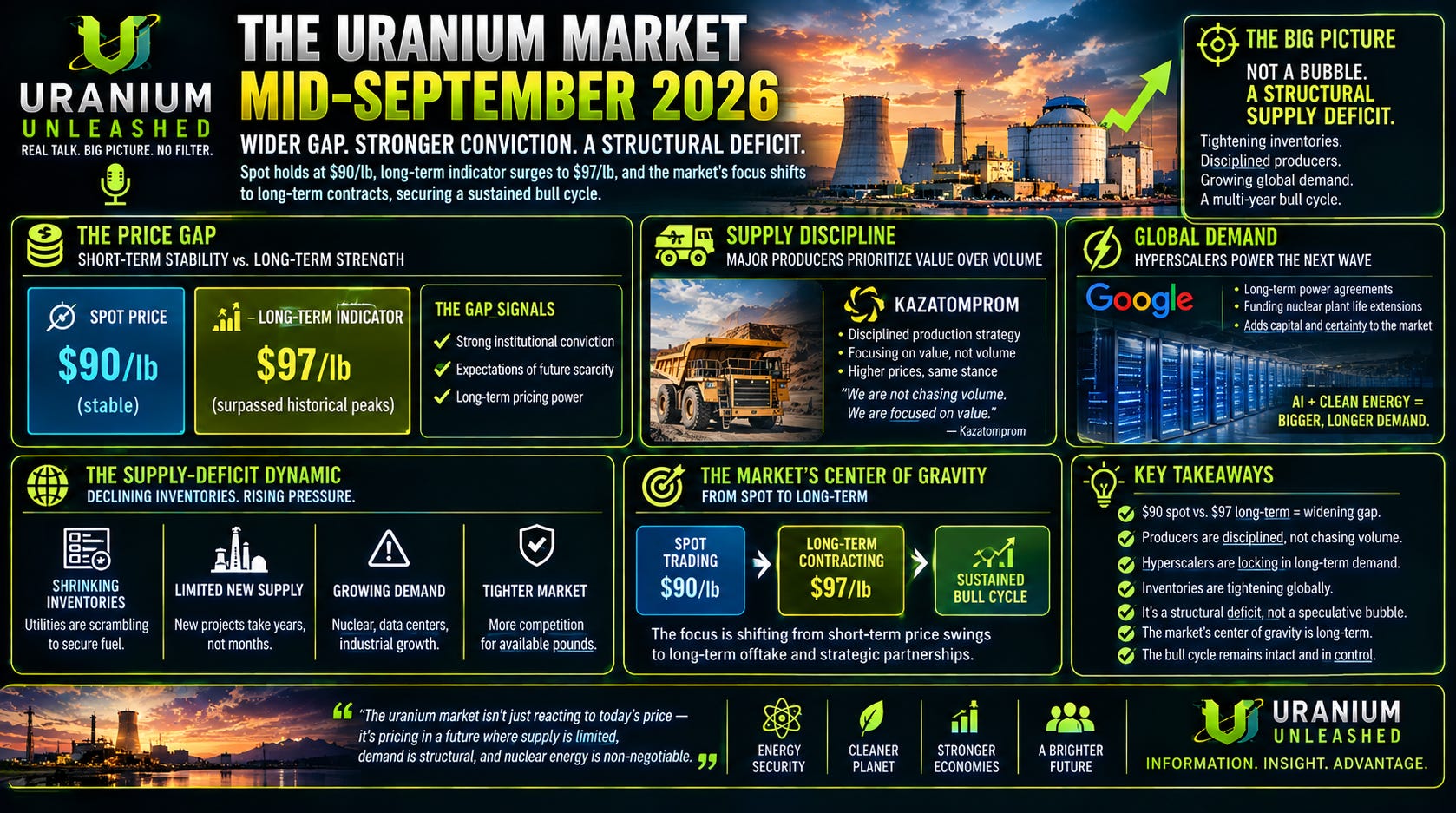
而现在,就在今天,你手里有现金,愿意以每磅90美元的价格竞标眼前这批材料。
And right now, today, you have the cash and you are willing to bid exactly $90 a pound for the material sitting right in front of you.
你可以提货,它归你所有,但然后你看向那些大型公用事业公司,你知道,那些高度受监管的实体,他们真正需要这种重金属来维持供电、医院运转,以及为数百万人提供城市电力。
You can take delivery, it's yours to hold but then you look over at the massive utility you know, the highly regulated entities who actually need this heavy metal to, keep the lights on, hospitals running and cities powered for millions of people.
真正的终端用户。
The actual end users.
终端用户。
The end users.
而他们今天正看着这个仓库。
And they are looking at the warehouse today.
他们直接绕过眼前的现货库存,急切地签署这些铁板钉钉、具有法律约束力的合同,锁定自己以每磅97美元的价格购买铀,而这些铀甚至要再过四五年才会从地下开采出来。
They are walking right past the immediate inventory, eagerly signing these ironclad legally binding contracts, locking themselves in to pay $97 a pound for uranium that won't even be pulled out of the ground for another four or five years.
这真的是一个非常显著的错位。
It's a it's a really remarkable dislocation.
我的意思是,它完全打破了传统的经济模型。
I mean, it completely fractures traditional economic modeling.
嗯,货币时间价值的基本逻辑。
Well, the fundamental logic of the time value of money.
它告诉我们,今天的钱比明天的钱更值钱。
It tells us that a dollar today is worth more than a dollar tomorrow.
当然。
Sure.
金融入门第一课。
Finance one zero one.
没错。
Exactly.
而且,今天手里有的实物商品,应该比五年后承诺交付的商品更有价值。
And a physical commodity in hand today should carry a premium over a promise of a commodity half a decade from now.
但我们在市场上看到的,却是这个原则被彻底颠覆了。
But what we are seeing on the tape is the outright inversion of that principle.
我看到任何未来价格远高于当前价格的市场时,我的直觉是,买家在表现出纯粹的恐慌。
My instinct when looking at any market where the future costs significantly more than the present is that while the buyers are signaling pure panic.
哦,当然。
Oh, absolutely.
因为你正在为假设的未来支付巨额溢价,而现在就在眼前,却处于折价状态。
Because you are paying a massive premium for the hypothetical future while the present is sitting right there at a discount.
如果我没理解错的话,这意味着全球市场对未来的单纯保证的估值,远高于当下的物理现实。
If I'm reading this correctly, it means the global market values the mere guarantee of future existence significantly more than the physical reality of the present moment.
你对这种焦虑的解读非常到位。
You are interpreting the anxiety perfectly.
我们观察到的结构性转变表明,我们已经从一个以库存充裕为特征的市场转变了。
The structural shift we're observing implies that we've we've moved from a market defined by inventory abundance.
在那个市场里,公用事业公司基本上可以把现货市场当作得来速窗口来用。
Where utilities could essentially treat the spot market like a drive through window.
没错。
Exactly.
转变成了一个结构性长期恐慌的状态。
To a state of structural long term panic.
这些公用事业公司的工程师和风险管理人员正在计算未来十年全球供需的数据。
The engineers and the risk managers at these utility companies are running the math on global supply and demand for the next decade.
而计算出来的结果并不乐观。
And the math isn't moltening.
他们普遍认为,每磅的价格不再是他们主要的风险因素。
They have universally decided that the price per pound is no longer their primary risk vector.
他们主要的风险因素是绝对的供应量。
Their primary risk vector is absolute availability.
哇。
Wow.
所以他们只需要磅数,就这么简单。
So they just need the pounds, period.
是的。
Yes.
他们意识到,如果现在不锁定97美元的材料,那么后果不是以后多付110美元那么简单。
They are realizing that if they don't lock in this material now at $97, the alternative isn't paying, you know, a $110 later.
另一种选择就是,不管出多少钱,这东西根本就不会存在。
The alternative is that simply will not exist at any price.
欢迎来到这次铀市场的深度解析。
Welcome to this deep dive into the uranium market.
如果你正在收听,不管你是为接下来一周的行情做准备,还是在关注全球能源转型,或者只是想弄明白正在重塑我们电网的宏观经济力量,那么这里就是我们把数据和现实对应起来的地方。
If you are joining us, whether you're prepping your portfolio for the week ahead, tracking global energy transitions, or just trying to understand the macroeconomic forces reshaping our power grid, well this is where we map the data to the reality.
很高兴来到这里。
Glad to be here.
今天我们专门来拆解《铀市爆发》第38期,内容覆盖2026年9月14日到18日这一关键周。
Today we are specifically unpacking Uranium Unleashed issue 38 covering the pivotal week of September 14 through the eighteenth, twenty twenty six.
这可不是对本周新闻的简单总结。
And this isn't just a standard summary of the week's news.
对,绝对不是。
No, definitely not.
我们是在对一个正在剧烈转型的市场做一次彻底的机械结构解剖。
We are doing a complete mechanical structural autopsy of a market that is violently in transition.
不。
No.
我们的议程严格以数据为先。
Our agenda is strictly data first.
本该如此。
As it should be.
我们将剖析最新的TradeTech定价指标,探讨全球最大生产商真正历史性的供应姿态转变,并研究超大规模科技资金——特别是谷歌的一项分水岭举措——如何激进地、永久性地改写核燃料的整个需求曲线。
We are going to dissect the latest TradeTech pricing metrics, explore a genuinely historic supply posture shift from the largest producer on earth and examine how hyperscaler tech money, specifically a watershed move by Google is aggressively, permanently rewriting the entire demand curve for nuclear fuel.
议程排得满满的。
It's a packed agenda.
确实如此。
It really is.
但我们必须先打好基础。
But we have to build the foundation first.
让我们看看数据。
Let's look at the tape.
数据才是这里的最终裁判。
The tape is the arbiter of truth here.
如果我们不把分析建立在日常交易数据上,接下来要讨论的那些宏观经济大叙事,听起来就很容易变成纯理论空谈。
If we don't ground our analysis in the day to day transaction data, the larger macroeconomic narratives we are about to discuss run the risk of sounding like, well, theoretical abstraction.
我们得避免这种情况。
You have to go and avoid that.
没错。
Exactly.
我们得从买卖双方在现货市场上实际成交的情况说起。
We have to start with what buyers and sellers are actually executing in the fiscal market.
那我们来看看截至2026年9月18日这一周的TradeTech周度指标。
So let's run through the TradeTech Weekly indicators for the week ending 09/18/2026.
关注现货市场的人应该知道,即期近期交割的价格目前是每磅90美元。
For those tracking the spot market, the price for immediate near term delivery, we are sitting at $90 per pound.
这个价格小幅上涨,比上周涨了25美分。
That's a modest move, up 25¢ week over week.
中期定价,一般覆盖两到三年内的交付,价格略高,为每磅91美元。
Midterm pricing, which generally covers deliveries in the two to three year window sits slightly higher at $91 per pound.
但长期指标,也是我们今天整个宏观讨论的绝对核心,价格高达每磅97美元,远远高于曲线上的其他部分。
But the long term indicator, and this is the absolute anchor of our entire macro discussion today is towering above the rest of the curve at $97 per pound.
要真正理解这些数字的分量,我们需要了解它们的走势背景。
And to really understand the weight of those numbers, we need to contextualize their momentum.
快照有帮助,但趋势才能说明问题。
A snapshot is helpful, but the trajectory tells the story.
没错。
Precisely.
我们来看看表现指标,了解这个趋势。
Let's look at the performance metrics to get that trajectory.
好的,那个SPOP价格90美元,虽然现在是盘面上最低的数字,但2026年年初至今仍上涨了9.8%。
Okay, that SPOP price of $90 even though it's the lowest number on the board right now, is still up 9.8% year to date in 2026.
这很健康。
Which is healthy.
确实。
Very.
如果我们回顾十二个月,同比上涨了20.8%。
And if we look back twelve months, it is up 20.8% year over year.
所以毫无疑问,整个资产类别表现非常出色。
So there is no denying that the asset class as a whole is performing incredibly well.
确实如此。
Not at all.
但关键指标,也就是资料中强调的那个,是整个盘面上最重要的分析数据点,那就是价差。
But the critical metric, the one that source material highlights is the single most analytically important data point on the board is the spread.
7美元的价差。
The $7 spread.
没错。
Exactly.
现货和期货之间存在每磅负7美元的价差。
We have a negative $7 per pound spread between spot and term.
现货价格出现了巨大的折价。
A massive gaping spot discount.
我们来分析一下这个价差,因为正确解读它确实是理解当前整个铀周期的关键。
Let's pull that spread apart because interpreting it correctly is honestly the key to understanding the entire Uranium cycle right now.
给我们讲讲吧。
Walk us through it.
在正常、平衡、平淡的大宗商品市场里,比如经济平稳期的铜,或者非收获季的农产品,现货和期货价格通常会保持相对紧密的联动。
In a normal, balanced, boring commodity market, think copper during a quiet economic stretch or, I don't know, agricultural products outside of harvest season, spot and term prices stay relatively tightly clustered.
它们会紧紧跟随彼此。
They hug each other.
如果突然出现意外的供应中断,造成暂时的供应紧张,你可能会看到现货价格略有溢价。
You might see spot trade at a slight premium if there is a sudden unexpected supply hiccup, creating a temporary squeeze.
没错。
Sure.
反过来,考虑到通胀、资金成本和多年期的实物储存成本,期货价格可能会略有溢价。
Conversely, you might see term trade at a very slight premium just to account for inflation, the cost capital, and the physical storage costs over a multiyear horizon.
有道理,这就是持有成本。
That makes sense, the cost of carry.
没错。
Exactly.
但出现7美元的价差,长期价格大幅领先现货价格。
But a $7 canyon where the long term price is drastically leading the immediate price.
这很奇怪。
That's weird.
确实非常奇怪。
It's extremely weird.
这是现货市场最直白、最无可辩驳的声明,表明机构聪明钱真正的信心所在。
That is the physical market's plainest, most undeniable statement about where institutional smart money conviction actually lives.
你知道,当我看到现货价格低于远期价格时,我的第一反应,我想任何交易过传统股票或大宗商品的人都会有同样的反应,就是当前现货需求一定非常疲软。
You know, when I see spot sitting below term, my natural instinct, and I suspect the instinct of anyone who has traded traditional equities or commodities, is that immediate present day demand must be terribly weak.
对,看起来像是今天缺乏兴趣。
Right, it looks like a lack of interest today.
对,看起来市场现在有点低迷,但可能在期待明天会更好。
Yeah, it looks like the market is sluggish right now but maybe hoping for a better tomorrow.
为什么这里期货价格才是真相的来源?
Why is term the source of truth here?
为什么我们不应该把90美元的现货价格看作拖累市场的看跌信号?
Why shouldn't we view a $90 spot price as a bearish signal dragging the market down?
这完全是个反直觉的局面,除非你明白谁在参与哪个市场。
It's an entirely counterintuitive setup until you understand who is participating in which market.
好,那你详细说说。
Okay, break that down.
期货市场是真相的揭示者,因为参与者的分量太重了。
The term market is the truth teller because of the sheer gravity of the participants.
铀的现货市场出了名的薄,流动性也相对差。
The spot market in uranium is notoriously thin and relatively illiquid.
这不像交易苹果股票那样。
It's not like trading Apple stock.
差远了。
Not even close.
你不会看到像原油那样,每天在公开交易所发生数百万英镑的大宗交易。
You aren't seeing massive multimillion pound transactions happening daily on a public exchange like you would with crude oil.
现货市场主要是金融玩家、寻找套利机会的交易商,以及持有可移动库存的实体。
The spot market is heavily populated by financial players, traders looking for arbitrage, and mobile inventory holders.
就是些倒卖英镑换现金的人。
Just people flipping pounds for cash.
基本上是这样。
Basically.
他们本质上就是那些为了快速获利而倒腾小批量材料的实体。
They are essentially entities moving small pockets of material around for immediate financial gain.
但长期市场,也就是每磅97美元的那个数字,完全是另一回事。
But the long term market, that $97 per pound figure, is an entirely different beast.
因为那是公用事业公司。
Because that's the utilities.
没错。
Exactly.
那个价格是由公用事业的燃料采购方决定的。
That price is dictated by utility fuel buyers.
这些人非常保守,厌恶风险,他们的职责是确保一座价值50亿美元的核反应堆不会停运。
These are the highly conservative, risk averse individuals responsible for ensuring that a $5,000,000,000 nuclear reactor does not go offline.
压力不小啊。
No pressure.
所以,当一家公用事业公司心甘情愿地签下2030年交付、每磅97美元的双边合同时,他们不是在投机。
So when a utility willingly signs a bilateral contract at $97 delivery in 2030, they aren't speculating.
他们是在锁定现实。
They're locking in reality.
他们在向整个供应链大声宣告:他们已经精心建模了未来,并且他们确信,低于97美元的价格,市场上不会有足够的实物供应来满足他们的基本负荷电力需求。
They are screaming to the rest of the supply chain that they have meticulously modeled the future, and they do not believe enough physical supply will exist to satisfy their baseload power needs at anything less than $97.
我们深入聊聊这笔交易的机制吧,因为我对这个价差的商业逻辑还是有点不太理解。
Let's dive deeper into the mechanics of that transaction because I still struggle a bit with the business logic of this spread.
这需要花点时间才能理解。
It takes a minute to wrap your head around.
确实如此。
It really does.
因为在几乎所有其他重工业中,量大和长期承诺通常能换来折扣。
Because in almost any other heavy industry, volume and commitment command a discount.
通常是这样。
Usually.
对。
Yes.
如果一家航空公司承诺五年内购买一千台喷气发动机,波音不会向他们收取溢价。
If an airline commits to buying a thousand jet engines over five years, Boeing doesn't charge them a premium.
波音会给他们一个巨大的批发折扣,因为未来的收入有保障,降低了制造商的风险。
They give them a massive wholesale discount because guaranteed future revenue lowers the manufacturer's risk.
就是批量折扣。
The bulk discount.
但在铀市场上,现在买家们纷纷加价,甚至愿意支付高额溢价,只为了确保产品能被开采出来。
But in uranium right now, buyers are stepping up and paying a heavy premium just to guarantee the product will simply be mined.
在开始录音之前,我提到了一个灭火器的比喻。
I mentioned a fire extinguisher analogy before we started recording.
这就像走进五金店,为了预订一个明年的灭火器,你愿意付双倍标价,仅仅是因为你已经闻到地下室传来烟味。
It feels like walking into a hardware store and paying double the list price to reserve a fire extinguisher for next year simply because you already smell smoke coming from your basement.
我很喜欢这个比喻,但我觉得我们需要把它延伸得更远,才能真实反映现在的情况。
I love that analogy, but I think we need to extend it even further to capture what's really happening.
好的。
Okay.
怎么说?
How so?
你不仅仅是在为灭火器里的加压化学物质付钱。
You aren't just paying for the pressurized chemicals in the extinguisher.
你是在为一种绝对的、铁板钉钉的确定性付钱,那就是当火焰一出现,灭火器就已经稳稳地挂在你的墙上了。
You are paying for the absolute ironclad certainty that the extinguisher will physically be mounted on your wall the moment the flames become visible.
哇。
Wow.
好的。
Okay.
在当前市场行情下,那个90美元的现货价格并不是天花板。
In the context of the current market tape, that $90 spot price is not acting as a ceiling.
它不是技术阻力位。
It is not technical resistance.
那它是什么?
Then what is it?
它只是当前临时库存持有者愿意出售材料的价格,比如一个三年前以40美元买入实物铀、现在想套现的对冲基金,他们持有这些材料并没有实际用途。
It is merely the clearing price at which current temporary inventory holders, perhaps a hedge fund that bought physical pounds three years ago at $40 and is looking to harvest their gains, are willing to part with material they have no operational use for.
他们没有反应堆。
Where they don't have a reactor.
没错。
Exactly.
他们没有反应堆需要供电,他们只需要管理资产负债表。
They don't have a reactor to power, they just have a balance sheet to manage.
所以90美元的现货价格并不是铀生产成本的反映,它只是不耐烦的价格,是那些今天想退出交易的人的清算价格。
So the $90 spot price isn't a reflection of what it costs to produce uranium, it's simply the price of impatience, it's the liquidation price for someone who wants to exit the trade today.
这完美地捕捉了这种动态。
That captures the dynamic perfectly.
这就是即时流动性的成本。
It is the cost of immediate liquidity.
但公用事业公司不能玩这种游戏。
But the utilities can't play that game.
对,他们不能。
No, they can't.
法国、日本、美国的公用事业公司,他们不能把燃料采购策略建立在那些不耐烦的对冲基金之上。
The utility companies in France, in Japan, in The United States, they cannot build their fuel procurement strategies around impatient hedge funds.
一个反应堆在十八到二十四个月的周期内,会消耗掉一个特定的、数学上固定的燃料量。
A reactor burns through a specific mathematically fixed amount of fuel over an eighteen to twenty four month cycle.
这台机器可不会心慈手软。
It's an unforgiving machine.
确实如此。
Truly.
要保证2030年的燃料供应,他们必须从初级生产商,也就是矿业公司那里购买。
To guarantee fuel for 2030, they have to buy from the primary producers, the mining companies.
他们必须激励真正从地壳中开采新的重金属。
They have to incentivize actual new heavy metal extraction from the Earth's crust.
而矿商们可不会便宜行事。
And the miners aren't doing it for cheap.
绝对不会。
Definitely not.
矿商们坐在谈判桌对面,盘算着不断上升的资本成本、飙升的劳动力成本,以及钢铁和硫酸供应链的爆炸性通胀,他们直截了当地说,如果每磅价格低于97美元,我们连许可审批和开凿新矿井这个多年过程都不会启动。
The miners are sitting across the negotiating table, calculating their rising cost of capital, their soaring labor cost, their explosive supply chain inflation for steel and sulfuric acid, and they are stating plainly, we will not even begin the multiyear process of permitting and sinking a new shaft for anything less than $97 a pound.
而公用事业公司呢。
And the utilities.
公用事业公司不但没有走开,反而掏出笔来问在哪里签字。
Rather than walking away, the utilities are pulling out their pens and asking where to sign.
公用事业公司愿意在这个价位签约,这直接把我们带入了今天要探讨的第一个宏观经济大主题。
That willingness of utilities to sign at that level transitions us directly into the first major macroeconomic narrative we need to explore today.
历史背景。
The historical context.
没错。
Exactly.
因为原始材料花了大量篇幅剖析97美元这个数字的历史分量。
Because the source material spends a massive amount of time dissecting the historical weight of that $97 number.
为什么这个特定的长期价格本周会在机构投资者中引起如此巨大的震动?
Why is this specific long term price sending such absolute shockwaves through the institutional investor base this week?
它引起震动,是因为它刚刚打破了近二十年来笼罩在这个行业头上的心理和历史天花板。
Well, it's sending shockwaves because it has just shattered a psychological and historical ceiling that has loomed over this industry for nearly two decades.
2007年的峰值。
The 2007 peak.
是的。
Yes.
一旦突破每磅97美元,TradeTech长期合同价格指标就正式在名义上超过了长期合同的此前历史最高点。
By crossing into $97 per pound, the TradeTech long term contract price indicator has officially nominally eclipsed the previous all time high for long term contracts.
如果你看历史图表,之前的长期合同价格上限是每磅95美元,那是在传奇的混乱牛市周期中创下的,从2007年5月到2008年3月一直保持为绝对高点。
If you look at the historical charts, that previous long term ceiling was $95 per pound, established all the way back during the legendary chaotic bull market cycle, and it held as the absolute top from May 2007 through March 2008.
我们正式突破了2007年的长期合同峰值。
We have officially broken the back of the 2007 term peak.
本周的数据显示,在9月10日,也就是世界核研讨会召开之前,我们报出了每磅96.50美元的价格。
The data from the week shows that we posted $96.50 on September 10 heading into the World Nuclear Symposium.
而且这还没完。
And it didn't stop there.
对。
No.
随着研讨会结束,公用事业买家回到办公桌前,价格并没有回落。
As the symposium wrapped up and utility buyers returned to their desks, the price didn't soften.
价格继续上涨,到周末突破了97美元,并且稳稳守住了这个价位。
It pushed upward, crossing into $97 by the week's end, and it firmly held that ground.
这太不可思议了。
That's incredible.
而且还有更好的消息。
And it gets better.
消息来源透露,在研讨会现场,有生产商级别的传闻,明确提到目前正在进行的双边合同谈判,价格已经超过每磅100美元,交付时间一直延续到2030年。
The source material highlights incredibly producer level anecdotes leaking from the symposium floor explicitly referencing active ongoing bilateral contract negotiations happening right now at prices above $100 per pound for delivery windows stretching through 2030.
好吧,如果你交易铀股票已经有一段时间,或者你熟悉上一个大宗商品超级周期的传说,你现在可能正对着扬声器大喊大叫。
Okay, if you've been trading uranium equities for a while or if you are familiar with the lore of the last commodity super cycle, you are probably yelling at your speakers right now.
哦,我敢肯定他们会的。
Oh, I'm sure they are.
因为任何经历过2007年市场的人都知道,铀的价格远不止95美元。
Because anyone who lived through the 2007 market knows that the price of uranium went significantly higher than $95
他们记得的是现货价格的飙升。
They're remembering the spot spike.
没错。
Exactly.
我们得把现货市场和长期合同市场的区别讲得非常清楚,因为把这两者混为一谈,就会完全误判我们目前所处的周期阶段。
We have to make the distinction between the spot market and the term market incredibly clear here because conflating the two leads to a complete misdiagnosis of where we are in the current cycle.
我们绝对得给2007年的对比加上一个大大的星号。
We absolutely must put a massive asterisk next to the 2007 comparisons.
我想提醒所有分析这个市场的人。
I want to warn anyone analyzing this market.
你不能把今天97美元的长期结构性高点,和2007年那个臭名昭著的、飙到每磅大约137美元的现货峰值混为一谈。
You cannot confuse today's $97 long term structural peak with the 2007 spot peak, which notoriously blew out to roughly a $137 per pound.
差别巨大。
Huge difference.
我们说的是两种完全不同的定价机制,它们是在截然不同的心理和物理环境下运作的。
We are talking about two entirely different pricing mechanisms operating under wildly different psychological and physical circumstances.
那我们来把2007年的市场机制和今天的做个对比吧。
Well let's break the mechanics of 2007 down compared to today.
当时到底是什么把价格推到了137美元,而今天的97美元为什么在结构上要扎实得多?
What actually drove the price to $137 back then and why is today's $97 a vastly more structurally sound number?
好的,2007年现货价格飙到137美元,纯粹是金融投机和局部供应冲击撞在一起的结果。
Okay so the 2007 spot spike to a $137 was the result of pure unadulterated financial speculation colliding with a localized supply shock.
就是Cigar Lake矿的洪水。
The Cigar Lake flood.
对。
Yes.
加拿大那个大型Cigar Lake矿发生了灾难性的洪水,这个矿原本预计供应全球铀的很大一部分。
The catastrophic flooding event at the massive Cigar Lake mine in Canada, which was expected to supply a huge portion of the world's uranium.
当水涌进那个矿时,市场就恐慌了。
When the water rushed into that mine, the market panicked.
这完全可以理解。
Understandably so.
交易员、对冲基金和激进的投机者涌入了流动性很差的现货市场,疯狂抢购市面上流通的实物铀,在恐慌中拼命推高价格,想抢在短缺之前下手。
Traders, hedge funds, and aggressive speculators flooded into the thinly traded spot market, wildly bidding up whatever physical pounds were floating around in a panic frenzy to front run the perceived shortage.
所以那是交易员的疯狂行为?
So it was a trader frenzy?
完全是。
Entirely.
但如果我们深入研究历史合同数据,会发现一个关键事实,它定义了那个时代。
But if we dig into the historical contracting data, we find a critical fact that defines that entire era.
长期合同市场完全拒绝跟随现货市场涨到137美元。
The long term contract market flatly refused to follow the spot market to a $137.
公用事业燃料买家看着交易场上的混乱,实际上退出了。
The utility fuel buyers looked at the chaos on the trading floor and effectively stepped away.
他们没有参与这场恐慌。
They didn't buy into the panic.
他们退出是因为他们有替代选择。
They stepped away because they had alternatives.
哦,对。
Oh, right.
二级供应。
The secondary supply.
是的。
Yes.
公用事业买家分析了137美元的现货价格,意识到这只是交易者制造的假象,与实际长期生产成本完全脱节。
The utility buyers analyzed that $137 spot price and recognized it as a trader driven illusion, completely untethered from the actual long term cost of production.
他们知道自己有大量的二级供应可以依赖,主要是“兆吨换兆瓦”计划。
They knew they had massive secondary supplies to rely on primarily the megatons to megawatts program.
把俄罗斯核弹头稀释成商用反应堆燃料。
Down blending Russian nuclear warheads into commercial reactor fuel.
没错。
Exactly.
因为有这个缓冲,他们基本上采取了买家罢工的策略。
Because they had that buffer, they essentially went on a buyer's strike.
他们说,我们不会让我们的费率支付者锁定在137美元的五年合同上。
They said, we are not locking our rate payers into five year contracts at $137.
所以期货市场在95美元处碰壁了。
So the term market hit a brick wall at $95.
然后泡沫就破了。
And then the bubble burst.
确实。
It did.
公用事业公司耗过了投机者。
The utilities waited out the speculators.
二次供应保证了反应堆继续运行,最终现货市场的投机资金耗尽,价格猛烈回落到现实。
The secondary supply kept the reactors running, and eventually, the spot market ran out of speculative cash and collapsed violently back down to reality.
所以2007年的动态基本上是现货市场拼命想把期货市场往上拉,把期货价格推到95美元,然后公用事业买家坚决不买账,让价格自然回落。
So the dynamic in 2007 was essentially the spot market desperately trying to drag the term market upward, getting the term price to $95 before the utility buyers dug their heels in and let gravity take over.
现货拉动期货。
Spot leaning term.
但如果我们看2026年9月14日那周的数据,机制完全反过来了,这一点无可否认。
But if we look at the data for the week of 09/14/2026, the mechanics are totally undeniably inverted.
这种倒挂就是整个论点的核心。
The inversion is the entire thesis.
现在,期货是引擎,现货是尾巴。
Today, term is the engine, and spot is the caboose.
我喜欢这个说法。
I like that framing.
期货价格在97美元,受基本公用事业需求推动,而现货在90美元,落后了。
The term price is forging ahead at $97 driven by fundamental utility demand, while spot is dragging behind at $90.
目前的价格走势完全没有华尔街投机者玩弄移动库存的影子。
The current price action is utterly devoid of Wall Street speculators playing games with mobile inventory.
这是现实世界的物理规律。
This is real world physics.
这是合同驱动的现实。
This is contract driven reality.
期货价格每上涨一美元,都代表着公用事业燃料采购层面一场艰难而精打细算的价格谈判。
Every single dollar of upward movement in that term, price, represents a grueling, highly calculated price negotiation at the utility fuel buyer level.
这反映的是经过大量研究和建模的全球能源动态前瞻视角,完全剔除了投机泡沫。
It reflects a heavily researched, highly modeled forward view of global energy dynamics, stripped of all speculative froth.
我们来总结一下。
Let's synthesize this.
如果2007年的周期是投机性的糖分爆发,由日内交易者应对矿场泛滥而推动,那么2026年的周期看起来像是结构性的蛋白质饮食,由电厂自身不可动摇的数学消耗所驱动。
If the 2007 cycle was a speculative sugar rush fueled by day traders reacting to a flooded mine, the 2026 cycle looks like a structural protein diet driven by the unyielding mathematical consumption of the power plants themselves.
蛋白质饮食。
Protein diet.
这个比喻很贴切。
That's a great way to put it.
谢谢。
Thanks.
但看起来我们不再定价暂时的泛滥了。
But it seems like we aren't pricing in a temporary flood anymore.
我们似乎在定价一个永久的范式转变。
We seem to be pricing in a permanent paradigm shift.
你说到了这十年最核心的矛盾点。
You are hitting on the core friction of the decade.
这种倒挂的价差,加上远期价格已经超过了2007年的历史高点,是整个周期里实物市场给出的最清晰、最无可辩驳的结构性信号。
This inverted spread with turn leading above the historical 2,007 high is the cleanest, most unassailable structural signal the physical market has produced in this entire cycle.
因为电力公司终于松口了。
Because utilities are finally giving in.
他们彻底投降了。
They are capitulating.
他们签下这些97美元的合同,是因为他们已经把未来十到十五年的全球供应量算得清清楚楚。
They're signing these $97 contracts because they have run the math on the global supply base for the next ten to fifteen years.
他们不再指望那些稀释过的弹头了。
They are no longer relying on down blended warheads.
那个项目早就没了。
That program is long gone.
早就没了。
Long gone.
他们在看主要的采矿管道,然后意识到那些磅根本不存在,无法满足他们的需求。
They are looking at the primary mining pipeline, and they realize the pounds simply do not exist to meet their requirements.
长期价格高于2007年峰值,是市场正式合法地承认,廉价、丰富、大量补贴的铀时代已经永久结束。
A long term print above the 2,007 peak is the market formally legally recognizing that the era of cheap, abundant, heavily subsidized uranium is permanently over.
要真正理解为什么这些公用事业买家抛弃了历史性的保守态度,以创纪录的价格抢签长期合同,我们必须换个角度,审视供应端。
To truly grasp why these utility buyers are shedding their historical conservatism and rushing into long term contracts at record prices, we have to flip the equation and examine the supply side.
我们必须看向东方。
We have to look east.
对。
Exactly.
因为这个价差的计算只有在供应端完全崩溃或根本改变的情况下才有意义。
Because the math of this spread only makes sense if the supply side is completely broken or fundamentally altered.
这意味着我们必须看看哈萨克斯坦。
Which means we have to look at Kazakhstan.
我们必须谈谈Kazatomprom。
We have to talk about Kazatomprom.
任何想建模铀市场的人,如果对Kazatomprom没有深入细致的了解,那就像蒙着眼睛飞行一样。
Anyone attempting to model the uranium market without a deep nuanced understanding of Kazatomprom is flying blind.
他们就是那个巨头。
They are the whale.
他们是哈萨克斯坦的国家国有运营商,采用高效的原位回收(ISR)采矿方法。
They are the national state owned operator of Kazakhstan, utilizing highly efficient in situ recovery or ISR mining methods.
就是把溶液注入地下,然后把铀抽上来。
Just pumping solution into the ground and pulling up uranium.
基本上就是这样。
Basically, yes.
而且由于他们的地质条件和规模,他们以惊人的优势,成为地球上最大的单一铀供应商。
And because of their geology and scale, they are by a breathtakingly wide margin, the largest single supplier of uranium on Earth.
他们就是市场的全球恒温器,既能通过大量廉价供应把竞争对手冻死,也能通过削减产量让市场过热。
They are the global thermostat for the market capable of freezing out competitors with a flood of cheap supply or overheating the market by throttling back production.
这周我们收到的关于Kazatomprom运营状况的数据,真是令人震惊。
And the data we received regarding Kazatomprom's operational posture this week is staggering.
消息来源的核心要点是,他们正式确立了一种完全不受价格影响的供应策略。
The headline from the source material is that they have formally codified a strictly price insensitive supply posture.
这可是一个巨大的转变。
Which is a massive pivot.
我们来看看他们具体是怎么操作的。
Let's look at the mechanisms of how they are doing this.
首先从他们的地下资源使用协议说起。
It starts with their Subsoil Use Agreements.
对,就是那个SUA协议。
Right, the S U A's.
这些协议本质上是国家规定的法律框架,决定了他们各个矿田允许的最大生产配额。
These are essentially the state mandated legal frameworks that dictate the maximum production quotas allowed for their various well fields.
Kazatomprom宣布,他们的名义生产上限已经被大幅削减。
Kazatomprom announced that their nominal production ceiling has been aggressively slashed.
而且我们手上有具体的数据。
And we have the numbers on that.
是的,我们有。
We do.
他们把上限从32,777吨铀(tU)降到了29,697吨铀(tU)。
They took the ceiling down from 32,777 tons of uranium or tU down to 29,697 tUm.
你得把这些吨数换算成磅,才能真正理解刚刚消失的规模有多大。
You need to convert those tons into pounds to really help conceptualize the scale of what just vanished.
是的,我们有。
We do.
从大约32,700吨降到29,700吨,这相当于他们的绝对理论最大产能减少了约10%。
A cut from roughly 32,700 to 29,700 tU is approximately a 10% reduction in their absolute theoretical maximum capacity.
换算成磅,这一笔行政命令就抹掉了大约800万磅的理论全球供应量。
In pounds, that wipes out roughly 8,000,000 pounds of theoretical global supply with a single administrative stroke of a pen.
800万磅。
8,000,000 pounds.
就这么没了。
Just gone.
就这么从预测里消失了。
Just gone from the projections.
把800万磅放到具体情境里看,这足以给好几座大型核反应堆提供燃料,为几百万户家庭提供一整年的基础电力。
To put 8,000,000 pounds in perspective, that is enough fuel to power several massive nuclear reactors, providing baseload electricity for millions of homes for an entire year.
哇。
Wow.
而且就这么从理论模型里消失了。
And it's just vanished from the theoretical model.
但名义上限只是法定限额。
But the nominal ceiling is just the legal limit.
2026年的实际机械生产指导值,比那个刚下调的上限还要低得多。
The actual mechanical production guidance for 2026 is significantly lower than even that newly reduced ceiling.
低得多。
Much lower.
他们引导市场预期,实际产量只有27,500到29,000吨铀,这是基于他们所有业务的100%基准。
They are guiding the market to expect actual production of only 27,500 to 29,000 tU on a 100% basis across all their operations.
当我们看他们应占的份额,也就是哈萨克斯坦原子能公司实际开采、拥有并自己销售的那部分铀。
And when we look at their attributable share, meaning the specific portion of that mined uranium that Kazatomprom actually keeps owns and sells themselves.
把合资企业的那部分剔除掉。
Stripping out the joint ventures.
把法国、俄罗斯和中国合资伙伴占的那一大块剔除后,他们的份额就只剩下区区14500到15500吨铀了。
Stripping out the massive portions owed to their various joint venture partners from France, Russia, and China, their share drops to a mere 14,500 to 15,500 tU.
我们现在看到的是那句让电力买家头疼了好几年的口号变成了现实——重价值,轻产量。
We're witnessing the operationalizing of a phrase that has haunted utility buyers for a couple of years now, value over volume.
重价值,轻产量。
Value over volume.
很长一段时间里,西方的分析师、基金经理和电力公司高管都拼命希望这句话只是营销噱头。
For a very long time, Western analysts, portfolio managers, and utility executives desperately hoped this phrase was just marketing spin.
他们以为对方在虚张声势。
They thought they were bluffing.
没错。
Exactly.
他们看着国有资源垄断企业的历史,心想,Kazatomprom 只是在说大话,好支撑价格。
They looked at the history of state owned resource monopolies and thought, Kazatomprom is just talking a big game to support the price.
但一旦现货市场达到90或100美元,他们肯定忍不住。
But the second the spot market hits 90 or $100, they won't be able to resist.
他们会打开闸门,用便宜的ISR磅淹没市场,抢占大量市场份额,然后把价格打回50美元。
They will open the spigots, flood the market with cheap ISR pounds, capture massive market share, and crash the price back down to $50
这是传统的套路。
Which is the traditional playbook.
经济学入门课告诉我们,当你的商品利润率创历史新高时,你就该全天候运转机器。
Economics 101 dictates that when your commodity hits a record high margin, you run the machines twenty four hours a day, seven days a week.
当然。
Of course.
尽可能多地开采材料,以最大化即时收入。
You extract as much material as humanly possible to maximize immediate revenue.
但本周的数据明确证明,他们完全摒弃了那套打法。
But what this week's data unequivocally proves is that they are rejecting that playbook entirely.
完全抛弃了那套做法。
Completely throwing it out.
重价值轻产量不是一句口号。
Value over volume is not a slogan.
这是一种正式的、坚定的、不受价格影响的供应姿态。
It is a formalized, hardened, price insensitive supply posture.
他们明确地向全世界传达了一个信息。
They are explicitly broadcasting to the world.
无论现货价格多高,我们都不会把额外的产量重新带回市场。
No spot price will tempt us to bring incremental pounds back to the market.
公用事业公司明天可以出价每磅150美元。
A utility could bid $150 a pound tomorrow.
而哈萨克斯坦原子能公司表示,他们不会为了追逐这个价格而随意增加井口开发。
And Kazatomprom is stating they will not arbitrarily increase their wellhead development to chase it.
这是长期市场纪律的典范,从根本上改变了全球成本曲线。
It is a masterclass in long term market discipline, and it fundamentally alters the global cost curve.
想想这种行为带来的巨大宏观影响。
Think about the massive macro implication of this behavior.
给我们讲讲。
Walk us through it.
全球成本曲线的绝对底部,世界上最便宜、最容易开采的丰富铀资源,位于哈萨克草原。
The absolute floor of the global cost curve, the cheapest, most easily extractable abundant uranium in the world is located in the Kazakh Steppes.
历史上,当低成本生产商像臃肿的国家实体一样,试图最大化就业和即时现金流时,他们会压垮其他所有人的利润空间。
Historically, when the low cost producer acts like a bloated state entity trying to maximize employment and immediate cash flow, they crush the margins of everyone else.
他们把所有人都赶出市场。
They drive everyone out of business.
但现在,低成本生产商表现得像一家高度自律、追求利润最大化的私营企业。
But right now, the low cost producer is behaving like a highly disciplined, private profit maximizing corporation.
他们故意让市场供应紧张,以永久抬高价格底线。
They are intentionally starving the market to permanently elevate the price floor.
我看到这个,就在想,这对他们自己的主权财富基金也有影响。
I am looking at this and thinking you have the implications for their own sovereign wealth.
展开剩余字幕(还有 356 条)
他们把实际生产指引定得比新降低的法定上限还要低,这就证明这不仅仅是他们努力想解决的技术供应链问题。
By setting their actual production guidance safely below their newly reduced legal ceiling, they are proving that this isn't just a technical supply chain constraint they are struggling to fix.
对,不只是硫酸短缺的问题。
Right, it's not just the sulfuric acid shortage.
没错。
Exactly.
是的,他们在采购硫酸方面确实有记录在案的问题,硫酸对他们的原地浸出采矿工艺至关重要。
Yes, they have had well documented issues procuring sulfuric acid, which is vital for their ISR mining process.
但这份指引暗示了更多刻意的意图。
But the guidance implies something much more deliberate.
这是他们主动选择采取的立场,他们掌握着关键资源,却选择让整个市场干着急。
This is a posture they are actively choosing to defend, They hold the keys to the kingdom and they are choosing to let the kingdom sweat.
你从哈萨克斯坦原子能公司的数据中提炼出了最关键的要点。
You've isolated the most critical takeaway from the Kazatomprom data.
一个主权实体为什么要迅速耗尽自己有限的国有资产,也就是实体铀储备,就为了立刻压低自己主要资产的全球价格呢?
Why would a sovereign entity rapidly deplete its finite national wealth, its physical uranium reserves just to immediately crash the global price of its own primary asset.
这在数学上根本说不通。
It makes no mathematical sense.
完全说不通。
None.
通过人为限制产量,他们可以把储备的寿命延长几十年,同时每磅的收益还能成倍增长。
By artificially constraining their output, they extend the life of their reserves by decades while simultaneously generating exponentially more revenue per pound.
当这个主导玩家这么做的时候,全球供应链的其他部分会发生什么?
And what happens to the rest of the global supply chain when the dominant player acts this way?
如果我是北美某个矿业公司的CEO,这份数据读起来就像是一份绝对的运营自由宣言。
If I'm a mining CEO in North America, this data must read like a declaration of absolute operational freedom.
哦,这绝对让所有西方开发者的经济可行性大大提高了。
Oh, it absolutely widens the economic viability for every western developer on the board.
过去十年,加拿大阿萨巴斯卡盆地、美国西部和澳大利亚的初级矿商和开发商都陷入了瘫痪。
For the last decade, junior miners and developers in the Athabasca Basin, in Canada, in the Western United States, and in Australia have been paralyzed.
因为他们拿不到资金。
Because they couldn't get funding.
没错。
Exactly.
他们拿不到建设复杂深层地下硬岩矿所需的数十亿美元,因为金融家们担心Kazatomprom会突然向市场大量供应铀,导致西方新项目破产。
They couldn't secure the billions of dollars needed to build complex, deep underground hard rock mines because financiers were terrified that Kazatomprom would suddenly flood the market and bankrupt the new western projects.
达摩克利斯之剑。
The sword of Damocles.
但随着Kazatomprom正式捍卫高价格底线,那种生存恐惧就消失了。
But with Kazatomprom formally defending a high price floor, that existential fear evaporates.
这让开发商有信心投入巨额资金,因为他们知道全球最大的玩家不会在他们数十年的投资上釜底抽薪。
It gives developers the confidence to spend massive capital, knowing the largest player in the world isn't gonna pull the rug out from under their multi decade investments.
如果这就是供应侧的严峻现实——对全球最便宜的铀进行刻意、精算的紧缩——那我们就得看看需求侧发生了什么,才能理解这7美元的价差为何如此剧烈。
If that is the hardened reality of the supply side, a deliberate calculated constriction of the cheapest pounds on earth, then we have to look at what is happening on the demand side to understand why this $7 spread is so violent.
这就是事情变得疯狂的地方。
This is where it gets crazy.
Kazatomprom的供应纪律与九月份形成的两大需求催化剂正面相撞。
The timing of Kazatomprom's supply discipline is colliding head on with two massive tectonic demand catalysts that crystallized in September.
说实话,这个时机真是让人震惊。
The timing is, quite frankly, staggering.
我们看到全球铀市场正被从两边同时夹紧。
We are watching a vice grip tighten on the global uranium market from both sides simultaneously.
低成本供应商在历史性和新兴需求来源同时涌现的时候退了一步。
The low cost supplier is stepping back at the exact moment historical and novel demand sources are stepping forward.
我们先从历史需求基础说起。
Let's start with historical demand base.
世界核研讨会于9月11日在伦敦闭幕。
The World Nuclear Symposium wrapped up in London on September 11.
WNS。
The WNS.
我们看到公用事业买家从传统的夏季淡季回归,直接进入一个完全改变的合同环境。
We are seeing utility buyers returning from their traditional summer lull walking straight into a completely transformed contracting environment.
生产商在97.7这个价位上坚持严格、不妥协的定价纪律。
The producers are holding strict, unyielding pricing discipline at that 97.7 level.
而且现在公用事业公司非常脆弱。
And the utilities are incredibly vulnerable right now.
给他们看看数据。
Show them the numbers.
数据显示,2025年全球公用事业公司签了大约1.16亿磅铀的长期合同。
The source data shows that globally, utilities placed roughly 116,000,000 pounds of uranium under long term contracts in 2025.
这个数字,1.16亿磅,对不了解的人来说可能听起来很大,但我们要把它和全球消费量放在一起看。
That number, pounds 116,000,000 might sound massive to a late person, but we have to contextualize it against global consumption.
对公用事业公司的风险管理人员来说,这是个吓人的数字。
It is a terrifying number for utility risk managers.
因为低于补充率。
Because it's below replacement rate.
远远低于。
Significantly below.
解释一下补充率的机制。
Explain the mechanics of that replacement rate.
如果公用事业公司达不到那个门槛,会发生什么?
What happens when a utility fails to meet that threshold?
核反应堆是一台无情的、由数学驱动的机器。
A nuclear reactor is a relentless, math driven machine.
它在运行周期内会消耗固定量的铀-235。
It consumes a fixed amount of U-two 35 over its operating cycle.
全球的核反应堆群每年大约要烧掉1.7亿到1.8亿磅的铀。
Globally, the fleet of reactors burns through roughly a 170 to 180,000,000 pounds of uranium every single year.
好的。
Okay.
所以消耗量是1.7亿到1.8亿磅。
So a 170 to a 180,000,000 consumed.
是的。
Yes.
所以如果公用事业公司只签了1.16亿磅的合同来替换,那他们就是在以巨大的结构性赤字运营。
So if the utilities are only signing contracts to replace a 116,000,000 pounds, they are operating at a massive structural deficit.
他们烧的燃料比买的还多。
They are burning more fuel than they are buying.
那多出来的燃料是从哪儿来的?
Where does the extra fuel come from then?
为了维持反应堆运转,他们不得不动用自家的战略储备和库存。
To keep the reactors running, they are being forced to cannibalize their own strategic stockpiles and inventories.
这种合同不足的情况,已经不再是智库表格上的理论推演了。
The under contracting arithmetic is no longer a theoretical projection on a think tank spreadsheet.
这是实实在在的实时赤字。
It is a harsh real time running deficit.
哇。
Wow.
每过一天,如果公用事业公司没有签下新的、足够的长期合同,他们的未来库存就会越来越接近红线。
Every single day that passes without a utility securing new, sufficient long term volume, their future inventory drops closer and closer to the red line.
也就是说,他们的紧迫感一天比一天强。
Which means their desperation increases by the day.
而坐在谈判桌对面的矿业生产商,完全清楚这个数学上的必然结果。
And the mining producers sitting across the table are fully aware of this mathematical inevitability.
他们掌握着所有的主动权。
They have all the leverage.
但传统公用事业公司面临的压力已经够大了,这次研讨会上却爆出了一个全新的需求冲击。
But as if the traditional utilities didn't have enough pressure on them, the symposium was rocked by a completely novel demand shock.
这就引出了本周最重磅的消息,一个从根本上改写核能需求长期格局的故事。
This brings us to the absolute bombshell of the week, the story that is fundamentally rewriting the entire long term narrative of nuclear energy demand.
9月9日,谷歌与芬兰公用事业公司富腾签署了一份22项购电协议,也就是PPA,购买洛维萨核电站的电力输出。
On September 9, Google and the Finnish utility company Fortum executed a 22 power purchase agreement, or PPA, for the output of the Loviisa nuclear plant.
我们得停下来,认识到这是全球能源市场一个划时代的、具有里程碑意义的事件。
We need to pause and recognize this as a paradigm shifting, epic defining event for global energy markets.
就是那么重要。
It's that big.
确实如此。
It is.
多年来,铀行业一直在没完没了地谈论科技公司利用核电的可能性。
For years, the Uranium has talked endlessly about the potential of tech companies utilizing nuclear power.
但那些讨论几乎全都集中在小型模块化反应堆,也就是SMR上。
But that conversation was almost exclusively focused on small modular reactors or SMRs.
就是下一代的技术。
The next generation stuff.
没错。
Exactly.
理论上的微型反应堆,科技公司可能会在2030年代帮助将其商业化,来支撑他们的人工智能野心。
Theoretical miniature reactors that tech companies might help commercialize in the twenty thirties to power their artificial intelligence ambitions.
在芬兰发生的事情完全不同。
What happened in Finland is completely different.
这不是一份关于未来技术的理论白皮书。
This is not a theoretical white paper on future technology.
这是庞大的科技资本与现有基荷核电现实之间的猛烈碰撞。
This is massive tech capital violently colliding with existing baseload nuclear reality.
我们来仔细拆解一下这份购电协议的具体条款,因为规模真的非常惊人。
Let's mechanically break down the exact terms of this PPA because the scale is staggering.
购电协议本质上是一种长期财务合同,买方承诺以预先商定的价格购买电厂产生的电力。
A power purchase agreement is essentially a long term financial contract where the buyer guarantees they will purchase the electricity generated by the power plant at a pre negotiated rate.
就是有了一个稳定的客户。
A guaranteed customer.
没错。
Exactly.
根据这份具体协议,谷歌承诺从2030年到2049年,购买洛维萨核电站高达50%的总发电量。
Under this specific agreement, Google is committing to taking up to 50% of the entire electrical output of the Loviisa Nuclear Plant from the year 2030 all the way through 2049.
差不多二十年。
Almost two decades.
为了实现电力的实际输送,公用事业公司富腾正在启动一项大规模资本支出计划,投资约10亿欧元,将这座即将退役的电厂的运营寿命延长至2050年。
And to make this physical delivery of power possible, the utility, Fortum, is embarking on a massive capital expenditure program, investing roughly €1,000,000,000 to extend the plant's operational life, which is nearing retirement, out to twenty fifty.
而公用事业公司这10亿欧元的投资,因为谷歌的参与,风险完全被化解了。
And that billion euro investment by the utility is entirely de risked by Google's involvement.
怎么说?
How so?
Fortum 可以走进世界上任何一家银行,为那次延寿项目拿到优惠融资,因为他们有一份长达二十二年的收入保障,签字的可是人类商业史上最有钱、信用最好的公司之一。
Fortum can walk into any bank in the world and secure favorable financing for that life extension because they have a twenty two year revenue guarantee signed by one of the most cash rich, credit worthy corporations in the history of human commerce.
谷歌的资产负债表在很大程度上为现有核基础设施的维护提供了担保。
Google's balance sheet is heavily underwriting the preservation of existing nuclear infrastructure.
而且谷歌不只是买电。
And Google isn't just buying the power.
他们还在建设基础设施,以便立即消耗这些电力。
They are building the infrastructure to consume it immediately.
他们同时还在2027到2028年间,在芬兰投资至少130亿欧元,大规模扩建数据中心。
They are simultaneously investing at least €13,000,000,000 in massive data center expansions in Finland between 2027 and 2028.
130亿欧元。
13,000,000,000.
真是疯狂。
It's wild.
这是谷歌在美国以外的首个核电购电协议,向全世界发出了一个强烈而明确的信号。
This is Google's first nuclear PPA outside The United States, and it acts as a massive, glaring statement of intent to the rest of the world.
我们再进一步,看看这对铀市场的更广泛影响。
Let's take that a step further and look at the broader implications for the uranium market.
这个协议本身的开创性意义,远比洛维萨那几兆瓦的电力重要得多。
The sheer precedent of this deal matters infinitely more than the specific MW involved at Loviisa.
这传递了什么信号?
What's the signal here?
谷歌刚刚向微软、亚马逊、Meta以及整个能源行业传递的信号就是:
What Google just signaled to Microsoft, to Amazon, to Meta, and to the entire energy sector is this.
AI革命等不了那些尚未成熟的小型模块化反应堆技术在未来十年慢慢发展。
The AI revolution cannot wait for unproven SMR technology to mature in the next decade.
他们现在就需要电力。
They need power now.
没错。
Exactly.
训练和部署大型语言模型需要天文数字般的、前所未有的持续不间断的零碳基荷电力,而且现在就要。
The training and deployment of large language models requires astronomical, unprecedented amounts of continuous two forty seven carbon free baseload power right now.
像太阳能和风能这样的间歇性可再生能源,即使配上大规模的电池组,也根本无法满足这些超大规模数据中心持续千兆瓦级的用电需求。
Intermittent renewables like solar and wind, even paired with massive battery banks, simply cannot bridge the continuous gigawatt draw required by these hyperscale data centers.
电池就是撑不了那么久。
The batteries just don't last long enough.
确实撑不了。
They don't.
地球上唯一可靠、可扩展、零碳的能源就是现有的那些大型传统核反应堆。
The only reliable, scalable, carbon free source on the planet is existing massive traditional nuclear reactors.
我看着这个结构,意识到这让传统电力公司陷入了多么可怕的境地。
I'm looking at this structure and realizing the terrifying position this puts traditional utilities in.
这基本上就是谷歌直接介入,替一座老旧的发电厂还房贷,来确保他们的AI服务器永远不会遭遇电压骤降。
This is Google essentially stepping in and paying the mortgage on an aging power plant to guarantee that their AI servers never experience a brownout.
是的。
Yes.
如果这个模式可以复制,考虑到人工智能领域的资本竞赛,它绝对会被复制。
If this template is exportable and given the capital arms race in AI, it absolutely will be.
我们现在看到的情况是,当地市政公用事业突然要和地球上最有钱的公司争夺电力。
We are looking at a scenario where a local municipal utility is suddenly in a bidding war for electricity with the deepest pockets on Earth.
你正好指出了传统能源电网面临的生死攸关的威胁。
You've outlined the exact existential threat facing the traditional energy grid.
这一份购电协议立刻保证了洛维萨核电站在未来二十年内的燃料补给。
This single PPA immediately guarantees two decades of future nuclear refuelings for the Loviisa plant.
那可是大量的铀。
That's a lot of uranium.
这意味着对新的硬铀的需求将增加数百万磅,一直持续到2040年代,而此前铀市场认为,当核电站达到原定退役日期时,这种需求就会消失。
That translates to millions of pounds of new hard uranium demand stretching into the twenty forties that the uranium market previously assumed would simply vanish when the plant hit its original retirement date.
现在,把这个情况乘以每一个在2030年代面临许可证续期决定的西方在运核电站。
Now multiply that dynamic by every operating Western nuclear fleet that has a license renewal decision pending in the twenty thirties.
科技巨头已经意识到,确保可靠的电力供应不再仅仅是ESG倡议。
The tech giants have realized that securing reliable power is no longer just an ESG initiative.
在AI竞赛中,这绝对关乎企业的生死存亡。
It is a matter of absolute corporate survival in the AI race.
他们愿意付出任何代价。
They will pay whatever it takes.
所以,如果我是俄亥俄州、法国或日本某个受监管市政公用事业的风险经理,正努力为居民供暖和制冷锁定未来的基础负荷电力,那我的整个风险模型就彻底崩溃了。
So if I'm a risk manager for a regulated municipal utility in Ohio or France or Japan trying to secure future baseload power for residential heating and cooling, my entire risk model just exploded.
已经过时了。
It's obsolete.
我现在不得不和那些市值万亿美元的超大规模企业争夺同样紧张的铀资源,对他们来说,电力和核燃料的成本不过是九牛一毛,而赢得人工智能垄断地位带来的数万亿美元利益才是重中之重。
I now have to compete for the exact same heavily constrained pounds of uranium against a trillion dollar hyperscaler who've used the cost of electricity and nuclear fuel as a mere rounding error compared to the trillions of dollars at stake in winning the artificial intelligence monopoly.
议价权完全回到了铀矿开采商手中。
The leverage completely shifts back to the uranium miners.
还记得我们讨论过的97美元长期价格吗?
Remember that $97 long term price we discussed?
未来六周内,每一份落在矿商办公桌上的招标书或公用事业RFP,都会严格考验每磅100美元这个锚定价格。
Every single request for proposal, every utility RFP landing on a miner's desk in the next six weeks is going to rigorously test that a $100 per pound anchor.
生产商们完全清楚,谷歌已经加入了这场竞争。
The producers are fully aware that Google has entered the chat.
谷歌已经加入了这场竞争。
Google has entered the chat.
我喜欢这个说法。
I love that.
确实如此。
It's true.
矿商为什么要给本地公用事业公司打折卖铀,而科技巨头们实际上已经证明他们愿意为整个供应链买单来确保电力供应?
Why would a miner discount their Uranium to a local utility when tech conglomerates are essentially proving they will underwrite the entire supply chain to secure power?
公用事业公司已经失去了所有的谈判筹码。
The utilities have lost all their negotiating leverage.
这种宏观经济叙事,哈萨克斯坦国家原子能公司的供应纪律与谷歌无休止的需求之间的碰撞,真是令人难以置信。
This macroeconomic narrative, the collision of Kazatomprom's supply discipline with Google's relentless demand, is incredible.
但我们需要把这个宏观层面的分析拉回到交易大厅的微观日常现实中来。
But we need to bring this high level analysis back down to the micro, day to day reality of the trading floor.
回到泰特。
Back to the Tate.
没错。
Exactly.
那么,在9月14日到18日这一周里,股票、信托和实物市场到底是怎么消化这些重磅消息的?
How did the equities, the trusts and the physical markets actually absorb and digest all this heavy news throughout this specific week of September 14 through the eighteenth?
这一周的交易真是极具揭示性。
It was an incredibly revealing week of trading.
我们按时间顺序来梳理一下,因为市场每天对这些不同信号的精确反应,恰恰证明了我们现在所处的市场环境在结构上非常独特,而且已经相当成熟。
Let's walk through the chronological breakdown because the precise way the tape absorbed these disparate signals day by day proves that we are operating in a structurally distinct, highly mature market environment.
那我们就从9月14日星期一开始复盘吧。
Let's start the autopsy on Monday, September 14.
周一完全是在消化研讨会后的即时评论中度过的。
Monday was entirely defined by the market digesting the immediate post symposium commentary.
周末期间,机构投资者有时间去消化伦敦闭门会议背后真正发生的事情。
Over the weekend, institutional investors had time to process what actually happened behind closed doors in London.
周一早上,第一波卖方分析师的报告就送到了交易台,大家的共识非常明确。
The first wave of sell side analysts' notes hit the trading desks Monday morning, and the consensus was clear.
公用事业合同的签约周期已经大幅且积极地重新启动了。
The utility contracting cycle had dramatically and aggressively reopened.
市场是怎么反应的?
How did the market react?
市场反应非常迅速,而且很积极。
The reaction was immediate and constructive.
铀矿股全线高开,关键是,Sprott实物铀信托(SPUT)的折价开始小幅收窄。
The uranium equities opened firm across the board, and crucially, the discount on the Sprott Physical Uranium Trust, or SPUT began narrowing modestly.
好,这里得放慢点,解释一下SPUT的金融机制,因为它是连接金融市场和实物市场的关键传导机制。
Okay, need to slow down and explain the financial mechanics of SPUT because it is the vital transmission mechanism between financial markets and physical reality.
从机制上讲,SPUT的溢价或折价收窄到底意味着什么?
What does it actually mean mechanically when the SPUT premium or discount narrows?
SGT是一只交易所交易信托,它用投资者的资金去实际购买并持有存放在安全存储设施中的实物铀磅。
SGT is an exchange traded trust that takes investor capital and uses it to physically buy and hold actual pounds of uranium in secure storage facilities.
所以它基本上就是一个巨大的铀仓库。
So it's basically a giant vault of uranium.
没错。
Exactly.
它在股票交易所交易,让金融玩家直接接触到实物商品。
It trades on the stock exchange, giving financial players direct exposure to the physical commodity.
当机构投资者看好铀价时,他们会积极买入SPUT的股票。
When institutional investors are bullish on uranium prices, they aggressively buy shares of SSPE.
这种买盘压力会把股价推高,超过它实际持有的铀的净值。
This buying pressure bids the stock price up higher than the actual underlying value of the uranium it currently holds.
那就是溢价。
And that's the premium.
当交易价格高于资产净值时,我们就说它处于溢价状态。
When it trades above that net asset value, we say it is trading at a premium.
而这种溢价会在现实世界中引发巨大的机械反应。
And that premium triggers a massive mechanical reaction in the real world.
是的。
Yes.
当SPUT以足够高的溢价交易时,它会利用市场发行(ATM)来发行新股,用这些新资金立即在现货市场上购买更多的实物铀。
When SPUT trades at a sufficient premium, it utilizes an at the market or ATM offering to issue new shares, takes that fresh cash, and immediately goes into the spot market to buy more physical uranium.
真的是把市场上的铀都买走了。
Literally taking pounds off the market.
实际上是在抽干市场上的铀,推高现货价格。
Physically draining the market of pounds and forcing the spot price higher.
相反,当投资者看跌时,他们会卖出股票,导致股价低于其内在价值,这意味着信托基金处于休眠状态,无法购买铀。
Conversely, when investors are bearish, they sell the stock and it trades at a discount to its underlying value, meaning the trust sits dormant and cannot buy pounds.
所以周一的行动是看涨的。
So Monday's action was bullish.
周一折价收窄意味着金融玩家开始意识到Loviisa PPA和研讨会数据的实物现实。
A narrowing discount on Monday meant that financial players were waking up to the physical reality of the Loviisa PPA and the Symposium data.
他们正在摆脱看跌情绪,积累股票,使信托基金更接近其净资产价值。
They were shedding their bearishness and accumulating shares, pushing the trust closer to its net asset value.
这表明看涨情绪在周末后依然存在。
It signaled that the bullish sentiment survived the weekend.
这不仅仅是周五晚上的昙花一现。
It wasn't just a Friday night flash in the pan.
接下来是周二,9月15日。
Moving to Tuesday, September 15.
叙事开始逐渐成形。
The narrative starts to solidify.
周二对于主流叙事的构建来说是个关键日子。
Tuesday was a pivotal day for mainstream narrative framing.
Efnerina,一个备受尊敬的主流财经新闻来源,发表了一篇大胆标题的文章,叫做“合同季升温”。
Efnerina, a highly respected major financial news source, published a piece boldly titled contracting season heats up.
媒体也跟上了。
The media caught on.
这是对这次研讨会后新环境的首次主流认可。
This was the first major mainstream validation of this new post symposium environment.
但周二最有趣的信号来自股票市场。
But the most interesting signal on Tuesday came from the equities tape.
生产商的股票明显跑赢了初级勘探和开发公司。
Producer equities significantly and noticeably outperformed the junior explorers and developers.
我想深入探讨一下这个分化。
I wanna dig into that divergence.
为什么市场在这个特定时刻选择大力奖励生产商而不是初级公司?
Why is the market choosing to heavily reward producers over juniors in this specific moment?
通常在疯狂的牛市中,高杠杆、高风险的小型公司会暴涨。
In a wild bull market usually, the highly leveraged risky juniors skyrocket.
因为市场正在变得高度成熟和挑剔。
Because the market is becoming highly sophisticated discriminating.
它明确认识到了未签约磅的时间价值。
It is explicitly recognizing the time value of uncontracted pounds.
什么意思?
Meaning?
把一个初级勘探项目从审批、可行性研究到建设阶段走完,需要十年时间和数亿美元。
It takes a decade and hundreds of millions of dollars to take a junior exploration project through the permitting, feasibility, and construction phases.
阶段。
Phases.
初级公司可能地下有很好的铀矿,但他们没法把它卖到今天97美元的现货市场上。
A junior might have great uranium in the ground, but they cannot sell it into today's $97 term market.
他们还没有矿。
They don't have a mine yet.
他们离产生现金流还有好几年。
They are years away from cash flow.
但像Kumiko或Kazatomprom这样有未签约产能的活跃生产商,现在就能立刻抓住那些创纪录的利润。
But an active producer like a Kumiko or a Kazatomprom who has uncontracted capacity today can immediately capture those record margins.
对。
Yep.
市场正在大力奖励那些现在就能交付实物材料的公司,而把那些长期的理论项目甩在后面。
The market is aggressively rewarding companies that can deliver physical material now while leaving the long term theoretical projects trailing behind.
另外,周二TradeTech正式确认现货价格为90美元,证明底部支撑依然稳固。
Also, on Tuesday, TradeTech officially confirmed the spot price at $90, proving the floor was holding.
这就把我们带到了周三,9月16日。
That leads us into Wednesday, September 16.
周三的重点是供应侧在机构资本心中进一步巩固地位。
Wednesday was all about the supply side cementing itself in the minds of institutional capital.
Kazatomprom的“价格再高也不卖”这一立场,我们之前深入分析过的那种对价格不敏感的姿态,从行业内的一个小话题,变成了机构投资者报告中的核心内容。
Kazatomprom's no price is high enough, framing that price insensitive posture we analyzed deeply earlier, transitioned from being a niche industry talking point into a core feature of institutional investor decks.
这在华尔街成了主流话题。
It went mainstream on Wall Street.
各大金融平台对它进行了铺天盖地的二次报道。
It received a full wave of secondary coverage across major financial platforms.
作为回应,现货价格稳稳保持在90美元,长期指标也一直钉在97美元,股市则巩固了本周早些时候的涨幅,没有出现剧烈抛售。
In response, spot held exactly at $90, the long term indicators stayed glued to $97, and the equities consolidated their gains from earlier in the week without violently selling off.
涨势后的盘整正是你想看到的。
Consolidation after a rally is exactly what you wanna see.
这显示出市场的成熟。
It shows maturity.
这证明市场是在消化涨幅,而不是纯粹靠投机情绪推动。
It proves the market is digesting the gains fundamentally rather than purely on speculative momentum.
市场上最重要的结构性事实——哈萨克斯坦原子能公司的绝对纪律,终于从备受争议的反向理论,转变为主要机构基金共同的基础模型假设。
The most important structural fact in the market, Kazatomprom's absolute discipline finally transitioned from being a hotly debated contrarian theory into a shared foundational modeled assumption among major institutional funds.
好的。
Okay.
9月17日,星期四。
Thursday, September 17.
焦点重新回到宏观建模上。
The focus shifts back to the macro modeling.
星期四的主角是世界核能协会,也就是WNA。
Thursday was dominated by the World Nuclear Association, the WNA.
他们备受期待的燃料报告中的供应缺口论调,开始在各大交易台间广泛流传。
Their highly anticipated fuel report supply gap narrative began circulating heavily across trading desks.
报告说了什么?
What does the report say?
世界核能协会用详尽的数据来预测未来的供需情况。
The WNA utilizes exhaustive data to project future supply and demand.
他们最新的预测模型显示,供应缺口巨大,而且这个缺口会一直持续到2040年。
Their latest projection visually models a massive gaping supply demand deficit stretching relentlessly all the way through the year 2040.
缺口一直持续到2040年。
A deficit into 2040.
这里有一个关键的心理转变。
And here is the vital shift in psychology.
在之前的周期里,公用事业公司和分析师看到世界核能协会的缺口预测,基本上都会持怀疑态度。
In previous cycles, utilities and analysts would look at those WNA deficit projections and essentially bet against them.
他们会认为市场总能神奇地找到办法,把缺口补上,甚至供过于求。
They would assume the market would somehow magically find a way to oversupply the deficit.
但这次不一样了。
But not this time.
不。
No.
如今,公用事业公司正在积极按照WNA的供应缺口数据签订合同。
Today, utilities are actively contracting into those WNA supply gap numbers.
他们相信这个缺口是真实存在的。
They believe the deficit is real.
SPUT在这条消息面前保持低调稳定。
The SPUT stayed quietly firm on this news.
铀行业ETF交易表现非常积极,显示出整个行业的广泛支持,而像NexGen和Denison这样的阿萨巴斯卡盆地主要开发商,成功保住了本周早些时候获得的所有重大涨幅。
Uranium sector ETF traded very constructively, demonstrating broad sector support, and major advanced Athabasca Basin developers like NexGen and Denison managed to hold all their significant gains from earlier in the week.
最后,9月18日星期五,本周收盘。
And finally, Friday, September 18, the close of the week.
本周以坚不可摧的强势收盘。
The week closed with unyielding strength.
价格坚挺地维持在97美元,而Sprott则持平在90美元。
Terms stubbornly held at $97 and Sprott sat flat at $90.
Efferino更进一步,发布了一篇总结文章,明确将铀定位为整个市场的主导性宏观经济主题。
Efferino went a step further, publishing a wrap up piece that explicitly framed uranium as the dominant overarching macroeconomic thematic for the entire market.
这个说法很大胆。
That's a bold claim.
但周五最关键的发展是目睹了主要卖方机构的转变。
But the most crucial development on Friday was witnessing major sell side institutional conversion.
Canaccord Genuity发布了一份研究报告,明确指出铀市场的乐观情绪和资金流入依然非常强劲,完全无视了其他大宗商品挣扎的艰难宏观环境。
Canaccord Genuity put out a research note explicitly highlighting that the upbeat sentiment and capital flows in uranium were holding incredibly strong, completely defying the challenging broader macroeconomic environment where other commodities were struggling.
在一切动荡时依然坚挺。
Standing strong while everything else shakes.
没错。
Exactly.
花旗研究发布了一份庞大且详尽的预测,预计长期铀价将达到每磅125美元。
Citi Research released a massive, highly detailed forecast projecting long term uranium prices to reach between $125 per pound.
我看着这个时间线,对你如何解读这些卖方活动有一个根本性的反向挑战。
I am looking at this timeline, and I have a major fundamental contrarian challenge for you on how we are interpreting this sell side activity.
我欢迎这个挑战。
I welcome it.
那我们就来检验一下这个论点。
Let's test the thesis.
你之前提到,这周的行情看起来像是被高度控盘的。
You mentioned earlier that this week's trading action reads like a highly controlled tape.
对。
Yep.
你还特别把这段时间称为大规模结构性牛市周期的中段。
And you specifically referred to this period as the middle innings of a massive structural bull cycle.
是的,我说过。
I did.
但让我们看看华尔街的历史现实。
But let's look at the historical reality of Wall Street.
像花旗这样的大型保守投行突然给出125美元的目标价。
We have major conservative bulge bracket banks like Citi suddenly issuing $125 price targets.
卖方分析师们完全转向了这种狂热的看涨叙事。
We have sell side analysts completely converting to the euphoric bullish narrative.
历史告诉我们,当大型银行最终投降,发布大规模上调评级,并开始以实物市场已经交易了六个月的方式来描述行情时,那就是晚期顶部的终极闪烁红灯。
History tells us that when the major banks finally capitulate, issue the massive upgrades and start describing the tape the way the physical market has already been trading for six months, that is the ultimate blinking red light of a late inning top.
死亡之吻。
The kiss of death.
通常当大银行终于高喊买入时,聪明钱正在悄悄从后门溜走。
Usually when the big banks finally scream buy, the smart money is quietly exiting out the back door.
我们怎么知道这不是顶峰?
How do we know this isn't the peak?
这是个很棒的问题,也是一个非常经典、非常合理的逆向思维。
It is a phenomenal question and it is a very classic, very fair contrarian read.
但在这种特定的结构性背景下,我强烈不同意这种解读。
But I strongly disagree with that interpretation in this specific structural context.
那就说说你的理由。
Defend it.
虽然银行在科技股上涨时给出乐观的评级可能预示着顶部,但卖方在实物商品市场现实面前的投降,实际上是结构性短缺周期中一个教科书式的、得到充分确认的中期信号。
While euphoric bank upgrades in a tech stock rally might signal a top sell side capitulation to physical commodity market realities is actually a textbook, deeply confirmed middle inning signal in a structural deficit cycle.
给我讲讲机制上的区别。
Walk me through the mechanical difference.
为什么花旗给出125美元的目标价就意味着我们处于中局,而不是比赛结束?
Why does a $125 target from Citi mean we are in the middle innings rather than the end of the game?
区别在于分析师们上调评级所依据的东西。
The difference lies in what the analysts are actually basing their upgrades on.
在典型的后期投机顶部,比如互联网泡沫或2007年铀现货飙升,卖方分析师是用理论上的、不切实际的、完全脱离实物供应的预测来推动叙事的。
In a classic late inning speculative top think the .com bubble or the 2007 uranium spot spike, the sell side analysts are driving the narrative using theoretical blue sky impossible projections that are entirely disconnected from physical supply.
就是随便编数字。
Just making up numbers.
他们在告诉你,为什么一家公司应该基于假设的、未经证实的技术采用,以未来收益的100倍进行交易。
They are telling you why a company should trade at a 100 times future earnings based on hypothetical unproven technological adoption.
但现在铀行业发生的事情恰恰相反。
But what is happening right now in the uranium sector is the exact opposite.
怎么说?
How so?
卖方分析师并不是靠想象力来引领市场的。
The sell side analysts are not leading the market with imagination.
他们是被实物市场残酷且不可否认的现实拖着走的,挣扎着、尖叫着。
They're being dragged, kicking, and screaming by the brutal undeniable reality of the physical market.
他们只是在更新自己的表格,以匹配实物收据。
They're just updating their spreadsheets to match the physical receipt.
没错。
Precisely.
他们并没有预测一个神奇的新范式,比如无限需求。
They aren't predicting a magical new paradigm of infinite demand.
他们只是在承认一个数学事实:公用事业公司目前确实在按97美元的价格签署具有法律约束力的合同。
They're simply acknowledging the mathematical fact that utility companies are actually currently signing legally binding contracts at 97 alarms.
因为这事已经发生了。
Because it's already happening.
他们是在向结构性事实低头,这些事实终于从行业内部的私下传言变成了机构间的共识。
They are capitulating to structural facts that have finally moved from private industry whispers to shared institutional assumptions.
实物市场已经紧张了六到十二个月,让人很不舒服。
The physical market has been uncomfortably tight for six to twelve months.
各大银行终于调整了他们的风险模型,来反映这个实物市场的现实。
The major banks are just finally adjusting their risk models to reflect that physical reality.
所以这是追赶现实,而不是前瞻预测。
So it's catching up, not projecting forward.
没错。
Exactly.
因为他们是在对基本面物理现实做出反应,而不是在预测投机性的狂热,这说明当前这个估值水平的基础非常扎实。
Because they are reacting to fundamental physics rather than projecting speculative euphoria, it tells you the foundation of this current valuation level is incredibly solid.
它是建立在基岩上的,不是泡沫上的。
It is built on bedrock, not light cycle foam.
我们今天已经讨论了海量的宏观经济和实物市场数据。
We have covered an immense overwhelming amount of macroeconomic and physical data today.
从哈萨克斯坦原子能公司的减产,到谷歌史无前例地拥抱核能。
From Kazatomprom supply cuts to Google's unprecedented nuclear embrace.
这周真是够忙的。
It's been a heavy week.
确实。
It has.
我想请你把这次深入的探讨,提炼成对我们听众最实用的一个要点。
I want to ask you to distill this entire rigorous deep dive into the ultimate actionable takeaway for our listener.
周一开盘时,本周最关键的信号是什么?他们交易屏幕上应该紧盯哪三个具体的技术指标?
When the market opens on Monday, what is the single defining signal of the week and what are the three specific mechanical indicators they should have their eyes glued to on their trading screens?
本周在分析上最重要的发展。
The single most analytically important development of this week.
压倒一切噪音的关键信号,就是现货和期货之间每磅7美元的负价差。
The defining signal that overrides all other noise is that $7 per pound negative spread between spot and term.
价差。
The spread.
我怎么说都不为过,这件事太严重了。
I cannot emphasize the gravity of this enough.
TradeTech的长期价格稳稳地停在97美元,正式突破了2007年的名义高点,而现货市场还落后在90美元。
TradeTech's long term price sits defiantly at $97, officially breaking above the 2,007 nominal peak while the spot market lags behind at $90.
有道理。
Fair.
当那些规避风险的公用事业燃料买家愿意签下接近100美元、交付期在2030年代的多年度合同时。
When risk averse utility fuel buyers willingly sign multiyear contracts approaching a 100 for delivery in the 2030s.
他们是在向全世界发出信号:他们已经深入、彻底地模拟了全球供应基础,并且从数学上得出结论,实物磅数根本不可能以更低的价格供应。
They are signaling to the entire world that they have intensely, exhaustively modeled the global supply base, and they have mathematically concluded that the physical pounds will simply not be available for anything less.
而且因为这些合同的根本性质,那7美元的价差最终必须被消除。
And because the fundamental nature of those contracts, that $7 spread has to eventually resolve.
从数学上讲,它必须被消除。
It mathematically must resolve.
而这种结构性安排的含义是,现货价格极有可能猛烈向上压缩,向长期价格靠拢,而不是长期价格慢慢向下滑落,向现货价格靠拢。
And the implication of this structural setup is that the spot price is overwhelmingly more likely to violently compress upward into the term price, rather than the term price slowly fading downward into spot.
因为远期合同是法律约束的现实,而现货价格只是暂时的流动性。
Because the term contracts are legally binding reality, whereas the spot price is just temporary liquidity.
没错。
Exactly.
远期定价是由数十亿美元实体之间签署的固定、具有法律约束力的双边合同牢牢锚定的。
Term pricing is firmly anchored by fixed, legally binding, bilateral contracts executing between multibillion dollar entities.
一份已签署的公用事业合同不会因为股市一周表现不佳就轻易下调价格。
A signed utility contract cannot easily be repriced downward just because the stock market has a bad week.
那合同已经板上钉钉了。
That ink is dry.
另一方面,现货市场只受临时库存持有者一时兴起的左右。
The spot market, on the other hand, is anchored only by the whims of temporary inventory holders.
而那些库存持有者现在正盯着97美元的远期价格,意识到未来巨大的供应缺口,并得出结论:他们有充分的理由撤回报价、持有材料,并要求更高的价格才肯出手他们的实物磅。
And those inventory holders are looking at that $97 term price right now, realizing the massive deficit ahead, and concluding they have every rational reason to pull their offers, hold their material, and demand significantly more money to part with their physical pounds.
我们来看看可操作的重点清单吧。
Let's get to the actionable watch list.
下周我们要重点关注三件具体的事情。
Three concrete things to watch as we head into next week.
第一件,就是研讨会后发出的RFP回应,这些会在九月下旬陆续出来。
Number one on the list, the post symposium RFP responses that will be rolling through late September.
我们正在密切关注公用事业公司的招标书,也就是从伦敦会议上传出来的正式采购文件。
We are watching the utility requests for proposals, the formal procurement documents that are currently bleeding out of the London gathering.
我们要从中看什么呢?
What are we looking for in those?
具体来说,我们想看看实际成交价格最终落在什么位置。
Specifically, we want to see where the dust settles on the actual transaction prices.
我们正在密切关注这些新的公用事业合同是否会以每磅100美元这个关键心理价位或明确高于这个价位成交。
We are intensely monitoring to see if those new utility contracts settle at or definitively above that critical $100 per pound psychological threshold.
如果真是这样,
If they do
如果我们看到公开确认的成交价在100美元或105美元,那正是整个市场明确无误地接受新价格体系的那一刻。
If we get a confirmed public print at a $100 or a $105, that is the exact moment the broader market unambiguously, undeniably prices in the new high price regime.
这彻底打消了那些机构观望者的所有疑虑。
It completely removes all remaining doubt for the institutional holdouts.
好的。
Okay.
观察清单上的第二项。
Number two on the watch list.
哈萨克斯坦原子能公司第三季度的运营更新。
The Kazatomprom q three operational update.
预计未来几周内发布,这份公告里的每一个字、每个逗号、每个脚注都会被算法交易机器人和人类分析师仔细分析。
This is expected to drop in the coming weeks, and every single word, comma, and footnote of this release will be hyperanalyzed by algorithmic trading bots and human analysts alike.
我们在寻找他们决心动摇的迹象。
We're looking for signs of weakness in their resolve.
我们特别关注他们关于2026年生产目标的任何新增评论,这些评论要么强化要么削弱他们“没有价格是过高”的立场。
We are specifically looking for any incremental commentary regarding their 2026 production targets that either reinforces or softens their no price is high enough posture.
如果他们坚定立场,确认即使现货价格更高也不会加速油田开发,那么全球成本曲线就得到了保护,西方开发商的论点也就无懈可击了。
If they firmly hold the line and confirm they are not accelerating well field development despite higher spot prices, the entire global cost curve is defended, and the Western developer thesis is bulletproofed.
最后,第三点。
And finally, number three.
美国浓缩铀里程碑和HALEU合同授予。
US enrichment milestones and HALEU contract awards.
这是一个持续且至关重要的滚动事件,决定了西方能源独立的未来。
This is an ongoing, vital, rolling story that dictates the future of Western energy independence.
美国能源部已批准一项高达27亿美元的浓缩铀计划,以建设国内产能。
The United States Department of Energy has authorized a massive $2,700,000,000 enrichment program to build out domestic capacity.
我们需要向可能只关注采矿方面的听众简要解释一下HALEU。
We need to briefly explain HAUU for the listener who might be focused purely on the mining side.
它与标准反应堆燃料有何不同,为什么如此关键?
What makes it different from standard reactor fuel and why is it so critical?
标准商业反应堆使用低浓缩铀,其铀-235同位素浓缩度约为3%到5%。
Standard commercial reactors run on low enriched uranium, which is enriched to about three to 5% of the u two thirty five isotope.
好的。
Okay.
但是下一代先进反应堆,包括很多科技公司想部署的设计,都需要高纯度低浓缩铀,也就是HALEU,它的浓缩程度要高得多,在5%到20%之间。
But the next generation of advanced reactors, including many of the designs tech companies wanna deploy, require high assay low enriched uranium or HLEU, which is enriched much higher between 520%.
那问题出在哪里?
And what's the problem?
最大的地缘政治问题在于,历史上,俄罗斯是世界上唯一的HALEU商业供应商。
The massive geopolitical problem is that historically, Russia was the only commercial supplier of HLEU in the world.
西方世界目前完全依赖一个地缘政治对手来获取未来的燃料。
The Western world is currently entirely dependent on a geopolitical adversary for the fuel of the future.
这是一个巨大的弱点。
That's a huge vulnerability.
美国能源部的这个27亿美元的项目,是一场打破这种垄断的紧急竞赛。
The DOE's $2,700,000,000 program is a desperate race to break that monopoly.
这个项目的任何合同授予,或者像Uranium Energy Corp推动重启其在怀俄明州的转化设施这样的国内企业的任何许可里程碑,都大大强化了这样一种观点:美国政府是认真的,决心强制实现其整个核供应链的国内化。
Any award from that program or any permitting milestone from domestic players like Uranium Energy Corps' push to restart their Wyoming conversion facility heavily strengthens the thesis that the US government is dead serious about forcefully domesticating its entire nuclear supply chain.
而这会影响相关股票。
And that impacts the equities.
而且,任何这方面的好消息都会立刻引发那些高度依赖美国市场的矿业开发公司的股价重新评估。
And by extension, any positive news on that front immediately triggers an equity re rating for any mining developers heavily exposed to The United States.
所以我们来到了最关键的问题。
So we arrive at the ultimate question.
这一切对听众来说意味着什么?
What does this all mean for the listener?
我们开始这次深度探讨时,看到一个交易员站在仓库外,出价90美元购买实物材料,而董事会会议室里的公用事业高管却愿意以97美元的价格签下未来尚未开采的合同。
We started this deep dive looking at a trader standing outside a warehouse bidding $90 for physical material, while a utility executive inside a boardroom willingly finds a $97 contract for a future that hasn't even been mined yet.
这画面真是超现实。
That's a surreal picture.
你系统地给我们讲解了一个市场,在这个市场里,全球最大、成本最低的供应商Kazatomprom基本上已经关上了钱包,拒绝用新的廉价供应来追逐创纪录的现货价格。
You have methodically walked us through a market where Kazatomprom, the largest lowest cost supplier on earth has essentially closed its checkbook, refusing to chase record spot prices with new cheap supply.
重价值,轻产量。
Value over volume.
你向我们展示了令人震惊的数据,全球公用事业公司正面临结构性短缺,它们消耗反应堆燃料的速度远快于签订新合同补充的速度。
You have shown us the terrifying math of how global utilities are operating at a running structural deficit mathematically burning their reactor fuel significantly faster than they are contracting to replace it.
这个缺口是真实存在的。
The deficit is real.
然后谷歌这个变量突然闯了进来,把现有的所有需求模型都打乱了。
And then the Google variable violently enters the equation shattering every existing demand model.
这改变了一切。
It changes everything.
这就是我想留给听众的最后一个问题,一个有点挑衅性的思考,供你们在下周的市场中参考。
And that is where I want to leave you, the listener, with a final overarching, slightly provocative thought to consider as you navigate the markets next week.
说吧。
Go for it.
如果那些超大规模企业,像谷歌、亚马逊、微软,这些现代经济中的万亿美元巨头,现在都在积极大力支持现有核电站延长寿命,只是为了确保他们的数据中心有足够的电力来训练模型。
If the hyperscalers, the Googles, the Amazons, the Microsofts, the trillion dollar behemoths of our modern economy are now actively aggressively underwriting decades of existing nuclear lifespans just to guarantee their data centers have the massive juice required to train their models.
我们不再仅仅是为了满足传统城市电网的需求来给铀定价了。
We are no longer just pricing uranium to satisfy traditional municipal energy grids.
对,不再是了。
No, we are not.
整个范式已经完全变了。
The paradigm has shifted entirely.
我们现在是在从结构上,为人工智能革命本身最核心、最不可或缺的燃料定价。
We are actively, structurally pricing the underlying indispensable fuel of the artificial intelligence revolution itself.
这就是新的现实。
That's the new reality.
所以,当你看着自己的投资组合时,问问自己这个问题。
So ask yourself this as you look at your portfolio.
当全球最有钱、最赚钱的科技公司意识到,它们必须直接和你们当地那个受严格监管的电力公司,一分钱一分钱地竞争,去抢那些同样受限、又在地缘政治上很脆弱的实体铀矿时,全球能源市场到底会发生什么?
What actually happens to the global energy market when the world's most cash rich, profit generating technology companies realize they must compete directly, dollar for dollar, with your local, heavily regulated power utility for the exact same heavily constrained, geopolitically vulnerable physical pounds of uranium.
那肯定会很疯狂。
It's gonna be wild.
这场未来能源的竞标战,其实还没真正开始呢。
The bidding war for the future of power hasn't even fully started yet.
这是一个深刻的、结构性的转变。
It is a profound structural shift.
旧模式已经行不通了。
The old models are broken.
原子的物理现实正在决定算法的未来。
The physical reality of the atom is dictating the future of the algorithm.
在正式结束今天的讨论之前,我需要换个话题,读一下我们必须宣读的监管免责声明。
And before we officially close out today's discussion, I need to shift gears and read our required regulatory disclaimer.
那些细则。
The fine print.
本播客仅供信息和教育目的制作。
This podcast is produced for informational and educational purposes only.
本集内容不构成任何财务、投资、法律或税务建议。
Nothing in this episode constitutes financial, investment, legal, or tax advice.
铀市场涉及重大风险,包括可能损失本金。
Uranium markets involve significant risk, including potential loss of principal.
所表达的观点仅代表主持人的看法,不构成买卖任何证券的建议。
The views expressed are those of the hosts and do not constitute a recommendation to buy or sell any security.
做投资决定前,一定要自己做足功课,并咨询持牌财务顾问。
Always conduct your own due diligence and consult a licensed financial advisor before making investment decisions.
说得好。
Well said.
感谢大家收听我们这期关于能源未来真实物理成本的深度探讨。
Thank you for joining us on this exhaustive deep dive into the true physical cost of our energy future.
请密切关注现货价差,留意那些公用事业招标书,我们下周再见。
Keep your eyes firmly fixed on that spot term spread, watch for those utility RFPs, and we will see you next week.
关于 Bayt 播客
Bayt 提供中文+原文双语音频和字幕,帮助你打破语言障碍,轻松听懂全球优质播客。