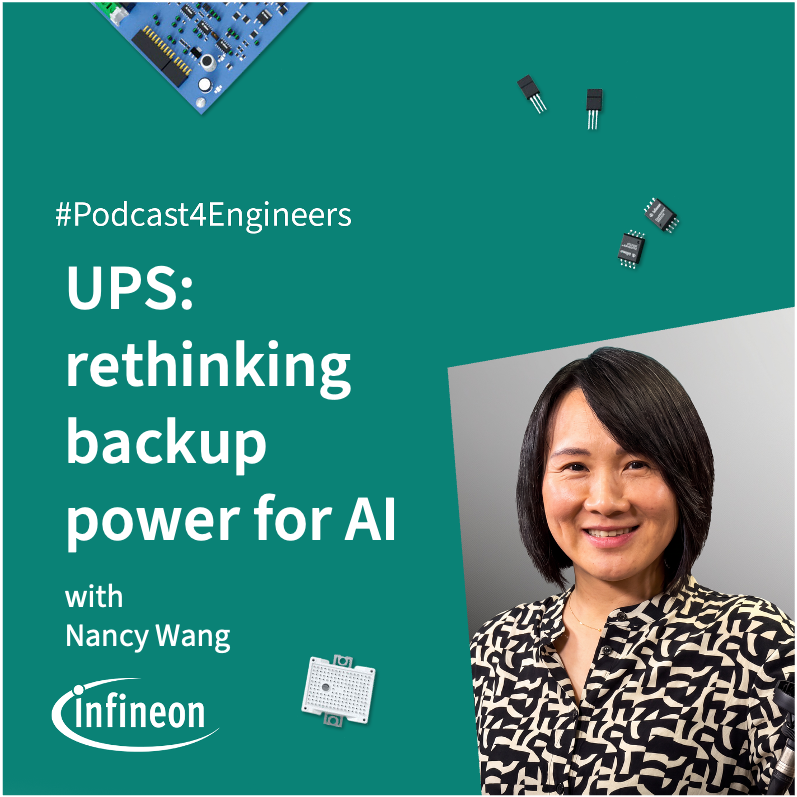
本集简介
双语字幕
仅展示文本字幕,不包含中文音频;想边听边看,请使用 Bayt 播客 App。
你可以设计或开发出世界上速度最快的处理器,但如果你不能提供干净、高效、可靠的电源,那么性能再好也无济于事。
You can design or develop the fastest processor in the world, but if you don't provide it, clean, efficient, and reliable power, then the performance doesn't matter.
大家好,欢迎收听本期《工程师播客》。
Hello, and welcome to this episode of Podcast for Engineers.
如果你对半导体市场的动态感兴趣,这个播客是你绝对不能错过的。
It's the podcast you just have to listen to if you're interested in what's happening in the semiconductor market.
我是主持人彼得·巴林特,今天我们有幸邀请到了南希·王。
I'm your host, Peter Balint, and today we're talking with Nancy Wang.
她是英飞凌的应用营销总监,专门负责UPS产品。
She's the director of application marketing here at Infineon, specifically for UPS.
那么,感谢你今天来参加节目。
So, and thanks for joining today.
谢谢,彼得。
Thanks, Peter.
感谢你的邀请。
Thanks for having me.
我很高兴能来这里。
I'm happy to be here.
那么,我的第一个问题是,大家都在谈论AI和GPU,以及为这些AI数据中心供电所需的能源,但我们今天要聊的是一个可能不那么常被提及的话题,那就是备用能源。
So, first question I have is, everyone's talking about AI and GPUs and the energy required to power these AI data centers, but we're looking at something that's maybe not talked about so often, and this is, backup energy.
那么,从你的角度来看,你在英飞凌的职位上,为什么这是一个值得关注的重要话题,为什么现在应该引起我们听众的注意?
So, from your perspective, in your role here at Infineon, why is this, an important topic to look at, and why should this get the attention of our audience right now?
对。
Right.
AI基础设施中最不显眼但可能最重要的部分之一就是UPS,也就是不间断电源。
So one of the least visible, but perhaps the most important part of AI infrastructure, is the UPS, so the uninterruptible power supply.
所以我喜欢把它比作数据中心的安全带,因为没有人会为了安全带而买车,但当你遇到麻烦时,它就是车里最重要的系统。
So I like to think of it as the the seat belt of the data centers because no one really buys a car for the seat belt, but when you get into trouble, that is now the most important system in the vehicle.
所以,如果电力中断哪怕只有几毫秒,成千上万的GPU可能都需要重启。
So if you lose power for just a few milliseconds, tens of thousands of GPUs may have to reset.
这意味着可能损失数天的计算时间。
That means that days of compute might have to be lost.
所以这不再只是一个工程问题,而是一个商业问题。
So this is no longer just a engineering issue, it is a a business issue.
而且它的重要性还会继续增加,因为未来AI系统可能会用来运营医院或支持电网和其他非常关键的服务。
And the importance of it will continue to increase because in the future, AI systems may be used to run hospitals or support the power grids and other very critical services.
在这些情况下,五个九的可用性不仅仅是理想,而是必须的。
And in these situations, five nines of availability is not just desirable, it is a necessity.
五个九就是99.999%的正常运行时间。
So five nines means 99.999% of uptime.
这意味着当UPS完美工作时,没有人会注意到它。
So this means that when a UPS is doing its job perfectly, no one notices it.
但在很多方面,它和计算本身一样重要。
But, in many ways, it is just as important as compute.
对。
Yeah.
那个安全带的比喻真的很棒。
That's a great analogy about the seat belt.
我觉得这个观点真的很有说服力。
I think that's a really good point to drive this point home.
所以,谢谢你。
So, thanks for that.
我们在节目开始前聊了一会儿,你提到的一点我觉得挺有意思的,就是AI发展得太快了,其中一个副作用就是术语好像处于一种不太确定的状态。
We talked a little bit before the show, and, the one thing that you mentioned, which I think was kind of interesting, that there's AI is moving so rapidly, and one of the side effects of this is the terminology seems to be in a sort of unsure state.
大家在提到某个东西或某个流程的时候,都不确定自己说的是不是同一个东西。
Nobody's sure they're referring to the same things when they refer to an item or a process.
那你能稍微谈谈这个吗?
So, can you talk about that a little
好的,当然可以。
Yes, of course.
几年前,描述备份还挺简单的。
So, some years ago, it was quite easy to describe backup.
就是电力房里放一个大的UPS,然后它支撑着整个数据中心。
It was just one large UPS sitting in a power room, and that supported the entire data center.
但我们现在看到的是,未来会变得更加分散和分层,所以你可能会有电容器、机架电池、分布式UPS系统、园区级储能,甚至支持电网的资产,它们都在协同工作。
But what we're seeing that moving forward is becoming a little bit more distributed and layered, so you might have capacitors, rack batteries, you might have distributed UPS systems, campus scale, energy storage, or even assets that support the grid and they're all working together.
所以像BBU、UPS、ESS这些术语,开始被混用,取决于你在和谁说话,以及你在世界哪个地方。
So terms like BBU, UPS, ESS, they are starting to be used interchangeably depending on who you're speaking to and where you are in the world.
所以我觉得更有用的做法是关注功能本身,而不是太在意标签。
So what I find is more useful is actually to focus on the the function and not so much on the label.
所以如果有人说UPS,或者随便叫它什么,你就问三个问题。
So if someone says, UPS or call it whatever they want, you ask three questions.
它的响应速度有多快?
How fast does it respond?
它能提供多长时间的备用电源?
How long does it provide backup for?
它在电力链路中处于什么位置?
And where does it sit in the power chain?
而这些问题的答案比盒子上的名字要有用得多,也更有意义。
And so the answers to these questions are a lot more useful and and much more relevant than the the name on the box.
不过我们也看到,不同地区之间存在差异。
So what we're also seeing, though, is that there are regional differences.
美国和欧洲那边,更倾向于遵循开放计算项目。
So those in The US and in Europe, they tend to follow more of the open compute project.
但在大中华区,他们目标相似,但实施路径可能略有不同。
But in Greater China, they are targeting the similar goals, but the implementation path may be slightly different.
所以,术语可能还会继续演变一段时间。
So, the terminology will likely continue evolving for some time.
好的。
Okay.
我想,随着事物变化这么快,术语也跟着变,对吧?
And I guess as rapidly as things change, the terminology sort of follows along?
是的。
Yes.
所以,
So,
随着AI的出现,我们其实才刚刚开始这一切,但我们已经看到,比如数据中心或机架所承载的工作负载在不断增加。
with AI, with the advent of AI, we're really just at the beginning of all this, but we see increasing workloads in terms of what is expected out of a data center, for example, or out of a rack from a data center.
这些都在上升。
This is all on the rise.
那么,我们能不能根据今天数据中心对备用能源的需求,来判断今天的解决方案在未来是否仍然适用、是否可扩展,还是说我们需要一种全新的架构?
So, is it possible to look at today's demand in a in a data center for backup energy and say that the solutions of today can work in the future, that they're scalable, or do we need a whole new kind of architecture here?
AI数据中心最大的变化不仅仅是耗电更多,而且用电方式也不同了。
So the biggest change in AI data centers is that not only is it using more power, but it's using the power differently.
传统数据中心就像汽车在高速公路上以稳定的速度行驶。
So traditional data centers are like cars driving on a highway at a very steady speed.
而AI数据中心就像汽车在城市的车流中穿梭,不断加速和刹车。
But AI data centers are like cars racing through city traffic and constantly accelerating and braking.
所以备用电源不再只是负责应对断电。
So backup power is no longer just responsible for managing the outages.
它还必须应对这种快速波动的电力需求。
It also has to manage the volatility of these rapid swings in power demand.
所以我们看到的是,要满足这种需求,需要分层次来应对。
So what we're seeing is that there are layers that are needed to fulfill this need.
不过,挑战在于这些波动往往发生在不同的时间尺度上。
The challenge though, however, is that these disturbances tend to happen at different time scales.
高频波动,比如微秒或毫秒级的,需要在GPU附近处理;而低频波动,比如秒级或分钟级的,可以由更远的大型储能设备来处理。
So high frequency disturbances, so in the microseconds or milliseconds, need to be handled close to the GPU, whereas lower frequency disturbances, so in the the seconds or minutes, can be handled by larger energy storage further away.
所以我们看到的是,备用电源采用了一种分层的方法。
So what we're seeing is a a layered approach to to backup power.
举个更具体的例子,机架级别的BBU可以为GPU提供几秒钟的备用电源。
So for a more specific example is you might have a rack level BBU that supports seconds of backup to the GPU.
分布式UPS可以为整个IT机架组提供几分钟的备用电源。
You might have a distributed UPS that supports minutes of backup to a pod of IT racks.
中央UPS可以支撑更长时间,直到发电机启动,而公用事业规模的BESS可以为整个设施和电网提供数小时的备用电源。
You might have a a central UPS that bridges a little longer until the generators kick in, and you might have a utility scale, BESS, can support the facility and the grid for hours.
所以未来不是单一的UPS,而是多层次的备用电源,每一层都针对特定的时间尺度设计。
So the future is not one single UPS, it is multiple layers of of backup and each layer is designed specifically for a particular time scale.
好的,所以这只是在讨论AI和数据中心时又增加了一层复杂性。
Okay, so this represents just another layer of complexity when we're talking about AI Yeah, in a data amazing.
我们现在听到的是,未来设施内部和机架级直流电取代交流电是不可避免的趋势。
What we're hearing now is that it's inevitable that we're going to be going towards high voltage in the inside the facility and to the rack DC, as opposed to AC.
这对备用能源供应方面有什么改变呢?
What does this change in terms of this, backup energy supply?
对。
So yeah.
过去的数据中心分配的是交流电,但电池本质上是直流设备。
So data centers in the past distributed AC, but batteries are inherently DC devices.
是的。
Yes.
而且GPU也是用直流电运行的。
And the GPU also runs on DC.
所以所有这些交流到直流再到交流的转换都在损耗能量。
So all this kind of AC to DC to to AC conversion is losing energy.
这增加了成本、复杂性,也增加了潜在的故障点。
It's adding cost, complexity, as well as potential failure points.
所以这就是为什么很多超大规模数据中心运营商正在研究高压直流配电,比如正负400伏、800伏或1500伏直流。
And so this is why a lot of hyperscalers are investigating high voltage DC distribution, so plus minus 400, 800 or 1,500 volt DC.
电压越高,电流就越小,传导损耗就越低,对铜的需求也越少。
So higher voltage means lower current, means less conduction losses, it means less need for copper.
当然,这也改变了UPS的角色。
So this, of course, also changes the role of the UPS.
随着我们转向直流配电,我们会看到更多直流耦合的UPS架构,而传统的双转换UPS会越来越少。
So as we switch to DC distribution, we'll start to see more DC coupled UPS architectures and less of these traditional double conversion UPS.
好的。
Okay.
所以可以说,每一级电力转换都会有损耗,如果我们不需要从交流转直流,那就至少消除了一个损耗环节。
So, we could say with every stage of power conversion there are losses, and if we don't have to convert from AC to DC, then this eliminates at least one of the areas for loss.
是的。
Yes.
而且这还不是唯一的好处。
And that's not the only benefit.
所以,这不仅仅是好处。
So, is not only the benefit.
这还使得设计更加模块化。
So, this also enables more modular designs.
这也让运营商能够灵活决定在哪里接入备用电源。
It also allows operators to to have the flexibility to decide where to attach the the backup.
可以接在直流母线上,也可以接在固态变压器旁边,甚至还可以更上游,接在中压接口处,作为更大的储能系统的一部分,与可再生能源互动,甚至为电网提供服务。
So it could be on the DC bus, it could be next to a solid state transformer, or could it be even further upstream at the medium voltage interface and be part of a larger energy storage that can interact with renewables or even provide services to the grid?
不过,有一个非常重要的注意事项。
There is, however, one very important caveat.
直流配电并不意味着整个数据中心都使用直流电。
DC distribution does not mean that the entire data center is on DC.
仍然有一些关键系统,尤其是冷却系统,需要交流电。
There are still critical systems, especially cooling, that requires AC power.
所以这就是为什么交流UPS和直流UPS至少在一段时间内会共存。
So this is why AC UPS together with DC UPS will coexist for at least some time.
好的。
Okay.
那么,这些必需的交流系统,它们也有UPS支持吗?
So, are these AC systems that are required, are those also supported by UPS?
是的。
Yes.
它们有交流双转换UPS,也有直流耦合UPS。
So, they are AC, double conversion UPS, and also DC coupled UPS.
好的。
Okay.
没错。
Correct.
是的。
Yeah.
所以我就想,我们在这里已经确认了一件事,那就是事情变化的速度非常快。
So, I have to wonder, the one thing that we have established here is that things are changing at such a rapid pace.
我想知道,比如对你来说,或者对英飞凌来说,是怎么跟上这些变化的。
I wonder how it is for you, for example, or Infineon to keep up with the changes.
我的意思是,你们怎么知道行业下一步会发生什么?
I mean, how do you know what's happening in the industry next?
你们是不是需要某种引导,对吧?
Do you have to be guided in some way, right?
对。
Yeah.
所以,我们在英飞凌的一个优势是,我们看到的不仅仅是问题的一部分。
So, one of the advantages that we have here in Infineon is that we don't just see one piece of the puzzle.
我们实际上看到了整个电力链。
We actually see the entire power chain.
从电网基础设施,经过所有系统,一直到处理器。
So, the grid infrastructure through all of the systems all the way to the processor.
这是因为我们与行业深度合作,与超大规模数据中心运营商、系统设计师合作,这让我们对整个能源生态系统有独特的洞察,能比主流趋势更早看到它的发展方向。
And this is because we are working deeply with the industry, working with hyperscalers, system designers, and this gives us unique visibility on how the whole energy ecosystem and see where it's it's heading and much sooner than before it becomes mainstream.
所以,这让我们能够把这些洞察转化为产品。
So this then allows us to take these insights and translate them into products.
今天,我正好带了一个例子来。
So actually, I have here today an example.
我手上拿的是我们EZ power模块系列的一部分。
So in my hands here is part of our EZ power module family.
这是EZ HD三。
This is the EZ HD three.
它集成了三电平ANPC拓扑结构,采用了我们最新的碳化硅和IGBT技术。
It has an integrated three level AMPC topology using our latest silicon carbide and IGBT technologies.
它还有一个基板,专门为液冷优化过。
It also has a base plate, which is optimized for liquid cooling.
所以,这非常适合构建紧凑、高效率的UPS模块,功率可达200千瓦。
So this is good for compact, high efficiency UPS building blocks up to 200 kilowatts.
所以很明显,而且公开的信息也表明,未来在发电方面,也许这些AI数据中心会自己负责发电和管理电力?
So it's pretty clear and it's pretty public that, in the future, for power generation, that maybe these AI data centers will be responsible for generating and managing their own power?
对此你怎么看?
What do you have to say about that?
从某种程度上说,确实是这样。
To some extent, that would be true.
我们已经开始看到下一代数据中心园区配备大规模储能系统了。
So we are already starting to see these large scale energy storage in the next generation data center plants.
所以,把太阳能这类可再生能源和储能结合起来,是提升可持续性和经济效益的好办法。
So pairing renewables such as solar with energy storage is a good way to improve the sustainability and the economics.
而且一些地区也会开始出台政策,鼓励这种做法。
And some regions will also start to have regulations that encourage this approach.
不过,我不认为数据中心能完全自给自足,因为所需的电力规模实在太大了。
However, I I don't believe that data centers will be fully self sufficient, and this is because the scale of the power that is needed is just too large.
比如一个AI园区,可能需要几兆瓦甚至吉瓦的电力,这相当于一个公用事业规模的发电厂。
So I an AI campus, for example, needs several megawatts, perhaps gigawatts of power, and this is comparable to a utility scale power plant.
所以AI的电力需求实在是太大了。
So the AI power demand is just simply too large.
但我确实相信,数据中心会成为电网的积极参与者,而不仅仅是消耗能源。
But what I do believe will happen is that data centers will become active participants of the grid instead of just consuming energy.
它可以储存电力,可以转移负荷,还可以与可再生能源整合,甚至可能为电网提供辅助服务。
It can store power, it can shift the the load, it can also integrate with renewables and perhaps provide grid services back to the grid.
所以它不会取代电网,而是会与电网协同工作。
So it will not replace the grid, but it will work alongside the grid.
你说储存能量,那一定是指电池吧。
And when you say store energy, you must be talking about batteries.
对吧?
Right?
是的。
Yes.
大量的电池组。
Massive blocks of batteries.
确实。
True.
好的。
Okay.
如果我们五年后坐下来再聊这个话题,你觉得最让你震惊的会是什么?是已经发生的事情,还是可能成为现实的状况?
And if we were to sit down in, let's say, five years and maybe talk about this same topic, what do you think would shock you the most about what has happened or what might be reality?
我不会感到震惊,我想我们都会看到的是,电力基础设施会变得更加具有战略性。
I wouldn't be shocked, I guess what we will all kind of see happen is that the power infrastructure becomes more strategic.
对。
Yeah.
过去,数据中心的进步意味着更快的处理器。
So in the past, progress in the data centers meant faster processors.
对吧?
Okay?
但AI教会我们的是,计算只是等式的一半。
But what AI is teaching us is that compute is only half of the equation.
所以你可以设计或开发出世界上最快的处理器,但如果你不能提供清洁、高效、可靠的电力,那性能再好也没用。
So you can design or develop the fastest processor in the world, but if you don't provide it clean, efficient, and reliable power, then the performance doesn't matter.
我还认为,未来我们不会再像看待一个盒子那样看待UPS。
What I also believe will happen in the future is that we will no longer look at UPS as a as a box.
BBU、UPS或ESS之间的界限会变得越来越模糊。
The boundaries of what a BBU or UPS or ESS are will become more blurry.
这些功能很可能会合并,甚至可能集成到电力链中的其他系统中,它们会作为一个协调的能源平台协同工作。
The functions are likely to merge and perhaps even be integrated into other systems in the power chain, and they will all kind of work together as a coordinated energy platform.
但也许最令人惊讶或最重要的是要记住,电力输送不再只是支持AI,它正在决定什么是可能的。
So but perhaps what's most surprising or important to to remember is that power delivery is no longer just supporting AI, it is determining what is possible.
所以,AI革命将不会受到我们计算速度的限制,而会受到我们如何智能地生成、传输、转换和存储能源的限制。
So the the AI revolution will not be limited by how fast we can compute, it will be limited by how intelligently we can generate, move, convert, and store energy.
也许我们应该五年后聚一聚,看看情况如何。听起来不错。
So maybe we should get together in five years and see where things are at, at that Sounds good.
是的。
Yeah.
谢谢你抽出时间,跟我们的观众分享一些你日常工作的事情。
So thank you, for taking the time to share a little bit about what you do on a daily basis with our audience.
不客气。
My pleasure.
还有你在英飞凌做的事情,以及英飞凌正在做的事情。
And what you're doing at Infineon and what Infineon is doing.
我们很感谢你提供的这些信息。
We appreciate all the information.
也感谢我们的观众,谢谢你们的收看,请继续关注《我们为AI赋能》的更多节目,感谢观看这档面向工程师的播客。
And to our audience, I say thank you, and stay tuned for more episodes of We Power AI, and thanks for watching the podcast for engineers.
关于 Bayt 播客
Bayt 提供中文+原文双语音频和字幕,帮助你打破语言障碍,轻松听懂全球优质播客。